
How to Save Money in Kenya 2026: 17 Real Tips That Work on Any Income
Learn how to save money in Kenya! If you earn KES 20,000 a month and you are not saving anything, you are leaving money on the table that could change your life in three years. Over 60% of Kenyans live paycheck to paycheck — not because they do not earn enough, but because nobody taught them a saving system built for Kenyan realities.
To build long-term wealth, you need to combine smart saving habits with high-yield financial instruments.
Generic saving advice tells you to cancel subscriptions and make coffee at home. That is Western advice. You do not have Netflix. You do not drink Starbucks. You share chai from the kiosk for KES 10, you send money to family every week, and harambees arrive without warning.
This guide is different. Every tip here was designed for the Kenyan context. Whether you earn KES 15,000 or KES 50,000 a month, or whether your income comes from surveys, gig work, or a side hustle — you can start saving today.
Why Saving in Kenya Is Hard — and Why the Usual Advice Fails
The four real barriers Kenyans face are not laziness or low income. They are structural:
- Family obligations are non-negotiable: Harambees, school fees for relatives, fare requests, funeral contributions — you are not just supporting yourself. These costs cannot be wished away; they must be budgeted for.
- Irregular income is the norm for millions: Survey platforms pay KES 500 one week and KES 2,000 the next. Gig work varies by season. You cannot save a rigid “20% of salary” when your income changes every month.
- M-Pesa makes spending frictionless: You can send money in five seconds. There is no physical cash friction to slow you down, meaning money disappears without you noticing.
- Social pressure is real: Saying “I am saving” in many Kenyan social circles still feels like admitting you are broke. This makes the decision to save psychologically harder than it needs to be.
The solution is not willpower. It is a system that works with these realities, not against them.
The Most Important Concept: Pay Yourself First
This is the foundation of every tip in this article. Most Kenyans save in the wrong order:
- The Wrong Order: Receive income -> pay rent -> buy food -> send family money -> handle emergencies -> save what is left (which is usually nothing).
- The Right Order: Receive income -> immediately transfer savings before spending anything -> live on what remains.
The moment any income hits your M-Pesa — salary, survey payout, side hustle payment — transfer a fixed amount to savings first. The money is gone before you can spend it, and your brain naturally adjusts your spending to what remains.
- The 10% Rule: Remove one zero from your income. KES 20,000 -> save KES 2,000. KES 30,000 -> save KES 3,000. If you cannot do 10%, start with 5%. If you can do more, go to 20%.
How to automate your savings so discipline is not required:
- Set up an M-Pesa standing order to your SACCO Paybill on the 1st of every month.
- Ask your employer to deduct directly to a SACCO before paying your net salary — this is the most powerful option because you never even see the money.
- Give a trusted family member access to transfer your savings the moment income arrives if you struggle with impulsive spending.
17 Practical Money-Saving Tips for Kenyans
Group 1: M-Pesa Savings Tools & Hacks (Tips 1–4)
Tip 1: How does M-Pesa Goal Savings work?
Tip 2: How to save and earn interest with M-Shwari Savings
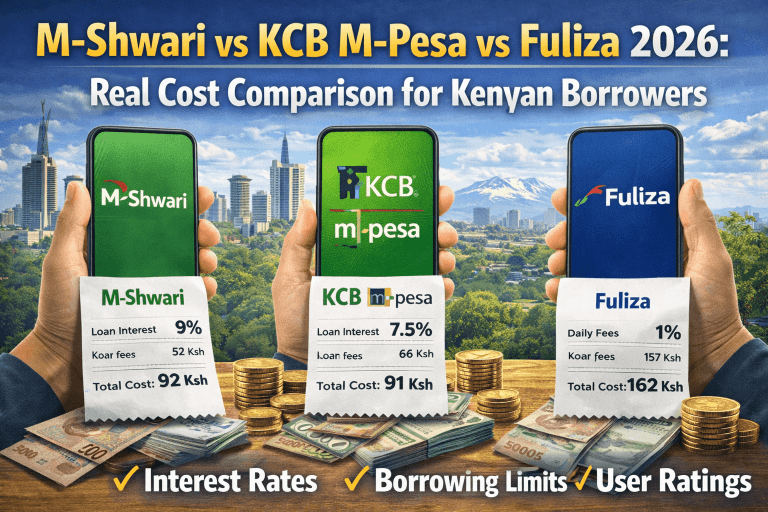
Most Kenyans use M-Shwari only for mobile loans. However, the savings side earns 2–4% annually, keeps money out of your main M-Pesa balance where it is invisible, and remains accessible same-day for emergencies. Dial *234# -> M-Shwari -> Save. Note: A Lock Savings option is also available on M-Shwari for higher interest.
Tip 3: KCB M-Pesa Savings (A high-yield alternative)
Accessible via *522#. Interest typically ranges from 3–5% annually—often beating basic M-Shwari returns. Check both rates and move your funds to whichever product is currently paying more.
Tip 4: Reduce M-Pesa withdrawal fees by withdrawing less often
M-Pesa transaction fees eat into your capital silently.
| Withdrawal Amount | Agent Fee |
|---|---|
| KES 100 – 500 | KES 27 |
| KES 501 – 1,500 | KES 27 – 29 |
| KES 2,501 – 3,500 | KES 52 |
| KES 3,501 – 5,000 | KES 69 |
The Math: Withdrawing KES 500 three times a week costs KES 81 in fees. Withdrawing KES 1,500 once costs KES 29. Same money, KES 52 saved per week — which adds up to KES 2,700 per year saved just on fees.
Group 2: SACCO and Community Savings (Tips 5–8)
Tip 5: Join a SACCO (Even at KES 500 per month)
SACCOs are Kenya’s most powerful wealth-building tool for low- and middle-income earners. By saving KES 500–2,000 per month, you earn 10–15% in annual dividends. After 6–12 months, you can unlock loans at an affordable 12% annual interest rate, borrowing up to 3–4 times your deposits.
- Entry-level options: Harambee SACCO (KES 500/month minimum) or UNAITAS (open membership).
Tip 6: Join a trusted Chama for forced social accountability
Ten members contribute KES 2,000 per month to a pool of KES 20,000. Each month, one member receives the full lump sum. The social obligation to contribute acts as a powerful discipline mechanism.
- Risk Warning: Only join chamas with people you genuinely trust. Chama fraud is real.
Tip 7: Use Table Banking to earn interest on community savings
An advanced version of the chama. Instead of handing the pot to one member, the group loans it out to members at a 5–10% monthly interest rate. At the end of the year, the interest earned is split among all members as dividends.
Tip 8: Set up Employer SACCO deductions (Check-Off System)
If your employer offers a SACCO check-off deduction, use it. Your employer deducts KES 2,000–10,000 from your gross salary before it hits your bank. You never see the money, meaning you cannot spend it.
Group 3: Spending Habits & Lifestyle Changes (Tips 9–13)
Tip 9: Use the Weekly Cash Envelope System
On Monday morning, withdraw your weekly budget for food, transport, and personal items in physical cash. Keep your M-Pesa wallet untouched. Handing over physical KES 100 or KES 200 notes creates psychological friction, reducing impulse purchases by 15–20%.
Tip 10: Buy household staples at wholesale markets
Buying foods in local retail kiosks is expensive. Go to wholesale hubs once or twice a month:
| Item | Supermarket | Wholesale | Monthly Saving |
|---|---|---|---|
| 2kg Rice | KES 240 | KES 160 | KES 80 |
| Cooking Oil (3L) | KES 750 | KES 550 | KES 200 |
| Onions (1kg) | KES 120 | KES 60 | KES 60 |
| Tomatoes (1kg) | KES 100 | KES 50 | KES 50 |
| Maize Flour (2kg) | KES 220 | KES 160 | KES 60 |
- In Nairobi: Visit Wakulima, Marikiti, or Gikomba.
- In Mombasa: Visit Kongowea or Mackinnon.
Tip 11: Carry packed lunch to work (KES 30 vs KES 150)
Cooking a large Sunday pot of ugali, sukuma wiki, or beans costs roughly KES 30 per portion. Buying lunch daily at a kibanda or restaurant costs KES 100–150. Making this change saves you roughly KES 2,500 per month (KES 30,000 per year).
Tip 12: Avoid expensive Buy-Now-Pay-Later (Lipa Mdogo Mdogo) schemes
Installment plans sound cheap, but they inflate prices. A KES 25,000 television can end up costing over KES 28,000. Save KES 3,000 a month for 10 months and pay in cash to negotiate cash discounts.
Tip 13: Budget for social obligations (Harambees and funerals)
Social expectations will happen. Calculate your likely annual social contribution costs (typically KES 8,000–18,000) and set aside KES 650–1,500 monthly in a separate M-Pesa Goal Savings account labeled “Social”.
Group 4: Increasing Income to Save More (Tips 14–17)
Tip 14: Save 100% of your online survey earnings
Treat survey earnings (from apps like Premise, AttaPoll, or Toluna) as pure investment capital. Never spend it on daily living. If you make KES 2,000 a month from surveys, route it directly to a SACCO or Money Market Fund.
Tip 15: Clean out your house and sell unused items on Jiji
Take clear photos of old electronics, clothes, or furniture and list them on Jiji or Facebook Marketplace. Price them 10% below market value to trigger quick cash sales via M-Pesa.
Tip 16: Monetize a digital freelance skill
Learn high-demand remote skills like article writing, data entry, or social media management. Platforms pay KES 1–10 per word. Reinvest these side hustle revenues directly into wealth-generating assets.
Tip 17: Take the KES 100 per Day Savings Challenge
Saving KES 100 every single day by walking short distances or skipping soda accumulates to KES 3,000 per month.
Where to Put Your Savings in Kenya
Choose your savings vehicle based on your timeline and liquidity needs:
- Tier 1: Emergency Fund (Immediate Access): Target 1–3 months of expenses. Use M-Shwari Savings or M-Pesa Goal Savings (yields 2–5%, instant withdrawal).
- Tier 2: Short-Term Goals (1–12 Months): Use a Money Market Fund (MMF). They yield 10–14% annually, compound daily, and allow M-Pesa withdrawals in 1–3 days.
- Tier 3: Long-Term Wealth (1+ Years): Use SACCO deposits (10–15% annual dividends + loan leverage) or Government Treasury Bills (T-Bills) for risk-free yields.
The Savings Calculator: What KES X Per Month Grows To
Here is what monthly contributions grow to at a conservative 12% compound interest rate:
| Monthly Saving | Year 1 | Year 3 | Year 5 |
|---|---|---|---|
| KES 1,000 | KES 12,780 | KES 43,240 | KES 81,370 |
| KES 2,000 | KES 25,560 | KES 86,480 | KES 162,740 |
| KES 5,000 | KES 63,900 | KES 216,200 | KES 406,850 |
Frequently Asked Questions (FAQ)
How can I save money in Kenya when there is nothing left at month-end?
You are saving in the wrong order. Transfer your savings (e.g., 10%) before paying any bills or rent. When money sits in your primary M-Pesa balance, your brain treats it as spendable. Move it out of sight immediately.
What is the best savings account in Kenya with high interest?
For instant access, M-Shwari (2–4%) is convenient. For goals you can leave untouched for a few months, a Money Market Fund (10–14%) is superior. For multi-year targets, SACCOs are best because they offer dividends and credit leverage.
How much should I save each month in Kenya?
A minimum of 10% is recommended. If your living expenses are low, aim for 20–30%. If your income is irregular, save 20% during high-earning months and 5% during slow periods.
Your Weekly Action Plan to Start Saving
- Day 1: Dial *234# and move KES 500 to M-Shwari Savings, or start an M-Pesa Goal Savings pocket.
- Day 2: Register with a reputable Money Market Fund (such as Sanlam, CIC, or Co-op).
- Day 3: Request your HR department to set up a direct monthly check-off deduction to your preferred SACCO.