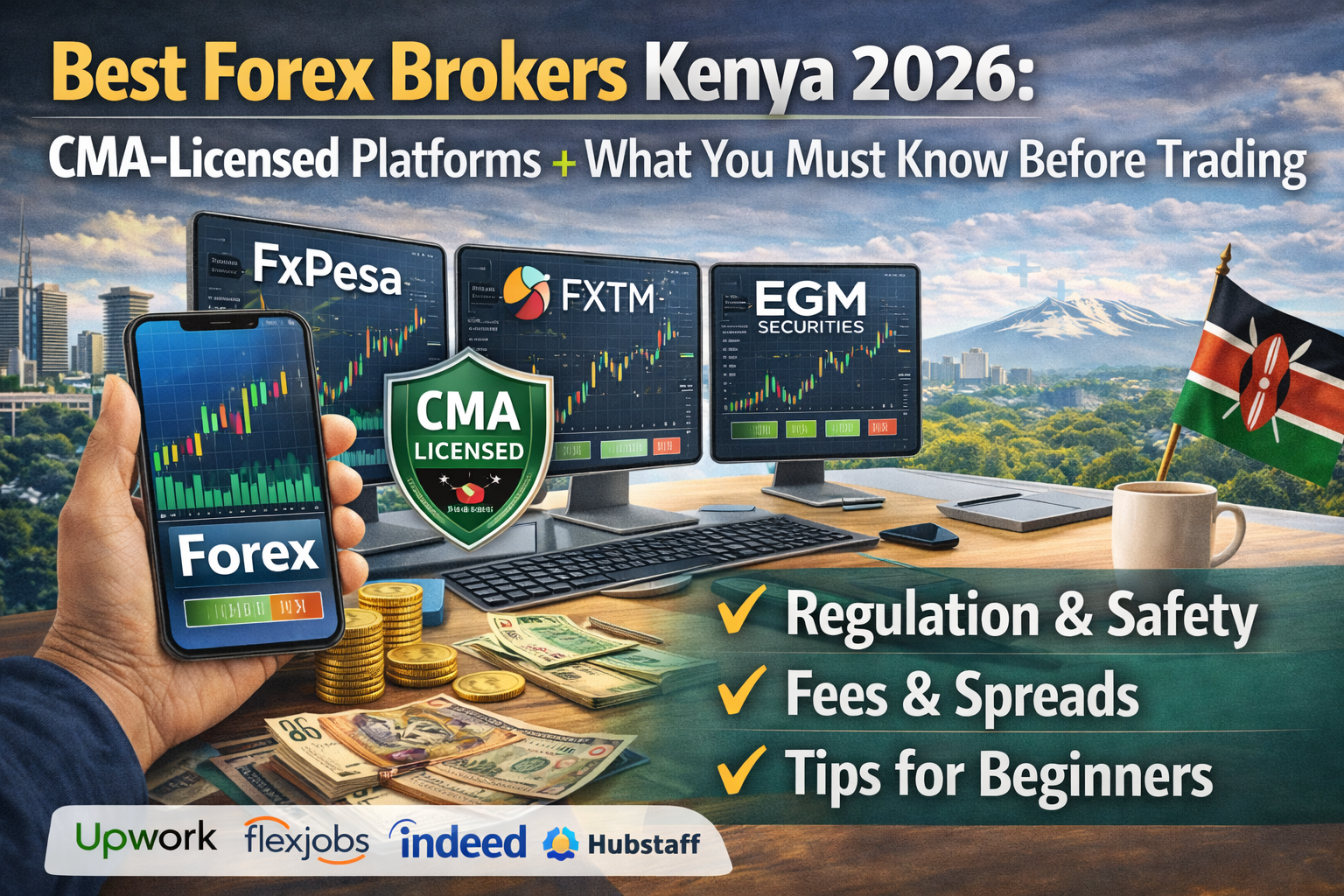
Best Forex Brokers Kenya 2026: CMA-Licensed, Honest Review
The best forex brokers in Kenya 2026 that are CMA-licensed are EGM Securities, Scope Markets, and Exinity — the only three brokers you can trade with and have full legal protection under Kenyan law.
⚠️ Read this before depositing anything: 70–80% of retail forex traders lose money. This is not an opinion — it comes from regulated brokers’ own disclosure reports. This guide will not tell you forex is easy. It will tell you the truth.
The only 3 CMA-licensed brokers in Kenya — the only ones with full legal protection:
| Broker | CMA licence | Min deposit | EUR/USD spread | M-Pesa | Best for |
|---|---|---|---|---|---|
| EGM Securities | ✅ Yes | KES 10,000 | 1.5–2.0 pips | ✅ Yes | Beginners, Kenyan-owned |
| Scope Markets | ✅ Yes | KES 5,000 | 0.5–1.5 pips | ✅ Yes | Best overall balance |
| Exinity (FXTM) | ✅ Yes | ~KES 1,300 | 1.3–1.8 pips | ✅ Yes | Lowest entry point |
One international broker used by many Kenyans:
| Broker | CMA licence | Min deposit | Spread | M-Pesa | Risk |
|---|---|---|---|---|---|
| XM Group | ❌ No (CySEC) | ~KES 650 | 1.0–2.0 pips | ✅ Yes | No Kenya legal protection |
Verdict: Start with a CMA-licensed broker. Trade demo for 6–12 months before depositing real money. Risk only money you can afford to lose entirely.
Jump to what you need:
- Why 70–80% of Kenyan traders lose money
- CMA-licensed brokers — full reviews
- Popular unregulated brokers — risks explained
- How to choose a broker — 10-point checklist
- Real trading costs in KES
- Forex vs MMFs vs stocks vs business
- Responsible trading framework
- FAQ
The Harsh Reality About Forex Trading in Kenya
What Forex Brokers Won’t Tell You in Their Ads
The Instagram/Facebook Ads You See:
- “Turn Ksh 5,000 into Ksh 50,000 in 2 weeks!”
- “I made Ksh 200,000 trading from my phone”
- Screenshots of huge profits
- Lamborghinis, luxury lifestyle
- “Anyone can do this”
The Reality (From Actual Data):
ESMA Report (European Regulator):
- 74-89% of retail forex traders lose money
- Average loss: 50-70% of deposited capital within 12 months
- 95% of day traders lose money within 3 years
FCA Report (UK Regulator):
- 82% of retail traders lost money with CFD/forex brokers
- Median loss: £2,200 (Ksh 350,000)
- Only 11% profitable after 12 months
Kenya-Specific Reality:
- No official CMA data published on trader profitability
- But: Most Kenyan traders use 100:1-500:1 leverage (higher than Europe’s 30:1 limit)
- Higher leverage = faster losses
- Estimated 80-90% of Kenyan forex traders lose money
Why Most Kenyans Lose Money in Forex
Reason 1: Leverage Trap
What Leverage Is:
- Borrow money from broker to trade larger positions
- Example: Ksh 10,000 deposit + 100:1 leverage = Ksh 1,000,000 trading power
The Trap:
- Market moves 1% against you = You lose 100% of Ksh 10,000
- Account wiped in minutes
- Happened to thousands of Kenyans during COVID-19 crash (March 2020)
Real Example:
- Trader deposits Ksh 20,000
- Uses 200:1 leverage → Controls Ksh 4,000,000 position
- EUR/USD moves 0.5% against position
- Loss: Ksh 20,000 (entire deposit gone)
- Time elapsed: 10 minutes
Reason 2: Zero Trading Education
Most Kenyans:
- Watch 1-2 YouTube videos
- Join Telegram “signals group”
- Start trading real money immediately
- No understanding of: Risk management, position sizing, stop losses, market structure
What Professional Traders Do:
- 6-12 months of demo trading (no real money)
- Study: Technical analysis, fundamental analysis, trading psychology
- Risk only 1-2% of capital per trade
- Year+ of education before risking real money
Gap = Losses
Reason 3: Unregulated Brokers (Scams)
The Pattern:
- Broker advertises on Facebook/Instagram
- Promises huge returns
- Kenyan deposits Ksh 50,000-200,000
- Trades, sees “profits” on screen
- Tries to withdraw
- Broker disappears or refuses withdrawal
Red Flags:
- Not CMA-licensed (Kenya)
- No regulation anywhere (offshore)
- Headquarters: Seychelles, Belize, St. Vincent (tax havens with weak regulation)
- Customer support disappears after deposit
Happened to Thousands of Kenyans:
- 2018-2020: Multiple “forex companies” collapsed
- Kenyans lost estimated Ksh 5-10 billion collectively
- Most never recovered their money
Reason 4: Telegram “Signals Groups” (Scams)
The Pitch:
- “Join our VIP signals group”
- “90% win rate guaranteed”
- “Just copy our trades”
- Fee: Ksh 5,000-20,000/month
The Reality:
- Most “signal providers” are not profitable traders
- They make money from subscription fees, not trading
- When signals fail: “Market conditions changed”
- You lose money, they keep collecting fees
The Math:
- Signal provider: 1,000 subscribers × Ksh 10,000/month = Ksh 10M/month
- Why would they trade if subscription revenue is Ksh 10M/month?
- Answer: They don’t trade profitably. They sell signals.
The ONE Group That Wins in Forex
Brokers.
How Brokers Make Money:
- Spreads (difference between buy/sell price): Ksh 20-100 per trade
- Commissions: Ksh 200-1,000 per lot traded
- Overnight financing fees: Ksh 50-500 per day
- More you trade = more they earn, whether you win or lose
Broker’s Ideal Customer:
- Trades frequently (daily or multiple times per day)
- Uses high leverage (bigger positions = bigger spreads)
- Doesn’t withdraw profits (keeps depositing)
- Loses slowly over 6-12 months
Brokers profit from your trading volume, not your success.
CMA-Licensed Forex Brokers Kenya 2026 — The Only Legal Options
If you choose to trade, only use CMA-licensed brokers. Here’s why.
What CMA Licensing Means
Capital Markets Authority (CMA) Kenya:
- Financial regulator for securities and derivatives
- Licenses and supervises forex brokers in Kenya
- Requirements for license:
- Minimum capital: Ksh 50 million
- Segregated client funds (your money separate from broker’s)
- Annual audits
- Investor compensation fund
CMA-Licensed = Legal Protection:
- Broker must follow rules or lose license
- Client funds protected (cannot be used for broker operations)
- Complaint mechanism (CMA enforces)
- Some recourse if broker fails
Unlicensed = No Protection:
- Broker can do anything
- Your money can disappear
- No legal recourse in Kenya
- CMA cannot help
CMA-Licensed Forex Brokers (2026)
As of March 2026, these brokers are CMA-licensed:
1. EGM Securities
- CMA License: ✅ Yes
- Headquarters: Nairobi, Kenya
- Platforms: MetaTrader 4, MetaTrader 5
- Min Deposit: Ksh 10,000
- Leverage: Up to 100:1
- Only fully Kenyan-owned CMA-licensed broker
2. Scope Markets Kenya
- CMA License: ✅ Yes
- Parent: Scope Markets (Mauritius)
- Platforms: MetaTrader 4, MetaTrader 5, cTrader
- Min Deposit: Ksh 5,000
- Leverage: Up to 100:1
3. Exinity (formerly FXTM)
- CMA License: ✅ Yes
- Global broker with Kenya operations
- Platforms: MetaTrader 4, MetaTrader 5
- Min Deposit: $10 (~Ksh 1,300)
- Leverage: Up to 200:1
4. ADS Securities Kenya (Note: Verify current status)
- Previously CMA-licensed
- Check CMA website for current license status
IMPORTANT: CMA license list changes. Always verify current licensing at cma.or.ke before depositing money.
Popular Unregulated Brokers Kenyans Use (HIGH RISK)
These are NOT CMA-licensed but widely advertised in Kenya:
XM Group
- License: Cyprus (CySEC), Australia (ASIC)
- NOT licensed in Kenya
- Risk: No Kenyan legal protection
HotForex
- License: Various offshore (St. Vincent, Seychelles)
- NOT licensed in Kenya
- Risk: Weak offshore regulation
FBS
- License: Cyprus, Belize
- NOT licensed in Kenya
- Popular in Kenya but no local protection
Binomo, IQ Option, Olymp Trade (Binary Options)
- NOT forex brokers (they’re binary options)
- Illegal in many countries
- Very high risk of total loss
- Avoid completely
The Risk:
- These brokers may be legitimate globally
- But: If dispute arises, CMA Kenya cannot help
- Withdrawals can be blocked
- No Kenyan legal recourse
Use at your own risk.
How to Choose a Forex Broker (Critical Checklist)
Before depositing Ksh 1, verify these 10 things:
1. CMA License (Non-Negotiable)
How to Verify:
- Visit cma.or.ke
- Go to “Licensed Institutions”
- Search for broker name
- Confirm license is active
Red Flag:
- Broker claims “CMA-licensed” but not on official list
- License expired or suspended
- Do NOT deposit
2. Regulation in Other Jurisdictions (If Not CMA)
If using international broker, check for:
Tier 1 Regulators (Strong):
- UK: FCA (Financial Conduct Authority)
- US: CFTC/NFA
- Australia: ASIC
- EU: CySEC (Cyprus), BaFin (Germany), FCA (France)
Tier 2 Regulators (Moderate):
- South Africa: FSCA
- Mauritius: FSC
- Dubai: DFSA
Tier 3 (Weak – Avoid):
- Seychelles FSA
- Belize IFSC
- St. Vincent & Grenadines
- These are “regulation” in name only
No Regulation = No Deposit
3. Fund Segregation (Client Money Protection)
What to Check:
- Does broker keep client funds in separate bank account?
- Which bank? (Kenyan bank = better)
- Is there investor compensation scheme?
CMA-Licensed Brokers:
- Required to segregate funds
- Must use Kenyan banks for client deposits
Offshore Brokers:
- Depends on their jurisdiction
- Seychelles/Belize: Often NO segregation
- Your deposit can be used for broker operations = high risk
4. Spreads and Commission (The Real Cost)
Spreads:
- Difference between buy and sell price
- Example: EUR/USD Buy 1.1000, Sell 1.0998 = 2 pip spread
- You pay spread on every trade
Typical Kenya Spreads (2026):
| Pair | ECN/Low Spread | Standard Account |
|---|---|---|
| EUR/USD | 0.1-0.5 pips | 1.0-2.0 pips |
| GBP/USD | 0.3-0.8 pips | 1.5-3.0 pips |
| USD/JPY | 0.2-0.6 pips | 1.0-2.5 pips |
| EUR/GBP | 0.5-1.0 pips | 2.0-4.0 pips |
Commission (ECN Accounts):
- $3-7 per lot ($6-14 round trip)
- Ksh 390-1,820 per lot traded
- Lower spreads but pay commission
Which Is Cheaper?
- Active traders (10+ trades/day): ECN with commission
- Casual traders (1-5 trades/week): Standard spreads
Compare using this formula:
- Standard spread cost vs (ECN spread + commission)
- Choose lower total cost
5. Trading Platform Quality
MetaTrader 4 (MT4):
- Industry standard
- Reliable, stable
- Thousands of indicators
- Best for most traders
MetaTrader 5 (MT5):
- Newer version
- More timeframes, tools
- Not as widely supported as MT4
- Good for advanced traders
cTrader:
- Modern interface
- Good charting
- Preferred by some ECN traders
Proprietary Platforms:
- Broker’s own platform
- Often less features than MT4/MT5
- Be cautious (harder to switch brokers)
Mobile Trading:
- All major brokers have mobile apps
- Check: Is MT4/MT5 app supported? (universal standard)
6. Deposit and Withdrawal Methods
Deposit Methods in Kenya:
- M-Pesa: Instant (most convenient)
- Bank transfer: 1-3 days
- Credit/debit card: Instant
- Skrill/Neteller: Instant
Withdrawal Methods:
- Should match deposit methods
- M-Pesa: 1-2 days (best)
- Bank transfer: 2-5 days
- Card: 3-7 days
Red Flags:
- Easy deposits, difficult withdrawals
- Withdrawal requests “pending” for weeks
- Required to trade X volume before withdrawal
- Broker making it hard to withdraw = scam warning
7. Leverage Limits (Lower Is Safer)
Kenya CMA Regulation:
- Maximum leverage: 100:1 (for CMA-licensed brokers)
- Some offshore brokers offer 500:1-1000:1
What Leverage Means:
| Leverage | Ksh 10,000 Deposit Controls | 1% Market Move = Your Loss |
|---|---|---|
| 10:1 | Ksh 100,000 | Ksh 1,000 (10%) |
| 50:1 | Ksh 500,000 | Ksh 5,000 (50%) |
| 100:1 | Ksh 1,000,000 | Ksh 10,000 (100% – wiped) |
| 500:1 | Ksh 5,000,000 | Account wiped in 0.2% move |
Recommendation:
- Beginners: Use 10:1-20:1 maximum
- Experienced: 50:1 maximum
- Never use 100:1+ unless you know exactly what you’re doing
High leverage = high risk of total loss
8. Educational Resources
Good Brokers Provide:
- Free webinars (trading basics)
- Demo accounts (practice with fake money)
- Market analysis
- Trading guides
What to Look For:
- At least 100 hours of free educational content
- Demo account with no time limit
- Risk management education
- Not just “how to trade” but “how to manage risk”
Red Flag:
- Broker pushes you to deposit immediately
- No demo account
- No educational resources
- “Just follow our signals”
9. Customer Support (Kenya Time Zone)
Test Before Depositing:
- Contact support with questions
- Check response time: <2 hours = good, >24 hours = bad
- Language: English, Swahili support?
- Channels: Phone, email, live chat
Kenya-Specific:
- CMA-licensed brokers: Usually have Nairobi office
- Can visit in person if needed
- Offshore brokers: Support via email/chat only
10. Reviews and Complaints (Due Diligence)
Where to Check:
- Forex Peace Army (forexpeacearmy.com)
- Trustpilot
- Google reviews
- Kenya Forex Trading forums/groups
What to Look For:
- Withdrawal problems? (biggest red flag)
- Slippage complaints?
- Platform crashes during high volatility?
- Customer support issues?
Pattern Recognition:
- 1-2 bad reviews = normal
- 10+ bad reviews with same issue (withdrawals) = avoid
Best Forex Brokers Kenya 2026 — Side-by-Side Comparison
Top Brokers Serving Kenya (Mix of CMA-Licensed + Major International):
| Broker | CMA | Min Deposit | EUR/USD Spread | Leverage | M-Pesa | Withdrawal Speed | Rating |
|---|---|---|---|---|---|---|---|
| EGM Securities | ✅ Yes | KES 10,000 | 1.5–2.0 pips | 100:1 | ✅ Yes | 1–2 days | ⭐⭐⭐⭐ |
| Scope Markets | ✅ Yes | KES 5,000 | 0.5–1.5 pips | 100:1 | ✅ Yes | 1–2 days | ⭐⭐⭐⭐ |
| Exinity (FXTM) | ✅ Yes | ~KES 1,300 | 1.3–1.8 pips | 200:1 | ✅ Yes | 1–3 days | ⭐⭐⭐⭐ |
| XM Group | ❌ No (CySEC) | ~KES 650 | 1.0–2.0 pips | 888:1 | ✅ Yes | 1–5 days | ⭐⭐⭐ |
Key:
- ✅ = Available
- ❌ = Not available or not CMA-licensed
- Rating based on: Regulation, spreads, reliability, Kenya accessibility
Recommendation:
- Start with CMA-licensed brokers (EGM, Scope, Exinity)
- Only consider international brokers if: (a) FCA/ASIC regulated, (b) you understand the risks, (c) you’ve verified reviews
- Best Kenyan Stocks 2026 — to learn more.
The Real Costs of Forex Trading in Kenya
Beyond spreads and commissions—the hidden costs most Kenyans don’t know about.
Cost 1: Spreads (Every Trade)
Example: Trade EUR/USD
- Spread: 1.5 pips
- Position size: 1 standard lot (Ksh 13M notional)
- Cost: ~Ksh 1,950 (per trade)
If you make 100 trades:
- 100 × Ksh 1,950 = Ksh 195,000 in spread costs
- This is BEFORE considering wins/losses
- You must make Ksh 195,000+ just to break even
Cost 2: Overnight Financing (Swap Fees)
If you hold position overnight:
- Broker charges interest (or pays you, depending on direction)
- Typical swap: -Ksh 200 to -Ksh 1,000 per lot per night
Example:
- Hold 1 lot EUR/USD for 30 days
- Swap fee: -Ksh 500/night
- Total: Ksh 15,000 in financing costs
Islamic Accounts (Swap-Free):
- No overnight fees
- But: Usually higher spreads or commission
- Available from most brokers
Cost 3: Deposit/Withdrawal Fees
M-Pesa to Broker:
- Usually Ksh 0 (broker covers)
- Some charge 1-2%
Broker to M-Pesa Withdrawal:
- Ksh 0-500 (varies by broker)
- Check before depositing
Currency Conversion:
- If broker account in USD, you pay conversion fees
- Ksh to USD: ~1-2% markup
- USD to Ksh withdrawal: ~1-2% markup
- Round trip: 2-4% lost to conversion
Cost 4: Trading Psychology (Biggest Cost)
Emotional Trading Costs:
- Revenge trading after loss: Average 20-50% of capital
- FOMO (fear of missing out) trades: 10-30% losses
- Overleveraging: Can wipe account in one trade
These are harder to calculate but destroy most accounts.
Responsible Forex Trading Framework (If You Proceed)
If after all warnings you still choose to trade, follow these rules religiously.
Rule 1: Trade Only Money You Can Afford to Lose
What This Means:
- Not rent money
- Not school fees
- Not emergency fund
- Not loan money
- Only discretionary money (money you’d be okay losing completely)
Reality Check:
- If losing Ksh 20,000 would hurt your family, don’t deposit Ksh 20,000
- Start with Ksh 5,000-10,000 maximum
- Accept that it may go to zero
Rule 2: Demo Trade for 6-12 Months First
Before Risking Real Money:
- Open demo account (free from any broker)
- Trade for 6 months minimum
- Track every trade
- Only move to real money if profitable on demo for 6 consecutive months
Why:
- Demo trading is free
- Teaches you without losing money
- 90% of demo traders lose (same as real money)
- If you can’t profit on demo, you definitely won’t profit with real money
Rule 3: Never Risk More Than 1-2% Per Trade
The Math:
- Account size: Ksh 50,000
- Max risk per trade: 1% = Ksh 500
- Set stop loss so max loss = Ksh 500
Why:
- Prevents blowing account on one bad trade
- Allows 50-100 losing trades before account wiped
- Gives time to learn and adapt
What Most Kenyans Do Instead:
- Risk 10-50% per trade
- Account wiped in 3-10 trades
- Don’t be most Kenyans
Rule 4: Use Stop Losses on Every Trade
Stop Loss:
- Pre-set exit point if trade goes against you
- Limits losses automatically
Example:
- Buy EUR/USD at 1.1000
- Set stop loss at 1.0980 (20 pips)
- If market hits 1.0980, position closes automatically
- Max loss: Ksh 500 (if position sized correctly)
Never trade without stop loss. Ever.
Rule 5: Keep Leverage Low (10:1-20:1 Maximum)
Despite broker offering 100:1-500:1:
- Use 10:1-20:1 only
- Lower leverage = slower losses, more time to learn
How to Control Leverage:
- Calculate position size based on risk, not maximum buying power
- Example: Ksh 50,000 account
- Don’t open Ksh 5,000,000 position (100:1)
- Open Ksh 200,000-500,000 position (4:1-10:1)
Rule 6: Journal Every Trade
Track:
- Entry price, exit price
- Reason for entry
- Profit/loss
- Emotions felt during trade
- What you learned
Why:
- Identify patterns (good and bad)
- Learn from mistakes
- Most profitable traders keep journals
Rule 7: Withdraw Profits Monthly
If profitable (rare):
- Withdraw 50% of profits monthly
- Reinvest 50%
- Never let all profits sit in account (protects against giving it back)
Example:
- Start: Ksh 50,000
- Month 1 profit: Ksh 10,000
- Withdraw: Ksh 5,000 to M-Pesa
- Keep trading: Ksh 55,000
Rule 8: Accept That You’ll Probably Lose
Statistically:
- 70-80% lose money
- You’re likely in this group
- Plan accordingly
Mental Frame:
- Think of initial deposit as tuition fee
- You’re paying to learn
- If you lose Ksh 10,000 but learn risk management, that’s valuable
- Better than losing Ksh 100,000 later
Forex Trading vs Other Investments (Kenya Context)
Before trading forex, consider these alternatives:
Forex vs Money Market Funds
Money Market Fund:
- Returns: 10-14% annually
- Risk: Very low (government securities)
- Effort: Deposit and forget
- Guaranteed not to lose principal
Forex Trading:
- Returns: -100% to +1000%+ (wild variance)
- Risk: Very high (70-80% lose)
- Effort: Hours daily monitoring
- Can lose everything
Reality:
- Ksh 100,000 in MMF for 5 years at 11% = Ksh 169,000 (Ksh 69,000 gain)
- Ksh 100,000 in forex trading: 80% chance it becomes Ksh 0-30,000
See our Money Market Funds Kenya 2026 guide.
See also How to Build Passive Income Kenya 2026
Forex vs NSE Stocks
NSE Stocks:
- Returns: 10-25% annually (long-term)
- Risk: Moderate (company-specific)
- Effort: Research, hold long-term
- Lower chance of total loss
Forex Trading:
- Returns: Unpredictable
- Risk: Very high
- Effort: Constant monitoring
- High chance of total loss
KCB Stock Example:
- Buy Ksh 100,000 KCB shares
- 5 years: Dividends + capital gains = ~15-20% annual return
- Ksh 100,000 becomes Ksh 200,000-250,000
Forex:
- Trade Ksh 100,000 for 5 years
- Statistically: Ksh 100,000 becomes Ksh 0-20,000
Forex vs Starting a Business
Small Business (Ksh 100,000 Capital):
- Mitumba stall, food kiosk, freelancing tools
- Returns: 20-50% annually (if successful)
- Risk: Moderate
- Effort: High (daily work)
- Builds real asset and skills
Forex Trading:
- Same Ksh 100,000
- Returns: Likely negative
- Risk: Very high
- Effort: High
- No tangible asset created
Success Rate:
- Small business: ~40-50% profitable within 2 years
- Forex trading: ~10-20% profitable within 2 years
Best Forex Brokers Kenya 2026 — FAQ
Q: Can I make money with forex trading in Kenya?
Answer: Yes, but statistically you won’t.
The Math:
- 70-80% of retail traders lose money (regulator data)
- 10-20% break even
- Only 5-10% consistently profitable
If You Want to Be in the 5-10%:
- Trade demo for 12+ months
- Study 500+ hours (technical analysis, risk management, psychology)
- Use 1-2% risk per trade
- Keep leverage under 20:1
- Journal every trade
- Accept 2-3 years of losses before potential profit
Realistic Expectations:
- Year 1: Lose Ksh 20,000-50,000 (learning)
- Year 2: Break even (if disciplined)
- Year 3+: Maybe profitable (if you survived)
Most Kenyans:
- Watch 2 YouTube videos
- Deposit Ksh 20,000
- Lose it in 2 weeks
- Never trade again
The 5-10% who succeed treat it like a profession with years of study. Are you willing to do that?
Q: Which is the best forex broker in Kenya?
Answer: Depends on what you prioritize. Here’s the breakdown:
Best for Beginners (Safety First):
- EGM Securities or Scope Markets
- Why: CMA-licensed (Kenya legal protection), good education, reasonable spreads
- Start here if new to forex
Best for Low Costs (Experienced Traders):
- Scope Markets (ECN account) or Exinity
- Why: Tightest spreads (0.1-0.5 pips), low commission
- For active traders (10+ trades/day)
Best for Small Deposits:
- Exinity (FXTM) – minimum $10 (~Ksh 1,300)
- Why: Lowest barrier to entry
- Good for testing with tiny amounts
Best Overall (Balance):
- Scope Markets
- Why: CMA-licensed, tight spreads, good platform, M-Pesa integration
- Best combination of safety + cost
International Option (If Not CMA):
- XM Group (CySEC regulated)
- Why: Strong EU regulation, good reputation, Kenya support
- But: Not CMA-licensed (no Kenya legal protection)
My Recommendation:
- Start with CMA-licensed broker (Scope or EGM)
- Trade demo for 6-12 months
- If profitable on demo, deposit Ksh 10,000 maximum
- Only move to international brokers if you outgrow local options
Q: How much money do I need to start forex trading in Kenya?
Answer: Minimum Ksh 5,000-10,000, but you should start with demo (Ksh 0).
Broker Minimums:
- EGM Securities: Ksh 10,000
- Scope Markets: Ksh 5,000
- Exinity: ~Ksh 1,300
- XM: ~Ksh 650
Realistic Amount for Learning:
- Ksh 10,000-20,000 maximum
- This is your “tuition fee”
- Expect to lose most or all of it
- Don’t deposit more until profitable for 3+ months
Why Not Ksh 100,000-500,000?
- You WILL lose it
- 80% of traders lose
- Start small, learn, then scale (if you ever become profitable)
Better Path:
- Demo trade: Ksh 0 (6-12 months)
- Live micro account: Ksh 10,000 (6-12 months)
- If profitable: Scale to Ksh 50,000
- If still profitable: Scale to Ksh 100,000+
Most Kenyans skip steps 1-2, deposit Ksh 100,000, lose it in month 1.
Q: Is forex trading legal in Kenya?
Answer: Yes, forex trading is legal in Kenya, but only through CMA-licensed brokers.
Legal Framework:
- Capital Markets Authority (CMA) regulates forex brokers
- Licensed brokers must:
- Register with CMA
- Maintain Ksh 50M capital
- Segregate client funds
- Submit to audits
What’s Legal:
- Trading with CMA-licensed broker ✅
- Trading with internationally regulated broker (FCA, ASIC) ✅ (but no Kenya legal protection)
What’s Risky:
- Trading with unregulated offshore broker ⚠️
- No legal protection if broker scams you
- CMA cannot help
What’s Illegal:
- Operating forex broker in Kenya without CMA license ❌
- Pyramid schemes disguised as “forex trading” ❌
- Binary options (banned in many countries) ❌
Bottom Line:
- Forex trading itself: Legal
- But: Only trade with CMA-licensed or top-tier international brokers
- Avoid: Seychelles/Belize offshore brokers
Q: What is the difference between forex and binary options?
Answer: Forex is trading currencies. Binary options is gambling disguised as trading.
Forex Trading:
- Trade actual currency pairs (EUR/USD, GBP/JPY)
- Profit/loss based on price movement
- Can hold position for minutes to months
- Risk = what you put in (with stop loss)
Binary Options:
- Bet on whether price will go up or down in 60 seconds-5 minutes
- Win: Fixed payout (e.g., 70% of bet)
- Lose: Entire bet gone
- Closer to casino than investing
Why Binary Options Are Worse:
- House edge: ~15-20% (worse than casino)
- No proper risk management possible
- Extremely fast losses
- Illegal in many countries (EU, UK, Australia banned them)
Popular in Kenya But Dangerous:
- Binomo, IQ Option, Olymp Trade = binary options
- Heavily advertised in Kenya
- Avoid completely
- If you want to trade, stick to actual forex
The Math:
- Binary options: Need 54-58% win rate just to break even (house edge)
- Forex: Need 50% win rate with proper risk management
Q: Can I trade forex on my phone in Kenya?
Answer: Yes, every major broker has mobile apps. But trading on phone has drawbacks.
Mobile Platforms:
- MetaTrader 4 Mobile: Most popular, works with all MT4 brokers
- MetaTrader 5 Mobile: Newer version
- Broker-specific apps: EGM, Scope, Exinity all have apps
Advantages:
- Trade anywhere (matatu, office, home)
- Instant notifications
- Quick entry/exit
Disadvantages:
- Small screen = harder chart analysis
- Easy to make mistakes (fat finger trades)
- More emotional trading (less deliberate)
- Most profitable traders use desktop for analysis, mobile for execution
Best Practice:
- Analysis on desktop (evening after work)
- Identify setups, set alerts
- Execute on mobile when alert triggers
- Not: Scroll through phone randomly making trades
Reality:
- Most Kenyan forex losses happen on mobile
- Too easy to trade impulsively
- Consider: Desktop for serious trading, mobile for monitoring
Conclusion: Should You Trade Forex?
The question isn’t “Can I make money in forex?” It’s “Am I willing to treat forex like a 2-3 year university degree with no guarantee of success?”
The Brutal Honesty You Need
If Your Goal Is:
- “Make quick money”
- “Turn Ksh 10,000 into Ksh 100,000 in 2 months”
- “Quit my job and trade full-time”
Then: DO NOT trade forex. You will lose money.
If Your Approach Is:
- “I’ll study 6-12 months on demo first”
- “I’ll risk only 1% per trade”
- “I’ll treat this as skill development, not income”
- “I’m prepared to lose my initial Ksh 10,000-20,000 as tuition”
- “I’ll journal every trade and learn from mistakes”
Then: You have a 5-10% chance of success. Still low, but honest odds.
Better Alternatives for Most Kenyans
Instead of Forex:
For Passive Income:
- Money Market Funds: 10-14% annual, no effort
- NSE Dividend Stocks: 5-8% dividend yield, stable
- SACCOs: 12-14% dividends, loan access
For Active Income:
- Side hustles: Freelancing, small business
- Skill development: Learn copywriting, design, coding
- Career advancement: Certifications, networking
For Learning Markets:
- NSE stock investing: Lower risk, builds wealth understanding
- Crypto (small amounts): High risk but learning value
Expected Returns (5 Years, Ksh 100,000 Initial):
- Forex: Ksh 0-20,000 (80% of people)
- MMF: Ksh 169,000 (everyone)
- Small business: Ksh 150,000-300,000 (40-50% of people)
- Most Kenyans better off NOT trading forex
If You Still Choose to Trade
Your Checklist:
- ✅ Choose CMA-licensed broker (or top-tier FCA/ASIC)
- ✅ Verify license on cma.or.ke or regulator website
- ✅ Open demo account (free)
- ✅ Trade demo for 6-12 months
- ✅ Only deposit real money if profitable on demo for 6 months
- ✅ Start with Ksh 10,000-20,000 maximum
- ✅ Use 1-2% risk per trade
- ✅ Keep leverage under 20:1
- ✅ Journal every trade
- ✅ Accept you’ll probably lose (plan accordingly)
Related Guides
Better Investment Options:
- Money Market Funds Kenya 2026 – 10-14% safe returns
- Best SACCOs Kenya 2026 – 12% dividends + loans
- Unit Trusts Kenya 2026 – Diversified investing
Build Wealth Without Trading:
- How to Save Money Kenya – 17 proven strategies
- How to Budget Kenya – 60-20-10-10 framework
Earn Money Safely:
- Side Hustles Kenya – 33 real opportunities
- Freelancing Kenya – Online income
- Remote Jobs Kenya – Work from home
Final Word:
Forex brokers make money from your trading volume, not your success. The house always wins. 70-80% of retail traders lose money. These are facts, not opinions.
If you choose to trade, do it with open eyes, demo trade for months, risk only what you can lose, and accept that you’ll probably fail.
For most Kenyans, forex trading is a path to financial loss, not wealth.
Choose wisely.
Last Updated: March 12, 2026 | CMA license data verified, broker information current, risk warnings from regulator reports