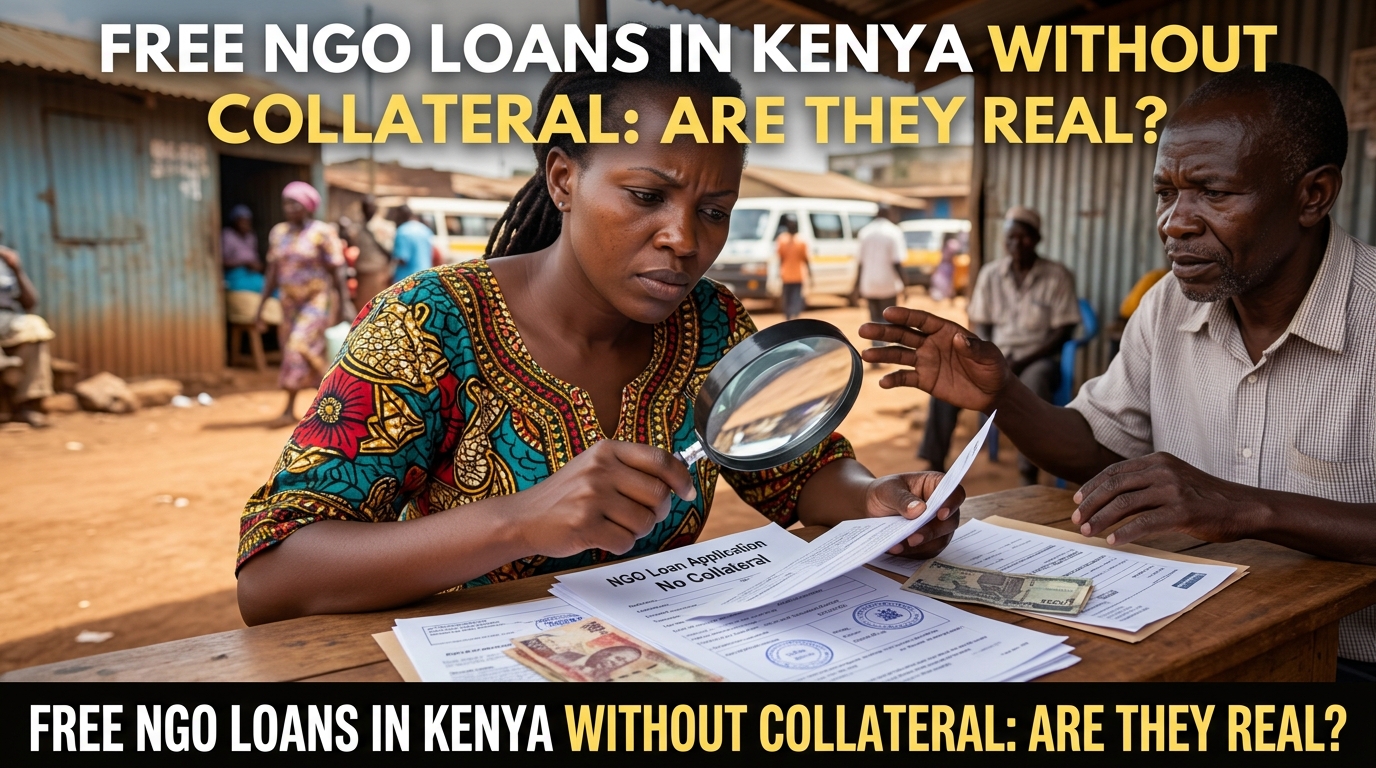
Free NGO Loans in Kenya Without Collateral: Are They Real?
Free NGO loans in Kenya without collateral do exist — but “free” and “no requirements at all” are two very different things. Understanding that distinction is exactly what separates a genuinely helpful loan from a scam.
If you’ve been searching for this exact phrase, here’s the honest picture: real NGO and microfinance loan programs that don’t require traditional collateral like land titles or logbooks, what they actually require instead, and how to spot the fake versions preying on this exact search term.
What “Free NGO Loans Without Collateral” Actually Means
No legitimate lender — NGO, microfinance institution, or bank — gives away loans with zero conditions attached. When people search for free NGO loans in Kenya without collateral, what they’re really looking for (and what genuinely exists) are loans that:
- Don’t require land titles, logbooks, or other traditional physical collateral
- Charge low, subsidized interest rates (often 3-8%, well below typical microfinance rates of 20-40%)
- Use alternative forms of security instead — group guarantees, livestock, business stock, or savings history
- Sometimes bundle in free training, mentorship, or financial literacy support
“Free” in this context usually refers to the absence of collateral or the low-cost nature of the financing, not a grant with no repayment obligation at all. Genuine no-repayment funding exists too, but it’s called a grant, not a loan, and is a separate category (see our guide on business grants in Kenya).
Real NGOs and Microfinance Institutions Offering Collateral-Free Loans
Here are genuine, verifiable organizations operating in Kenya that offer loans without requiring traditional collateral:
VisionFund Kenya — the microfinance arm of World Vision, focused primarily on women in rural communities. Roughly 75% of their loans go to women, with a reported 95% repayment rate and over KSh 5 billion disbursed to date. Loans are structured around group models and community-based guarantees rather than physical collateral.
Kenya Women Microfinance Bank (KWFT) — one of the largest players in this space, serving over 330,000 active borrowers, exclusively focused on women. KWFT works with group guarantee models where peers co-sign and hold each other accountable, rather than requiring land titles or payslips.
Juhudi Kilimo — focused on smallholder farmers and micro-entrepreneurs, offering asset financing where the asset being financed (livestock, farm equipment) itself often serves as security, alongside business management and financial literacy training.
ECLOF Kenya — provides financial and non-financial services to micro, small, and medium entrepreneurs, structured as empowerment tools rather than purely commercial lending.
Inuka Africa — specializes in agribusiness, particularly dairy farming, with loans starting from as little as KES 5,000 and no fixed upper limit. Loans use livestock as security, which the institution helps insure on the borrower’s behalf.
How Collateral-Free NGO Loans Actually Work
Since these institutions can’t rely on land titles or formal payslips the way commercial banks do, they use alternative mechanisms to manage risk:
- Group guarantee models — borrowers form small groups where members co-sign for each other, creating peer accountability. If one member struggles, the group is collectively invested in helping them succeed.
- Asset-based security — livestock, farm equipment, or business stock can serve as security instead of land or vehicles.
- Savings-first structures — some institutions require a period of consistent savings before disbursing a loan, using that track record as a substitute for a formal credit history.
- Non-financial support — many of these programs bundle in business training, financial literacy education, or technical mentorship, since building borrower capacity reduces default risk over time.
What You’ll Actually Need to Apply
Even without physical collateral, legitimate NGO and microfinance lenders typically require:
- A valid Kenyan national ID and proof of age (usually 18+)
- Evidence of an existing business or income-generating activity
- Willingness to join a lending group, where applicable
- A demonstrated ability to repay, even without a formal payslip
- In some cases, a savings history with the institution before a loan is disbursed
None of these require paying money upfront — which brings us to the most important part of this guide.
How to Spot a Fake “Free NGO Loan” Scam
This exact search phrase is a magnet for scam apps and fraudulent schemes, precisely because “free” and “no collateral” sound irresistible. Watch for these red flags:
- Any request for an upfront fee — “processing fee,” “insurance deposit,” or “activation charge” before you receive funds is always a scam. Legitimate NGOs deduct any fees from the disbursed amount, they never ask you to pay first.
- No physical presence or verifiable registration — real microfinance institutions in Kenya are licensed under the Microfinance Act and have physical branches, verifiable websites, and a track record you can check.
- Pressure to recruit others before you can borrow or withdraw — this is a pyramid scheme pattern, not how legitimate group-lending models work.
- Promises of amounts that seem too large for a “free” collateral-free loan — legitimate collateral-free NGO loans tend to start small (a few thousand shillings) and grow with your repayment history, not jump straight to large sums.
- Requests for your M-Pesa PIN — no legitimate lender ever needs this; it’s only ever entered on the official Safaricom SIM toolkit or M-Pesa app.
NGO Loans vs Other Kenyan Loan Types: How Rates Compare
To put collateral-free NGO loans in context against other borrowing options in Kenya:
| Lender Type | Typical Interest Rate | Speed | Collateral Needed |
|---|---|---|---|
| Government/NGO programs | 3–8% | 2–12 weeks | Usually none, or group guarantee |
| Commercial banks | 8–16% | 4–8 weeks | Usually required |
| Microfinance institutions | 20–40% | 1–3 days | Often none, or group/asset-based |
| Mobile money apps | 10–30%+ | Seconds to minutes | None |
NGO and government-backed programs offer by far the lowest rates on this list — the tradeoff is a slower approval process and often a requirement to join a group or complete training before disbursement, rather than the instant access mobile loan apps provide.
Frequently Asked Questions
Are there genuinely free loans in Kenya without collateral? No loan is entirely free of conditions, but real NGO and microfinance programs like VisionFund Kenya, KWFT, and Juhudi Kilimo offer loans without requiring traditional collateral like land titles, often at rates far below commercial lenders.
What do NGO loans use instead of collateral? Most use group guarantee models (peer co-signing), asset-based security (livestock, equipment, stock), or a savings history built up before the loan is disbursed.
Is it a scam if an NGO loan app asks for a fee before disbursing funds? Yes. Legitimate lenders never require payment before releasing loan funds — any processing costs are deducted from the amount disbursed, not charged upfront.
Who qualifies for collateral-free NGO loans in Kenya? Requirements vary by institution, but generally include a valid Kenyan ID, being at least 18 years old, having an existing business or income source, and in many cases, joining a borrower group.
How is an NGO loan different from a business grant in Kenya? A loan must be repaid, even at a low interest rate. A grant is money you don’t have to repay. Both exist in Kenya, but “free NGO loans” typically refers to low-cost, collateral-free lending — not grant funding.
This article is for educational purposes only and does not constitute financial advice. Loan terms, rates, and eligibility criteria change — confirm current details directly with each institution before applying.