18 February 2026
Sacco vs Bank Kenya 2026: Which is Better for Your Savings?
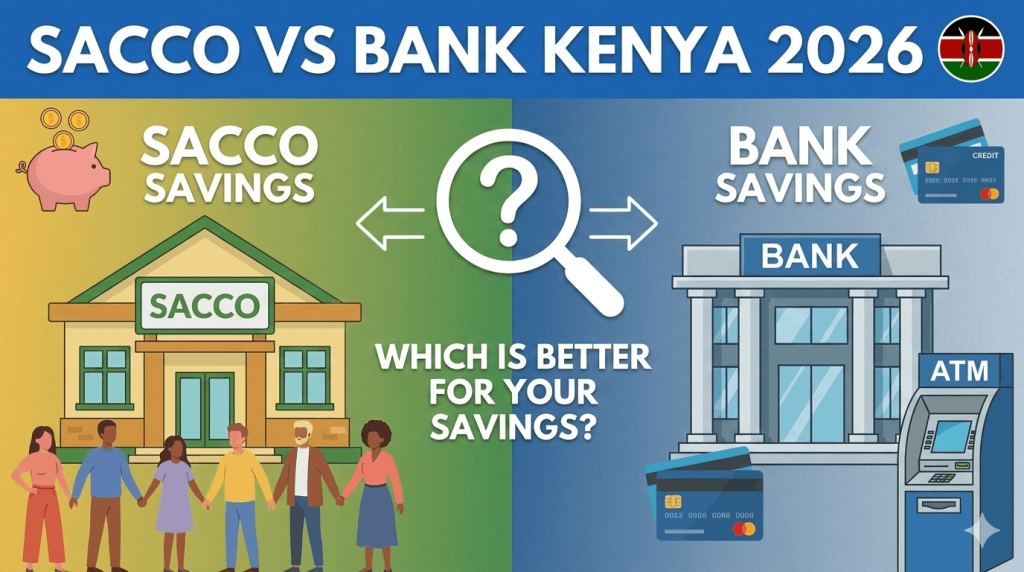
You’ve just been hired. Your employer asks: “Which account should we deposit your salary — bank or Sacco?” This sacco vs bank decision will affect your wealth for years. Choose wrong: lose thousands in foregone interest, pay higher loan rates, struggle with access. Choose right: earn 3-4x more interest, borrow at half the cost, build actual wealth. This complete sacco vs bank guide helps you decide correctly.
The sacco vs bank debate is THE fundamental money decision facing 15M+ working Kenyans. Every employed person must choose where to save their hard-earned money, and this choice creates massive wealth differences over time.
The Stakes Are Real
Let’s look at what this choice really means for your money:
Bank Savings Example:
- Ksh 50,000 saved @ 2.5% = Ksh 1,250/year
Sacco Savings Example:
- Ksh 50,000 saved @ 10% = Ksh 5,000/year
DIFFERENCE: Ksh 3,750 more per year in a Sacco!
Over 10 years, that’s Ksh 37,500+ difference from the same Ksh 50,000 principal. This isn’t pocket change — it’s real wealth you’re either building or leaving on the table.
What Makes This Sacco vs Bank Choice Difficult?
The sacco vs bank comparison reveals competing advantages that make this decision complex:
Banks offer:
- ✅ Brand trust (Equity, KCB, Co-op — household names you know)
- ✅ ATMs everywhere (withdraw at 3am in Nanyuki if you need to)
- ✅ Digital banking (M-Pesa integration, apps, USSD codes)
- ✅ Deposit protection (KDIC insurance up to Ksh 500,000)
Saccos offer:
- ✅ 3-4x higher interest rates (8-12% vs 2-3%)
- ✅ 2x cheaper loans (12% vs 16-24%)
- ✅ Annual dividends (you share in the profits!)
- ✅ Community support (actually know your loan officer)
So which wins? It depends on YOU.
What This Complete Guide Covers
- Sacco vs Bank: Complete comparison across 15 critical factors
- Interest rates reality (2026 verified rates)
- Loan access and terms breakdown
- Top 10 Saccos in Kenya reviewed in detail
- Digital banking comparison
- Risks and red flags to watch for
- Tax implications you need to know
- Who should choose what (by income and life stage)
- How to use BOTH strategically
⚡ Quick Answer: Which Should You Choose?
- Salary workers with employer Sacco: Sacco (primary) + Bank (convenience)
- Freelancers/businesses: Bank (primary) + Sacco (savings/loans)
- Retirees: Bank (accessibility) + Sacco (higher returns)
- Students: Bank (convenience)
- High earners (Ksh 100,000+): BOTH strategically
- Wealth builders: 60% Sacco, 40% Bank
Reality: Most successful Kenyans use BOTH!
Understanding Saccos in Kenya
Before diving deeper into the sacco vs bank comparison, let’s understand exactly what a Sacco is and how it works.
What Is a Sacco?
A Sacco (Savings and Credit Cooperative) is a member-owned financial institution where people pool money together to save, borrow, and share profits. Think of it as a bank owned by its customers, not external shareholders.
Full Name: Savings and Credit Co-operative Society
How Saccos Work
Here’s a simple breakdown of the Sacco model:
1. Members Save Money:
- You: Deposit Ksh 5,000/month
- Other 499 members: Each deposit Ksh 5,000/month
- Total Sacco pool: Ksh 2,500,000/month
2. Sacco Lends to Members:
- Member A needs Ksh 300,000 for home improvement
- Sacco provides loan at 12% interest
- Member A pays back with interest over 24 months
3. Profits are Shared:
- Sacco earns Ksh 36,000 interest from Member A’s loan
- After expenses: Ksh 28,000 profit
- Divided among all 500 members as dividend
- You receive: Ksh 56 dividend (your share!)
4. Your Benefits:
- Interest on savings (8-12%)
- Annual dividends (2-5% extra!)
- Access to cheap loans (12-14%)
- Emergency support from your community
YOU are both customer AND owner!
Types of Saccos in Kenya
1. Employer-Based Saccos (Most Common)
Membership: Limited to employees of specific companies or sectors
Examples:
- Mwalimu Sacco (teachers)
- Stima Sacco (Kenya Power employees)
- Kenya Police Sacco (police officers)
- Kenya Bankers Sacco (banking sector employees)
- KBC Staff Sacco (KBC employees)
Advantages: ✅ Salary deductions (automatic savings — no willpower needed) ✅ Employer co-contribution (literally free money!) ✅ Lower default risk (members have stable income) ✅ Better loan terms
Disadvantages: ❌ Can’t join if you’re not in that sector ❌ May lose access if you leave your employer
2. Open/Community Saccos
Membership: Anyone can join (general public)
Examples:
- Unaitas Sacco
- Afya Sacco (healthcare focus but open to all)
- Bandari Sacco (port community but open)
- Trans-Counties Sacco
Advantages: ✅ No employment restrictions ✅ Open to everyone ✅ Accept freelancers and entrepreneurs
Disadvantages: ❌ No employer co-contribution ❌ Manual deposits (no salary deduction convenience) ❌ Slightly higher default risk
3. Faith-Based Saccos
Membership: Church or religious community members
Examples:
- Catholic Church Saccos
- PCEA Church Saccos
- Citam Sacco
These tend to be smaller and community-focused, with very member-supportive approaches and sometimes lower interest rates for members experiencing financial hardship.
4. Matatu/Transport Saccos
Membership: Matatu owners, drivers, and conductors
Examples:
- Metropolitan Sacco
- Githurai Sacco
- Various route-specific Saccos
Unique features:
- Daily deposit models (accommodate daily earnings)
- Vehicle loan specialization
- Emergency funds for accidents
Sacco Regulation in Kenya
Regulated By: SASRA (Sacco Societies Regulatory Authority)
Key Regulations:
- Minimum capital requirements
- Mandatory annual audits
- Deposit insurance through DPF (Deposit Protection Fund)
- Licensing requirements
- Governance standards
How to Verify a Legitimate Sacco
Step 1: Check SASRA website (sasra.go.ke) Step 2: Look for the Sacco name in the licensed list Step 3: Confirm registration number Step 4: Check for any warnings or sanctions Step 5: Review latest financial reports (should be publicly available)
RED FLAGS: ❌ Not registered with SASRA ❌ No physical office location ❌ Promises 20%+ guaranteed returns ❌ Won’t show financial statements ❌ High-pressure recruitment tactics
Deposit Protection Fund (DPF)
Coverage: Up to Ksh 100,000 per member vs Banks (KDIC): Up to Ksh 500,000
Example: If your Sacco collapses with Ksh 200,000 of your money:
- DPF pays: Ksh 100,000
- You lose: Ksh 100,000
vs if your bank collapses with Ksh 200,000:
- KDIC pays: Ksh 200,000
- You lose: Ksh 0
KEY INSIGHT: Banks have 5x higher deposit protection!
Brief History of Saccos in Kenya
- 1950s: First cooperative movements (pre-independence era)
- 1964: Co-operative Societies Act established
- 1970s-80s: Explosive growth (government encouraged co-ops)
- 1990s: Collapse of many Saccos due to poor management
- 2008: SASRA established (proper regulation begins)
- 2010: Sacco Societies Act (modern regulatory framework)
- 2024: 180+ licensed Saccos, 5.8M+ members, Ksh 800B+ in assets
Today: Saccos are a MAJOR force in Kenya’s financial sector, handling 30% of national savings and representing 40% of deposit-taking institutions.
Banks in Kenya — The Alternative
To make a fair sacco vs bank comparison, we need to understand what banks offer and why they remain popular despite lower returns.
What Banks Offer
1. Savings Accounts
Interest rates: 2-4% annually (very low!)
Why so low? Banks invest your money elsewhere at 14%+ interest rates, keeping the 10%+ spread as profit. Shareholders benefit, depositors don’t.
BUT you get:
- High liquidity (withdraw anytime, anywhere)
- ATM network (600+ ATMs across Kenya)
- Digital banking (apps, USSD, internet banking)
- Extensive branch network (visit when needed)
- International transfers (SWIFT)
2. Current Accounts
Interest: 0% (none at all!) For: Businesses and frequent transactions Fees: Monthly maintenance Ksh 200-500 Features:Checkbooks, overdraft facilities
3. Fixed Deposits
Interest: 6-9% (better than savings!) Lock-in period: 1-12 months Penalty: If you withdraw early Good for:Emergency funds, short-term savings goals
4. Loans
Personal loans: 14-17% interest Business loans: 13-16% Asset finance: 14-18% Mortgages: 12-14%
Requirements: Strict income verification, collateral often required Processing time: 2-4 weeks Approval rate: Lower than Saccos
Top Banks in Kenya (2026)
Tier 1 Banks (Largest):
- KCB Bank Kenya — Largest by assets (Ksh 1.3 trillion)
- Equity Bank — Most customers (14M+)
- Co-operative Bank — Co-operative movement (10M+ customers)
- Absa Bank Kenya — International backing (formerly Barclays)
- NCBA Bank — Merger of NIC + CBA (strong digital presence)
Digital-First Banks:
- Stanbic Bank Kenya — Excellent mobile banking
- Standard Chartered Kenya — International network
- I&M Bank — Good for SMEs
- DTB Kenya — Regional presence
Why Banks Win in Some Areas
✅ KDIC protection: Up to Ksh 500,000 (5x Sacco protection!)
✅ Digital banking: World-class apps, USSD codes, internet banking
✅ ATM network: Withdraw cash 24/7 anywhere in Kenya
✅ International services: Send/receive money globally (SWIFT, IBAN)
✅ Visa/Mastercard: Debit/credit cards accepted worldwide
✅ Multiple branches:500+ branches nationwide
✅ M-Pesa integration: Instant, seamless transfers
✅ Bill payments: Pay KPLC, water, school fees instantly
✅ Stability: 100+ year history, unlikely to collapse
Bank Regulation
Regulated By: Central Bank of Kenya (CBK)
Stricter Than Saccos:
- Higher capital requirements (Ksh 1 billion minimum)
- Quarterly stress tests
- Higher liquidity ratios
- Tougher governance standards
- More frequent audits
Result: Banks are generally safer than Saccos (but pay much lower interest!)
The Ultimate Comparison — Sacco vs Bank
Now let’s get to the heart of the sacco vs bank debate with a comprehensive side-by-side analysis. This sacco vs bank comparison covers every factor that matters to your money.
Complete Head-to-Head Analysis
| Factor | SACCOS | BANKS | Winner |
|---|---|---|---|
| INTEREST RATES | |||
| Savings interest | 8-12% | 2-4% | Sacco 🏆🏆🏆 |
| Fixed deposits | 10-14% | 6-9% | Sacco 🏆 |
| Annual dividends | 2-8% extra | 0% | Sacco 🏆🏆 |
| COMBINED RETURN | 10-20%/year | 2-4%/year | Sacco 🏆🏆🏆 |
| LOAN TERMS | |||
| Loan interest | 10-14% | 14-18% | Sacco 🏆🏆 |
| Loan multiples | 3-4x savings | 3-5x salary | Tie |
| Approval time | 1-2 weeks | 2-4 weeks | Sacco 🏆 |
| Approval rate | 70-80% | 50-60% | Sacco 🏆 |
| Collateral required | Often not needed | Usually required | Sacco 🏆 |
| ACCESSIBILITY | |||
| ATM network | Limited (100 ATMs) | Excellent (6,000+) | Bank 🏆🏆🏆 |
| Branch network | Limited (300 total) | Excellent (1,500+) | Bank 🏆🏆 |
| Opening hours | 8am-4pm | 8:30am-4pm + Sat | Tie |
| Digital banking | Basic | Excellent | Bank 🏆🏆🏆 |
| Mobile app quality | 3/10 | 8/10 | Bank 🏆🏆 |
| USSD codes | Limited | Excellent | Bank 🏆🏆 |
| M-Pesa integration | Basic | Seamless | Bank 🏆🏆 |
| SECURITY & SAFETY | |||
| Deposit insurance | Ksh 100,000 (DPF) | Ksh 500,000 (KDIC) | Bank 🏆🏆🏆 |
| Regulator strength | SASRA (moderate) | CBK (very strong) | Bank 🏆🏆 |
| Collapse risk | Medium (it happens) | Low (rare) | Bank 🏆🏆 |
| Historical failures | 100+ collapsed | <10 in 50 years | Bank 🏆🏆🏆 |
| FEES & CHARGES | |||
| Monthly maintenance | Ksh 0-200 | Ksh 200-500 | Sacco 🏆 |
| Withdrawal fees | Ksh 0-50 | Ksh 30-100 | Sacco 🏆 |
| Transfer fees | Low | Higher | Sacco 🏆 |
| ATM fees (own) | Ksh 0 | Ksh 0 | Tie |
| ATM fees (other) | Ksh 50-100 | Ksh 35-50 | Bank 🏆 |
| OWNERSHIP & BENEFITS | |||
| Who owns it | Members (you!) | Shareholders | Sacco 🏆🏆 |
| Annual dividends | Yes (2-8%) | No | Sacco 🏆🏆🏆 |
| Voting rights | Yes | No (unless shareholder) | Sacco 🏆 |
| Profit sharing | Yes | No | Sacco 🏆🏆 |
| Community focus | High | Low | Sacco 🏆 |
| LOAN BENEFITS | |||
| Emergency loans | Fast (48 hours) | Slow (2 weeks) | Sacco 🏆🏆 |
| Flexible terms | Yes (negotiate) | No (strict policy) | Sacco 🏆 |
| Member support | High | Low | Sacco 🏆🏆 |
| LIQUIDITY | |||
| Withdraw savings | Some restrictions | Anytime | Bank 🏆🏆🏆 |
| Close account | 3-6 months notice | 1 week | Bank 🏆🏆 |
| Access funds 3am | Limited | Yes (ATM) | Bank 🏆🏆🏆 |
| INTERNATIONAL | |||
| SWIFT transfers | No | Yes | Bank 🏆🏆 |
| Forex exchange | No | Yes | Bank 🏆🏆 |
| International cards | No | Yes | Bank 🏆🏆 |
| Diaspora-friendly | No | Yes | Bank 🏆🏆 |
| MINIMUM REQUIREMENTS | |||
| Opening balance | Ksh 500-5,000 | Ksh 0-1,000 | Bank 🏆 |
| Minimum savings | Ksh 500-2,000/month | None | Bank 🏆 |
| Share capital | Ksh 5,000-10,000 | None | Bank 🏆 |
| ADDITIONAL SERVICES | |||
| Investment products | Limited | Excellent | Bank 🏆🏆 |
| Insurance products | Basic | Comprehensive | Bank 🏆 |
| Pension plans | Some | Yes | Bank 🏆 |
| Checkbooks | Rare | Common | Bank 🏆 |
THE SCORECARD:
Saccos Win: 18 factors (mostly financial — rates, loans, dividends) Banks Win: 20 factors (mostly convenience — digital, ATMs, safety)
But the factors Saccos win at = MORE MONEY IN YOUR POCKET
Real Money Impact — 10-Year Comparison
This sacco vs bank calculation shows the real wealth difference over time.
Scenario: Saving Ksh 5,000/month for 10 years
BANK SAVINGS ACCOUNT (2.5% interest):
- Monthly: Ksh 5,000
- Annual: Ksh 60,000
- 10 years invested: Ksh 600,000
- With 2.5% compound interest: Ksh 684,000
- Interest earned: Ksh 84,000
- Minus 15% tax on interest: -Ksh 12,600
- Net earned: Ksh 71,400
SACCO SAVINGS + DIVIDENDS (10% interest + 4% dividend = 14% total):
- Monthly: Ksh 5,000
- Annual: Ksh 60,000
- 10 years invested: Ksh 600,000
- With 14% compound return: Ksh 1,231,000
- Total earned: Ksh 631,000
- Tax: Ksh 0 (Sacco dividends untaxed)
- Net earned: Ksh 631,000
DIFFERENCE: Ksh 559,600!
That’s 8.8x more wealth using a Sacco vs Bank for the same deposits! This is WHY wealthy Kenyans use Saccos for savings.
The Loan Comparison
Scenario: Borrowing Ksh 500,000 for 3 years
BANK PERSONAL LOAN (16% interest):
- Loan amount: Ksh 500,000
- Interest rate: 16% per annum
- Term: 36 months
- Monthly payment: Ksh 17,643
- Total repaid: Ksh 635,148
- Interest paid: Ksh 135,148
SACCO LOAN (12% interest):
- Loan amount: Ksh 500,000
- Interest rate: 12% per annum
- Term: 36 months
- Monthly payment: Ksh 16,607
- Total repaid: Ksh 597,852
- Interest paid: Ksh 97,852
SAVINGS: Ksh 37,296 by borrowing from a Sacco!
Plus:
- Sacco: Faster approval (1-2 weeks vs 2-4)
- Sacco: No collateral needed (guarantee by other members)
- Sacco: More flexible terms (negotiate payment schedules)
Top 10 Saccos in Kenya (2026)
When considering the sacco vs bank decision, knowing which Saccos offer the best returns and stability is crucial. Here are Kenya’s top Saccos based on comprehensive analysis.
Ranking Methodology:
- Asset size (30%)
- Member satisfaction (25%)
- Financial stability (20%)
- Interest rates offered (15%)
- Digital services (10%)
RANK #1: STIMA SACCO
Full Name: Stima Deposit Taking Sacco Society Ltd Established: 1974 Regulator: SASRA licensed
Membership:
- Primary: Kenya Power employees
- Associate: Open to public (since 2015!)
- Total members: 85,000+
Financial Strength (2025):
- Total Assets: Ksh 35+ billion (LARGEST Sacco in Kenya!)
- Member deposits: Ksh 24 billion
- Loan book: Ksh 28 billion
- Share capital: Ksh 7 billion
- Credit rating: BBB+ (stable)
Interest Rates & Returns:
- Savings interest: 8% p.a.
- Fixed deposits: 10-12% p.a.
- Annual dividends: 12-14% (on share capital!)
- FOSA interest: 4% (instant access account)
- Combined return: 10-14% annually (3-5x better than banks!)
Loan Products:
- Personal loans: 12% interest (vs banks 16%+)
- School fees loans: 10%
- Emergency loans: 12% (approved in 48 hours!)
- Asset finance: 12-13%
- Mortgages: 11-12% (cheapest in Kenya!)
- Loan limit: Up to 3x your deposits (some 4x)
- No collateral needed for most products
Digital Banking:
- Mobile app: StimaCash (rated 4.2/5)
- USSD code: *334#
- M-Pesa integration: Yes
- Online platform: Yes
- ATMs: 15 (limited but growing)
Branches: 20+ nationwide
Pros: ✅ Largest Sacco (most stable) ✅ Highest combined returns (10-14%) ✅ Excellent loan rates (12%) ✅ Open to public (can join as associate member!) ✅ Mortgages at 11% (impossible to beat!) ✅ Strong financial position
Cons: ❌ Limited ATM network (only 15) ❌ App not as polished as bank apps ❌ Requires minimum Ksh 5,000 monthly contribution ❌ Share capital: Ksh 10,000 (upfront cost)
Who It’s Best For:
- Kenya Power employees (primary members)
- Anyone wanting highest returns (associate members welcome!)
- Mortgage seekers (11-12% unbeatable rates)
- Long-term savers (10+ year horizon)
How to Join:
- Visit any Stima Sacco branch
- Fill membership application form
- Pay Ksh 10,000 share capital (one-time)
- Commit to Ksh 5,000/month minimum savings
- Start earning 10-14% returns!
Website: stimasacco.co.ke
RANK #2: MWALIMU NATIONAL SACCO
Full Name: Mwalimu National Sacco Society Ltd Established: 1974 Focus: Teachers and education sector
Membership:
- Primary: TSC teachers, private school teachers
- Total members: 100,000+
Financial Strength:
- Total Assets: Ksh 32 billion
- Member deposits: Ksh 20 billion
- One of the oldest and most stable
Returns:
- Savings interest: 9% p.a.
- Dividends: 10-12%
- Combined: 10-12% annually
Loan Products:
- Personal loans: 12% interest
- School fees: 10%
- Emergency: 13%
- Mortgages: 12%
- Loan limit: 3x deposits
Digital Banking:
- Mobile app: Mwalimu App
- USSD: *428#
- M-Pesa: Integrated
- ATMs: 8 locations
Branches: 12 countrywide
Pros: ✅ Second-largest Sacco in Kenya ✅ Very stable (50 years history) ✅ Excellent returns (10-12%) ✅ Teacher-friendly (understand education cycle) ✅ School fees loans (teachers’ biggest need)
Cons: ❌ Limited to education sector ❌ Non-teachers can’t join ❌ Few ATMs ❌ Digital platform basic compared to banks
Best For: Teachers, lecturers, education sector employees
RANK #3: TOWER SACCO
Full Name: Tower Sacco Society Limited Established: 1972 Focus: Kenya Posts Corporation + telecommunications
Membership:
- Primary: Postal Corporation, Telkom Kenya employees
- Associate: Open to public!
- Members: 45,000+
Financial Strength:
- Assets: Ksh 18 billion
- Deposits: Ksh 12 billion
- Rating: Stable
Returns:
- Savings: 8-10%
- Dividends: 10-12%
- Combined: 10-14%
Loan Products:
- Personal loans: 12%
- Emergency: 12% (48-hour approval)
- Development: 13%
- Business loans: 13%
- Limit: 3x deposits
Digital:
- App: Tower Sacco App
- USSD: Available
- M-Pesa: Yes
- ATMs: 6
Branches: 10
Pros: ✅ Open to public (associate members welcome) ✅ Good returns (10-14%) ✅ Reasonable loan rates (12%) ✅ Fast emergency loans (48 hours) ✅ Established history (52 years)
Cons: ❌ Smaller than Stima/Mwalimu ❌ Limited digital platform ❌ Few ATMs ❌ Less known brand
Best For:
- Postal/telecom workers
- Public wanting Sacco returns with easier access
- Emergency loan needs
Website: towersacco.co.ke
RANK #4: UNAITAS SACCO
Full Name: Unaitas Sacco Society Ltd Established: 2008 Type: OPEN to all (no employment restrictions!)
Membership:
- Open: Anyone 18+ can join
- Members: 65,000+
Financial Strength:
- Assets: Ksh 15 billion
- Growing fast (newer Sacco with modern management)
Returns:
- Savings: 7-9%
- Dividends: 8-10%
- Combined: 9-11%
Loan Products:
- Personal: 13-14%
- Asset finance: 14%
- Business loans: 14%
- Mortgages: 13%
- Limit: 4x deposits (higher than most!)
Digital:
- App: Unaitas App (best Sacco app!)
- USSD: *447#
- Mobile banking: Excellent
- Agency banking: 200+ agents
- ATMs: 10
Branches: 15+
Pros: ✅ OPEN to everyone (no employment barrier!) ✅ Best Sacco digital banking experience ✅ Higher loan multiples (4x deposits) ✅ Growing fast (modern management) ✅ Good returns (9-11%) ✅ Agency banking network (access via agents)
Cons: ❌ Slightly lower returns than Stima ❌ Newer (16 years — less track record) ❌ Loan rates slightly higher (13-14%)
Best For:
- Freelancers, entrepreneurs (no employer requirement!)
- Digital-native users (best app)
- Those wanting higher loan limits (4x)
- Gen Z/Millennials who prioritize digital experience
Website: unaitas.co.ke
RANK #5: KENYA POLICE SACCO
Membership: Kenya Police Service only Assets: Ksh 20+ billion Returns: 10-12% combined Loan rates: 12%
Pros: ✅ Very stable (government employees) ✅ Excellent returns ✅ Cheap loans ✅ Strong community support
Cons: ❌ Police only (can’t join if not in police force) ❌ Limited digital infrastructure
Best For: Police officers exclusively
RANK #6: HARAMBEE SACCO
Membership: Central Bank of Kenya employees + associates Assets: Ksh 30 billion Returns: 11-13% combined
Unique: Backed by CBK employees (most financially literate professionals!)
Pros: ✅ Excellent financial management ✅ High returns ✅ Very stable
Cons: ❌ Hard to join (need CBK connection) ❌ Limited accessibility
RANK #7: AFYA SACCO
Membership: Healthcare workers + public Assets: Ksh 9 billion Returns: 9-11% Loan rates: 12-13%
Pros: ✅ Open to public ✅ Healthcare focus (understand sector needs) ✅ Good returns ✅ Community-oriented
RANK #8: KENYA BANKERS SACCO
Membership: Banking sector employees Assets: Ksh 14 billion Returns: 9-11%
Unique: Run by bankers (excellent financial management!)
Pros: ✅ Professional management ✅ Good returns ✅ Strong financial practices
RANK #9: BANDARI SACCO
Membership: Port community + public Assets: Ksh 8 billion Returns: 9-10%
Pros: ✅ Regional strength ✅ Open membership
RANK #10: JAMII SACCO
Membership: Open to all Assets: Ksh 5 billion Returns: 8-10%
Good for: Beginners, low barriers to entry
Quick Comparison Table:
| Sacco | Assets | Returns | Open? | Loan Rate |
|---|---|---|---|---|
| Stima | Ksh 35B | 10-14% | Yes (associate) | 12% |
| Mwalimu | Ksh 32B | 10-12% | No (teachers) | 12% |
| Tower | Ksh 18B | 10-14% | Yes | 12% |
| Unaitas | Ksh 15B | 9-11% | Yes (fully open!) | 13-14% |
| Police | Ksh 20B | 10-12% | No (police) | 12% |
Top Recommendation for Most People: STIMA SACCO (best returns, stable, open to public as associates)
Best for Beginners: UNAITAS (fully open, best digital platform, lower barriers)
Advantages & Disadvantages
Understanding the sacco vs bank pros and cons is crucial for making the right choice. Let’s examine both sides of this sacco vs bank comparison.
Advantages of Saccos Over Banks
1. Returns (Biggest Advantage)
Saccos: 10-14% total (interest + dividends) Banks: 2-4% → 3-5x more money in your pocket!
Example: Ksh 10,000/month for 10 years
- Sacco result: Ksh 2.46 million
- Bank result: Ksh 1.37 million
- Difference: Ksh 1.09 million extra from Sacco!
2. Cheaper Loans
Sacco loans: 10-14% interest Bank loans: 14-18% → Save thousands in interest on the same loan
Example: Ksh 1M loan over 5 years
- Sacco (12%): Pay Ksh 1,334,000 total
- Bank (16%): Pay Ksh 1,485,000 total
- Savings: Ksh 151,000!
3. Member Ownership
You’re not just a customer — you’re an OWNER
- Vote in AGMs (Annual General Meetings)
- Elect board members
- Influence decisions
- Share in profits (dividends)
Banks: Shareholders benefit, not customers Saccos: Members ARE the shareholders!
4. Community Support
- Know your loan officer personally
- Flexible terms (negotiate based on your situation)
- Emergency loans (approved in 48 hours)
- Member welfare fund (support during crisis)
- Benevolent fund (death, sickness support)
5. Lower Fees
Monthly fees:
- Sacco: Ksh 0-200
- Bank: Ksh 200-500
Withdrawal fees:
- Sacco: Ksh 0-50
- Bank: Ksh 30-100
Annual savings: Ksh 2,400-3,600
6. Higher Loan Multiples
Saccos: 3-4x your deposits Banks: Based on income (usually 3-5x monthly salary)
If you’ve saved Ksh 300,000 in a Sacco:
- Can borrow Ksh 900,000-1,200,000
- Even if your salary is only Ksh 40,000/month!
(A bank would only lend ~Ksh 200,000 based on that salary)
Disadvantages of Saccos vs Banks
1. Lower Deposit Protection (BIGGEST RISK)
Sacco DPF: Covers only Ksh 100,000 Bank KDIC: Covers up to Ksh 500,000
If a Sacco collapses with your Ksh 300,000:
- You lose Ksh 200,000!
This is THE biggest risk of using Saccos
2. Limited Access
Sacco ATMs: ~100-200 nationwide Bank ATMs: 6,000+ nationwide
Need cash at 2am in Garissa?
- Bank: Possible via ATM
- Sacco: Unlikely (limited network)
3. Poor Digital Banking
Sacco apps: Basic, limited features (3-5/10 rating) Bank apps: Excellent, full-featured (7-9/10)
Want to:
- Pay bills instantly? Banks win
- Transfer money at midnight? Banks win
- Check balance via USSD? Banks better
4. Liquidity Restrictions
Sacco withdrawals: May need 30-90 days notice for large amounts Bank withdrawals: Instant (up to your balance)
Saccos encourage saving by making it harder to withdraw. Banks prioritize convenience.
5. Limited Branches
Saccos: 300 branches total (all Saccos combined) Banks: 1,500+ branches
Traveling to Lodwar for work?
- Bank branch: Likely exists
- Sacco branch: Unlikely
6. No International Services
Banks offer:
- SWIFT transfers (send/receive internationally)
- Forex exchange
- International debit/credit cards
Saccos:
- None of the above
- Kenya-only operations
7. Higher Minimum Requirements
Sacco requirements:
- Ksh 5,000-10,000 share capital (upfront)
- Ksh 500-5,000 monthly minimum savings (mandatory)
Banks:
- Ksh 0-1,000 opening (one-time)
- No mandatory monthly savings
Advantages of Banks Over Saccos (Summarized)
✅ 5x higher deposit insurance (Ksh 500,000)
✅ Excellent digital banking (apps, USSD)
✅ Massive ATM network (6,000+ ATMs)
✅ International services (SWIFT, forex)
✅ More branches (1,500+ vs 300)
✅ Instant liquidity (withdraw anytime)
✅ Lower entry barriers (no share capital)
✅ Better stability (CBK regulation stronger)
✅ Seamless M-Pesa integration
✅ Visa/Mastercard acceptance worldwide
THE VERDICT:
Saccos WIN on: Money (returns + cheap loans) Banks WIN on: Convenience (access + digital + safety)
Smart Kenyans use BOTH strategically!
Who Should Choose What?
The sacco vs bank question doesn’t have a one-size-fits-all answer. Your ideal choice in the sacco vs bank debate depends on your personal situation, income level, and financial goals.
Choose Sacco as PRIMARY if:
✅ You have stable employment (salary workers)
✅ Your employer has a Sacco (salary deduction available)
✅ You want maximum returns on savings (10-14%)
✅ You’ll need loans in the future (land, house, school fees)
✅ You can commit to monthly savings (Ksh 500-5,000)
✅ You have access to a good employer Sacco (Stima, Mwalimu)
✅ You’re building long-term wealth (5-10+ years)
✅ You don’t need frequent withdrawals
✅ You value community support
✅ You want to beat inflation (6%) comfortably
Best profile: Employed Kenyan, age 25-55, stable income, wealth-building focus
Choose Bank as PRIMARY if:
✅ You’re self-employed/freelancer (irregular income)
✅ You run a business (need frequent transactions)
✅ You travel frequently (need ATM access everywhere)
✅ You need international services (SWIFT, forex)
✅ You value digital convenience (apps, USSD)
✅ You can’t commit to monthly minimums
✅ You need 24/7 access to funds
✅ You’re in the diaspora (international banking)
✅ You want maximum safety (KDIC Ksh 500,000)
✅ You’re a student (convenience matters most)
Best profile: Entrepreneur, business owner, freelancer, student, diaspora, frequent traveler
THE HYBRID STRATEGY (Recommended for Most)
Use BOTH strategically:
SACCO (Primary Savings — 60-70% of money):
- Monthly salary deduction to Stima/Mwalimu/Unaitas
- Build to Ksh 300,000+ (enables loan access)
- Earn 10-14% returns
- Rarely withdraw
- Use for: Long-term wealth, loan access
BANK (Operational Account — 30-40% of money):
- Salary first deposits here
- Pay bills, rent, daily expenses
- ATM withdrawals
- M-Pesa transfers
- Keep 1-3 months expenses here
- Use for: Daily life, convenience
COMBINED BENEFITS:
✅ High Sacco returns (majority of money growing)
✅ Bank convenience (daily operations smooth)
✅ Best of both worlds!
Example Split:
Salary: Ksh 60,000/month
Distribution:
- Ksh 40,000 → Sacco (automatic deduction)
- Builds at 12% returns
- After 5 years: Ksh 3.2M
- Ksh 20,000 → Bank account
- Rent: Ksh 10,000
- Food: Ksh 6,000
- Transport: Ksh 2,500
- Entertainment: Ksh 1,500
This strategy works!
By Life Stage
Student (Age 18-24):
- Primary: Bank (convenience, no minimums)
- Secondary: Join Jamii Sacco if possible (Ksh 500/month)
Young Professional (25-35):
- Primary: Employer Sacco (60-70%)
- Secondary: Bank (30-40%)
Mid-Career (35-50):
- Primary: Sacco (70-80%)
- Secondary: Bank (20-30%)
- Add: REITs, stocks for diversification
Pre-Retirement (50-60):
- Sacco: 50% (building for retirement)
- Bank: 30% (liquidity increasing)
- MMF: 20% (safety)
Retired (60+):
- Bank: 60% (need easy access)
- MMF: 30% (safety + returns)
- Sacco: 10% (if still active member)
Comprehensive FAQ Section
Here are the most common questions Kenyans ask about the sacco vs bank choice:
Q1: What is the difference between SACCO and bank in Kenya?
The core difference: Ownership structure
SACCO (Savings and Credit Co-operative):
- Owned by: Members (customers themselves)
- Profits go to: Members (as dividends)
- Focus: Serving members, not profit maximization
- Returns: 10-14% (interest + dividends)
- Loans: Cheaper (10-14% interest)
BANK:
- Owned by: Shareholders (external investors)
- Profits go to: Shareholders (not customers)
- Focus: Profit maximization
- Returns: 2-4% only
- Loans: Expensive (14-18% interest)
Simple Analogy:
SACCO = A co-op where you’re both customer AND owner
- Like a formalized chama with regulation
- You benefit from YOUR OWN savings
BANK = A business where you’re just a customer
- Shareholders earn from your deposits
- You get minimal returns
Bottom Line:
- Saccos = Better returns, cheaper loans, but less convenient
- Banks = Lower returns, expensive loans, but very convenient
Most Kenyans use BOTH: Sacco for savings/loans, Bank for daily transactions
Q2: What are the benefits of SACCOs over banks?
Top 10 Benefits of Saccos Over Banks:
1. 3-5x Higher Returns
Sacco: 10-14% total annual return Bank: 2-4% annual return
Example: Save Ksh 5,000/month for 10 years
- Sacco result: Ksh 1,231,000
- Bank result: Ksh 684,000
- Extra from Sacco: Ksh 547,000!
THIS IS THE #1 BENEFIT — massive wealth difference!
2. Much Cheaper Loans
Sacco loans: 10-14% interest Bank loans: 14-18% interest
Example: Borrow Ksh 500,000 for 3 years
- Sacco at 12%: Pay Ksh 597,852 total (Ksh 97,852 interest)
- Bank at 16%: Pay Ksh 635,148 total (Ksh 135,148 interest)
- Save: Ksh 37,296 in interest!
3. Annual Dividends (Extra Money!)
Saccos distribute 2-8% of profits to members annually
Example:
- Your Ksh 100,000 in Sacco share capital
- Dividend: 10%
- You receive: Ksh 10,000 (in addition to savings interest!)
Banks: 0% dividends (shareholders get them, not you)
4. Member Ownership & Voting
You’re not just a customer — you OWN the Sacco
Rights:
- Vote at AGM (Annual General Meetings)
- Elect board members
- Propose changes
- Access financial statements
- Share in decision-making
Banks: Customers have zero say
5. Community Support & Flexibility
Saccos understand member circumstances
Examples:
- Job loss? Negotiate loan restructuring
- Emergency? Fast-track loan approval (48 hours)
- Bereavement? Access benevolent fund
- Know your loan officer personally
Banks: Strict policies, no exceptions, impersonal service
6. No Collateral for Most Loans
Sacco loans: Guaranteed by other members
- No title deeds needed
- No logbooks needed
- Just 2-3 member guarantees
Bank loans: Often require collateral
- Title deed
- Logbook
- Fixed deposit
7. Higher Loan Limits (Relative to Savings)
Saccos: Lend 3-4x your deposits Banks: Lend based on salary (3-5x monthly income)
Example: You’ve saved Ksh 300,000 in Sacco
- Borrow: Up to Ksh 1,200,000 (4x)
- Even if your salary is only Ksh 40,000/month!
(Bank would only lend ~Ksh 200,000 based on that salary)
8. Lower Fees
Monthly fees:
- Sacco: Ksh 0-200
- Bank: Ksh 200-500
Withdrawal fees:
- Sacco: Ksh 0-50
- Bank: Ksh 30-100
Annual savings: Ksh 2,400-4,800
9. Faster Loan Approval
- Sacco: 1-2 weeks
- Bank: 2-4 weeks
- Emergency loans (Sacco): 48 hours!
10. Tax-Free Dividends
- Sacco dividends: 0% tax
- Bank interest: 15% withholding tax
More money stays in your pocket!
Q3: What does SACCO mean?
SACCO stands for: Savings and Credit Co-operative Society
Breaking It Down:
- “Savings” — Members pool money together (deposit savings)
- “and Credit” — Members borrow from the pool (access loans)
- “Co-operative” — Owned and run by members collectively
- “Society” — A registered legal entity
Full Kenyan Term: “Sacco Society” or “Savings and Credit Co-operative Organization”
How It Started:
- Origin: Co-operative movement in Europe (1800s)
- Workers pooled money to help each other
- Concept: “Together we’re stronger than alone”
- Kenya adoption: 1960s post-independence
- Government encouraged co-ops
- Farmers, teachers, workers formed Saccos
- By 1970s: Saccos were widespread!
- Today: 180+ licensed Saccos in Kenya, 6M+ members
In Simple Swahili:
Sometimes called: “Shirika la Ushirika” (Co-operative Organization)
Or informally: “Chama ya Akiba” (Savings Group)
Key Principles:
- Voluntary membership — Join by choice
- Democratic control — One member = one vote (not one share = one vote)
- Member economic participation — Share profits
- Autonomy — Self-governed
- Education — Member financial literacy
- Co-operation — Work with other Saccos
- Community concern — Serve community needs
Q4: Is it better to save in a bank or SACCO?
Quick Answer: SACCO is better for SAVINGS, but use both strategically.
Why Sacco is Better for Savings:
Reason 1: 3-5x Higher Returns
Sacco: 10-14% total return (interest + dividends) Bank: 2-4% return
Ksh 100,000 saved for 10 years:
- Sacco result: Ksh 367,000 (after growth)
- Bank result: Ksh 128,000 (after growth + tax)
- Difference: Ksh 239,000 more in Sacco!
Over a lifetime: MILLIONS more from a Sacco
Reason 2: Your Money Works Harder
In a Bank: Your Ksh 100,000 earns you Ksh 2,500/year
- Bank lends it out at 16% (earning Ksh 16,000)
- Bank keeps Ksh 13,500 profit
- Shareholders benefit, you don’t
In a Sacco: Your Ksh 100,000 earns you Ksh 10,000-14,000/year
- Sacco lends to members at 12%
- After costs: Profit shared with YOU (dividend)
- Members benefit (YOU!)
Reason 3: Builds Loan Access
Save Ksh 300,000 in Sacco over 3 years
- Can borrow Ksh 900,000-1,200,000 (3-4x)
Same in Bank savings:
- Can borrow ~Ksh 0 (banks don’t care about savings balance)
- They base loans on SALARY, not savings
BUT Banks Are Better For:
✅ Emergency fund (need 24/7 access via ATM)
✅ Daily operations (paying bills, M-Pesa)
✅ International transactions (SWIFT, forex)
✅ Travel money (ATMs everywhere)
✅ Maximum safety (KDIC Ksh 500,000 vs DPF Ksh 100,000)
THE SMART STRATEGY:
SACCO: 60-70% of total savings
- Long-term wealth building
- Rarely touch
- Earn 10-14%
- Build loan capacity
BANK: 30-40% of total
- 1-3 months expenses
- Daily operations
- ATM withdrawals
- Bill payments
- Convenience
COMBINED RESULT:
✅ High returns (from Sacco majority)
✅ Daily convenience (from Bank minority)
✅ Best of both!
Example:
Your situation:
- Salary: Ksh 50,000/month
- Can save: Ksh 15,000/month
Smart split:
- Ksh 10,000 → Sacco (automatic deduction)
- Builds at 12% annually
- After 5 years: Ksh 816,000
- Ksh 5,000 → Bank savings
- Emergency fund
- After 1 year: Ksh 60,000 (safety cushion)
Total wealth: Ksh 816,000 + Ksh 60,000 = Ksh 876,000
vs ALL in bank: Ksh 785,000
Sacco-primary approach earns Ksh 91,000 more!
Verdict: Sacco for SAVINGS (primary), Bank for OPERATIONS (secondary)
Q5: What are the disadvantages of SACCOs over banks?
Complete List of Sacco Disadvantages:
1. 5x Lower Deposit Protection (BIGGEST RISK)
Sacco DPF: Covers ONLY Ksh 100,000 Bank KDIC: Covers up to Ksh 500,000
If a Sacco collapses with your Ksh 500,000:
- You recover: Ksh 100,000 only
- You LOSE: Ksh 400,000!
This has happened — some Saccos have collapsed in the past
2. Limited ATM Access
Sacco ATMs nationwide: ~100-200 Bank ATMs: 6,000+
3am in Kisumu, need cash?
- Bank: Withdraw at any ATM ✅
- Sacco: Good luck finding a Sacco ATM ❌
3. Poor Digital Banking
Sacco apps: Basic (rated 3-5/10 on Google Play) Bank apps: Excellent (rated 7-9/10)
Want to:
- Check balance at midnight? Sacco app often down
- Transfer money instantly? Bank app works flawlessly
- Pay KPLC bill at 2am? Bank yes, Sacco no
4. Limited Branch Network
All Saccos combined: ~300 branches total Banks: 1,500+ branches
Traveling to Lodwar?
- Bank branch: Likely exists
- Sacco branch: Unlikely (unless it’s a local Sacco)
5. Restricted Withdrawals
Want to withdraw Ksh 200,000 from your Sacco?
- May need 30-90 days written notice
- May face penalties
- May need board approval
From a Bank?
- Walk in, withdraw (up to your balance)
- Or use ATM instantly (up to daily limit)
6. No International Services
Banks offer:
✅ SWIFT transfers (send USD to USA)
✅ Forex exchange
✅ International Visa/Mastercard
✅ Online shopping globally
Saccos:
❌ None of the above
❌ Kenya-only operations
7. Higher Entry Barriers
Sacco requirements:
- Ksh 5,000-10,000 share capital (upfront!)
- Ksh 500-5,000 monthly minimum (mandatory)
- Can’t skip months
Bank requirements:
- Ksh 0-1,000 opening (one-time)
- No mandatory monthly deposits
- Deposit when you want
8. Membership Restrictions
Employer Saccos: Must work for specific employer
- Leave job? May lose Sacco access
- Can’t join if not in that sector
Banks: Open to everyone, always
9. Slower Transactions
- Transfer money Sacco → Bank: 1-3 days
- Transfer Bank → Bank: Instant (via M-Pesa or app)
Sacco infrastructure: Older, slower Bank infrastructure: Modern, real-time
10. Limited Tech Integration
Banks integrate with:
- M-Pesa seamlessly
- Google Pay
- Apple Pay
- All bill payment platforms
Saccos:
- Basic M-Pesa integration
- No Google/Apple Pay
- Limited bill payment options
11. Risk of Collapse (Real)
1990s-2000s: 100+ Saccos collapsed in Kenya
- Poor management
- Corruption
- Bad loans
- Members lost money
Recent example: Some Saccos have faced liquidity issues
Banks: Very rare (only ~5 collapsed in 50 years)
12. No 24/7 Customer Support
- Banks: Call center 24/7, app support anytime
- Saccos: Office hours only (8am-4pm weekdays)
Problem at 9pm Saturday?
- Bank: Get help via app/phone
- Sacco: Wait until Monday 8am
Despite These Disadvantages:
For SAVINGS specifically, Sacco advantages (10-14% returns) often outweigh disadvantages
Solution: Use both
- Sacco for majority savings (capture high returns)
- Bank for convenience (ATM, digital, daily use)
Q6: Can I withdraw all my savings from a Sacco?
Yes, but with important conditions and restrictions:
What You CAN Withdraw:
1. FOSA (Front Office Service Activity) Account
This is like a current account within the Sacco
- Withdraw anytime during business hours
- No restrictions
- Acts like a bank savings account
- But earns ~4% interest (vs 2% in banks)
Think of it as: Your “operating” account within the Sacco
2. Regular Savings (With Restrictions)
Usually can withdraw BUT:
- May need 30-90 days written notice
- May face withdrawal penalties (0.5-2%)
- Can’t withdraw below minimum balance (e.g., Ksh 10,000)
- Board may need to approve large withdrawals
Reason for restrictions: Saccos lend your savings to other members. If everyone withdraws at once, the Sacco can’t function. Restrictions ensure stability.
What You CANNOT Easily Withdraw:
3. Share Capital
Your initial Ksh 5,000-10,000 shares
- LOCKED until you leave the Sacco
- This is your “ownership stake”
- Earns highest dividends (10-14%)
To get it back:
- Must formally leave Sacco
- Give 6-12 months notice
- Wait for refund processing
- May take 3-12 months to receive
This is NOT liquid money!
4. Savings Committed to Active Loans
If you borrowed Ksh 300,000 (based on Ksh 100,000 savings):
- Your savings are “securing” the loan
- Can’t withdraw until loan is repaid
Safety mechanism: Prevents members from borrowing then withdrawing their collateral
The Withdrawal Process:
Small Amounts (Ksh 10,000-50,000):
- Visit Sacco branch
- Fill withdrawal form
- Present ID
- Receive cash or transfer to bank
- Timeline: Same day
Or via FOSA: ATM withdrawal if available
Large Amounts (Ksh 100,000+):
- Written request to Sacco manager
- State reason for withdrawal
- Wait for approval (2-7 days)
- Notice period may apply (30-90 days)
- Withdrawal processed
Some Saccos limit withdrawals:
- Max Ksh 100,000/month
- Or max 30% of savings at once
Leaving Sacco Completely:
- Clear all outstanding loans
- Submit resignation letter (6-12 months notice!)
- Wait for AGM approval
- Refund calculated:
- All savings returned
- Share capital returned
- Final dividend included
- Payment via cheque/transfer
- Timeline: 3-12 months total
This is a LONG process!
Tips for Maintaining Liquidity:
- Keep 20-30% in FOSA account (easily accessible)
- Keep 70-80% in regular savings (higher returns but restricted)
- Never put ALL emergency funds in a Sacco
- Keep 1-3 months expenses in bank savings (instant access)
This way:
- Most money earns high Sacco returns
- But you still have access to emergency funds
WARNING: Never treat a Sacco like a bank for liquidity!
- Sacco = Long-term savings and wealth building
- Bank = Short-term operations and emergencies
The Hybrid Strategy — Using Both
The smartest answer to the sacco vs bank question? Use BOTH strategically. This sacco vs bank hybrid approach combines the best of both worlds.
The Perfect Sacco + Bank Combination
Recommended Split by Income Level:
Low Income (Ksh 20,000-40,000/month):
- Sacco: 40% (Ksh 8,000-16,000/month)
- Bank: 60% (Ksh 12,000-24,000/month)
Why more in bank?
- Need liquidity for daily survival
- Lower ability to lock money away
- Still building toward Sacco loan eligibility
Middle Income (Ksh 40,000-100,000/month):
- Sacco: 60% (Ksh 24,000-60,000/month)
- Bank: 40% (Ksh 16,000-40,000/month)
Sweet spot:
- Majority earning high Sacco returns
- Enough bank liquidity for comfort
- Ideal for wealth building
High Income (Ksh 100,000+/month):
- Sacco: 70% (Ksh 70,000+/month)
- Bank: 20% (Ksh 20,000+)
- Investments: 10% (REITs, stocks)
At this level:
- Can afford to lock more in Sacco
- Bank minimum for operations
- Add diversification
Monthly Money Flow Example
Salary: Ksh 60,000 (direct deposit to bank)
IMMEDIATE (Salary Day):
- Ksh 40,000 auto-deducted to Sacco (Employer Sacco via check-off system)
REMAINS in Bank: Ksh 20,000
Week 1:
- Rent: Ksh 10,000 (bank transfer)
- Groceries: Ksh 3,000 (Visa debit card)
- Remaining: Ksh 7,000
Week 2-4:
- Transport: Ksh 3,000 (M-Pesa from bank)
- Utilities: Ksh 2,000 (bank app payments)
- Entertainment: Ksh 2,000 (bank ATM withdrawals)
End of Month:
- Bank balance: ~Ksh 0-1,000 (almost used up)
- Sacco balance: Growing steadily at 12%/year
After 12 months:
- Sacco: Ksh 528,000 (Ksh 480,000 + Ksh 48,000 returns)
- Bank: Ksh 1,000-5,000 (operating balance)
THIS WORKS! Money in the right places.
Account Setup Recommendations
PRIMARY SACCO:
- Stima or Mwalimu (if eligible)
- OR Unaitas (open to all)
- Salary deduction
- Rarely check
- Let it grow
PRIMARY BANK:
- Equity or Co-op Bank
- Salary first lands here
- M-Pesa integration
- ATM access
- Bill payments
OPTIONAL ADDITIONS:
- Money Market Fund (emergency fund backup)
- Investment app (REITs for diversification)
- Stock market exposure
Conclusion
You Now Know the Complete Sacco vs Bank Truth
After this comprehensive sacco vs bank analysis, the path forward should be clear. The sacco vs bank debate in Kenya comes down to understanding what each offers and using them strategically.
Key Takeaways:
✅ Saccos win on MONEY — 10-14% returns vs 2-4%
✅ Banks win on CONVENIENCE — ATMs, apps, access
✅ Saccos win on LOANS — 10-14% vs 14-18% interest
‘✅ Banks win on SAFETY — Ksh 500,000 insurance vs Ksh 100,000
✅ The answer? Use BOTH! — 60-70% Sacco, 30-40% Bank
The Wealth Gap
Two Kenyans, same Ksh 5,000/month saved for 10 years:
- Person A (Bank only): Ksh 684,000
- Person B (Sacco primary): Ksh 1,231,000
- DIFFERENCE: Ksh 547,000
Over a lifetime? MILLIONS in difference!
This is why the Sacco vs Bank choice matters so much for your financial future.
Your Action Plan
THIS WEEK:
- Ask your employer about company Sacco options
- Or research Unaitas/Tower (open to public)
- Visit nearest Sacco branch
- Open an account
THIS MONTH: 5. Start Ksh 1,000-5,000/month contributions 6. Keep bank account for daily operations 7. Let Sacco savings build automatically
THIS YEAR: 8. Build to Ksh 100,000+ in Sacco 9. Access cheap loans if needed 10. Watch your wealth grow at 10-14%
Your financial future depends on this choice.
Most successful Kenyans use BOTH strategically.
Start today. Your future self will thank you.
Final Thoughts
The sacco vs bank debate in Kenya isn’t about choosing one over the other — it’s about understanding what each offers and using them strategically. When comparing sacco vs bank options, Saccos excel at growing your money and providing affordable credit. Banks excel at convenience and accessibility.
The wealthiest Kenyans understand this sacco vs bank balance and leverage both systems:
- Saccos for wealth accumulation (where the 10-14% returns compound over decades)
- Banks for operational convenience (where instant access and digital tools matter)
Whether you’re just starting your career, building a family, or planning for retirement, the right combination of Sacco and bank accounts can make a difference of hundreds of thousands — even millions — of shillings over your lifetime.
The question isn’t “Sacco vs Bank?”
The question is: “How can I use BOTH to build the financial future I want?”
Now you have the complete information to make that sacco vs bank decision wisely.