13 March 2026
Treasury Bills Kenya 2026: How to Earn 13-17% Risk-Free from Government Bonds
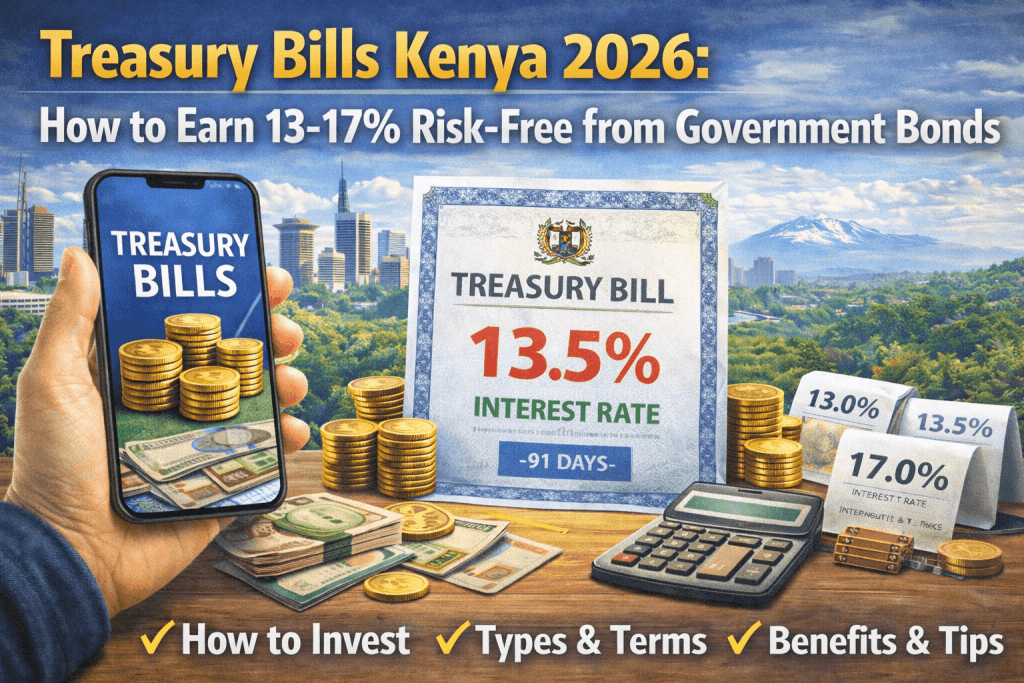
Treasury Bills pay 13-17% annually in Kenya. That’s government-guaranteed. No stock market volatility. No company risk. Pure fixed income.
Most Kenyans have never heard of T-Bills. Banks know about them—that’s where they invest your savings at 3% and pocket the 10% difference. SACCOs know—they buy billions in T-Bills. Fund managers know—Money Market Funds invest 80% in T-Bills.
But individual Kenyans? Only ~50,000 out of 50 million invest directly.
Why? Three myths:
- “You need millions to invest” (FALSE: Minimum Ksh 100,000)
- “It’s complicated” (FALSE: Takes 20 minutes to set up online)
- “Only for rich people” (FALSE: Government wants YOUR money, not just institutional)
This guide destroys the myths and shows you exactly:
- What T-Bills are (plain English)
- Current rates (91-day, 182-day, 364-day)
- How to buy via CBK portal (step-by-step with screenshots)
- T-Bills vs Money Market Funds vs SACCOs vs Fixed Deposits
- Tax implications (15% withholding tax)
- Risks (spoiler: nearly zero)
If you have Ksh 100,000 sitting in a bank savings account earning 3%, you’re losing Ksh 10,000-14,000 per year. Let’s fix that.
What Are Treasury Bills? (The 2-Minute Explanation)
Government Needs to Borrow Money
The Situation:
- Kenya government needs Ksh 500 billion to:
- Pay salaries (teachers, nurses, police)
- Build infrastructure (roads, hospitals)
- Cover budget deficit
Two Ways to Get Money:
- Tax citizens (already doing this)
- Borrow from citizens (this is T-Bills)
How T-Bills Work
Treasury Bill (T-Bill):
- Short-term loan to Kenya government
- You lend Ksh 100,000
- Government promises to pay back Ksh 100,000 + interest
- Term: 91 days, 182 days, or 364 days
- Interest: 13-17% annually
Example:
- You buy Ksh 100,000 worth of 364-day T-Bill at 17%
- You pay Ksh 100,000 today
- 364 days later: Government pays you Ksh 117,000
- Profit: Ksh 17,000 (minus 15% tax = Ksh 14,450 net)
Why Government Pays 13-17%
Supply and Demand:
- Government needs money constantly
- Investors want safe returns
- 13-17% is market rate that balances both
Why So High vs Bank Savings (3%):
- Banks borrow from you at 3%
- Lend to government at 13-17%
- Keep difference (Ksh 10-14 per Ksh 100)
- You can cut out the bank, get 13-17% directly
Three T-Bill Types in Kenya
91-Day T-Bill (3 Months):
- Maturity: 91 days
- Current rate: ~13-14% annually
- Best for: Short-term parking (3-6 months)
- Liquidity: Matures every 3 months
182-Day T-Bill (6 Months):
- Maturity: 182 days
- Current rate: ~14-15% annually
- Best for: Medium-term savings
- Balance: Return vs access
364-Day T-Bill (12 Months):
- Maturity: 364 days (almost 1 year)
- Current rate: ~15-17% annually
- Best for: Maximum returns, can wait 1 year
- Highest rate of the three
Pattern: Longer maturity = higher interest rate
Current Treasury Bill Rates (March 2026)
Actual rates from CBK auctions:
| T-Bill Type | Maturity | Interest Rate | Effective Annual Return (After 15% Tax) |
|---|---|---|---|
| 91-Day | 3 months | 13.5% | 11.5% |
| 182-Day | 6 months | 14.8% | 12.6% |
| 364-Day | 12 months | 16.5% | 14.0% |
Note: Rates change weekly based on auction demand. Check current rates at cbit.co.ke before bidding.
How T-Bill Rates Move
When Rates Go UP:
- Central Bank raises interest rates (fighting inflation)
- Government needs more money (budget pressures)
- Investors benefit (higher returns)
When Rates Go DOWN:
- Central Bank lowers rates (stimulating economy)
- Government has less borrowing need
- Investors get lower returns
Historical Range (2020-2026):
- Low: 6-8% (2021-2022, COVID stimulus period)
- High: 16-18% (2023-2026, high inflation period)
- Current: 13-17% is above historical average (good time to lock in)
How to Buy Treasury Bills (Step-by-Step CBK Portal)
Two ways to invest: Via CBK directly (free) or via bank (they charge fees).
Method 1: CBK Direct (Recommended – Ksh 0 Fees)
Step 1: Register on CBK Portal
Requirements:
- National ID or Passport
- KRA PIN certificate
- Bank account statement (for verification)
- Email address and phone number
Process:
- Visit cbit.co.ke (Central Bank Integrated Trading Portal)
- Click “Register New User”
- Choose “Individual Investor”
- Fill details:
- Full name (as per ID)
- ID/Passport number
- KRA PIN
- Phone, email
- Bank account details (for receiving payments)
- Upload documents:
- ID copy (scanned or photo)
- KRA PIN certificate
- Bank statement (1 page showing account number)
- Create password
- Submit
- Wait 1-3 business days for approval
- Receive email: “Account approved”
One-time setup. Takes 20 minutes.
Step 2: Fund Your CDS Account
What is CDS Account?
- Central Depository System
- Your “wallet” for holding T-Bills
- CBK creates this for you automatically
How to Add Money:
- Log into your bank
- Transfer money to:
- Bank: Central Bank of Kenya
- Account: Your CDS account number (emailed after registration)
- Amount: Minimum Ksh 100,000
- Reference: Your ID number
- Money reflects in CDS within 1 business day
Important: CDS account is SEPARATE from your personal bank. Think of it like M-Pesa—it’s your CBK wallet.
Step 3: Bid for T-Bills (Every Monday)
Auction Schedule:
- Every Monday: New T-Bills offered
- Bidding deadline: Monday 3:00 PM
- Results announced: Monday 4:00 PM
- Settlement: Tuesday (money deducted from CDS)
How to Bid:
- Log into cbit.co.ke
- Click “Primary Market”
- Select “Treasury Bills”
- Choose type: 91-day, 182-day, or 364-day
- Enter amount: Ksh 200,000 (example, minimum Ksh 100,000)
- Choose bid type:
- Competitive: You specify rate (e.g., “I want 15%”)
- Non-competitive: Accept whatever market rate is (RECOMMENDED for beginners)
- Submit bid
- Wait for results (Monday 4pm)
Step 4: Wait for Maturity
What Happens:
- Tuesday: Money deducted from CDS (Ksh 100,000)
- You now own T-Bill
- Interest accrues daily (you don’t see this daily)
- Maturity day (91/182/364 days later): Principal + interest deposited to CDS
- You can withdraw to bank or reinvest
Example Timeline:
- March 3 (Monday): Bid for 91-day T-Bill, Ksh 100,000
- March 4 (Tuesday): Ksh 100,000 deducted from CDS
- June 2 (91 days later): Ksh 103,375 deposited to CDS (Ksh 100K + Ksh 3,375 interest after tax)
- You withdraw Ksh 103,375 to bank, or reinvest in new T-Bill
Method 2: Via Your Bank (Easier but Fees Apply)
Most Banks Offer T-Bill Purchase:
- Equity Bank
- KCB
- Cooperative Bank
- NCBA
- Stanbic
Process:
- Visit bank branch or use mobile app (some banks)
- Request “Treasury Bill investment”
- Fill form
- Deposit minimum Ksh 100,000
- Bank handles bidding, settlement
- You receive interest at maturity
Fees:
- Processing fee: Ksh 500-2,000 per transaction
- Custody fee: 0.5-1% annually
- Total cost: Ksh 1,000-3,000/year on Ksh 100,000
vs CBK Direct:
- CBK: Ksh 0 fees
- Bank: Ksh 1,000-3,000 fees
- Difference: Bank fees eat 1-3% of returns
Recommendation: Use CBK direct (free). Only use bank if you can’t manage online portal.
Treasury Bills vs Other Investments (Real Numbers)
Ksh 100,000 invested for 12 months:
T-Bills (364-Day at 16.5%)
Gross interest: Ksh 16,500
Tax (15% WHT): -Ksh 2,475
Net interest: Ksh 14,025
Total return: Ksh 114,025
Effective return: 14.0%
Money Market Fund (at 11%)
Returns: Ksh 11,000
Fees: Already deducted (management fee ~1.5%)
Total return: Ksh 111,000
Effective return: 11.0%
T-Bills win by: Ksh 3,025
Bank Fixed Deposit (at 9%)
Interest: Ksh 9,000
Tax (15% WHT): -Ksh 1,350
Net interest: Ksh 7,650
Total return: Ksh 107,650
Effective return: 7.65%
T-Bills win by: Ksh 6,375
Bank Savings Account (at 3%)
Interest: Ksh 3,000
Tax (15% WHT): -Ksh 450
Net interest: Ksh 2,550
Total return: Ksh 102,550
Effective return: 2.55%
T-Bills win by: Ksh 11,475 (HUGE difference!)
SACCO Shares (at 12% dividend)
Dividend: Ksh 12,000
Tax: Ksh 0 (SACCOs exempt)
Total return: Ksh 112,000
Effective return: 12.0%
T-Bills win by: Ksh 2,025
But: SACCOs offer loan access (borrow 3X shares), T-Bills don’t.
NSE Stocks (variable, example 15%)
Capital gains: Ksh 15,000 (example year)
Tax: Ksh 0 (capital gains exempt)
Dividends: Ksh 5,000 (5% yield example)
Dividend tax: -Ksh 250
Total return: Ksh 119,750
Effective return: 19.75%
Stocks win by: Ksh 5,725
But: Stocks can also LOSE 20% (T-Bills never lose principal).
Summary Table
| Investment | 12-Month Return | Risk | Liquidity | Tax |
|---|---|---|---|---|
| T-Bills (364-day) | 14.0% | Lowest | Medium (locked) | 15% |
| NSE Stocks | -10% to +30% | High | High | 0-5% |
| Money Market Fund | 11.0% | Very low | High (2-3 days) | Included |
| SACCO Shares | 12.0% | Low | Low (illiquid) | 0% |
| Fixed Deposit | 7.65% | Very low | Locked | 15% |
| Bank Savings | 2.55% | Very low | Instant | 15% |
The Verdict:
- Best risk-free return: T-Bills (14%)
- Best total return (with risk): Stocks (19.75% average, but can lose)
- Best tax treatment: SACCOs (0% tax) or Stocks (0-5%)
- Worst: Bank savings (2.55%—you’re losing to inflation!)
Treasury Bills Tax Treatment (What You Actually Keep)
The 15% Withholding Tax
How It Works:
- T-Bill pays 16.5% gross interest
- Government deducts 15% withholding tax
- You receive 14.0% net
Example (Ksh 100,000 Investment):
- Gross interest: Ksh 16,500
- Tax deducted: Ksh 2,475 (15%)
- Net to you: Ksh 14,025
This happens automatically. You never see the full 16.5%—CBK deducts tax before paying you.
Is Withholding Tax Final?
For Most Kenyans: Yes
- 15% WHT is final tax
- No need to declare in income tax return
- Done
For High Earners (Top Tax Bracket 30%+):
- If total income > Ksh 500,000/month
- May need to pay additional tax
- Consult KRA
For Most: The 15% is all you pay. Simple.
Tax Comparison
T-Bills vs Other Investments:
| Investment | Tax Rate | Net Example (Ksh 100K) |
|---|---|---|
| T-Bills | 15% WHT | Ksh 14,025 |
| Fixed Deposit | 15% WHT | Ksh 7,650 |
| Money Market Fund | Included in return | Ksh 11,000 |
| SACCO Dividends | 0% (exempt) | Ksh 12,000 |
| NSE Dividends | 5% WHT | Ksh 4,750 |
| NSE Capital Gains | 0% (exempt) | Ksh 15,000 |
Tax Winners:
- SACCOs (0% on dividends)
- Stocks (0% capital gains)
- T-Bills, Fixed Deposits (15% WHT)
Treasury Bills Risks (Nearly Zero, But Not Quite)
Risk 1: Interest Rate Risk (Your Opportunity Cost)
The Scenario:
- You buy 364-day T-Bill at 16% (today)
- 3 months later: Rates jump to 20%
- You’re stuck at 16% while new investors get 20%
Impact:
- Not a loss of principal
- But: Opportunity cost of 4%
Mitigation:
- Use shorter T-Bills (91-day) when expecting rates to rise
- Ladder T-Bills (buy every month, not all at once)
Risk 2: Liquidity Risk (Money Is Locked)
The Problem:
- T-Bill matures in 364 days
- Day 200: Emergency, need money
- Can’t access your Ksh 100,000
Technically You Can Sell:
- Secondary market exists (CBIT portal)
- But: Sell at discount (lose some returns)
- Rarely worth it
Mitigation:
- Only invest money you won’t need
- Keep emergency fund in Money Market Fund (accessible)
- Don’t put ALL savings in T-Bills
Risk 3: Government Default Risk (Theoretical)
The Question: What if Kenya government can’t pay?
Reality:
- Kenya has NEVER defaulted on domestic debt (T-Bills)
- Government can print shillings if needed (unlike foreign debt in USD)
- Probability: Near zero
But:
- Countries CAN default (Greece, Argentina, Lebanon)
- If Kenya economic collapse: T-Bills at risk
- Lower risk than any company bond/stock, higher than nothing
Practical Take:
- T-Bills = safest Kenyan investment
- Still backed by government, not private company
- Risk = 0.1% (virtually zero)
Risk 4: Inflation Risk
The Hidden Risk:
- T-Bill pays 14% net
- Inflation: 7% (2026 estimate)
- Real return: 14% – 7% = 7%
What This Means:
- Nominal: You have 14% more shillings
- Real: Your purchasing power increased only 7%
- Inflation erodes value
Comparison:
- Bank savings at 2.5% – inflation 7% = -4.5% real return (losing purchasing power!)
- T-Bills at 14% – inflation 7% = +7% real return (winning)
Mitigation:
- For long-term (10+ years), consider stocks/equity funds (20%+ returns)
- T-Bills good for 1-5 years, not 20 years
How to Build a T-Bill Ladder (Advanced Strategy)
Problem with buying single T-Bill:
- All money locked for 91/182/364 days
- No access until maturity
Solution: T-Bill Ladder
The Ladder Strategy
Month 1:
- Buy Ksh 100,000 in 91-day T-Bill
Month 2:
- Buy another Ksh 100,000 in 91-day T-Bill
Month 3:
- Buy another Ksh 100,000 in 91-day T-Bill
Month 4:
- First T-Bill matures (from Month 1)
- Reinvest Ksh 103,375 in new 91-day T-Bill
- Now you have access to Ksh 100K every month (rolling maturity)
Benefits:
- Liquidity: Ksh 100K matures every month (can withdraw or reinvest)
- Interest: Earn 13-14% on all money
- Flexibility: Adjust to rate changes monthly
Example with Ksh 400,000:
- Split into 4× Ksh 100,000
- Buy one T-Bill per month
- After Month 4: One matures every month
- You’ve created monthly access to Ksh 100K while earning 13-14%
Treasury Bills for Different Goals
Emergency Fund (DON’T Use T-Bills)
Why NOT:
- T-Bills lock money for 91-364 days
- Emergency = need money within 24 hours
- Use Money Market Fund instead (2-3 day access)
Short-Term Savings (1-3 Years) → USE 91-Day or 182-Day T-Bills
Example Goal: Save for House Deposit in 18 Months
Strategy:
- Save Ksh 20,000/month
- Invest in 91-day T-Bills (rolling)
- After 18 months: Ksh 360,000 saved + Ksh 36,000 interest
- Total: Ksh 396,000
vs Bank Savings at 3%:
- Total: Ksh 369,000
- T-Bills gain: Ksh 27,000 extra
Medium-Term Savings (3-5 Years) → USE 364-Day T-Bills
Example Goal: Business Capital in 4 Years
Strategy:
- Invest Ksh 200,000 lump sum
- Reinvest in 364-day T-Bills each year
- 4 years at 14% average = Ksh 338,000
- Profit: Ksh 138,000
vs Fixed Deposit at 9%:
- Total: Ksh 283,000
- T-Bills gain: Ksh 55,000 extra
Long-Term Wealth (10+ Years) → DON’T Use T-Bills Exclusively
Why:
- T-Bills: 14% average
- Equity funds: 20%+ average long-term
- Over 20 years, 6% difference = massive wealth gap
Example (Ksh 10,000/month for 20 years):
- T-Bills at 14%: Ksh 7,000,000
- Equity fund at 20%: Ksh 15,000,000
- Difference: Ksh 8,000,000
Recommendation for Long-Term:
- 30% T-Bills (stability)
- 70% Equity funds (growth)
- Rebalance every 5 years
Frequently Asked Questions
Q: What is the minimum amount to invest in Treasury Bills in Kenya?
Answer: Ksh 100,000 minimum via CBK portal. Higher minimums via some banks.
CBK Direct (cbit.co.ke):
- Minimum first purchase: Ksh 100,000
- Subsequent purchases: Ksh 50,000
- Most Kenyans start with Ksh 100,000
Via Banks:
- Varies by bank
- Equity Bank: Ksh 100,000
- KCB: Ksh 50,000 (some branches)
- Cooperative: Ksh 100,000
- Check with your bank
Workaround for Smaller Amounts:
- If you have Ksh 10,000-50,000: Use Money Market Fund instead
- MMFs invest in T-Bills (you own T-Bills indirectly)
- No minimum (can start with Ksh 1,000)
- Returns: 10-11% (slightly lower than direct T-Bills but accessible)
See our Money Market Funds Kenya 2026 guide for Ksh 1,000-100,000 amounts.
Q: Can I withdraw my money before the Treasury Bill matures?
Answer: Yes, but you’ll sell at a discount and lose some returns. Better to plan properly and not need early withdrawal.
How Early Withdrawal Works:
Step 1: List on Secondary Market
- Log into CBK portal
- Offer your T-Bill for sale
- Example: Ksh 100,000 T-Bill, 200 days remaining
Step 2: Buyer Found (Maybe)
- Another investor buys your T-Bill
- Price: Usually 95-98% of face value (you lose 2-5%)
- You get Ksh 95,000-98,000 (lost Ksh 2,000-5,000)
Step 3: Money Received
- Credited to CDS account
- 1-3 days
The Problem:
- Finding buyer is not guaranteed (low liquidity)
- You sell at discount (lose money)
- Not recommended
Better Strategy:
- Don’t invest money you might need
- Keep emergency fund in MMF (2-3 day access)
- Use T-Bill ladder (monthly access)
Q: How safe are Treasury Bills in Kenya?
Answer: Safest investment in Kenya. Backed by government, never defaulted on domestic debt.
Safety Ranking (Safest to Riskiest):
1. Treasury Bills/Bonds (Safest)
- Backed by Kenya government
- Government can print money to pay (domestic debt)
- Never defaulted in Kenya’s history
- Risk: 0.1% (virtually zero)
2. Bank Deposits
- Protected by KDIC up to Ksh 500,000
- Slightly riskier than T-Bills (bank can fail)
- Risk: 0.5%
3. Money Market Funds
- Invest mostly in T-Bills (80%+)
- Not directly government-backed
- But underlying assets are T-Bills
- Risk: 1%
4. SACCOs
- Member-owned, deposits in T-Bills/banks
- SASRA-regulated
- Risk: 2-5% (depends on SACCO)
5. Corporate Bonds
- Company debt (KCB, Safaricom, KenGen)
- Company can default
- Risk: 5-10%
6. Stocks
- Company equity, can lose 50%+
- Risk: 20-50% (volatility, not default)
T-Bills = Safest Kenya investment available.
But: Not zero risk (government could theoretically default, but hasn’t in 60 years).
Q: Are Treasury Bills better than Money Market Funds?
Answer: T-Bills pay ~3% more (14% vs 11%), but MMFs are more flexible. Use both for different purposes.
Treasury Bills Win On:
- ✅ Returns: 14% vs 11% (27% higher!)
- ✅ Fees: Ksh 0 (CBK direct) vs 1-1.5% MMF management fee
- ✅ Direct government backing
Money Market Funds Win On:
- ✅ Liquidity: 2-3 days vs 91-364 days locked
- ✅ Low minimum: Ksh 1,000 vs Ksh 100,000
- ✅ Auto-reinvestment (no manual rebidding weekly)
- ✅ Easier (no CBK portal registration)
When to Use T-Bills:
- You have Ksh 100,000+ to invest
- Can lock money for 91-364 days
- Want maximum safe return
- Willing to manage CBK portal
When to Use MMF:
- You have Ksh 1,000-100,000
- Need emergency fund (access in 2-3 days)
- Want simplicity (no auction bidding)
- Building up to Ksh 100K for T-Bills
Smart Strategy (Ksh 300,000 to invest):
- Ksh 100,000: MMF (emergency fund, liquid)
- Ksh 200,000: T-Bills 91-day rolling (higher returns)
- Best of both worlds
Q: Do I pay tax on Treasury Bills?
Answer: Yes, 15% withholding tax on interest. Deducted automatically.
How Tax Works:
You Invest: Ksh 100,000 in 364-day T-Bill at 16.5%
Maturity:
- Principal returned: Ksh 100,000
- Gross interest: Ksh 16,500
- Tax deducted (15%): Ksh 2,475
- Net interest to you: Ksh 14,025
Total received: Ksh 114,025
You don’t pay tax separately. CBK deducts before paying you.
Do You Declare in Tax Return?
For Most Kenyans: No
- 15% WHT is final tax
- No need to file separately
- Done automatically
High Earners (Ksh 500K+/month):
- May need to declare
- Could owe additional tax if in top bracket
- Consult tax advisor
Compare to Other Investments:
| Investment | Tax | Net Return (Example) |
|---|---|---|
| T-Bills | 15% WHT | 14.0% |
| Fixed Deposit | 15% WHT | 7.65% |
| SACCO Dividends | 0% (exempt!) | 12.0% |
| NSE Dividends | 5% WHT | 4.75% (on 5% yield) |
| NSE Capital Gains | 0% (exempt!) | Full gain |
Tax Best: SACCOs (0%) and NSE capital gains (0%)
Tax Neutral: T-Bills and Fixed Deposits (same 15% rate)
Q: Can I invest in Treasury Bills via M-Pesa?
Answer: Not directly to CBK. But Money Market Funds (which invest in T-Bills) accept M-Pesa deposits.
Direct T-Bill Investment (CBK):
- Requires: Bank transfer to CDS account
- M-Pesa NOT accepted (CBK doesn’t have M-Pesa integration yet)
Indirect via Money Market Fund:
- Invest Ksh 1,000+ via M-Pesa Paybill
- Fund buys T-Bills with pooled money
- You own units representing T-Bill exposure
- Returns: 10-11% (slightly lower than direct, but accessible)
Process (MMF via M-Pesa):
- Choose MMF: GenAfrica (Paybill 222111), CIC (222222), Sanlam (220220)
- Lipa na M-Pesa → Paybill
- Enter account: Your phone number (for new investors)
- Amount: Ksh 5,000 (example)
- Confirm
- You now own T-Bill exposure via MMF
When You Have Ksh 100,000 in MMF:
- Withdraw to bank
- Open CBK account
- Buy T-Bills directly (higher returns)
See our Money Market Funds Kenya 2026 and M-Pesa Savings Tips guides.
Conclusion: Should You Invest in Treasury Bills?
The simple truth: If you have Ksh 100,000+ sitting in a bank savings account earning 2-3%, you’re throwing away Ksh 11,000-14,000 per year.
Treasury Bills Make Sense When:
✅ You Have Ksh 100,000+ Available:
- Below Ksh 100,000: Use Money Market Fund (same underlying investment, lower minimum)
- Ksh 100,000+: Direct T-Bills worth the effort
✅ You Can Lock Money for 91-364 Days:
- Not emergency fund (use MMF for that)
- Known future need (house deposit in 12 months, school fees in 6 months)
- Money you won’t touch
✅ You Want Maximum Risk-Free Return:
- 14% net is best you’ll get with near-zero risk
- Better than banks (2-3%)
- Better than MMFs (11%)
- Government-guaranteed
✅ You’re Comfortable with Online Portals:
- CBK portal is not hard (20 minutes setup)
- But: Some people prefer bank in-person
- If tech-savvy: T-Bills are great
Treasury Bills DON’T Make Sense When:
❌ You Have Under Ksh 100,000:
- Use Money Market Fund instead (same returns, Ksh 1,000 minimum)
- Build up to Ksh 100,000, then switch to T-Bills
❌ You Need Emergency Access:
- T-Bills lock for 91-364 days
- Emergency fund must be accessible in 24-48 hours
- Use MMF for emergency fund
❌ You’re Investing for 10+ Years:
- T-Bills: 14% average
- Equity funds: 20%+ long-term
- For long-term, stocks/equity funds crush T-Bills
- Use T-Bills for stability portion only (30% of portfolio)
❌ You’re Not Comfortable with Online Systems:
- CBK portal requires computer/smartphone
- If you prefer in-person: Use bank T-Bill service (but you’ll pay fees)
The Smart Treasury Bill Strategy
For Most Kenyans with Ksh 200,000-1,000,000 to Invest:
Tier 1: Emergency Fund (3 Months Expenses)
- Money Market Fund: Ksh 50,000-150,000
- Liquid (2-3 day access)
- Returns: 10-11%
Tier 2: Short-Term Goals (1-3 Years)
- T-Bills 91-day or 182-day (rolling)
- Example: Ksh 200,000 in 91-day T-Bills
- Ladder: Buy monthly for rolling access
- Returns: 13-14%
Tier 3: Medium-Term (3-7 Years)
- T-Bills 364-day: 50%
- Balanced Unit Trust: 50%
- Returns: 15-16% blended
Tier 4: Long-Term (10+ Years)
- Equity Unit Trusts: 70%
- T-Bills 364-day: 30%
- Returns: 18-20% blended
Example (Ksh 500,000 to Invest):
- Emergency fund (MMF): Ksh 100,000 @ 11% = Ksh 11,000/year
- Short-term T-Bills 91-day: Ksh 200,000 @ 13.5% = Ksh 27,000/year
- Long-term Equity fund: Ksh 200,000 @ 20% = Ksh 40,000/year
- Total annual gain: Ksh 78,000 (15.6% blended return)
vs All in Bank Savings at 3%:
- Ksh 500,000 @ 3% = Ksh 15,000/year
- T-Bill/MMF/Equity strategy gains: Ksh 63,000 MORE per year
Over 20 years, that Ksh 63,000 difference compounds to millions.
Related Guides
Compare Safe Investments:
- Money Market Funds Kenya 2026 – 10-14% returns, lower minimum
- Best SACCOs Kenya 2026 – 12% dividends (0% tax) + loan access
- Unit Trusts Kenya 2026 – 15-25% long-term returns
Build Complete Investment Plan:
- How to Save Money Kenya – Foundation strategies
- How to Budget Kenya – 60-20-10-10 framework
Earn More to Invest:
- Side Hustles Kenya – 33 income opportunities
- Freelancing Kenya – Online income
- Remote Jobs Kenya – Work from home
Treasury Bills are the foundation of safe wealth building in Kenya. 14% government-guaranteed returns beat 90% of what banks offer. If you have Ksh 100,000, you have no excuse not to use T-Bills.
Open your CBK account this week. Your future self will thank you.
Last Updated: March 12, 2026 | T-Bill rates current as of March 2026, CBK portal process verified, tax treatment confirmed