KQ Shares 2026: Should You Buy Kenya Airways Stock?

29 January 2026

KQ Shares 2026: Should You Buy Kenya Airways Stock?

KQ Shares 2026

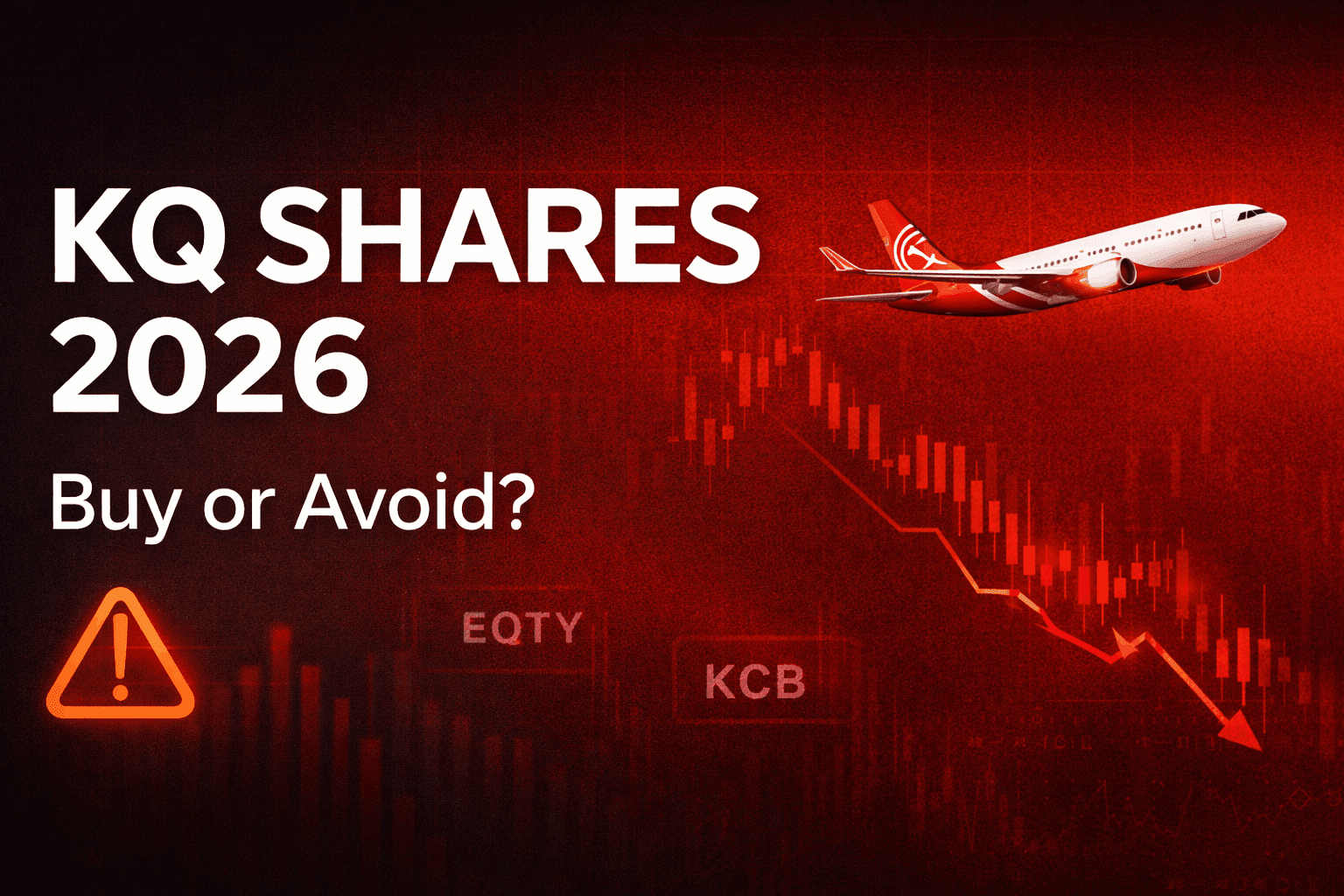
KQ shares are trending again in 2026. The stock is down over 78% from its KSh 14 IPO price in 2014, now trading around KSh 3 per share. This makes some investors think: “It’s cheap! Could this be a bargain?” But is Kenya Airways stock a contrarian value opportunity, or a value trap that could wipe out your investment?

As Kenya’s national carrier and symbol of national pride, KQ evokes strong emotions. But emotions don’t make good investment decisions. Hard financial analysis does.

⚠️ Upfront Warning: KQ is a HIGHLY SPECULATIVE investment. You could lose 50-100% of your money. If you can’t afford that risk, check out our Best Kenyan Stocks 2026 guide for safer options.

KQ Shares Quick Reference (At-a-Glance)

MetricValue
Current Price (Jan 2026)KSh 3.00
52-Week RangeKSh 2.50 – KSh 4.80
IPO Price (2014)KSh 14.00
Loss Since IPO-78%
Total DebtKSh 150+ billion
Last Dividend Paid2010 (None since)
Profitability StatusLosing money (10+ years)
My Investment RatingAVOID (1/5 stars)
Risk LevelEXTREMELY HIGH
📊 One-Sentence Summary: KQ shares are a highly speculative turnaround play with massive debt, recurring losses, and government dependency—only for aggressive investors who can afford total loss.

Kenya Airways Company Overview: The Reality

What Does KQ Actually Do?

  • Kenya’s national flag carrier — operates domestic, regional, and international routes
  • Hub: Jomo Kenyatta International Airport (JKIA), Nairobi
  • Fleet: 30+ aircraft
  • Alliance: SkyTeam member
  • Ownership: 49% government, 51% public shareholders

Financial Performance: A Decade of Losses

Revenue Trend:

  • 2019 (Pre-COVID): KSh 128 billion
  • 2020 (COVID): KSh 55 billion (-57%)
  • 2023: KSh 118 billion (recovery)
  • 2024-2025: Still struggling to return to profitability

Key Insight: Even with travel demand back to 2019 levels, KQ still isn’t making consistent profits. This isn’t a demand problem—it’s a structural efficiency problem.

Profitability Status: The Hard Truth

  • ❌ 2015-2024: 10 consecutive years of losses
  • ❌ No profitable year since 2012
  • ❌ No dividend paid to shareholders since 2010
  • ❌ Shareholders have made ZERO return in 12+ years

The Debt Problem: The Elephant in the Room

How Much Debt Does KQ Actually Have?

Total Debt: KSh 150+ billion (approximately USD $1.15+ billion)

To put this in perspective:

  • KQ’s market cap: Approximately KSh 10-15 billion
  • Debt is 10X the company’s entire value
  • This means equity holders (shareholders) are essentially worthless until this debt is addressed

Debt Breakdown:

  • Aircraft leases: KSh 80+ billion (most expensive)
  • Bank loans: KSh 40+ billion
  • Government loans: KSh 20+ billion
  • Supplier debt: KSh 10+ billion

Can KQ Service This Debt?

  • Annual interest payments: KSh 10-15+ billion
  • Annual operating profit: Losses (when they occur)
  • Result: KQ pays debt with more debt (classic death spiral)
⚠️ Critical Warning: If KQ goes bankrupt, here’s the payment priority: (1) Aircraft lessors (paid first), (2) Banks/suppliers (paid second), (3) Government (paid last), (4) Minority shareholders like YOU (paid NEVER).

The Bull Case: Why Some Investors Are Buying

To be fair, let’s hear the optimistic arguments for KQ shares:

Bull Argument #1: “Too Big to Fail”

The argument: KQ is Kenya’s national carrier. The government won’t let it collapse. It will get bailed out indefinitely and eventually restructured.

My response: Yes, bailouts prevent bankruptcy. But every bailout dilutes shareholders. The government owns 49% already. More bailouts = more share dilution = your shares worth less.

Bull Argument #2: “Trading at All-Time Lows”

The argument: Stock at KSh 3 vs KSh 14 IPO. “It can’t go much lower!” Huge upside potential if turnaround happens.

My response: Stocks can ALWAYS go lower. Look at Uchumi Supermarkets (went to near-zero). KSh 3 to KSh 0.50 is still -83% loss from here. “Cheap” doesn’t equal “good value.”

Bull Argument #3: “Aviation Is Recovering”

The argument: Global travel demand back to 2019 levels. Airlines globally doing well. KQ should benefit from recovery.

My response: Profitable airlines like Ethiopian and Qatar Airways are thriving. KQ still losing money even with full demand recovery. The problem isn’t demand—it’s operational inefficiency.

Bull Argument #4: “The Speculative Play”

The argument: Risk KSh 10,000. If turnaround happens, could 5X or 10X. Lottery ticket mentality.

My response: This is the ONLY argument I partially accept. IF you treat it as pure speculation (like betting), AND you can afford to lose 100%, MAYBE. But don’t call it “investing”—it’s gambling.

The Bear Case: Why I’m Avoiding KQ Shares

Bear Argument #1: Chronic Losses

KQ has lost money for 10+ consecutive years. This isn’t temporary—it’s structural. The business model is fundamentally broken.

Bear Argument #2: The Debt Death Spiral

  • Debt is 10X market cap
  • Can’t service debt from operations
  • Taking debt to pay debt
  • Clear path to bankruptcy

Bear Argument #3: Government Ownership Risk

Government owns 49% and will likely increase stake. Future bailouts = more shares issued. Your ownership percentage shrinks. Value per share decreases.

Bear Argument #4: Crushed by Competitors

AirlineProfitabilityFleet SizeRoutes
Ethiopian AirlinesPROFITABLE140+130+
Kenya AirwaysLOSING MONEY30+50+
Rwanda AirGROWING1328

Question: Why would you invest in the losing competitor when profitable alternatives exist?

Bear Argument #5: No Income to Shareholders

  • ❌ No dividends since 2010
  • ❌ Won’t pay for foreseeable future (losing money)
  • ❌ Your only return is share price appreciation
  • ❌ But why would share price rise for unprofitable company?

Bear Argument #6: Dilution History

Share count has increased massively over the years. Each bailout = more shares issued. Your slice of the pie shrinks with every rescue package.

KQ Share Price Scenarios: What Could Happen?

Scenario 1: KQ Rises to KSh 5 (67% Upside)

Would require:

  • Return to profitability (hasn’t happened in 10+ years)
  • Debt restructuring (creditors taking 50%+ losses)
  • Revenue growth + margin improvement
  • Major market sentiment shift

Probability: 20-30% | Timeline: 3-5 years minimum

Scenario 2: KQ Rises to KSh 10+ (233% Upside)

Would require:

  • All of above PLUS
  • Privatization or strategic investor (Emirates, Qatar)
  • Major cost restructuring (massive layoffs)
  • Significant debt forgiveness
  • Macro tailwinds (Kenya economy booming)

Probability: 5-10% | Timeline: 5-10 years

Scenario 3: KQ Goes to KSh 0 (100% Loss)

Would require:

  • Continued operating losses
  • Creditors forcing bankruptcy
  • Government unwilling/unable to bail out
  • Liquidation and equity wipeout

Probability: 30-40% | Timeline: 2-5 years

Most Likely Scenario: Stock muddles along at KSh 2-4 for years. Occasional spikes on hopeful news, but returns to lows. Shareholders slowly diluted. No meaningful gains. Opportunity cost of your capital: MASSIVE.

Better Alternative Investments to KQ

If You Want Aviation Exposure:

If You Want a “Turnaround Story”:

  • Look for companies with actual profitability path
  • KQ’s turnaround would require complete restructuring (unlikely)
  • Better to find companies already on turnaround path

If You Want NSE Exposure With Better Safety:

Read our Best Kenyan Stocks 2026 guide with 10 safer options:

  • Safaricom Limited — Market leader, profitable
  • Equity Bank — Growing, consistent dividends
  • KCB Group — Solid fundamentals
  • ABSA Bank Kenya — Stable returns

If You MUST Invest in KQ Shares: Hard Rules

If you’re ignoring all my warnings, here are the minimum rules to follow:

Rule #1: Treat It as Speculation, Not Investment

This is gambling, not investing. Accept you might lose 100%. Don’t call it an “investment strategy”—call it what it is.

Rule #2: Position Size: 1-2% Maximum

If you have a KSh 500,000 portfolio, invest KSh 5,000-10,000 in KQ MAXIMUM. Never more. This limits your damage if it goes to zero.

Rule #3: Set a Loss Limit

If the stock drops 30-50%, SELL. Don’t “average down” (throwing good money after bad). Accept the loss and move on.

Rule #4: Have a Profit Target

If somehow stock doubles to KSh 6, SELL immediately. Take profit off the table. Don’t get greedy and hold for a 5-bagger (you probably won’t get it).

Rule #5: Monitor Quarterly Results

Read every quarterly report. Watch debt levels closely. Exit immediately if deteriorating further.

What Would Make Me Change My Mind on KQ?

I would genuinely reconsider my AVOID rating IF:

  • ✓ Debt restructuring completed (creditors take 50%+ haircut)
  • ✓ Return to profitability (2+ consecutive profitable quarters)
  • ✓ Strategic investor involvement (Emirates, Qatar, Ethiopian take stake)
  • ✓ Government reduces ownership (privatization)
  • ✓ New business model emerges (cargo focus, regional focus)

Until then: AVOID

Key Lessons for Kenyan Investors

Lesson #1: Avoid Debt-Heavy Companies

Debt kills shareholder value. Airlines are inherently debt machines. Look for companies with manageable debt-to-equity ratios.

Lesson #2: Profitability Matters More Than Revenue

Revenue growth is meaningless if you’re losing money. Profit is king. A company with declining revenue but growing profit is better than the opposite.

Lesson #3: Government Ownership = Double-Edged Sword

Yes, bailouts prevent bankruptcy. But they also dilute shareholders and often lead to political interference that hurts efficiency.

Lesson #4: Don’t Catch Falling Knives

A 78% decline doesn’t make something cheap. It could drop another 80% from here. Wait for turnaround PROOF, not just hope.

Lesson #5: Opportunity Cost Is Real

  • KSh 10,000 invested in KQ (2014) = KSh 2,200 now (-78%)
  • Same KSh 10,000 in Safaricom = KSh 15,000+ now (+50%)
  • Difference: KSh 12,800 lost opportunity cost

Frequently Asked Questions About KQ Shares

Q: Is KQ a good investment in 2026?A: No. It’s a highly speculative play with significant downside risk. You could lose 50-100%. There are better opportunities on NSE.

Q: Should I buy KQ shares now that they’re “cheap” at KSh 3?A: Cheap doesn’t mean good value. KQ at KSh 3 might still be overvalued given debt load and chronic losses. Avoid.

Q: Will KQ go bankrupt?A: Possible. The government will try to prevent it with bailouts, but if losses continue and bailouts stop, bankruptcy is realistic. Probability: 30-40% over 5 years.

Q: Can KQ stock reach KSh 14 again (IPO price)?A: Extremely unlikely without massive debt forgiveness and complete business turnaround. Even then, 20-year timeline minimum.

Q: What if I already own KQ shares?A: Review your position. If you’re down significantly, consider tax-loss harvesting (use loss to offset other gains). Unless you have strong contrarian conviction, consider exiting.

Q: Is KQ better than Safaricom or Equity Bank stock?A: No. KQ loses on every metric: profitability, debt, dividends, growth. Pick Safaricom or Equity Bank every time.

Q: Could KQ be bought by another airline?A: Possible, but unlikely. Any buyer would assume KSh 150B+ debt and face government approval requirements. Who would take that deal?

🎯 FINAL VERDICT: AVOID KQ SHARES (Rating: 1/5 Stars)

Summary: KQ shares are trending, but that doesn’t make them a good investment. After analyzing the fundamentals—KSh 150+ billion in debt, a decade of losses, chronic unprofitability, and no path to dividend—I cannot recommend KQ shares to anyone except the most aggressive speculators with gambling money.

Could the stock double? Maybe on turnaround hope or government bailout news. But it could just as easily drop to KSh 1 or go to zero if bankruptcy happens.

The math: 30-40% chance of bankruptcy (total loss). 20-30% chance of 67% gain to KSh 5. 5-10% chance of 233% gain to KSh 10. Expected value = negative.

There are simply too many better opportunities on the NSE.

Who Should and Shouldn’t Buy KQ Shares

✅ Who Might Buy Despite My Warning:

  • Extreme risk-takers with gambling money (1-2% portfolio max)
  • Contrarians betting on turnaround story
  • Those with insider information (unlikely)
  • Kenyans with emotional attachment to national carrier (NOT a good reason)

❌ Who Should Definitely Avoid:

  • Conservative investors
  • Dividend seekers (no dividend since 2010)
  • Anyone who can’t afford 100% loss
  • First-time investors
  • Retirement accounts (never speculative)
  • Anyone buying based on emotion/patriotism
  • People with limited capital (better alternatives available)

Ready to Make Smarter Investment Decisions?

Don’t let emotions or hype guide your investments.

📚 Related Investment Guides

📋 Disclaimer

This is personal analysis and opinion, not financial advice. I don’t own KQ shares and have no financial interest in the outcome. Airlines are inherently risky investments. Always do your own research, consult licensed financial advisors, and make decisions based on your personal risk tolerance and financial situation. Past performance doesn’t guarantee future results. Please review our full disclaimer before making any investment decisions.

© 2026 Local Listing Dealz. All Rights Reserved.

Your trusted source for local deals and honest financial analysis in Kenya

Last Updated: January 29, 2026 | Will Review After Q1 2026 Results

See Your Business Here?

Want Your Business Listed on Local Listing Dealz? Contact Us Today For Further Information on Listing and Advertising.