NSE Kenya 2026: How to Invest for Beginners — Start with KES 5,000
NSE Kenya 2026: How to Invest for Beginners — Start with KES 5,000
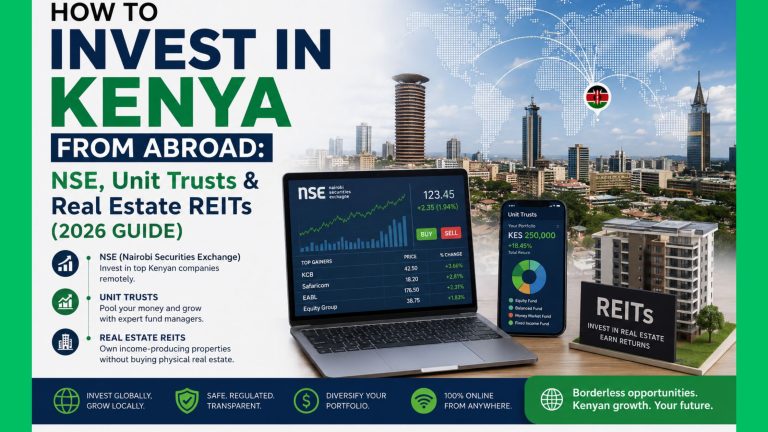
If you have been reading about how to invest in NSE Kenya as well as watch KCB’s record KES 7.00 dividend, Safaricom’s growing M-Pesa profits, or Standard Chartered Kenya yielding approximately 9% — and you want a piece of that — this guide shows you exactly how to start investing in the Nairobi Securities Exchange from scratch.
You can start with as little as KES 5,000. You do not need a financial advisor, a high salary, or previous investing experience. You need a National ID, a KRA PIN, and 30 minutes to open an account.
Here are the current entry points for the most popular beginner stocks on the NSE as at May 2026:
| Stock | Price per share | KES 10,000 buys | Est. dividend yield |
|---|---|---|---|
| Safaricom (SCOM) | ~KES 30.20 | ~331 shares | ~5.3% |
| Co-operative Bank (COOP) | ~KES 29.25 | ~341 shares | ~8.3% |
| KCB Group (KCB) | ~KES 72 | ~138 shares | ~9.7% |
| Equity Group (EQTY) | ~KES 55 | ~181 shares | ~7.7% |
| KenGen (KEGN) | ~KES 7.50 | ~1,333 shares | ~11% |
Prices as at May 2026 — verify at nse.co.ke before investing. Dividend yields are estimates based on most recent declared dividends.
What Is the NSE and Why Should You Care?
The Nairobi Securities Exchange is Kenya’s official stock market — a regulated platform where companies sell shares of ownership to the public, and where investors buy and sell those shares. Over 60 companies are currently listed across banking, telecoms, manufacturing, energy, and consumer goods.
When you buy a share, you buy a small piece of ownership in that company. If the company makes profits, two things can happen in your favour: the share price rises (your investment grows in value) and the company pays dividends (cash deposited directly to your bank account). Most NSE blue-chip companies do both.
The NSE had an exceptional 2025. Market capitalisation surpassed KES 3 trillion, 13 companies posted share price gains above 100%, and dividend payouts hit record highs across the banking sector. The momentum has continued into 2026 — the NSE banking sector gained 5.59% in January alone. This is not distant financial news. These are cash payments going directly to Kenyans who own shares.
The alternative — leaving money in a bank savings account — earns 3–4% per year. The top NSE dividend stocks earn 8–15% per year, with potential share price growth on top. That gap is why NSE investing matters.
What You Need to Start
Minimum capital: KES 5,000 is enough to start. KES 10,000 gives you more flexibility and better cushions the impact of brokerage fees on your returns.
Documents required:
- Valid National ID or Passport
- KRA PIN Certificate — apply free at itax.kra.go.ke if you do not have one
- Proof of residence — recent utility bill or bank statement showing your address
- Two passport photos
- Bank account details for receiving dividends and sale proceeds
Age requirement: You must be 18 or older to open a CDS account independently. Parents can open and manage accounts on behalf of minors. Both Kenyan citizens and foreign nationals can invest.
Step 1: Open a CDS Account
A Central Depository System (CDS) account is where your shares are held electronically. You cannot receive NSE dividends, buy shares, or prove share ownership without one. Opening is free and takes 3–5 business days.
You open your CDS account through a licensed stockbroker — a regulated intermediary who executes trades on your behalf. You cannot buy NSE stocks directly without a broker.
Licensed stockbrokers to consider in 2026:
| Broker | Best for | Approx commission |
|---|---|---|
| Hisa (hisa.app) | Beginners, fully mobile | 1.3% |
| Faida Investment Bank | Online platform, research | 1.5% |
| Genghis Capital | Full service, research reports | 1.5% |
| Nabo Capital | Educational content, mobile app | 1.5% |
| NCBA Investment Bank | Bank integration | 1.8% |
| Standard Investment Bank | Established, full service | 2.0% |
Contact two or three brokers and compare current fees before committing. Many now offer fully digital account opening — you may not need to visit a physical office at all. Hisa in particular is designed for first-time investors and allows you to open an account and trade entirely from your phone.
The account opening process:
- Choose your broker and visit their website or office
- Complete the CDS account application form
- Submit your documents — ID, KRA PIN, proof of residence, passport photos, bank details
- Pay the account opening fee — typically KES 100–300 CDS fee plus KES 500–1,500 broker fee
- Wait 3–5 business days for activation
- Receive your CDS account number, broker account number, and trading login credentials
Once activated, deposit funds to your broker’s designated bank account using your CDS number as the payment reference. Confirm the funds have been received before placing any orders.
Important: The NSE changed its policy in 2025 to allow trading of single-unit shares — previously you had to buy shares in board lots of 100. This makes KES 5,000 a genuinely viable starting amount since you can buy any number of shares in most listed companies.
Step 2: Understand the Costs
Every NSE transaction carries fees. On a KES 10,000 purchase, expect total charges of approximately KES 154–224.
| Fee | Rate | On KES 10,000 |
|---|---|---|
| Broker commission | 1.3–2.0% | KES 130–200 |
| NSE levy | 0.12% | KES 12 |
| CDS fee | 0.06% | KES 6 |
| Statutory charges | 0.06% | KES 6 |
| Total | ~1.54–2.24% | ~KES 154–224 |
This means if you invest KES 10,000, approximately KES 9,800 actually goes into shares. The fees apply on both buying and selling — so frequent trading erodes your returns significantly. The right approach is to buy quality stocks and hold them for years, not weeks.
Step 3: Choose Your First Stocks
As a beginner, focus on blue-chip dividend-paying stocks. These are large, established companies with 10–40 year track records of consistent profit and regular dividend payments. They are less volatile than smaller companies and generate real cash income while you hold them.
Safaricom (SCOM) — Best for beginners
Kenya’s most liquid stock — millions of shares traded daily. You can buy or sell at any time without difficulty. M-Pesa revenue grew 18% in the last reported half-year and Safaricom’s integration of stock trading into M-Pesa via Ziidi Trader is deepening its retail reach further. Share price approximately KES 30.20. Estimated dividend yield approximately 5.3% — paid semi-annually. See our Safaricom dividend 2026 guide for exact payment dates.
Co-operative Bank (COOP) — Best for consistent income
Majority-owned by Kenya’s cooperative movement — 15 million SACCO members provide the most stable deposit base of any NSE-listed bank. Up 22.1% year-to-date in 2026. Share price approximately KES 29.25. Estimated dividend yield approximately 8.3%. 45% payout ratio means the dividend is highly sustainable. A strong choice for first-time investors who want predictable income.
KCB Group (KCB) — Best for dividend income
Kenya’s largest bank by assets, now operating across Kenya, Tanzania, Uganda, Rwanda, Burundi, Ethiopia, South Sudan, and DRC. Declared KES 7.00 total dividend in 2026 — its largest ever. Share price approximately KES 72. Estimated dividend yield approximately 9.7%. 33% payout ratio is the most conservative of any high-yield stock on the NSE, which makes the dividend extremely sustainable and positioned for further growth. See our KCB dividend 2026 guide.
Equity Group (EQTY) — Best for dividend growth
Dividend has grown 70% in four years — from KES 2.50 in 2021 to KES 4.25 in 2024. Share price approximately KES 55. Estimated yield approximately 7.7%. At 40% payout ratio, there is significant room for further increases as profits grow. Regional expansion across DRC, Rwanda, and Uganda adds long-term growth potential. See our Equity Group dividend 2026 guide.
KenGen (KEGN) — Best for small budgets
At approximately KES 7.50 per share, KenGen is one of the most affordable quality stocks on the NSE. KES 5,000 buys approximately 666 shares. Government-backed energy infrastructure company — Kenya’s largest power producer — with an estimated dividend yield of approximately 11% at current prices. Strong support levels confirmed by renewed buying interest in May 2026. See our KenGen dividend 2026 guide.
EABL — Best for defensive stability
40+ consecutive years of unbroken dividends. Beer and spirits consumption is one of the most resilient business models available — people drink in good times and bad. EABL raised its interim dividend 60% after a 37.6% jump in half-year profit. Estimated full-year yield 8%+. See our EABL dividend 2026 guide.
For a complete ranking of all NSE stocks by dividend yield, see our Top NSE Dividend Stocks Kenya 2026 guide.
Step 4: Place Your First Order
NSE trading hours are Monday to Friday, 9:30am to 3:00pm Kenya time.
Method 1 — Via broker app or website (recommended) Log into your broker’s trading platform. Search the stock by its ticker symbol — SCOM for Safaricom, KCB for KCB Group, EQTY for Equity Group, COOP for Co-operative Bank, KEGN for KenGen. Enter the number of shares you want to buy. Select your order type and confirm.
Method 2 — Via broker phone or email Call or email your broker directly: “I want to buy 200 Safaricom shares at market price.” They execute on your behalf and send you a confirmation.
Order types:
- Market order — buys at the current trading price. Executes immediately during trading hours. Use this for your first purchase.
- Limit order — sets the maximum price you will pay. Only executes if the share price drops to your target. Use this once you are comfortable with how the platform works.
What happens after purchase:
- You receive a trade confirmation within minutes showing shares bought, price paid, and fees charged
- Shares settle in your CDS account within T+3 business days — three business days after the trade date
- Your CDS account now shows your shareholding — you are a shareholder
- Dividends are paid automatically to your registered bank account on the payment date — no action required from you
Step 5: Receive Your First Dividend
This is the moment investing becomes real — cash arrives in your bank account simply because you own shares.
Here is exactly how it works:
- The company’s board announces a dividend per share and a book close date
- You must own shares before the ex-dividend date — typically 2–3 business days before the book close date (because of the T+3 settlement period, you need to buy at least 4 business days before book close)
- The company compiles its shareholder register on the book close date
- Withholding tax of 5% is deducted automatically for Kenyan residents — no filing required, it is a final tax
- The net dividend is deposited to your registered bank account on the payment date
No action required from you at any point after purchase. The money arrives automatically.
Upcoming 2026 dividend payment dates:
| Stock | Book close | Est. payment | Est. dividend |
|---|---|---|---|
| Stanbic Holdings | ~May 2026 | ~June 2026 | KES 18.55 final |
| EABL | ~August 2026 | ~October 2026 | TBA |
| Safaricom | ~July 2026 | ~August 2026 | TBA |
| KenGen | ~September 2026 | ~October 2026 | TBA |
See our NSE Dividend Calendar 2026 for all confirmed payment dates and amounts.
How Much Can You Earn — Real Shilling Examples
Example 1: KES 10,000 in Co-operative Bank
- Buy 341 shares at KES 29.25
- Estimated annual dividend at 8.3% yield: approximately KES 830 gross, KES 789 net after 5% tax
- After-tax yield: ~7.9%
- If COOP reaches KES 35 in two years: 341 shares × KES 35 = KES 11,935 — KES 1,935 capital gain plus dividends collected
Example 2: KES 50,000 in KCB Group
- Buy 694 shares at KES 72
- Estimated KES 7.00 annual dividend: 694 × KES 7.00 = KES 4,858 gross, KES 4,615 net after 5% tax
- After-tax yield: ~9.2%
Example 3: KES 100,000 diversified portfolio
| Stock | Investment | Est. annual net dividend |
|---|---|---|
| KCB Group (25%) | KES 25,000 | ~KES 2,308 |
| Co-operative Bank (25%) | KES 25,000 | ~KES 1,972 |
| Safaricom (25%) | KES 25,000 | ~KES 1,246 |
| KenGen (25%) | KES 25,000 | ~KES 2,475 |
| Total | KES 100,000 | ~KES 8,001/year |
Effective net yield: ~8.0%. Monthly passive income: ~KES 667. Plus any share price appreciation.
Five Mistakes Every Beginner Makes
1. Investing money you cannot afford to lose. Only invest surplus funds — never rent money, school fees, or emergency savings. Markets fluctuate. You need to be able to hold through downturns without being forced to sell at a loss.
2. Timing the market. Nobody reliably predicts when share prices will rise or fall. The strategy that consistently works is time in the market — buy quality stocks, hold them, collect dividends, and let compounding do the work. A KES 100,000 investment growing at 9% annually becomes KES 237,000 in 10 years.
3. Panic selling on dips. When a stock drops 15%, beginners sell. Experienced investors buy more. Short-term price fluctuations are normal for every quality stock — including Safaricom and KCB. Unless the company’s business has fundamentally deteriorated, price dips are opportunities, not reasons to exit.
4. Buying only one stock. Diversify across at least three companies in different sectors. Banking, telecoms, and energy behave differently in different economic conditions. Spreading your investment reduces risk without significantly reducing your returns.
5. Missing the ex-dividend date. If you buy shares on or after the ex-dividend date, you miss that year’s dividend entirely. Always check the ex-dividend date before purchasing. Because NSE settlement takes T+3 business days, you need to buy at least 4 business days before the book close date to qualify.
NSE vs Other Investments in Kenya
| Investment | Typical yield | Minimum | Liquidity | Risk |
|---|---|---|---|---|
| NSE dividend stocks | 8–15% + growth | KES 5,000 | High (sell anytime) | Medium |
| Money market fund | 10–14% | KES 1,000 | 1–3 days | Low |
| Treasury Bills | 13–15% | KES 50,000 | Locked 91–364 days | Zero |
| SACCO deposits | 10–15% | KES 500/month | Limited | Low |
| Bank savings | 3–4% | KES 0 | Instant | Very low |
NSE stocks are the only investment on this list with capital appreciation potential — your shares can grow in value on top of dividend income. For long-term wealth building over 5–10 years, dividend stocks consistently outperform fixed income when price appreciation is included.
See our guides on Best Money Market Funds Kenya 2026, Treasury Bills Kenya 2026, and Best SACCOs Kenya 2026 for the complete investment picture.
Tax on NSE Investments
Dividends: 5% withholding tax for Kenyan residents, deducted automatically before payment arrives in your bank account. No separate filing required — it is a final tax. You receive the net amount directly.
Capital gains: Currently no capital gains tax on profits from selling NSE shares in Kenya. You keep 100% of the profit from selling shares above your purchase price. This makes the NSE particularly tax-efficient compared to other investment types.
Record keeping: Your broker provides annual statements showing all transactions and tax deductions. Keep these for KRA compliance. See our KRA Returns Kenya 2026 guide for how to handle investment income in your annual return.
Frequently Asked Questions
Can I really start investing in the NSE with KES 5,000?
Yes. Following the NSE’s policy change allowing single-unit share trading, KES 5,000 buys a genuine shareholding in most listed companies. KenGen at approximately KES 7.50 per share and Co-operative Bank at approximately KES 29.25 are both accessible at this level. After brokerage fees of approximately KES 75–115, you have a real equity holding that earns dividends.
How long before I see returns?
Dividend income arrives within months of your first purchase if you buy before the next book close date. Capital appreciation — your shares growing in value — typically requires a 3–5 year horizon. The NSE banking sector returned over 20% in the first two months of 2026 alone, but such gains should not be expected consistently.
Is my money safe in the NSE?
The NSE is regulated by the Capital Markets Authority (CMA). Your shares are held electronically in your CDS account, which is separate from your broker’s own assets. Unlike bank deposits (covered by KDIC up to KES 500,000), share values fluctuate with market conditions — you could lose money if share prices fall. This risk is managed through diversification and a long-term investment horizon.
Can I invest in the NSE without a bank account?
You need a bank account to receive dividends and sale proceeds. Most major Kenyan banks offer free or low-cost basic accounts. Some brokers also support M-Pesa for deposits and withdrawals. If you do not have a bank account, opening one at Equity Bank, KCB, or Co-operative Bank takes one visit with minimal documentation.
What are the NSE ticker symbols for major stocks?
Safaricom: SCOM · KCB Group: KCB · Equity Group: EQTY · Co-operative Bank: COOP · EABL: EABL · Standard Chartered Kenya: SCBK · Stanbic Holdings: SBIC · BAT Kenya: BAT · KenGen: KEGN · Kenya Pipeline Company: KPC
Do I need to monitor my stocks daily?
No — and checking prices obsessively is counterproductive. For long-term dividend investors, a monthly or quarterly portfolio review is sufficient. Set up alerts for company announcements, dividend declarations, and book close dates. These are the events that matter. Daily price fluctuations for quality blue-chip stocks are noise, not signal.
Your Action Plan This Week
Day 1 — Choose your broker. Visit Hisa at hisa.app for a fully digital mobile experience, or contact Faida Investment Bank or Genghis Capital for full-service support. Compare current fees before committing.
Day 2 — Gather documents. National ID, KRA PIN certificate, recent utility bill or bank statement, two passport photos, your bank account details.
Day 3 — Submit your application. Complete the CDS account opening form online or in person. Pay the opening fee — typically KES 600–1,800 total including the CDS registration fee.
Days 4–7 — Wait for activation. Account typically activates in 3–5 business days. Use this time to decide which stock to buy first using our Top NSE Dividend Stocks Kenya 2026 guide.
Week 2 — Fund and buy. Deposit your starting capital using your CDS number as payment reference. Place your first market order during trading hours (9:30am–3:00pm). Your investment journey has begun.
Share prices and dividend yields are approximate as at May 2026 and change daily. Verify current prices at nse.co.ke or mystocks.co.ke before investing. This article is for educational purposes only and does not constitute financial advice. The Capital Markets Authority of Kenya maintains a register of all licensed brokers at cma.or.ke.
Related reading: