How to Register a Business in Kenya 2026: Complete Step-by-Step Guide (BRS & eCitizen)
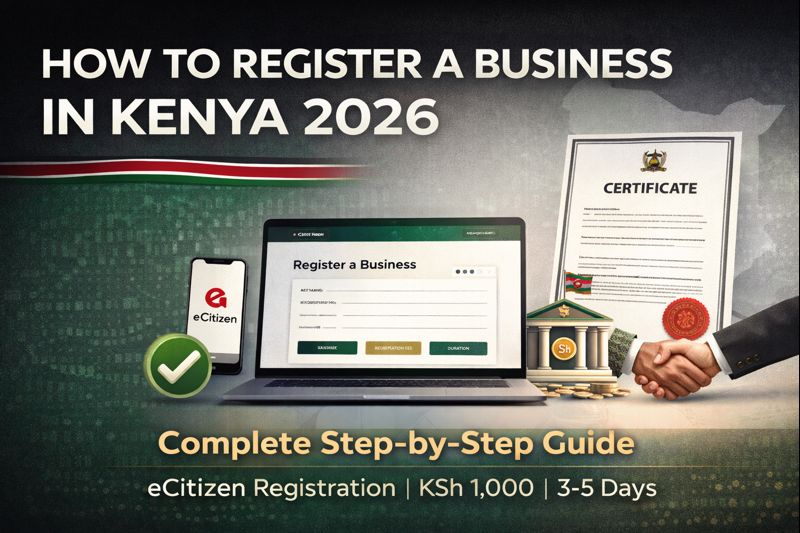
Registering a business in Kenya is faster and cheaper than most people expect. The entire process now runs through the Business Registration Service (BRS) on eCitizen, costs as little as KES 950 for a sole proprietorship, and can be completed from your phone in under an hour, with your certificate ready in 3-7 days.
This guide covers exactly what you need: the current BRS process step by step, real 2026 costs, which business structure fits your situation, the permits you need after registering, and the mistakes that trip up most first-time applicants.
Time to complete: 30-60 minutes | Cost: KES 950 – KES 15,000+ (depending on structure) | Processing time: 3-7 days
Quick Overview: 4 Ways to Register a Business in Kenya
| Structure | Best For | Cost | Time | Liability |
|---|---|---|---|---|
| Sole Proprietorship | Solo entrepreneurs, side hustles, freelancers | KES 950 | 3-5 days | Unlimited — personal assets at risk |
| Partnership | 2+ people starting together | ~KES 950 + deed | 5-7 days | Unlimited (unless LLP) |
| Private Limited Company | Serious businesses, investors, growth plans | ~KES 10,650 | 7-14 days | Limited — personal assets protected |
| Limited Liability Partnership | Professional services (law, accounting) | KES 15,000+ | 7-14 days | Limited |
Most common choice: roughly 80% of small Kenyan businesses start as a sole proprietorship, since it’s the cheapest and fastest option, with the ability to convert to a limited company later as you grow.
Step 1: Choose Your Business Structure
Sole Proprietorship (Business Name) — you and the business are legally the same entity.
- ✅ Cheapest, fastest, simplest paperwork, you keep all profits
- ❌ Unlimited liability, harder to secure bank loans, not transferable, less credible for large contracts
- Best for: freelancers, small shops, service providers, side hustles testing an idea
Partnership — 2-20 people running the business together.
- ✅ Shared startup costs, combined skills, more available capital
- ❌ Unlimited liability (you’re responsible for your partners’ actions too), requires a formal partnership agreement
- Best for: friends or family starting together, complementary-skill teams, professional services
Private Limited Company (Ltd) — a separate legal entity from its owners.
- ✅ Limited liability, easier to raise investment, banks lend more readily, transferable, can sell shares
- ❌ More expensive, more paperwork (annual returns), less privacy — company details are public
- Best for: businesses seeking investment, higher-risk ventures, anyone planning to hire and scale
Limited Liability Partnership (LLP) — a hybrid: partnership flexibility with liability protection.
- ✅ Limited liability, flexible management, no minimum capital requirement
- ❌ Most expensive to register, more complex regulations
- Best for: professional service firms (lawyers, accountants, architects)
Rule of thumb: most first-time entrepreneurs should start with a sole proprietorship and convert to a limited company later once the business has real traction.
Step 2: Choose and Reserve Your Business Name
Under the current BRS process, name reservation and registration have been merged into a single step — you submit your top three preferred names together with your full application, rather than reserving a name separately beforehand.
Naming rules:
- Must be unique and not already registered
- Can include your own name, describe what you do, or be creative
- Cannot suggest government affiliation, be offensive, or imply illegal activity
Before applying, it’s still worth doing a free preliminary check so you don’t waste your three submission slots on unavailable names:
- Search directly at search.ecitizen.go.ke, or
- Visit any Huduma Centre and ask staff to check availability
Naming tips: keep it short and memorable, make it easy to spell, hint at what you do, and check that a matching domain or social handle is available. Have your three names ready before you start the application, since BRS asks for all three upfront.
Step 3: Gather Your Required Documents
Sole Proprietorship: National ID copy, KRA PIN certificate, passport-style photo.
Partnership: National IDs and KRA PINs for all partners, passport photos, and a partnership deed (optional but strongly recommended).
Limited Company: Directors’ IDs and KRA PINs (minimum 1 director), shareholder details, a physical company address (a P.O. Box alone isn’t accepted), passport photos for all directors/shareholders, and a Memorandum & Articles of Association (a template is available on BRS).
Step 4: Register Through BRS on eCitizen
Create your eCitizen account at ecitizen.go.ke if you don’t already have one — registration takes your name, ID number, email, and phone number, followed by email verification.
For a Sole Proprietorship:
- Log in and navigate to Business Registration Service (BRS) under “All Services”
- Select Business Name Registration
- Submit your top three preferred names together
- Fill in your business details (nature of business, physical and postal address, county) and your own details as proprietor
- Upload your National ID, KRA PIN certificate, and passport photo
- Review and submit — you’ll receive an invoice
- Pay KES 950 via M-Pesa (Paybill 222222, using your invoice number as the account number), bank transfer, card, or at a Huduma Centre
- Wait 3-5 working days for processing; you’ll be notified by SMS
- Log back in and download your Business Registration Certificate
For a Private Limited Company:
- Log in and select Company Registration under BRS
- Choose “Private Company Limited by Shares” and submit your top three proposed names (must end in “Limited” or “Ltd”)
- Fill in company details: physical address, main business activity, and share capital (you can start with as little as KES 100)
- Enter director and shareholder details (minimum 1 of each, can be the same person), including ID, KRA PIN, and shareholding
- Upload director/shareholder IDs, KRA PINs, passport photos, and your Memorandum & Articles of Association
- Review and submit, then pay approximately KES 10,650 (covers name registration and incorporation for nominal share capital up to KES 100,000 — higher share capital increases stamp duty)
- Wait 7-14 working days for your Certificate of Incorporation, CR12, and Memorandum & Articles of Association
Step 5: Register for Your KRA PIN
Every business owner needs a KRA PIN for tax purposes — this is free and can be done instantly online.
- Go to itax.kra.go.ke and select “New PIN Registration”
- Choose “Individual PIN” and fill in your details (name, ID, date of birth, contact details)
- Upload your ID copy and submit
- Download your PIN certificate immediately — it’s issued instantly online
You can also visit any KRA office in person and get your PIN certificate the same day.
Step 6: Get Your Business Permits and Licenses
Single Business Permit (mandatory for everyone): this county-level license lets you legally operate. Costs typically range from KES 5,000 for small businesses to KES 50,000+ for larger operations, varying by county and business type. Apply through eCitizen (select your county → Single Business Permit) or at your county revenue office, uploading your business certificate, ID, KRA PIN, and — if applicable — a lease agreement and public health certificate.
Important: you need this permit before opening your doors. Operating without it risks fines and closure.
Industry-specific licenses, where they apply:
| Business Type | License Needed | Issued By |
|---|---|---|
| Food businesses | Public Health License | County Health Department |
| Bars, liquor stores | Liquor License | Kenya Wine Agencies Limited (KWAL) |
| Tour operators | Tourism License | Tourism Regulatory Authority |
| Clinics, pharmacies | Health License | Kenya Medical Practitioners & Dentists Board |
| Driving schools | Driving School License | NTSA |
| Construction | NCA Registration | National Construction Authority |
| Security companies | Security License | Private Security Regulatory Authority |
If you have employees, you must also register with NSSF (National Social Security Fund) and NHIF/SHA for statutory contributions.
Step 7: Open a Business Bank Account
Keep business and personal money separate from day one. You’ll typically need your business registration certificate, Single Business Permit, National ID, KRA PIN certificate, and proof of your physical address.
| Bank | Approx. Monthly Fee | Why Consider It |
|---|---|---|
| Equity Bank | KES 300–500 | Strong mobile banking, wide branch network |
| KCB Bank | KES 400–600 | Business-friendly, good loan options |
| Co-operative Bank | KES 300–500 | Strong fit for SACCO members |
| NCBA Bank | KES 500 | Solid digital banking features |
| Absa Kenya | KES 400 | Easy international transactions |
How Much Does It Actually Cost? (2026 Breakdown)
Sole Proprietorship — total approximately KES 16,950: Business name registration (KES 950) + Single Business Permit (~KES 10,000 average) + Public Health License if applicable (~KES 5,000) + bank account opening (KES 0-1,000). KRA PIN is free.
Limited Company — total approximately KES 26,650+: Company registration (~KES 10,650) + Single Business Permit (~KES 10,000 average) + Public Health License if applicable (~KES 5,000) + bank account (KES 0-1,000). Optional extras: company seal (~KES 3,000), lawyer fees (KES 5,000-20,000).
How Long Does the Whole Process Take?
| Stage | Sole Proprietorship | Limited Company |
|---|---|---|
| Name submission & application | 30-60 minutes | 1-2 hours |
| Certificate issuance | 3-5 days | 7-14 days |
| Business permit | 7-14 days | 7-14 days |
| Bank account opening | Same day | 3-5 days |
| Total | 10-19 days | 17-33 days |
You can work on your business permit and bank account while your certificate is still processing to save time overall.
Common Mistakes to Avoid
- Choosing a name too similar to an existing business — do a thorough search beyond just BRS; check Google and social media too, since a similar existing business can still sue you later.
- Skipping the Single Business Permit — county authorities can close your business and fine you KES 50,000+.
- Operating a food business without a Public Health License — health officers can shut you down on the spot.
- Choosing the wrong structure for your risk level — high-risk ventures (manufacturing, construction) generally warrant a limited company, not a sole proprietorship, regardless of cost.
- Mixing personal and business finances — open a separate business account immediately; it protects you and simplifies your taxes.
- Letting your permit lapse — set an annual renewal reminder; operating on an expired permit is treated as operating illegally.
- Using a P.O. Box as your only address — most licenses and banks require a physical location.
- Not keeping digital copies of every document — save PDFs to cloud storage in case physical certificates are lost.
After You’ve Registered: What Comes Next
- VAT registration is required once turnover exceeds KES 5 million/year — apply via iTax.
- Business insurance is worth considering: public liability, fire and theft, and business interruption cover are common starting points; Employee Compensation (WIBA) cover is mandatory once you have staff.
- Get online: a Google Business Profile listing is free and worth setting up immediately; a simple website and social media presence can follow as budget allows.
- Trademarking your name and logo (via KIPI) is optional but worth considering if you’re building a distinct brand you plan to protect long-term — expect a 12-18 month approval process.
Frequently Asked Questions
Can I register a business without a KRA PIN? No — a KRA PIN is mandatory, but it’s free and issued instantly via iTax, so this shouldn’t hold up your application.
Do I need a lawyer to register a business in Kenya? No. BRS is designed for self-service registration. For sole proprietorships it’s entirely unnecessary; for limited companies with complex shareholding structures, a lawyer can help but isn’t required.
Can I register a business from outside Kenya? Yes. Kenyan diaspora members can register via eCitizen with a valid Kenyan ID, KRA PIN, and a Kenyan phone number for M-Pesa payment, or by using a local agent.
How much capital do I need for a limited company? As little as KES 100 in nominal share capital — most businesses start with KES 100,000 to KES 1,000,000, though this doesn’t need to be paid in immediately.
Can I change my business name after registration? Yes — sole proprietors can register a new name and close the old one; limited companies apply for a formal name change requiring a board resolution, typically taking 2-4 weeks.
Do I need a physical office to register? No — a home address, co-working space, or virtual office all work. A P.O. Box alone is not accepted.
What happens if my application is rejected? Usually due to a name conflict, incomplete documents, or a payment issue. BRS will show the rejection reason — correct it and resubmit.
Do I pay any fees annually after registration? Yes — the Single Business Permit renews annually, and limited companies must file annual returns (around KES 5,000/year) within six months of their financial year-end.
Related Guides
- How to Get Business Funding in Kenya (15 Sources)
- How to Write a Business Plan in Kenya (Free Template)
- Best Business Ideas to Start in Mombasa
This article is for educational purposes only and does not constitute legal or tax advice. Fees and processes are current as of September 2026 but are set by BRS and KRA and may change — confirm current costs directly at brs.go.ke before applying. Have a question about registering your business? Drop it in the comments below.