23 February 2026
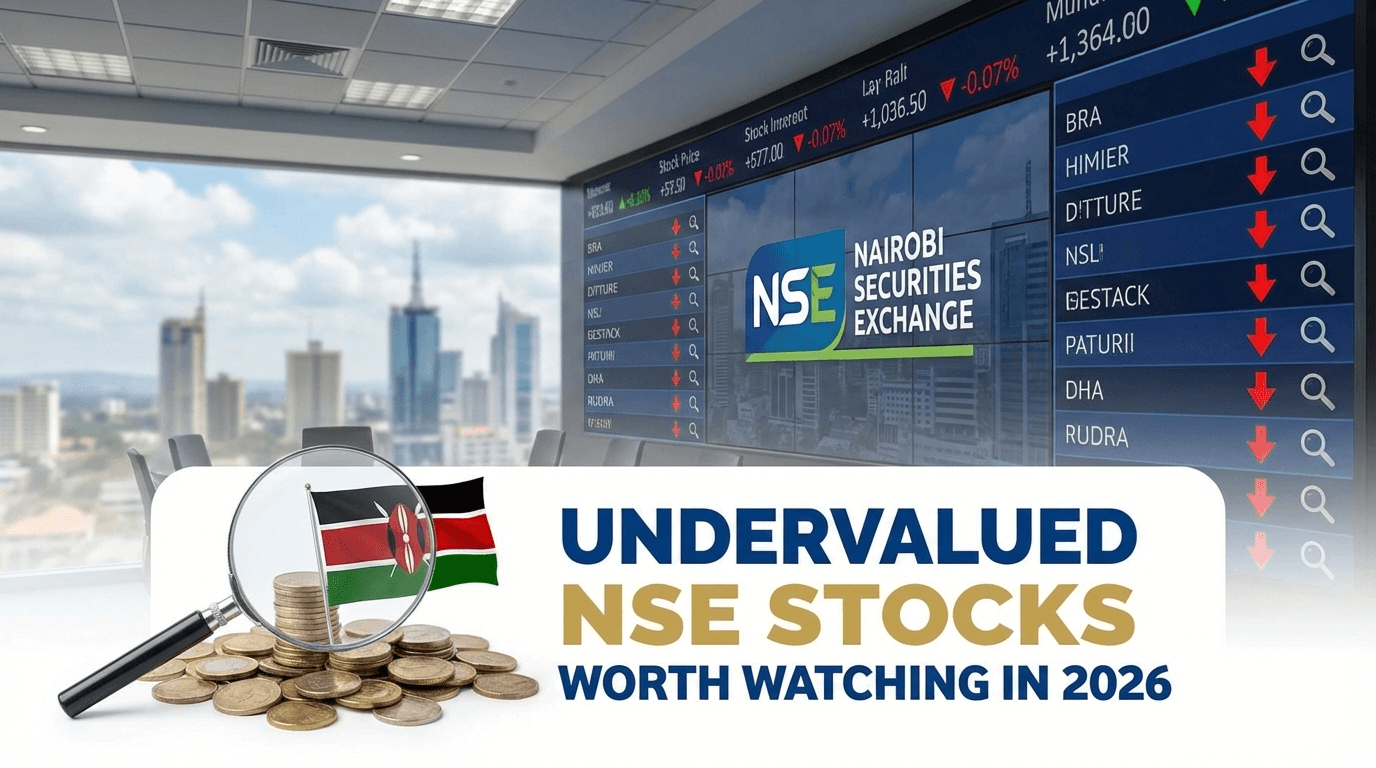
Undervalued NSE Stocks Worth Watching in 2026

While many investors chase the latest hot tip or momentum stock, smart money looks for undervalued NSE stocks in Kenya in 2026—quality companies selling at a discount. So, which NSE stocks are trading below their true value in 2026?
This comprehensive guide explains value investing in plain Kenyan English, shows you how to spot undervalued shares using PE ratios and book value analysis, and identifies the best stocks to buy Kenya NSE 2026 if you’re willing to be patient and think like a business owner rather than a speculator.
Understanding undervalued NSE stocks Kenya 2026 can help you buy quality at bargain prices and achieve superior returns over time.
What Does ‘Undervalued’ Mean?
Let’s start with the basics: what makes a stock undervalued?
The Simple Explanation: Undervalued NSE Stocks
Imagine shopping at a supermarket:
- A product worth Ksh 100
- On sale for Ksh 60
- You’re getting Ksh 100 of value for Ksh 60
- That’s 40% discount!
Undervalued stocks work the same way:
- Company’s true value: Ksh 100 per share
- Current market price: Ksh 60 per share
- You buy Ksh 100 of business for Ksh 60
- Discount: 40%
Why It Matters
Value investing advantage:
Over Time:
- Market recognizes true value
- Price rises from Ksh 60 → Ksh 100
- You profit Ksh 40 per share (67% gain!)
- Plus dividends while waiting
Downside Protection:
- Already cheap (limited downside)
- Large margin of safety
- Less likely to fall further
- Conservative approach
Famous Example: Warren Buffett built fortune buying undervalued companies “Price is what you pay, value is what you get”
How to Spot an Undervalued NSE Stock
Three key metrics help identify undervalued stocks NSE Kenya 2026:
1. Price-to-Earnings (PE) Ratio
What It Is: Share Price ÷ Earnings Per Share = PE Ratio
Example:
- Equity Bank share price: Ksh 47
- Earnings per share: Ksh 10
- PE ratio: 47 ÷ 10 = 4.7x
What It Means:
- You pay Ksh 4.7 for every Ksh 1 of annual earnings
- Lower PE = cheaper stock
- Higher PE = expensive stock
NSE Average PE:
- NSE average: 8-12x
- Below 8x = potentially undervalued
- Above 15x = potentially expensive
Low PE Signals: ✅ Stock may be cheap relative to earnings ✅ Market underestimates company ✅ Good value opportunity
But Beware: ❌ Low PE can mean company in trouble ❌ Earnings may be declining ❌ “Cheap for a reason”
2. Price-to-Book (PB) Ratio
What It Is: Share Price ÷ Book Value Per Share = PB Ratio
Book Value:
- Total assets minus total liabilities
- What company would be worth if liquidated
- Net asset value
Example:
- KCB share price: Ksh 30
- Book value per share: Ksh 40
- PB ratio: 30 ÷ 40 = 0.75x
What It Means:
- Below 1.0x = trading below book value
- You’re buying Ksh 40 of assets for Ksh 30
- Ksh 10 discount per share!
Kenyan Bank Analogy:
- Bank has Ksh 40 in cash, buildings, loans (assets)
- Bank owes Ksh 0 (simplification)
- Book value: Ksh 40
- Market only values it at Ksh 30
- Ksh 10 safety margin
PB Benchmarks:
- Below 1.0x = Potentially undervalued
- 1.0-2.0x = Fair value
- Above 3.0x = Expensive
3. Dividend Yield Relative to Price
What It Is: Annual Dividend ÷ Share Price = Dividend Yield %
Example:
- BAT Kenya dividend: Ksh 26
- Share price: Ksh 280
- Yield: 26 ÷ 280 = 9.3%
High Yield Signals:
Undervaluation:
- Price fell, yield rose
- Market undervalues dividend stream
- Good value if sustainable
Or Distress:
- Dividend about to be cut
- Company struggling
- “Yield trap”
How to Tell Difference: ✅ Check payout ratio (under 60% = sustainable) ✅ Review profit trends (growing = good) ✅ Assess business model (stable = safe)
Important Caveat: Undervalued NSE Stocks ≠ Cheap
Critical distinction for finding best stocks to buy Kenya NSE 2026:
The Value Trap
What It Is:
- Stock looks cheap (low PE, low PB)
- But company is dying
- Price falls forever
- You lose money
Example:
- Company PE: 3x (looks cheap!)
- But: Losing money, declining sales, obsolete business
- Price drops from Ksh 10 → Ksh 5 → Ksh 2 → Ksh 0
- “Cheap” became “worthless”
Undervalued vs Value Trap
True Undervalued Stock: ✅ Good business temporarily out of favor ✅ Strong fundamentals (profit, assets, cash flow) ✅ Fixable problems ✅ Market overreacted to bad news ✅ Price recovers over time
Value Trap: ❌ Dying business ❌ Structural decline ❌ Permanent problems ❌ “Cheap” gets cheaper ❌ Never recovers
How to Avoid Value Traps
Check These:
- Profitability: Is company making money?
- Debt: Manageable or crushing?
- Business Model: Still relevant?
- Competition: Sustainable advantage?
- Management: Competent and honest?
If answers are mostly “yes” → Undervalued If answers are mostly “no” → Value Trap
Our Methodology
How we screened NSE stocks to find these undervalued opportunities:
Data Sources
Information From:
- NSE public filings
- Company annual reports
- Financial statements (2023-2025)
- Market data (December 2025)
Cutoff Date: December 31, 2025
Screening Criteria
Must Meet 3 of 5:
- PE ratio below NSE average (under 8x)
- PB ratio below 1.5x
- Dividend yield above 5%
- Profitable last 3 years
- Trading below 5-year average price
Exclusions:
- Companies losing money 2+ consecutive years
- Debt-to-equity above 200%
- No trading activity (illiquid)
- Regulatory/legal problems
Undervalued NSE Stocks to Watch in 2026
Here are quality companies potentially trading below intrinsic value:
1. Kenya Airways (KQ) — Turnaround Story or Value Trap?
Current Price: ~Ksh 4.50 Market Cap: ~Ksh 2.5 billion
The Undervaluation Case:
Low Valuation:
- Trading near all-time lows
- PB ratio: 0.3x (trading at 30% of book value!)
- Massive asset base (planes, routes, slots)
Turnaround Potential:
- Post-COVID traffic recovering
- International travel rebounding
- Government support (won’t let it fail)
- Regional monopoly on some routes
What You’re Getting:
- Fleet worth billions
- Valuable landing slots
- Regional routes
- Brand recognition
The Value Trap Risk:
Serious Problems: ❌ Massive debt (Ksh 200+ billion) ❌ History of losses (rarely profitable) ❌ Tough competition (Ethiopian Airlines, Emirates) ❌ High operating costs ❌ Management challenges
Our Take:
High Risk, High Reward:
- IF turnaround succeeds: 5-10x potential
- IF continues losing: Could go to zero
- Not for widows and orphans
- Speculative value play
Only if: ✅ You understand airline economics ✅ Can afford to lose entire investment ✅ Have 5-10 year patience ✅ Limit to 5-10% of portfolio
Skip if: ❌ Need safe investment ❌ Can’t afford loss ❌ Short time horizon ❌ Risk-averse
Verdict: Turnaround possible but uncertain. High-risk value play.
2. Jubilee Holdings — Insurance Sector Underappreciated
Current Price: ~Ksh 390 Market Cap: ~Ksh 40 billion PE Ratio: 6.5x Dividend Yield: 5.1%
Why Undervalued:
Low PE:
- 6.5x vs NSE average 10x
- Trading at 35% discount to market
Solid Business:
- Leading insurance company in East Africa
- Diversified: Life, general, medical, pensions
- Operations: Kenya, Uganda, Tanzania, Mauritius, Burundi
- Profitable for decades
Financial Health:
- Consistent profitability
- Strong capital base
- Growing premiums
- Expanding regionally
Why Market Undervalues:
- Insurance “boring” (unsexy sector)
- Low trading volumes (illiquid)
- Not well understood by retail investors
- Overshadowed by banks
Catalyst for Revaluation:
- Digital insurance adoption
- Regional expansion success
- Dividend increase
- Healthcare demand growing
Our Take:
True Undervaluation: ✅ Quality business at fair price ✅ PE 6.5x too low for profitability ✅ 5% dividend while you wait ✅ Long-term hold
Risk Level: Moderate
Expected Return: 10-15% annually (dividend + appreciation)
Best For: Patient value investors seeking steady returns
3. Nation Media Group (NMG) — Digital Pivot Underway
Current Price: ~Ksh 18 Market Cap: ~Ksh 6.5 billion PE Ratio: 7x Dividend Yield: 6.7%
Why Undervalued:
Market Pessimism:
- Media industry declining (print newspapers dying)
- Advertising revenues challenged
- “Dinosaur” perception
But Reality Different:
- Digital transformation succeeding
- Online platforms growing (Nation.africa)
- Diversified: TV (NTV), radio, digital
- Valuable real estate (prime Nairobi land)
Asset Value:
- Prime land worth billions
- Broadcasting licenses (scarce)
- Brand recognition (Nation brand)
- Archives and content library
PB Ratio: 0.8x
- Trading below book value
- Landholdings alone worth more than market cap
- Hidden value in assets
Dividend:
- Still paying 6.7% yield
- Despite challenges
- Cash-generative even in transition
Catalyst for Revaluation:
- Digital revenue overtakes print
- Asset monetization (sell land/buildings)
- Cost-cutting success
- Election years (ad spending spikes)
Our Take:
Asset Play: ✅ Trading below asset value ✅ Digital transformation underway ✅ High dividend while waiting ✅ 2-3 year horizon
Risks:
- Print decline accelerates
- Digital transition fails
- Dividend cut possible
Expected Return: 12-18% if digital pivot succeeds
4. Bamburi Cement — Construction Boom Play
Current Price: ~Ksh 45 Market Cap: ~Ksh 25 billion PE Ratio: 8x PB Ratio: 0.9x
Why Undervalued:
Depressed Pricing:
- Trading near 5-year lows
- PB 0.9x (below book value)
- Market ignoring construction boom
Business Fundamentals:
- Leading cement producer
- Duopoly with Mombasa Cement
- Essential building material
- Pricing power
Infrastructure Boom:
- Government infrastructure projects
- Affordable housing initiative
- Roads, bridges, dams
- Private construction growing
Asset Base:
- Cement plants (expensive to build)
- Limestone quarries (scarce resource)
- Distribution network
- Land holdings
Why Market Undervalues:
- Cyclical industry (falls out of favor)
- Import competition (cement from Uganda, Tanzania)
- Energy cost concerns
- Short-term earnings volatility
Catalyst for Revaluation:
- Infrastructure spend accelerates
- Cement demand spikes
- Import tariffs/barriers
- Energy cost stabilization
Our Take:
Cyclical Value: ✅ Good business at trough pricing ✅ Infrastructure boom tailwind ✅ Asset backing provides floor ✅ 3-5 year hold
Risks:
- Import competition
- Energy prices spike
- Construction slows
Expected Return: 15-20% as cycle turns
5. Liberty Holdings — Financial Sector Discount
Current Price: ~Ksh 8.50 Market Cap: ~Ksh 7.5 billion PB Ratio: 0.7x Dividend Yield: 8.0%
Why Undervalued:
Deep Discount:
- PB 0.7x (buying Ksh 100 of assets for Ksh 70)
- 8% dividend yield (highest among banks)
- Market cap tiny relative to asset base
Business Model:
- Insurance and banking
- Heritage Insurance (motor, general)
- CIC Group association
- Real estate holdings
Financial Position:
- Profitable (though modest margins)
- Strong asset base
- Dividend sustainable (50% payout ratio)
- Well-capitalized
Why So Cheap:
- Small cap (overlooked)
- Illiquid (low trading volumes)
- “Orphan” stock (no institutional sponsorship)
- Merger/restructuring overhang
Catalyst for Revaluation:
- Merger/acquisition at premium
- Dividend increase
- Asset value recognition
- Institutional discovery
Our Take:
Deep Value: ✅ Significant discount to book ✅ High dividend while waiting ✅ Potential takeover target ✅ Patient money wins
Risks:
- Illiquidity (hard to sell large positions)
- Could stay cheap indefinitely
- Business stagnant
Expected Return: 12-16% (mostly from dividends)
Best For: Deep value investors, small positions
6. Standard Chartered Bank Kenya — Blue Chip on Sale
Current Price: ~Ksh 160 Market Cap: ~Ksh 56 billion PE Ratio: 6.8x Dividend Yield: 7.2%
Why Undervalued:
Quality at Discount:
- PE 6.8x (vs KCB 9x, Equity 8x)
- Blue chip bank
- Part of Standard Chartered global
- Cheaper than peers
Business Quality:
- Corporate banking leader
- SME focus
- Digital banking strong
- Excellent governance
Financial Strength:
- Highly profitable
- ROE 18-22% (excellent)
- Low NPL ratio
- Strong capital
Dividend:
- 7.2% yield
- Consistent payer
- Growing payouts
- 40% payout ratio (sustainable)
Why Undervalued:
- Less retail focus (vs Equity/KCB)
- Lower brand visibility among retail
- Smaller branch network
- Foreign ownership (48% StanChart)
Catalyst for Revaluation:
- Retail discovers quality
- Dividend increased
- SME banking success
- Merger/acquisition interest
Our Take:
Blue Chip Value: ✅ Quality bank at fair price ✅ Lower PE than peers unjustified ✅ Strong dividend ✅ Low-risk value play
Expected Return: 12-15% annually
Best For: Conservative value investors wanting banking exposure
7. TPS Eastern Africa (Serena) — Tourism Recovery
Current Price: ~Ksh 14 Market Cap: ~Ksh 6.5 billion PE Ratio: N/A (recovering from losses) PB Ratio: 0.5x
Why Undervalued:
Post-COVID Recovery:
- Tourism rebounding strongly
- Hotels filling up
- Pricing power returning
- Occupancy rates improving
Asset Value:
- Owns prime hotels (Serena chain)
- Nairobi, Mombasa, Amboseli, Mara, etc.
- Land and buildings worth billions
- Trading at 50% of book value
Business Quality:
- Premium brand (Serena)
- Best locations
- Loyal customer base
- Regional presence (Kenya, Uganda, Tanzania)
Why So Cheap:
- COVID devastated sector
- Losses 2020-2021
- Market hasn’t recognized recovery
- Illiquid stock
Recovery Indicators:
- Occupancy: 60-75% (vs 30% in 2020)
- ADR (average daily rate) up 20%
- International tourism roaring back
- Conference business returning
Catalyst for Revaluation:
- Return to profitability (2025-2026)
- Dividend resumption
- Tourism numbers continue growing
- Asset value recognition
Our Take:
Recovery Play: ✅ Asset value provides floor (0.5x PB) ✅ Tourism tailwind strong ✅ 2-3 year turnaround horizon ✅ High upside if successful
Risks:
- Another pandemic (tourism craters)
- Terrorism incidents (affects tourism)
- Competition from Airbnb
Expected Return: 20-30% if recovery continues
8. Car & General — Auto Sector Play
Current Price: ~Ksh 27 Market Cap: ~Ksh 7.2 billion PE Ratio: 7.5x PB Ratio: 1.2x
Why Potentially Undervalued:
Solid Business:
- Auto parts distribution
- Equipment leasing
- Diverse customer base
- Profitable for decades
Market Position:
- Leading auto parts distributor
- Relationships with OEMs
- Regional presence
- Diversified product lines
Financials:
- Consistent profitability
- 6% dividend yield
- Moderate debt
- Growing revenue
Why Undervalued:
- Auto sector overlooked
- Small cap
- Lack of glamour
- Cyclical concerns
Catalyst:
- Auto sales recovery
- Equipment leasing growth
- Dividend increase
- Regional expansion
Our Take:
Steady Eddie: ✅ Boring but profitable ✅ Fair valuation (not screaming cheap) ✅ 6% dividend ✅ Low drama
Risk Level: Low-Moderate
Expected Return: 10-14% annually
Risks of Value Investing on the NSE
Before buying undervalued stocks NSE Kenya 2026, understand the risks:
1. Liquidity Risk
Small-Cap Problem:
- Many undervalued stocks = small caps
- Low daily trading volumes
- Hard to buy large positions
- Even harder to sell
Example:
- Want to buy Ksh 500,000 of Liberty Holdings
- Daily volume: Ksh 100,000
- Takes weeks to buy without moving price
- Selling could tank the price
Mitigation:
- Keep undervalued small caps to 5-10% of portfolio
- Buy slowly over time
- Accept illiquidity
2. Currency Effects
NSE in Kenyan Shillings:
- Shilling volatile vs USD, EUR
- Company may be undervalued in KES terms
- But if shilling collapses, you still lose (in hard currency)
For Kenyans: Less concern (you earn/spend in KES)
For Foreign Investors: Currency risk significant
3. Sector Concentration
NSE Heavily Weighted:
- Banks: 40% of market cap
- Safaricom: 35%
- Remaining sectors: 25%
Finding undervalued stocks often means:
- Small banks
- Insurance
- Manufacturing
- All correlated with Kenya economy
Diversification limited on NSE
4. Value Trap Risk
As discussed:
- “Cheap” can get cheaper
- Some undervalued stocks never recover
- Permanent capital loss possible
Protection:
- Only buy profitable companies
- Avoid dying industries
- Set stop-losses (sell if down 30-40%)
5. Time Horizon
Value Unlocking Takes Time:
- 12-36 months typical
- Sometimes 5+ years
- Patience required
- Opportunity cost
Not for:
- Short-term traders
- Those needing money within 2 years
- Impatient investors
How to Buy These Stocks
Quick guide to purchasing undervalued NSE stocks Kenya 2026:
Step 1: Open CDS Account
Required:
- Central Depository System account
- Holds all your NSE shares
- One-time setup (5-10 days)
Where:
- Any stockbroker
- Investment apps (Hisa, Mali)
- Some banks (NCBA, KCB)
Step 2: Choose Broker
For Small Caps/Undervalued:
- Traditional broker better (can call and discuss)
- Genghis Capital, SBG, NCBA Investment
- Small caps may not be on apps
For Liquid Stocks:
- Investment apps work fine
- Hisa, Mali
- Lower fees
Step 3: Fund Account
Transfer Money:
- Bank transfer to broker
- Or M-Pesa (if app)
- Usually T+1 (money available next day)
Step 4: Place Orders
For Illiquid Stocks:
- Use limit orders (specify price)
- Be patient (may take days to fill)
- Buy in small batches
For Liquid Stocks:
- Market orders work fine
- Executes immediately
Step 5: Monitor and Hold
Value investing = Patience:
- Don’t check daily
- Review quarterly
- Hold 2-5 years minimum
- Rebalance annually
Patience Is the Strategy
Finding best stocks to buy Kenya NSE 2026 requires long-term thinking:
Realistic Timelines
Value Unlocking on Emerging Markets:
Year 1:
- Often: Nothing happens
- Price may even fall more
- You collect dividends
- Frustrating phase
Year 2:
- Market begins noticing
- Price slowly rises
- Dividends continue
- Portfolio green
Year 3:
- Fair value reached (or exceeded)
- Significant gains realized
- Time to consider selling
- Reinvest in new undervalued opportunities
Total: 12-36 months for average value play
Compounding Advantage
Example:
Ksh 100,000 invested in undervalued stock:
- Buy at 40% discount to value
- 6% dividend yield annually
- Fair value reached in 3 years
Returns:
- Year 1: +6% (dividend only, price flat)
- Year 2: +12% (dividend + small price gain)
- Year 3: +54% (dividend + price reaches fair value)
- 3-Year Total: +72%
Annualized: 19.5%
Compare to:
- T-Bills: 15% (45% in 3 years)
- Blue chips: 12% (40% in 3 years)
- Value investing: 19.5% (72% in 3 years)
But requires:
- Buying right (at genuine discount)
- Patience (holding through volatility)
- Conviction (not panic selling)
Conclusion
Undervalued NSE stocks Kenya 2026 offer opportunity for patient, disciplined investors willing to buy quality businesses at discounts. By focusing on low PE ratios, price-to-book values below 1.0x, and high dividend yields, you can identify the best stocks to buy Kenya NSE 2026 trading below intrinsic value.
Our Top Picks:
Lower Risk: ✅ Standard Chartered (blue chip at discount) ✅ Jubilee Holdings (steady insurer) ✅ Car & General (boring but profitable)
Moderate Risk: ✅ Bamburi Cement (cyclical recovery) ✅ Nation Media Group (digital turnaround) ✅ Liberty Holdings (deep value)
Higher Risk: ✅ TPS Serena (tourism recovery) ✅ Kenya Airways (speculative turnaround)
Key Takeaways:
✅ Undervalued ≠ cheap (avoid value traps) ✅ Use PE, PB, dividend yield to screen ✅ Patience required (12-36 months) ✅ Diversify (no single stock over 10%) ✅ Illiquidity acceptable for long-term holders
Next Steps:
- Review financial statements of companies that interest you
- Calculate your own intrinsic value estimates
- Open CDS account if you haven’t
- Start small (5-10% of portfolio in undervalued stocks)
- Build position slowly
- Hold patiently
For comprehensive dividend data on all NSE stocks, see our complete dividend calendar. For comparing undervalued stocks to blue chips, check our blue chip stocks guide.
Remember: The stock market is a voting machine in the short run, but a weighing machine in the long run. Undervalued stocks eventually get weighed—and when they do, patient value investors profit handsomely.
FAQ: Undervalued NSE Stocks
Q: What is the PE ratio of NSE stocks?
Answer:
The average PE ratio of NSE stocks is approximately 8-12x, but it varies significantly by sector and company.
NSE Average by Sector (2026):
Banking:
- Average PE: 7-9x
- Equity Bank: 8.0x
- KCB: 8.5x
- Standard Chartered: 6.8x
Telecoms:
- Safaricom: 10-12x
- Higher due to M-Pesa growth story
Consumer Goods:
- EABL: 12-15x
- BAT: 10-12x
- Premium valuations for defensive businesses
Insurance:
- Jubilee: 6-7x
- Britam: 5-6x
- Undervalued sector generally
Manufacturing:
- Bamburi: 7-9x
- Various (5-10x)
Overall NSE Index PE:
- NASI (All-Share Index): ~9x
- NSE 20: ~10x
- NSE 25: ~9.5x
What Different PEs Mean:
PE under 6x:
- Very cheap (possibly distressed)
- Value trap risk
- Or genuine deep value
PE 6-10x:
- Fair to attractive valuation
- Most NSE banks/insurance
- Good hunting ground for value
PE 10-15x:
- Market average to slightly expensive
- Defensive/quality businesses
- Reasonable for steady growers
PE above 15x:
- Expensive (by NSE standards)
- Better be high growth to justify
- Often speculative
Comparing to Other Markets:
US S&P 500: PE ~20x (much higher!) UK FTSE: PE ~12-15x South Africa JSE: PE ~10-12x NSE: PE ~9x (cheap globally!)
Why NSE PEs Lower:
- Emerging market discount
- Higher perceived risk
- Less liquidity
- Currency volatility
What’s a “Good” PE on NSE:
Depends on:
- Company quality (Safaricom can trade 12x, others can’t)
- Growth rate (faster growth = higher PE justified)
- Sector (banks lower, consumer higher)
- Profitability stability
General Rules:
Below 8x: Investigate for value (or trap) 8-12x: Fair value range for most NSE stocks Above 12x: Premium valuation (needs justification)
How to Use PE Ratios:
Compare to:
- NSE average (9x)
- Sector average
- Company’s own history
- Peers
Example:
Standard Chartered PE: 6.8x
- NSE average: 9x
- Banking average: 8x
- StanChart historical: 8-10x
Conclusion: Trading at discount!
Cautions:
❌ PE not useful for loss-making companies (negative PE) ❌ One-time items can distort (use normalized earnings) ❌ High PE sometimes justified (high growth) ❌ Low PE sometimes deserved (dying business)
Bottom Line: NSE average PE is 8-12x. Below 8x warrants investigation for undervaluation. Above 12x needs strong growth justification.
Q: How do I find undervalued stocks in Kenya?
Answer:
Finding undervalued stocks in Kenya requires screening NSE companies using valuation metrics and fundamental analysis.
Step-by-Step Process:
Step 1: Screen by Valuation Metrics
Use These Filters:
PE Ratio:
- Below 8x (NSE average is 9x)
- Profitable companies only
PB Ratio:
- Below 1.5x
- Below 1.0x is deeply undervalued
Dividend Yield:
- Above 5% (NSE average 4-5%)
- Check payout ratio under 70%
Where to Screen:
- NSE website (nse.co.ke) – Lists all stocks with basic data
- Business Daily newspaper – Weekly valuations
- Broker research reports – If you have account
- Yahoo Finance Kenya – Free screening tool
Step 2: Narrow by Quality
Check Fundamentals:
Profitability: ✅ Profitable last 3 years ✅ Positive cash flow ✅ Growing or stable revenue
Debt: ✅ Debt-to-equity under 150% ✅ Can service debt comfortably ✅ Not overleveraged
Business Model: ✅ Understandable business ✅ Still relevant (not obsolete) ✅ Competitive advantage
Where to Check:
- Annual reports (company investor relations)
- NSE filings
- Broker research
Step 3: Read Financial Statements
Focus On:
Income Statement:
- Revenue trend (growing?)
- Profit margins (improving?)
- Earnings per share (increasing?)
Balance Sheet:
- Assets vs liabilities
- Book value per share
- Cash position
Cash Flow Statement:
- Operating cash flow (positive?)
- Free cash flow (generating?)
- Capex requirements
Where to Find:
- Company websites (Investor Relations section)
- NSE website (Listed companies → Select company → Financials)
Step 4: Calculate Intrinsic Value
Simple Method:
For Banks:
- Fair PB: 1.0-1.5x
- If trading below → undervalued
For Consumer Goods:
- Fair PE: 10-12x
- If trading below → undervalued
For Industrials:
- Fair PE: 8-10x + asset value
- Compare to current price
Step 5: Compare to Peers
Relative Valuation:
Example: Standard Chartered vs KCB vs Equity
- StanChart PE: 6.8x
- KCB PE: 8.5x
- Equity PE: 8.0x
Conclusion: StanChart cheapest, investigate why!
Step 6: Identify Catalyst
What Could Unlock Value:
- Earnings recovery
- New management
- Asset sale
- Dividend increase
- Merger/acquisition
- Sector tailwind
Without catalyst: Stock may stay cheap indefinitely
Step 7: Monitor News and Sentiment
Why Undervalued:
- Bad news (temporary problem?)
- Sector out of favor
- Market overreaction
- Overlooked (small cap)
Free Resources:
Websites:
- nse.co.ke (official NSE)
- businessdailyafrica.com (news + valuations)
- African Markets (data provider)
Apps:
- Hisa app (shows PE, yields)
- Mali app (valuation data)
Newspapers:
- Business Daily (Monday – Weekly NSE valuations)
- Nation Business (stock analysis)
Example Screening:
Goal: Find undervalued bank
Step 1: List all NSE banks
- KCB, Equity, Co-op, StanChart, I&M, DTB, NCBA, etc.
Step 2: Check PEs
- StanChart: 6.8x ✅
- I&M: 7.2x ✅
- KCB: 8.5x
- Equity: 8.0x
Step 3: Check PBs
- StanChart: 1.1x ✅
- I&M: 0.9x ✅ (below 1!)
Step 4: Check profitability
- Both profitable last 3 years ✅
Step 5: Compare yields
- StanChart: 7.2%
- I&M: 6.8%
Conclusion: StanChart and I&M both undervalued, investigate further!
Common Mistakes:
❌ Buying cheap junk (value trap) ❌ Ignoring business quality ❌ Not reading financials ❌ Chasing lowest PE blindly ❌ Forgetting liquidity risk
Best Practices:
✅ Screen quantitatively (metrics) ✅ Research qualitatively (business quality) ✅ Calculate intrinsic value ✅ Buy with margin of safety (20-40% discount) ✅ Diversify (5-8 undervalued stocks) ✅ Be patient (12-36 months)
Bottom Line: Finding undervalued stocks requires combining quantitative screening (PE, PB, yield) with qualitative research (reading financial statements, understanding business). Start with NSE website data, screen by metrics, then deep-dive on companies that pass filters.
Q: Is value investing safe in Kenya?
Answer:
Value investing in Kenya is safer than speculation but NOT risk-free. It requires careful stock selection, diversification, and patience to work.
Safety Compared to Other Strategies:
Value Investing vs Other Approaches:
| Strategy | Risk Level | Safety Features | Downsides |
|---|---|---|---|
| Value Investing | Moderate | Margin of safety, asset backing | Illiquidity, slow gains |
| Growth Investing | High | High upside potential | Volatile, expensive valuations |
| Momentum Trading | Very High | Can profit quickly | Timing risk, often loses |
| Blue Chip Dividend | Low-Moderate | Quality companies, income | Lower returns, still fluctuates |
| Small Cap Speculation | Extreme | Massive upside if right | Most lose money |
Value investing is SAFER than growth/momentum but RISKIER than bonds/MMF.
What Makes Value Investing Relatively Safe:
1. Margin of Safety
Concept:
- Buy at 40% discount to value
- Stock can fall 20% and you’re still OK
- Downside limited by asset value
Example:
- Company book value: Ksh 100/share
- Buy at: Ksh 60 (40% discount)
- Even if market panics and drops 20%:
- New price: Ksh 48
- Still only 12% loss (vs 20% if bought at fair value)
2. Asset Backing
Protection:
- Undervalued stocks often have hard assets
- Banks: Loans, buildings
- Manufacturers: Factories, land
- Hotels: Prime real estate
Downside Floor:
- Assets provide minimum value
- Liquidation value sets floor
- Can’t go to zero if assets valuable
3. Mean Reversion
Tendency:
- Cheap stocks tend to rise
- Expensive stocks tend to fall
- Market corrects overreactions
History:
- Value outperforms over long periods
- Not every year, but decade+
- Proven globally
What Makes Value Investing Risky in Kenya:
1. Value Traps
Real Danger:
- “Cheap” can get cheaper
- Dying businesses never recover
- Permanent capital loss
Examples:
- Uchumi (went to zero)
- Mumias Sugar (collapsed)
- Some media companies
Protection:
- Only buy profitable companies
- Avoid dying industries
- Diversify (10+ stocks minimum)
2. Illiquidity Risk
NSE Problem:
- Many undervalued stocks are small caps
- Low trading volumes
- Hard to sell quickly
- Prices can gap down
Example:
- Need to sell Ksh 500,000 of small cap
- Daily volume: Ksh 100,000
- Selling crashes price 20-30%
- Liquidity trap
Protection:
- Keep small caps to 10-20% of portfolio
- Only invest money you won’t need 3+ years
- Accept illiquidity
3. Time Risk
Patience Required:
- Value unlocking takes 12-36 months
- Sometimes 5+ years
- Opportunity cost high
Risk:
- Money tied up long time
- Could have earned more in T-Bills
- Impatience leads to selling too early
4. Kenya-Specific Risks
Country Risks:
- Political instability (elections)
- Currency volatility (shilling)
- Economic shocks
- Regulatory changes
Sector Concentration:
- NSE dominated by banks
- Bank undervaluation common
- But all banks correlated
- Limited diversification
How to Make Value Investing Safer:
1. Diversify Heavily
- 10-15 undervalued stocks minimum
- Across sectors (banks, consumer, industrial)
- Mix large and small caps
- Reduces single-stock risk
2. Quality Screening
- Only profitable companies (3+ years)
- Manageable debt (under 150% equity)
- Understandable businesses
- Competitive advantages
3. Deep Research
- Read annual reports
- Understand why cheap
- Check management quality
- Verify catalyst exists
4. Position Sizing
- No stock over 10% of portfolio
- High-risk value plays: Max 5%
- Total value portfolio: Max 30-40% of net worth
5. Time Horizon
- 3-5 year minimum
- Don’t need money short-term
- Can withstand volatility
6. Margin of Safety
- Buy at 30-50% discount minimum
- Not just 10-15% cheap
- Bigger discount = more protection
7. Sell Discipline
- Set stop-loss (down 30-40%)
- Take profits when reaches fair value
- Don’t marry positions
Safety Verdict:
Value Investing in Kenya:
Safer Than: ✅ Forex trading (90% lose) ✅ Crypto speculation (extreme volatility) ✅ Penny stocks (pump and dump) ✅ Hot tips (usually disasters) ✅ Margin trading (can lose more than invested)
Riskier Than: ❌ Government bonds (near-zero risk) ❌ Money Market Funds (very stable) ❌ Blue chip dividends (quality companies) ❌ Bank fixed deposits (KDIC insured)
About As Risky As:
- Diversified blue chip portfolio
- Real estate investing
- Small business ownership
Expected Outcomes:
With Proper Discipline:
- 60-70% of picks work out (gain 15-30%)
- 20-30% break even or small loss
- 10% disasters (lose 30-50%)
- Net: 12-18% annual returns long-term
Without Discipline:
- 30% picks work
- 30% break even
- 40% disasters
- Net: 0-5% returns or losses
Bottom Line:
Value investing in Kenya is moderately safe IF you: ✅ Research thoroughly (avoid value traps) ✅ Diversify heavily (10+ stocks) ✅ Buy at significant discounts (30-50%) ✅ Have patience (3-5 years) ✅ Size positions appropriately (max 10% each)
It’s NOT safe if you: ❌ Buy blindly based on low PE alone ❌ Concentrate in 1-2 stocks ❌ Use money needed short-term ❌ Panic sell during volatility ❌ Ignore business quality
For most Kenyans, a balanced approach works best:
- 50% blue chip dividends (safety + income)
- 30% value stocks (higher returns)
- 20% bonds/MMF (stability)
This combines safety of dividends with upside of value investing while maintaining liquidity and diversification.
Also Read:
· best stocks to buy Kenya NSE 2026
· top performing stocks NSE Kenya 2026