KQ Shares 2026: Should You Buy Kenya Airways Stock? Honest Analysis

29 January 2026

KQ Shares 2026: Should You Buy Kenya Airways Stock? Honest Analysis

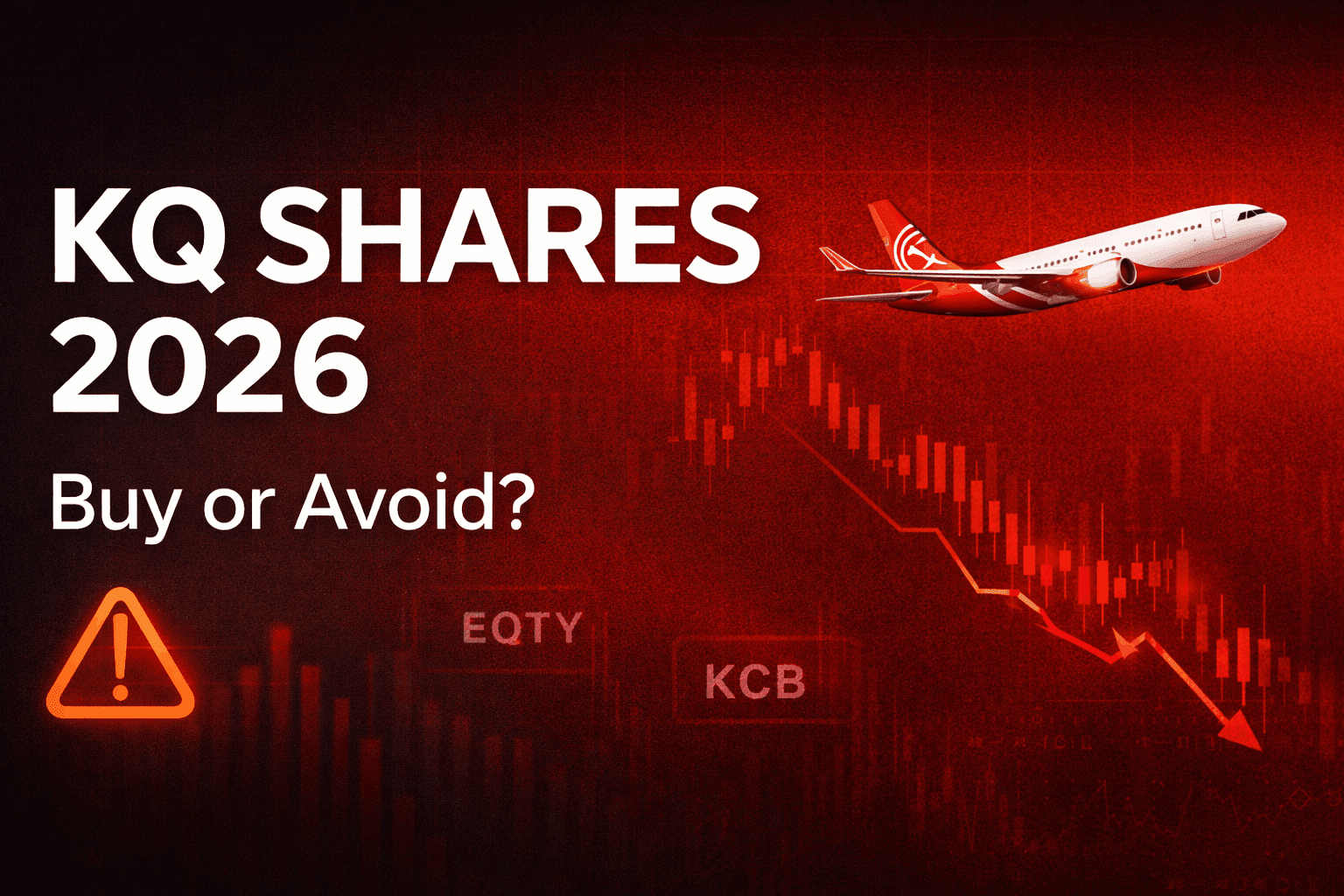
KQ Shares 2026

KQ shares have been one of the most talked-about stocks on the NSE in early 2026. Kenya Airways began the year with a share price of KES 3.53 and has since gained 53% year-to-date, ranking fifth on the NSE in terms of year-to-date performance. That kind of rally gets attention. New investors see the gain, see the low price, and ask the obvious question: is this the turnaround story Kenya has been waiting for?

This guide gives you the honest answer — updated with March 2026 data, no emotion, and no hype.

Before you read further: KQ is a highly speculative investment. You could lose 50–100% of your money. If you are not comfortable with that risk, our Best Kenyan Stocks 2026 guide covers ten NSE stocks with far better fundamentals.


KQ Shares — Current Data at a Glance

Metric Value
Current share price (Mar 2026) KES 5.40–5.48
Price January 1, 2026 KES 3.53
Year-to-date gain +53%
52-week performance -4.49%
Total debt KES 159.92 billion
Cash on hand KES 4.23 billion
Net cash position -KES 155.68 billion
Last 12 months revenue KES 171.51 billion
Last 12 months net income -KES 7.16 billion (loss)
Last dividend paid 2010 — none since
Market capitalisation ~KES 31 billion
My rating AVOID (1/5)

KQ is the fifth most traded stock on the NSE over the past three months, with 134 million shares traded in 25,586 deals valued at KES 718 million. High trading volume combined with a 53% YTD gain has attracted significant retail investor interest. Whether that interest is justified is a different question entirely.


What Kenya Airways Actually Does

Kenya Airways operates domestic flights and flies to around 60 destinations in Africa, the Middle East, Asia, and Europe. It has around 50 aircraft, either owned or on operating leases — around seven Boeing 777 wide body jets, six Boeing 787s, five Boeing 767 wide body jets, 14 Boeing 737 narrow body jets, 18 Embraer regional jets, and two Boeing 737 freighters.

Kenya Airways is Kenya’s national flag carrier and a member of the SkyTeam global airline alliance. The government owns approximately 49% with the remaining 51% held by public shareholders on the NSE.

The company is currently in a turnaround phase focusing on cost management, operational efficiency, and productivity of human resources. That phrase — “turnaround phase” — has appeared in KQ communications for over a decade. Execution is what matters, not the language.


The Financial Reality — Why the Numbers Are Alarming

A Decade of Losses

KQ has not reported a profitable full year since 2012. Despite revenue recovering from COVID lows, the structural profitability problem persists.

In the last 12 months, Kenya Airways had revenue of KES 171.51 billion and -7.16 billion in losses. Gross margin is 17.71%, with operating and profit margins of 1.40% and -4.17% respectively.

This is the core problem. Revenue of KES 171 billion — a strong number for a regional African carrier — still produces a net loss of KES 7 billion. The business earns but cannot keep.

KQ net income for the last half-year is -KES 12.15 billion, while the previous report showed KES 4.96 billion of net income.  That swing — from a KES 4.96 billion profit in one half-year to a KES 12.15 billion loss in the next — illustrates how volatile and unpredictable KQ’s earnings are. One good half-year followed by a significantly worse one is not a turnaround. It is noise.

The Debt Problem

The company has KES 4.23 billion in cash and KES 159.92 billion in debt, with a net cash position of -KES 155.68 billion or -KES 27.40 per share.

Read that last figure carefully. The net debt per share is KES 27.40 — five times the current share price of KES 5.40.Every share you buy at KES 5.40 represents ownership in a company carrying KES 27.40 in net debt per share. You are not buying a KES 5.40 asset. You are buying a KES 5.40 stake in an entity with KES 27.40 of liabilities attached to it.

The debt breakdown:

  • Aircraft leases: the largest component
  • Bank loans
  • Government loans
  • Supplier obligations

In the last 12 months, operating cash flow was KES 17.53 billion and capital expenditures KES 7.79 billion, giving a free cash flow of KES 9.74 billion. The positive free cash flow is the one genuinely encouraging number — it means KQ is generating enough operating cash to cover capex. But at KES 9.74 billion of annual free cash flow against KES 159.92 billion in debt, paying down that debt would take over 16 years at current rates — without spending a shilling on anything else.


Why the 53% YTD Rally Has Happened — And What It Means

KQ’s 53% gain from January to March 2026 is real but requires context.

The starting price was KES 3.53 — a historically depressed level reflecting the debt burden and chronic losses. A recovery from extreme lows on news-driven sentiment is not the same as a fundamentally justified re-rating.

KQ closed its last trading day at KES 5.40, recording a 10% gain over its previous closing price of KES 4.91. Single-session gains of 10% on a national airline stock reflect speculative momentum, not institutional conviction based on improved fundamentals.

What has actually changed in 2026 to justify a higher price?

The next earnings announcement is estimated for March 26, 2026. Until those results confirm a genuine improvement in profitability and debt reduction, the rally is built on hope rather than verified financial progress.


The Bull Case — Arguments for Buying KQ

To be fair, here are the genuine arguments that KQ buyers are making.

“Too big to fail” KQ is Kenya’s national carrier and a symbol of national connectivity. The government has bailed it out repeatedly and will likely continue. This prevents outright bankruptcy.

The problem: Every bailout dilutes shareholders. The government already owns 49%. More bailouts mean more shares issued to the government, which means your ownership percentage shrinks. Bailout survival is not the same as shareholder value creation.

“53% gain proves momentum” The stock has performed strongly year-to-date. Momentum is real and can continue in the short term.

The problem: Momentum without fundamental support reverses. KQ has rallied before — to KES 4.80 in its 52-week high — before falling back. The debt and loss structure has not changed.

“Aviation recovery” Global air travel demand has recovered fully from COVID. KQ now flies to around 60 destinations. Revenue at KES 171 billion is strong.

The problem: Revenue recovery without profit recovery is not a turnaround. Ethiopian Airlines is profitable. Qatar Airways is profitable. KQ lost KES 7 billion on KES 171 billion of revenue. The problem is not demand — it is cost structure and debt service.

“Pure speculation — lottery ticket mentality” Risk KES 5,000–10,000. If a privatisation deal or strategic investor appears, the stock could 3x–5x. Treat it like a lottery ticket.

This is the only argument I partially accept — but only if you genuinely can afford to lose every shilling invested and you treat it as speculation explicitly, not investing.


The Bear Case — Why I Recommend Avoiding KQ

Chronic losses despite revenue recovery. KES 7 billion net loss on KES 171 billion revenue in a year when global aviation was healthy. This is not a temporary problem.

Debt is 5x the share price. Net debt per share of KES 27.40 against a share price of KES 5.40 means equity holders own very little real value. In liquidation, aircraft lessors, banks, and the government get paid first. Minority shareholders get what remains — historically nothing.

No dividend since 2010. KQ doesn’t pay any dividends to its shareholders. Your only return mechanism is share price appreciation. But share price appreciation requires either profitability or a strategic buyer — neither of which is confirmed.

Profitable competitors make the choice obvious. Ethiopian Airlines is profitable, growing, and expanding aggressively across Africa. If you want African aviation exposure, why choose the loss-making carrier over the profitable one?

Dilution history. Share count has increased significantly through multiple government bailout share issuances. Each new issuance dilutes existing shareholders. The 5.68 billion shares currently outstanding represent years of accumulated dilution.


KQ Share Price Scenarios — What Could Realistically Happen

Scenario 1 — Stock consolidates at KES 4–6 (most likely) The debt problem persists. Revenues grow slowly. No strategic investor materialises. Stock drifts in the KES 4–6 range with occasional spikes on positive news before returning to the mean. Shareholders earn nothing meaningful. Probability: 45–50%.

Scenario 2 — Strategic investor or privatisation (upside scenario) An airline like Ethiopian, Emirates, or Qatar takes a meaningful stake. Debt restructuring occurs. Share price could reach KES 10–15. Probability: 10–15%. Timeline: 3–5 years minimum.

Scenario 3 — Continued deterioration (downside scenario) Losses continue, government support weakens, or a global aviation shock hits. Share price returns to KES 2–3. Total loss from current price: 44–63%. Probability: 30–35%.

Scenario 4 — Bankruptcy (tail risk) Government unable or unwilling to continue bailouts. Creditors force restructuring. Equity holders wiped out entirely. Probability: 10–15% over five years.

Expected value calculation: Weighted across scenarios, the expected return is approximately -5% to -15% annually, with high variance. There are far better risk-adjusted opportunities on the NSE.


If You Absolutely Must Buy KQ — Five Hard Rules

If you are buying regardless of this analysis, these rules limit your damage:

Rule 1 — Maximum 1–2% of your portfolio. On a KES 500,000 portfolio, that is KES 5,000–10,000. Never more. This is the maximum you can afford to lose entirely.

Rule 2 — Set a loss limit of 40–50%. If KQ drops from KES 5.40 to KES 3.00, sell. Do not average down. Accept the loss and protect your remaining capital.

Rule 3 — Set a profit target and sell when you reach it. If the stock reaches KES 8–10, sell at least half. Do not hold waiting for KES 14. Take profit when it appears.

Rule 4 — Read every quarterly result. The next one is March 26, 2026. Watch debt levels. If net debt is rising rather than falling, exit immediately.

Rule 5 — Watch the March 26 results before adding any position. The current rally may reverse sharply on disappointing results. Wait to see the actual numbers before committing new capital.


Better Alternatives — Where the Same Money Works Harder

If the KQ story appeals because you want NSE exposure at a low price, these alternatives offer far better risk-adjusted returns.

For income: KCB Group at KES 76 currently yields approximately 9.2% from its record KES 7.00 dividend — paid to your bank account twice per year with zero effort. KQ has paid nothing since 2010. See our KCB dividend 2026 guide.

For the lowest entry price on the NSE: KenGen trades at approximately KES 5.50 — similar to KQ — but with a 13.3% dividend yield and government-backed energy infrastructure. Same price point, completely different financial profile.

For growth: Equity Group has grown its dividend 70% in four years, operates across six East African countries profitably, and has 40% payout ratio leaving room for further increases. See our Equity Bank dividend 2026 guide.

For the complete picture: Our Top NSE Dividend Stocks Kenya 2026 guide ranks every major NSE stock by yield, payout ratio, and dividend safety — so you can see exactly where KQ sits relative to every alternative.


What Would Change My View on KQ

I would genuinely reconsider my AVOID rating if:

✅ March 26 results show a profitable half-year with improving margins ✅ Debt falls meaningfully — net debt below KES 120 billion ✅ A credible strategic investor takes a stake ✅ Two consecutive profitable quarters confirmed ✅ Government announces genuine privatisation timeline

Until one or more of these happens, the speculative rally does not reflect improved fundamentals.


FAQ

Is KQ a good investment in 2026? At current prices after a 53% YTD rally, KQ is a speculative momentum trade at best. The underlying financials — KES 7 billion net loss, KES 159 billion debt, no dividend since 2010 — have not improved enough to justify the price movement. Better opportunities exist across the NSE.

Should I buy KQ shares now that they have rallied 53%? The rally has already happened. Buying at KES 5.40 after a 53% gain from the year’s low means you are paying a significantly higher price without confirmed improvement in fundamentals. The March 26 earnings announcement is the next major catalyst — wait for those results before making any decision.

Will KQ pay a dividend in 2026? No. KQ cannot pay dividends while recording net losses. Until KQ returns to sustained profitability and reduces its debt burden, dividend payments are not possible.

What happens to my KQ shares if the company goes bankrupt? In bankruptcy, payment priority is: aircraft lessors first, banks and suppliers second, government last, minority shareholders after everyone else — which historically means nothing. Your shares would be worth zero.

Is KQ better than Safaricom or Equity Bank? No on every metric — profitability, debt, dividends, growth trajectory. Safaricom and Equity Bank both pay growing dividends, are consistently profitable, and carry manageable debt. KQ loses money and has not paid a dividend in 15 years.


The Finance Perspective — What Serious NSE Investors Do Instead

The investors building real wealth on the NSE are not speculating on turnaround stories. They are collecting dividends from profitable, well-run companies and compounding those dividends back into more shares.

KES 10,000 invested in KQ in 2014 at IPO price is worth approximately KES 3,850 today — a 61% loss. The same KES 10,000 invested in Safaricom in 2014 has grown significantly with dividends reinvested throughout.

This is the opportunity cost of speculative investing versus dividend investing. Every year spent holding KQ hoping for a turnaround is a year your capital is not compounding in a profitable business.

Where that KES 10,000 works harder:

A money market fund at 12% annually turns KES 10,000 into KES 17,623 in five years with zero risk of capital loss. See our Best Money Market Funds Kenya 2026 guide.

KCB Group at 9.2% dividend yield pays you KES 920 per year in cash on KES 10,000 invested — while you still own the shares. See our How to Invest in the NSE Kenya 2026 beginner guide for how to start with KES 5,000.

Standard Chartered Kenya at 14.8% dividend yield pays KES 1,480 per year on KES 10,000 — the highest yield on the NSE. See our NSE dividend stocks guide for the full rankings.


Final verdict: AVOID KQ shares (1/5)

The 53% year-to-date rally is real. The underlying problem — KES 159 billion in debt, KES 7 billion annual loss, no dividend for 15 years — is also real. Until the March 26 results confirm genuine financial improvement, this is a momentum trade in a fundamentally challenged company, not an investment.

Share price data as at March 9–17, 2026. Financial data from most recent available reporting periods. Next KQ earnings announcement expected March 26, 2026 — update article immediately after. This article is for educational purposes only and does not constitute financial advice. Always conduct your own research before investing.


See Your Business Here?

Want Your Business Listed on Local Listing Dealz? Contact Us Today For Further Information on Listing and Advertising.