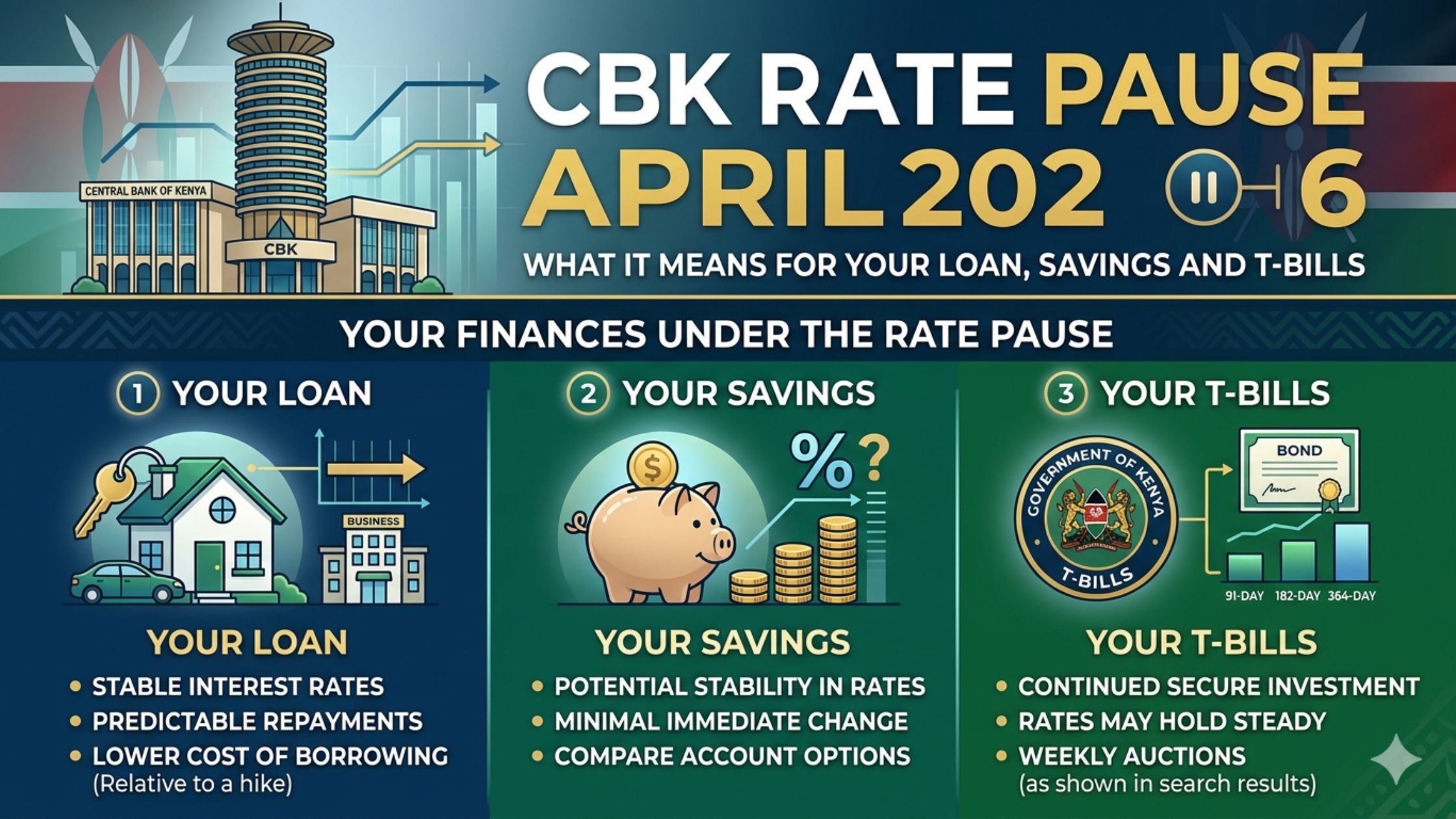
CBK Rate Pause April 2026: What It Means for Your Loan, Savings and T-Bills
The CBK rate pause in April 2026 caught many Kenyans off guard. After ten consecutive interest rate cuts since August 2024 — totalling a massive 425 basis points — the Central Bank of Kenya’s Monetary Policy Committee held the Central Bank Rate (CBR) steady at 8.75% at its April 8th meeting. No cut. No raise. A deliberate pause.
If you have a loan, a savings account, a money market fund, or Treasury Bills, this decision affects your money directly. This article explains exactly what the MPC decided, why they paused, and — more importantly — what it means for each part of your financial life right now.
What Is the CBK Rate and Why Does It Matter?
The Central Bank Rate (CBR) is the benchmark interest rate set by the Central Bank of Kenya — the rate at which CBK lends money to commercial banks. When the CBR drops, banks can borrow more cheaply and are expected to pass those savings on to customers through lower loan rates. When the CBR rises, borrowing costs go up across the economy.
The CBR is the single most important number in Kenyan personal finance. It influences your mortgage rate, your personal loan rate, your savings account returns, and the yields on Treasury Bills and government bonds. When it moves, everything downstream moves with it — eventually.
What Happened at the April 8, 2026 MPC Meeting
The Monetary Policy Committee met on April 8th and voted to hold the CBR at 8.75% — ending a remarkable run of ten consecutive cuts that had brought the rate down from 13.00% in August 2024.
The MPC’s stated reasons for pausing were specific and significant:
1. Rising global risks Conflict in the Middle East has disrupted global supply chains and pushed energy prices sharply higher. CBK Governor Kamau Thugge explicitly cited these geopolitical risks as a reason to hold. Kenya imports virtually all its petroleum — when global oil prices spike, domestic fuel costs follow, and inflation follows fuel costs.
2. Inflation creeping back up Kenya’s annual inflation ticked up to 4.4% in March 2026, from a seven-month low of 4.3% in February. While still comfortably within the CBK’s 5% ± 2.5% target band, the direction of travel matters to the MPC. A month later, April 2026 inflation jumped further to 5.6%, driven by rising fuel and food prices — vindicating the committee’s caution in hindsight.
3. Trimmed growth outlook Kenya’s GDP growth forecast for 2026 was revised down from 5.5% to 5.3%, reflecting the emerging global headwinds. The MPC concluded that the current rate stance is appropriate to keep inflation anchored and the exchange rate stable.
In plain terms: the CBK cut aggressively for over a year and now wants to observe what happens before moving again. It is a deliberate pause after a sprint, not a signal that the easing cycle is finished.
What the CBK Rate Pause Means for Your Loan
Variable Rate Loans
If you have a variable rate loan — most personal loans, business loans, and mortgages in Kenya are variable — your monthly repayment will not change immediately as a result of this pause.
The positive news from the past year is real: the ten consecutive cuts already reduced commercial bank lending rates meaningfully. Average commercial bank lending rates fell to 14.78% in February 2026, down from 15.08% in September 2025. That is a material reduction for anyone with a large variable loan.
The frustrating reality: banks have been significantly slower to pass on the full benefit of CBK cuts to borrowers than they were to absorb the benefits themselves. The Kenya Bankers Association’s own research centre acknowledged in April 2026 that “the benefits of the low CBR are yet to reach the members of the public fully.” This language, from the industry’s own body, tells you everything about the asymmetry between how fast banks lower savings rates versus how slowly they lower lending rates.
What to do: If your loan was taken out before September 2024 when the CBR was above 13%, and your bank has not formally notified you of a rate reduction, call your bank and ask specifically what rate you are currently paying. Under the Risk-Based Credit Pricing Model (RBCPM) that took full effect in February 2026, you may be entitled to a reduction based on your credit risk profile. Ignorance benefits the bank, not you.
Fixed Rate Loans
If you have a fixed rate loan, the CBK pause has no immediate effect on your repayments. Your rate is locked until the fixed period ends. At maturity, you will be refinancing in a significantly more favourable rate environment than 2024.
New Loans
For new borrowers, the pause means rates are unlikely to drop materially in the near term. If you are planning a significant loan — particularly a mortgage — waiting indefinitely for further CBK cuts may not be the right strategy. The rate environment is already meaningfully improved from its 2024 peak, and the next move (if it comes) is likely to be only 25 basis points.
What the CBK Rate Pause Means for Your Savings
Bank Savings Accounts
Here is the uncomfortable truth most banks will not advertise: Kenyan commercial banks have been far faster to reduce savings deposit rates than they have been to reduce lending rates. As the CBK cut through 2024 and 2025, most banks quietly trimmed savings account interest from around 7–8% down to 3–5% — while keeping lending rates stickier.
The CBK rate pause does not reverse this. Your bank savings account is very likely earning less than it was 18 months ago — and earning less than inflation, which means your real purchasing power is declining every month your money sits there.
What to do: Move excess savings above your emergency float to a money market fund. Top MMFs in Kenya are still yielding 11–14% gross annually — three to four times the return of a standard bank savings account. At 10–11% net (after the mandatory 15% Withholding Tax), they continue to beat inflation meaningfully. The CBK pause actually stabilises MMF yields at current levels, making now a reasonable time to commit rather than wait.
Fixed Deposits
Fixed deposit rates have declined alongside the CBK rate cycle. Most banks in April 2026 are offering 8–11% on 6–12 month fixed deposits — down from 13–15% at the 2024 peak.
If you locked in a fixed deposit at those peak rates, the maturity will be a reckoning. When it rolls over, you will be doing so at current — lower — rates. The lesson for the future: when the CBK is cutting aggressively, lock in fixed-rate instruments as early as possible in the cycle, not at the end.
What the CBK Rate Pause Means for Treasury Bills and Bonds
Treasury Bills
T-Bill yields have tracked the CBK rate cycle closely, falling from above 16% in mid-2024 to their current levels.
Approximate T-Bill yields (April–May 2026):
| T-Bill Tenor | Approximate Yield |
|---|---|
| 91-day | ~10.5% |
| 182-day | ~11.2% |
| 364-day | ~12.1% |
The CBK pause is actually positive news for T-Bill investors in one specific way: it signals that yields are unlikely to fall significantly further in the near term. The floor of this rate cycle is probably close. If you have been hesitating to buy T-Bills while waiting for rates to stabilise, that stabilisation has effectively arrived.
Access government securities through the CBK’s DhowCSD platform (dhowd.csd.ke) — individual investors can purchase T-Bills from a minimum of KES 50,000 with no brokerage fees on primary market purchases.
Infrastructure Bonds
Infrastructure bonds — which offer tax-exempt returns, meaning no 15% Withholding Tax — remain among the most attractive instruments for Kenyan individual investors. The CBK recently raised KES 30 billion through a 30-year infrastructure bond auction at a 12.5% coupon, exceeding its target by 50%. The oversubscription demonstrates that institutional and retail investor appetite for Kenyan government paper remains strong at current yields.
For a Kenyan investor in the 25–30% effective tax bracket, a 12.5% tax-free infrastructure bond yield is equivalent to a gross taxable return of approximately 14.7–17.9% — making it one of the highest risk-adjusted returns available from a government-guaranteed instrument.
At a 12.5% tax-free coupon, KES 500,000 in an infrastructure bond earns KES 62,500 per year — fully tax-free, paid semi-annually, with the principal returned at maturity.
Money Market Funds
MMF yields track the CBR and T-Bill rates closely. Through the aggressive cutting cycle of 2024–2025, MMF gross yields drifted down from 14–16% to the current 11–14% range for top funds.
The CBK pause means this downward drift has largely stabilised. Significant further declines in MMF yields require further CBK cuts, which are unlikely to arrive before June 2026 at the earliest — and even then, the MPC’s April language suggests any further movement will be cautious and incremental.
Top funds currently yielding in the 11–14% gross range include Cytonn (11.81–11.9%), Arvocap (11.8–12.13%), and select fixed income funds reaching higher. Compare current yields at Money254 or Serrari before choosing — they update weekly.
What the CBK Rate Pause Means for the Kenya Shilling
A pause or hold is generally constructive for the shilling. By keeping rates steady rather than cutting further, the MPC maintains Kenya’s interest rate differential with major global currencies — making Kenyan assets relatively more attractive to foreign portfolio investors.
The shilling strengthened significantly through 2025 after the difficult depreciation period of 2023–2024. The April 2026 pause supports that stability. A rate cut — particularly if it coincided with rising inflation — would have applied additional pressure to the shilling.
What Happens Next: Will the CBK Cut Again?
The MPC’s next scheduled meeting is June 2026. Whether they cut again depends on three variables:
1. Inflation trajectory. April 2026 inflation at 5.6% is uncomfortably close to the CBK’s 5.0% upper comfort level. If May and June data show inflation continuing above 5%, the June meeting will almost certainly be another hold — and a cut will be deferred to later in the year.
2. Global energy prices. The Middle East conflict is the biggest external risk to the CBK’s projections. A de-escalation that stabilises oil prices opens the door to resumed easing. An escalation that pushes diesel and super petrol further above current levels — already at historic highs in Kenya — would close it.
3. Credit growth. The CBK wants to see evidence that its previous 425 basis points of cuts are actually stimulating lending to the private sector. If bank credit growth to businesses and households accelerates meaningfully, the urgency for further cuts reduces.
Most likely scenario: One further cut of 25 basis points in H2 2026 (August or October MPC meeting), bringing the CBR to 8.50% — unless inflation remains persistently above 5% or global conditions deteriorate significantly. A return to the cutting pace of 2024–2025 is not expected.
Your Action Plan: What to Do With Your Money Right Now
Based on the CBK rate pause and the current rate environment, here is what makes sense across different financial situations:
If you have a variable rate loan: Do not assume your bank has already passed on the full benefit of CBK’s ten cuts. Call your bank, ask for your current rate in writing, and compare it to what the RBCPM framework suggests for your credit profile. If you are overpaying, negotiate.
If you have savings in a bank account: Move any savings above your 1–2 month emergency float into a money market fund earning 11–14% gross — not a bank savings account earning 3–5%. The CBK pause has stabilised MMF yields at current levels; there is no advantage to waiting.
If you invest in T-Bills: Current yields are close to their floor for this rate cycle. Locking into 12-month T-Bills now gives you certainty of return for a year at reasonable yields. The risk of waiting is that any future cuts reduce yields further.
If you are considering a long-term bond: The CBK’s recent infrastructure bond at 12.5% tax-free with strong oversubscription signals continued government debt issuance at attractive yields. For investors with a 5–15 year horizon who do not need immediate liquidity, infrastructure bonds remain compelling. Access via DhowCSD.
If you are considering a mortgage: The rate environment is the best it has been since 2021. The difference between a 14.78% lending rate today and the 18–20% rates of two years ago is meaningful on a 20-year mortgage. Modelling what current rates cost monthly may change your calculus about whether now is the right time.
If you hold NSE equities: Lower interest rates are broadly positive for equities — cheaper borrowing costs support company earnings, and lower bond yields reduce the relative attractiveness of fixed income. The CBK pause does not change this picture materially. If inflation rises and forces the CBK to reverse course, that would be a more significant negative signal.
Frequently Asked Questions
Will bank loan rates come down further after the CBK pause? Possibly, but slowly and not dramatically. Banks have structural reasons to maintain spreads above the CBR, and the RBCPM framework creates pressure for risk-based pricing rather than uniform rate cuts. Do not expect your lending rate to fall significantly without direct negotiation.
Is my money market fund yield going to drop? The pause stabilises MMF yields at current levels. A small further decline remains possible if the CBK cuts once more in H2 2026, but the dramatic drops of the 2025 cutting cycle are very likely behind us for this rate cycle.
Should I move from T-Bills to longer-term bonds? If you expect rates to remain stable or decline slightly over the next 2–5 years — which is the most likely scenario — locking into longer-term bonds at current yields makes sense and protects you from reinvestment risk when short-term instruments mature. Consult a licensed investment advisor before making this shift with significant capital.
What does the CBK pause mean for the Kenya Shilling? The hold is broadly positive for exchange rate stability — it preserves the interest rate differential that attracts foreign portfolio investment into Kenyan government securities. Rising inflation, if it persists, is the greater risk to shilling stability in the near term.
Is this the end of the rate cutting cycle? Not necessarily the end, but almost certainly the end of rapid, consecutive cuts. The next move — if it comes in H2 2026 — is likely to be a single cautious 25 basis point reduction, not a resumption of the aggressive easing that characterised 2024–2025.
The Bottom Line
The CBK rate pause in April 2026 marks the end of one of the most aggressive monetary easing cycles in Kenya’s recent history. In less than two years, the CBR dropped 425 basis points — from 13.00% to 8.75% — transforming the cost of credit, the return on savings, and the landscape for every Kenyan with financial assets or liabilities.
For most Kenyans, the key takeaway is this: the window of exceptional returns on short-term savings instruments is closing. T-Bill yields above 15%, fixed deposits above 13%, MMF yields approaching 16% — those levels belong to 2024. What is available now — 10–14% on quality instruments — is still significantly above inflation and still represents genuine real returns. But locking in what is available today matters more than waiting for something better.
Move idle savings from bank accounts to money market funds. Check your variable loan rate with your bank. Consider locking longer-term capital into infrastructure bonds at tax-free yields. And watch the June 2026 MPC meeting — it will tell you whether the CBK’s pause was a brief rest or the beginning of a more extended hold.
Verify current T-Bill yields and access government securities at centralbank.go.ke and compare money market fund yields at Money254 or Serrari.
Disclaimer: Interest rates, T-Bill yields, and MPC decisions are subject to change. All rates and figures in this article reflect publicly available data as of April–May 2026. This article is for informational purposes only and does not constitute financial advice. Verify current rates at centralbank.go.ke before making any financial decisions.
Sources: CBK Monetary Policy Committee Statement, April 8, 2026; CBK Governor Kamau Thugge Press Conference (April 2026); Kenya Bankers Association Research Centre (April 2026); KNBS CPI Reports March–April 2026; CBK Infrastructure Bond Prospectus (2026); Vasili Africa MMF Report (February 2026); DhowCSD Platform (centralbank.go.ke).