Avoid CRB Listing Kenya 2026: What Banks Won’t Tell You
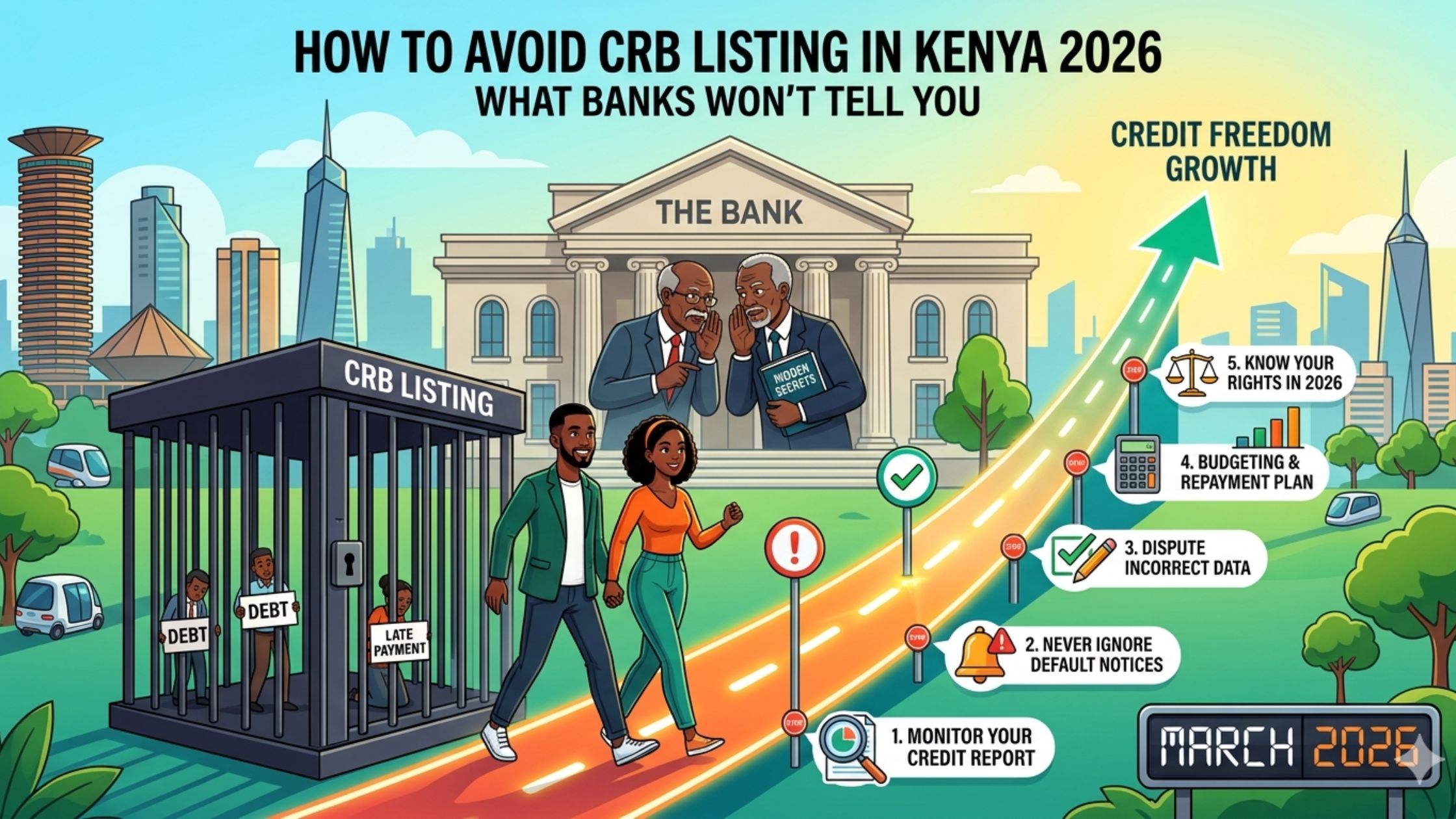
If you want to know how to avoid CRB listing in Kenya, this is the article that actually answers the question — not with generic advice, but with the specific information lenders have and borrowers are never told. The rules that govern when you get listed, how fast it happens, and what quietly destroys your credit long before any formal CRB action — none of this is explained at the moment you borrow. It happens to thousands of Kenyans every year, not because they are reckless, but because they were simply uninformed.
A KES 800 Tala loan. Forgotten for 45 days. Four years later, it blocks a KES 500,000 bank loan application.
This guide is not about what to do after you’re listed. That’s covered in our CRB Kenya 2026 guide. This is about how to avoid CRB listing in Kenya entirely — using the specific knowledge that banks and mobile lenders possess and never volunteer to you.
What Actually Triggers a CRB Listing in Kenya (Most Borrowers Get This Wrong)
The most dangerous misconception in Kenyan personal finance is that CRB listings happen to people who take big loans and dramatically fail to repay them. The reality is far more ordinary — and far more avoidable if you understand the actual mechanics.
The threshold misconception. Most Kenyans assume only significant loan amounts get reported to credit bureaux. This assumption has destroyed credit scores across the country. Tala reports defaulted loans from as low as KES 500. M-Shwari’s reporting threshold is KES 1,000. Branch reports from KES 1,000. These are not large sums. They are the kind of amounts that slip through the cracks when a salary is delayed or a month-end gets hectic. The lender doesn’t care about the size — they care about the pattern.
The 90-day myth. You may have heard that lenders wait 90 days before listing you with CRB. For formal CRB listing, this is roughly accurate for M-Shwari and Hustler Fund. For Tala, it can be as fast as 30 days. But here is what lenders don’t tell you: long before any formal CRB listing, the consequences are already arriving. Your M-Shwari limit collapses. Your Fuliza limit shrinks. Your Tala account gets suspended. Your KCB M-Pesa access tightens. The internal credit damage happens weeks before a bureau is involved.
The “I paid most of it” trap. Paying KES 900 of a KES 1,000 M-Shwari loan does not protect you from listing. The KES 100 outstanding balance is treated as a default by the system. There is no partial credit for partial payment in mobile lending. The account is either settled or it isn’t. This catches people who genuinely thought they had cleared a debt and moved on.
Fuliza’s silent accumulation. This is the mechanism that generates the most unintended CRB consequences in Kenya. An unpaid Fuliza balance doesn’t just sit there accruing daily fees at approximately 1% per day. It actively and immediately reduces your limits across every other Safaricom credit product. A KES 300 Fuliza balance sitting unpaid for two weeks is simultaneously: growing in cost, shrinking your M-Shwari limit, reducing your KCB M-Pesa access, and quietly signalling distress to the entire Safaricom credit ecosystem — all before anyone has typed your name into a CRB database.
What banks won’t tell you: The consequences of non-payment begin immediately. The formal CRB listing is just the paperwork confirming damage that started on day one.
The 7 Things Lenders Know (And Never Explain to You)
This is the information asymmetry that keeps Kenyans trapped in credit trouble. Lenders are not required to explain these things. They are simply advantages that informed borrowers use and uninformed borrowers discover too late.
1. All three CRBs don’t automatically sync.
Kenya has three licensed Credit Reference Bureaux: TransUnion, Metropol, and Creditinfo. A Tala default reported to Metropol does not automatically appear on TransUnion. But commercial banks typically check both TransUnion and Metropol when evaluating loan applications. This means you can check one bureau, find yourself clean, and still get rejected by a bank that checked the other. The only way to know your full picture is to check all three. The good news: each bureau provides one free annual report. Use all three.
2. The CRB countdown clock starts when you PAY — not when you were listed.
This is the most misunderstood rule in Kenyan credit law, and understanding it has significant financial consequences. Under CRB Regulations 2013, a negative listing remains on your record for five years from the date the account is resolved — meaning the date you pay, not the date you were listed. If you default in March 2026 and pay in March 2028, your listing stays until March 2033 — eight years of damage from a debt you eventually cleared. If you pay in April 2026, the listing clears in April 2031 — just over five years. Every month you delay payment extends your credit damage beyond the original five years. Pay fast. The clock doesn’t start until you do.
3. Lenders are legally required to warn you before listing — but the warning looks like spam.
Under CRB Regulations 2013, Section 14, a lender must notify you before submitting your name to a credit bureau. This notification must state the amount in default, how many days overdue, the intent to report to CRB, and the timeline you have to respond. Most lenders fulfil this legal obligation via SMS. The problem is that the SMS is designed to look like a routine payment reminder. It does not say “THIS IS YOUR LEGAL CRB WARNING NOTICE.” It says something like “Your M-Shwari loan of KES 1,500 is overdue. Please repay to avoid further action.” That is your legal warning window. If you receive any loan repayment reminder SMS, treat it as a formal notice and act on it within 48 hours.
4. A “settled” listing is not the same as a “clean” record.
When you pay off a defaulted loan and the CRB updates your record, your listing status changes from “Active Non-Performing Loan” to “Settled Non-Performing Loan.” Banks and SACCOs see both. A settled listing tells a lender: this person defaulted, and eventually got around to paying it. It is meaningfully better than an active listing — many SACCOs and some banks will work with settled accounts. But it is not the same as never having been listed. The settled record stays for five years from payment date. This is why preventing a listing entirely is worth incomparably more than clearing one later. The prevention costs almost nothing. The clearing costs years of reduced financial access.
5. Multiple loan applications harm your score even if you never borrow.
Every time you apply for a loan — from a bank, SACCO, or mobile lender — a “hard enquiry” is recorded on your CRB report. This enquiry is visible to every subsequent lender who checks your credit. Five loan applications in one month, even if all were rejected, signals financial desperation to any institution reviewing your profile. The pattern says: this person is urgently seeking credit from multiple sources and being declined. Lenders respond to this pattern with caution or rejection. The rule of thumb: research first, apply once. If rejected, diagnose the reason before applying elsewhere. Scattering applications across lenders amplifies the original problem.
6. Your electricity bill can list you with CRB.
Kenya Power and Nairobi Water now report large unpaid utility bills to credit bureaux. The threshold for KPLC reporting is generally bills exceeding KES 10,000 outstanding for 90 or more days. Most Kenyans think of CRB as a mobile loan issue. It is increasingly a utility bill issue as well. A household that accumulates three months of unpaid electricity and disconnects rather than paying is creating a CRB listing that will affect loan applications for five years. Pay utility bills on time. Set M-Pesa auto-pay for recurring bills. A KES 3,000 monthly KPLC bill is far less consequential than the CRB listing that follows ignoring it.
7. Your Hustler Fund default collapses every Safaricom credit product in real time.
Unlike other cross-lender effects that take time to filter through CRB systems, a missed Hustler Fund payment has immediate consequences inside the Safaricom ecosystem. The system treats your combined exposure across Hustler Fund, M-Shwari, and Fuliza as an interconnected credit profile. A default on any one product signals distress across all of them. Your M-Shwari limit can drop in the same week as a missed Hustler Fund payment — before any bureau is involved. This cross-product sensitivity is never explained when you register. It means that managing your Hustler Fund repayments is not just about the Hustler Fund — it is about protecting your entire Safaricom credit access.
The Pre-Borrow Checklist: How to Avoid CRB Listing in Kenya Before It Starts
Most CRB listings are not caused by financial catastrophe. They are caused by borrowing without thinking through the repayment. This checklist takes 60 seconds and eliminates the most common causes of accidental listing.
Check Hustler Fund first. Before opening any other mobile lending product, dial *254# and check your Hustler Fund limit. At 8% per annum versus M-Shwari’s 90% or Fuliza’s approximate 365%, Hustler Fund is so much cheaper that the comparison barely makes sense. If your limit covers the need, the decision is made. Using a more expensive product when Hustler Fund is available is always the wrong choice. Our Hustler Fund Kenya 2026 guide covers exactly how to grow your limit.
Write down your repayment date before the money arrives. The moment you confirm a loan, before the funds even land in your M-Pesa, open your phone’s calendar and set a reminder for three days before the repayment deadline. Not on the deadline. Three days before. This gives you time to arrange funds if needed. The number of CRB listings caused by people who genuinely forgot a repayment date is staggering. Lenders know this. They are counting on it.
Confirm the exact repayment amount — not the principal, the total. If you borrow KES 5,000 from M-Shwari, you do not repay KES 5,000. You repay KES 5,375. Borrowing KES 1,000 from KCB M-Pesa and setting aside KES 1,000 to repay it leaves KES 50 outstanding — which can trigger the exact cascade described in this article. Know the total before you borrow. Check it in the loan confirmation SMS or USSD screen.
Only borrow against money you already know is coming. The most dangerous mobile loan is one taken against income that hasn’t arrived yet. Salary may be delayed. Client payment may bounce. A loan taken against hoped-for income becomes a loan with no repayment source. Only borrow when you can identify the specific, confirmed income that will repay it — and only borrow the amount that income can cover.
Never run two mobile loans simultaneously unless you’ve done the maths on both. Holding active M-Shwari and Fuliza balances at the same time is a common and expensive pattern. Any money entering your M-Pesa repays Fuliza automatically before you can direct it to M-Shwari repayment. People miss M-Shwari repayments not because they had no money, but because Fuliza took it first. Know which repayments are automatic and which require manual action before taking any second loan.
Lender-by-Lender Danger Ratings: Which Products List You Fastest
Not all mobile loans carry the same CRB risk. Here is an honest ranking from most dangerous to least, based on listing thresholds, timelines, and the speed at which consequences arrive before any formal listing.
| Lender | Min. Listable Amount | Days Before CRB Listing | Speed of Pre-Listing Damage | Danger Level |
|---|---|---|---|---|
| Tala | KES 500 | ~30 days | High — account suspended at day 30 | 🔴 Highest |
| Fuliza | KES 500 | ~60 days | Extreme — daily accumulation + immediate cross-product limit collapse | 🔴 Highest |
| Branch | KES 1,000 | ~60 days | Medium — account suspended, no cross-product effects | 🟠 High |
| M-Shwari | KES 1,000 | ~90 days | High — Fuliza limit collapses immediately | 🟠 High |
| KCB M-Pesa | KES 1,000 | ~120 days | Low — longer window, no immediate cross-product effects | 🟡 Medium |
| Hustler Fund | KES 500 | ~30 days | High — immediate Safaricom ecosystem impact | 🟡 Medium |
| Commercial Banks | KES 1,000+ | 90–180 days | Low — structured process with formal warnings | 🟢 Lower |
The pattern that every Kenyan borrower should understand — and the core of how to avoid CRB listing in Kenya — is this: the products with the lowest barriers to access are the products with the most aggressive listing timelines and the most immediate internal consequences. The ease of borrowing and the speed of damage travel together. The products that take the longest to list you are the ones that required the most documentation and verification before they lent to you. There is no coincidence in that relationship.
If You’re Already Behind: What to Do in the Next 72 Hours
If you’re reading this article because you already have overdue mobile loans rather than as a general precaution, this section is for you. The window between overdue and listed is the most valuable 72 hours in your credit life. Here is exactly how to use it.
Today: Get your actual picture. SMS “CRB” to 21272. It costs KES 100 and delivers a Metropol credit summary immediately, with a full report to your email. Do not guess about what’s listed and what isn’t — know. Many people carry anxiety about multiple loans when only one is actually near the listing threshold. Others assume they’re fine when they’re already listed. KES 100 buys you certainty. Also check your M-Shwari status via *234# and your Hustler Fund status via *254# to see where your limits currently stand.
Within 24 hours: Contact every lender with an overdue balance. Call the customer service line, use the in-app chat, or send an email. Do this before they contact you. Lenders at the operational level have significantly more flexibility than the automated SMS reminders suggest. A borrower who proactively calls to say “I have an overdue balance and I want to arrange repayment” is treated differently from one who ignores reminders until the system escalates. You are not obligated to accept the first repayment option offered. Ask specifically: “What are my options? Is a payment arrangement possible?”
Within 48 hours: Make a payment — any payment. Even KES 200 toward a KES 1,000 Tala debt does two things: it demonstrates intent, and it creates a transaction record you can reference in any dispute. Some mobile lenders interpret any payment activity as an indicator that the account is being managed, which can delay the formal listing process. Screenshot every payment confirmation. SMS yourself the M-Pesa confirmation. Create a paper trail.
Within 72 hours: If you cannot pay anything, get the arrangement in writing. Call the lender and ask for a formal payment arrangement — a specific agreed timeline for repayment. Ask them to confirm the arrangement via SMS or email. An on-file payment agreement is treated substantially better than silence by both lenders and credit bureaux. It does not guarantee you avoid listing, but it gives you grounds to dispute any listing that follows and demonstrates good faith if you do end up working through a clearance process.
For the full process of clearing an existing listing, see our CRB Kenya 2026 guide.
The Long-Term Habit Stack: How to Avoid CRB Listing in Kenya for Good
Prevention is a system, not a single decision. These five habits, practised consistently, make CRB listing functionally impossible regardless of what life throws at your finances.
Set a repayment calendar reminder the moment every loan lands. Not tomorrow. Not when you remember. The same day, as part of the borrowing process. Set it for three days before the due date, not on the due date. This one habit eliminates the most common cause of accidental listing: genuinely forgetting. It costs 30 seconds and provides years of protection.
Repay on day 7 rather than day 27. For a 30-day M-Shwari loan or a 14-day Hustler Fund loan, early repayment does three things simultaneously: it reduces your interest cost (especially on products with daily fees), it accelerates your limit growth as lenders reward early payment behaviour, and it removes the entire window of risk between borrowing and repaying. A loan you’ve already repaid cannot list you. The faster you repay, the shorter the window of danger.
Check your CRB report every January. This is your free annual review across all three bureaux — TransUnion, Metropol, and Creditinfo each provide one free report per year. Use them. Check not just for listings but for errors: loans you don’t recognise (identity theft is more common than most Kenyans know), duplicate entries, wrong amounts, or accounts you’ve settled that still show as active. Catching an error in January costs nothing. Discovering it when you’re rejected for a loan in September costs a great deal more.
Default to Hustler Fund for every emergency loan. The cost difference between Hustler Fund at 8% per annum and M-Shwari at 90% is not marginal — it is the difference between KES 3 and KES 75 in interest on a KES 1,000 loan. When the cost of borrowing is this low, the spiral into unrepayable debt becomes nearly impossible. Most CRB listings happen not from a single large default but from an accumulating series of expensive small loans that compound beyond repayment capacity. Using the cheapest product by default eliminates most of that compounding risk. Dial *254# first. Always.
Build a KES 3,000–5,000 M-Pesa Goal Savings buffer. This is the most effective CRB prevention measure available to any Kenyan, and the least discussed. A KES 3,000 savings buffer means that a KES 1,500 medical emergency, an urgent school fee, or a matatu breakdown does not require a loan at all. It costs KES 500 per month for six months. The M-Pesa Goal Savings feature locks the money automatically so it doesn’t get spent on day-to-day needs. Once built, a KES 3,000–5,000 buffer handles the majority of the real-world emergencies that drive mobile lending in Kenya. Zero loan means zero listing risk.
Frequently Asked Questions
Can I get CRB listed for a KES 500 loan in Kenya?
Yes. Tala reports defaulted loans from KES 500, and Fuliza’s reporting threshold is also in this range. The common belief that small loans don’t result in CRB listings is false and has cost many Kenyans years of financial access. If you borrow KES 500 and don’t repay within 30–60 days depending on the lender, formal listing is possible. The listing itself may only say “KES 500 outstanding” but its effect on bank loan applications is identical to a KES 50,000 default.
How long before M-Shwari reports you to CRB?
M-Shwari’s formal CRB listing threshold is approximately 90 days of non-payment for balances above KES 1,000. However, the consequences begin far earlier: your Fuliza limit collapses almost immediately when M-Shwari goes unpaid, and by day 30 your M-Shwari borrowing access is typically suspended. Treat day 30 as your real deadline, not day 90.
Does Fuliza affect CRB in Kenya?
Yes, in two ways. First, a Fuliza balance unpaid for approximately 60 days results in a formal CRB listing. Second, and more immediately, an outstanding Fuliza balance reduces your M-Shwari limit and overall Safaricom credit access before any formal listing occurs. Even KES 200 sitting in Fuliza for several weeks is quietly reducing your access to other products while you may be unaware. Repay Fuliza the moment money enters your M-Pesa — don’t wait.
What happens if I pay my loan one day late?
A single day late typically does not trigger listing. Most lenders have a brief grace period. However, a late payment may be recorded internally, can affect your limit growth trajectory, and if it becomes a pattern across multiple months, accumulates into the kind of repayment history that reduces your limits. The danger of one late payment is less in the immediate consequences and more in the habit it signals. Repay on time, every time.
Can I negotiate with a lender to avoid CRB listing?
Yes — and this option is almost never advertised. Most mobile lenders have the ability to offer payment arrangements to borrowers who contact them proactively before the listing deadline. The key word is proactively. A borrower who calls before the 60-day or 90-day threshold and asks for a payment arrangement is treated very differently from one who ignores reminders until the system escalates. If you are behind, call today. The offer to arrange payment, delivered early and confirmed in writing, can delay or prevent formal listing while you get the balance cleared.
Does Hustler Fund report to CRB?
Yes. The Hustler Fund reports to Kenya’s credit bureaux for balances unpaid beyond 30 days. Despite being a government welfare product with subsidised interest, it operates within the same CRB reporting framework as commercial lenders. A Hustler Fund default also has the immediate cross-product effect of reducing your M-Shwari and Fuliza limits within the Safaricom ecosystem. Treat Hustler Fund repayment with the same discipline as any other loan — the low interest rate does not come with reduced listing risk.
How do I know if I’ve already been listed?
The fastest method is SMS: type “CRB” and send to 21272. It costs KES 100 and delivers a summary immediately with a full report emailed to you. This checks the Metropol bureau, which covers most mobile lenders. For a complete picture including bank loans, also request your free annual report from TransUnion at transunion.co.ke. If you haven’t checked your CRB status in the last 12 months, check it today — the cost of not knowing is always higher than KES 100.
The Bottom Line
Knowing how to avoid CRB listing in Kenya in 2026 does not require a perfect financial life. It requires knowing the specific rules that lenders operate by and building the simple habits that keep you on the right side of them.
The information in this article is not secret. Lenders know all of it. They simply have no incentive to tell you — because the less you know about how and when listing happens, the more likely you are to inadvertently cross a threshold that generates fee income or a CRB entry that limits your options and keeps you dependent on their products.
Now you know what they know.
Start today with two actions that take under two minutes. Dial *254# to check your Hustler Fund limit and establish it as your default emergency loan. Then SMS “CRB” to 21272 to confirm your current status across Metropol. Two dials. KES 100. Two minutes. That is the entire starting cost of taking your credit health seriously in 2026.
Rates and CRB policies verified March 2026. Lender thresholds and timelines are subject to change — verify current terms directly with each lender before borrowing. For the complete guide to checking and clearing an existing CRB listing, see our CRB Kenya 2026 guide.
Related reading:
- CRB Kenya 2026: How to Check, Clear and Protect Your Credit Record
- M-Shwari vs KCB M-Pesa vs Fuliza 2026: Which Is Cheapest?
- Hustler Fund Kenya 2026: Real Interest Rate & How to Access It
- SACCO vs Bank Account in Kenya: Where Should Your Money Actually Go?
- How to Save Money in Kenya 2026: Building Your Emergency Fund