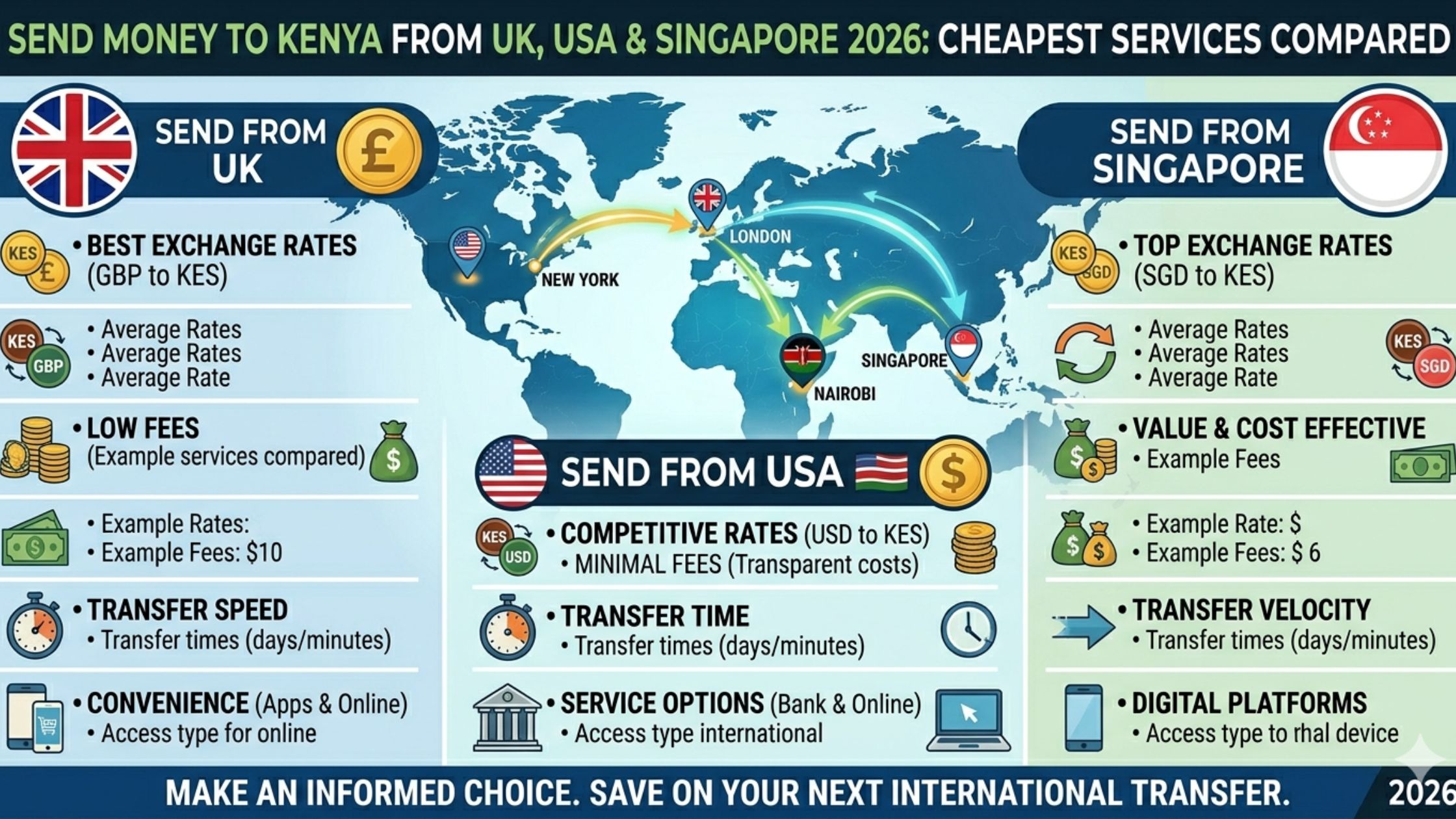
Send Money to Kenya from UK, USA & Singapore 2026: Cheapest Services Compared
Wanna send money to Kenya? You work hard abroad. You send money home every month. But between exchange rate margins, transfer fees, and the three-day wait that arrives when your family needed the money yesterday — you have probably wondered whether you are using the best way to send money to Kenya or simply the most familiar one.
Most comparison articles about sending money to Kenya are written for generic Western senders and bury the M-Pesa delivery question three pages in. This one is written specifically for Kenyan diaspora in the UK, USA, and Singapore, with M-Pesa delivery as the default assumption and real costs calculated in shillings — not percentages, not abstract fees, but the actual number that lands in your family’s phone.
By the end of this guide you will know the cheapest service for your specific sending corridor, exactly how to send directly to M-Pesa from abroad, and one trap that costs most diaspora Kenyans the equivalent of a full month’s remittance every year — without them ever realising it.
Why the Exchange Rate Matters More Than the Fee (The Hidden Cost Most People Miss)
Almost every diaspora Kenyan compares remittance services the wrong way. The conversation goes: “Western Union charges £3.99, Wise charges £4.50, so Western Union is cheaper.” This comparison is almost always wrong. It focuses on the visible cost and ignores the invisible one — and the invisible cost is almost always larger.
To understand why, you need to know what the mid-market rate is.
The mid-market rate — also called the interbank rate — is the real exchange rate. It is the rate at which banks trade currency between themselves on global markets. It is publicly visible at xe.com or by typing any currency pair into Google. No retail remittance service gives you this rate. Every service adds a margin on top — the difference between the mid-market rate and what they offer you. That margin is their profit, and it is never labelled as a fee anywhere on their platform.
Here is what the invisible fee looks like in real shillings:
Sending £500 from the UK to Kenya
Mid-market rate: £1 = KES 170
Western Union: Offers £1 = KES 158 (margin of KES 12 per pound). Transfer fee: £0. Your family receives: KES 79,000
Wise: Offers £1 = KES 168.50 (margin of KES 1.50 per pound). Transfer fee: £4.50. Your family receives: KES 83,492
Difference: KES 4,492 more arrives via Wise — despite Wise charging a higher headline fee.
Western Union’s “free transfer” costs your family KES 4,492 on a single £500 remittance. That is more than three months of a KES 1,500/month mobile loan fee. Multiplied across twelve monthly transfers, the same family receives KES 53,904 less per year by staying loyal to a service that advertises zero fees.
The lesson is simple but counterintuitive: always calculate the total KES received, not the transfer fee. The service with the lowest advertised fee almost always has the worst exchange rate — and the exchange rate difference costs far more than the fee saves.
Before comparing any two services, check the mid-market rate at xe.com, then check what each service offers for the same amount. The difference is the invisible fee you are paying or saving.
The 6 Main Services Compared: What They Actually Cost in 2026
Wise (formerly TransferWise)
Fee: Low fixed fee plus 0.4–0.6% of the transfer amount. On £500, expect approximately £4–6 total.
Exchange rate:Best in class — typically within 0.5% of mid-market. The closest any retail service comes to the real rate.
M-Pesa delivery: Yes — direct to M-Pesa number. One of the cleanest integrations available.
Speed: Minutes to a few hours for most transfers from the UK and USA. SGD transfers can take slightly longer.
Best for: Anyone who calculates total KES received rather than headline fee. Wise wins this calculation consistently.
Watch out for: Weekend transfers — some currency pairs have slightly wider spreads on weekends when interbank markets are closed.
Verdict: The default choice for most diaspora Kenyans. Best exchange rate, direct M-Pesa delivery, transparent fees. Open a Wise account before you need it — verification takes 24–48 hours on first use.
Remitly
Fee: Variable depending on speed. “Express” delivery (minutes) costs more than “Economy” (3–5 business days). On £500 Express, expect £2–4.
Exchange rate: Competitive — better than Western Union, slightly behind Wise on most corridors.
M-Pesa delivery: Yes — one of the strongest M-Pesa integrations among all remittance services. Widely used by Kenyan diaspora.
Speed: Express = minutes to M-Pesa. Economy = 3–5 business days to bank account.
Best for:Urgent transfers where speed matters as much as rate. When your family needs money today, not tomorrow, Remitly Express delivers.
Watch out for: First-time promotional rates. Remitly often offers a significantly better rate for a new customer’s first transfer — sometimes 3–5% better than their standard rate. After the first transfer, the rate normalises. Readers who set up a recurring transfer based on the promotional rate are now sending at a less favourable rate without knowing it.
Verdict: Best for urgent transfers. Strong M-Pesa integration. Check the rate after your first transfer to confirm you are still getting a competitive deal.
WorldRemit
Fee: Low flat fee — typically £1.99–3.99 depending on corridor and amount.
Exchange rate: Competitive — better than Western Union, broadly similar to Remitly.
M-Pesa delivery: Yes — established M-Pesa integration with a long track record for Kenya.
Speed: Minutes for M-Pesa delivery in most corridors.
Best for: Regular senders who want reliable M-Pesa delivery with a straightforward interface and no promotional rate surprises.
Watch out for: Rates vary more by sending amount than other services — the rate on £100 may differ meaningfully from the rate on £500. Always check for your specific amount.
Verdict: Solid, dependable, and genuinely M-Pesa friendly. A strong alternative when Wise or Remitly rates are temporarily less competitive.
Western Union
Fee: Varies — online transfers sometimes advertised as £0 fee. Agent transfers carry higher fees.
Exchange rate:Typically the worst of all major digital services — exchange rate margins of 3–8% above mid-market are common.
M-Pesa delivery: Yes — available, but not always the default option presented. You may need to specifically select mobile money delivery.
Speed: Fast — minutes for digital transfers.
Best for: One scenario only — when the recipient genuinely cannot receive via M-Pesa and needs physical cash pickup at a Western Union agent.
Watch out for: The zero-fee offer. As the example above demonstrates, a “free” Western Union transfer can cost your family KES 4,000–8,000 more than a Wise transfer with a visible fee. The fee is zero because the profit is hidden in the exchange rate.
Verdict: Only justifiable for cash pickup. For M-Pesa delivery, it is almost never the right choice when Wise, Remitly, or WorldRemit are available.
MoneyGram
Fee: Variable by corridor — similar range to Western Union.
Exchange rate: Generally poor compared to Wise, Remitly, or WorldRemit — better suited to cash pickup than digital transfer.
M-Pesa delivery: Available in some corridors — verify availability for Kenya before using.
Speed: Fast for digital, same-day for agent pickup.
Verdict: A secondary option — use when Western Union agents are unavailable and the recipient needs cash pickup. For M-Pesa delivery, the three services above are better choices.
Bank Wire Transfer (Your UK, US, or Singapore Bank)
Fee: Typically £15–30 from UK banks, $25–45 from US banks, SGD 20–40 from Singapore banks — flat per transfer regardless of amount.
Exchange rate: Typically the worst available. Banks use a heavily marked-up exchange rate on international transfers — often 4–6% above mid-market.
Speed: 2–5 business days. No express option.
M-Pesa delivery:No. Bank wires send to a Kenyan bank account. The recipient then needs to separately transfer from their bank to M-Pesa.
Best for: Very large amounts above £5,000–10,000 where the fixed fee becomes proportionally small and you have an existing relationship with a Kenyan bank account for the recipient.
Verdict: Almost never the right choice for amounts under £5,000. Use Wise instead — better rate, lower fee, and direct M-Pesa delivery.
The Master Comparison: Total KES Received
This is what actually matters. Not the fee. Not the advertised rate. The number that arrives in Kenya.
Note: Figures below are illustrative based on typical rate quality for each service as of early 2026. Exchange rates change daily — always verify the live rate at the moment of transfer. Use these tables to understand the relative quality of each service, not as guaranteed amounts.
Sending £500 from the UK to Kenya M-Pesa
| Service | Fee (£) | Exchange Rate (£1 =) | KES Received |
|---|---|---|---|
| Wise | ~£4.50 | ~KES 168.50 | ~KES 83,492 |
| Remitly (Express) | ~£3.00 | ~KES 166.00 | ~KES 82,502 |
| WorldRemit | ~£2.99 | ~KES 164.50 | ~KES 81,754 |
| Western Union | £0 | ~KES 158.00 | ~KES 79,000 |
| Bank Wire | ~£20 | ~KES 156.00 | ~KES 78,000 |
| Mid-market (theoretical max) | £0 | ~KES 170 | ~KES 85,000 |
Wise delivers KES 4,492 more than Western Union on a single £500 transfer.
Sending $500 from the USA to Kenya M-Pesa
| Service | Fee ($) | Exchange Rate ($1 =) | KES Received |
|---|---|---|---|
| Wise | ~$4.50 | ~KES 128.50 | ~KES 63,673 |
| Remitly (Express) | ~$3.00 | ~KES 126.50 | ~KES 62,867 |
| WorldRemit | ~$2.99 | ~KES 125.00 | ~KES 62,126 |
| Western Union | $0 | ~KES 120.00 | ~KES 60,000 |
| Bank Wire | ~$35 | ~KES 118.00 | ~KES 54,876 |
| Mid-market (theoretical max) | $0 | ~KES 130 | ~KES 65,000 |
Bank wire from a US bank is the worst option by a significant margin — the flat fee plus poor exchange rate can cost your family over KES 8,000 on a single $500 transfer compared to Wise.
Sending SGD 700 from Singapore to Kenya M-Pesa
| Service | Fee (SGD) | Exchange Rate (SGD 1 =) | KES Received |
|---|---|---|---|
| Wise | ~SGD 5.00 | ~KES 95.50 | ~KES 66,185 |
| Remitly | ~SGD 3.99 | ~KES 93.00 | ~KES 64,709 |
| WorldRemit | ~SGD 3.99 | ~KES 92.00 | ~KES 64,028 |
| Western Union | SGD 0 | ~KES 86.00 | ~KES 60,200 |
| Bank Wire | ~SGD 30 | ~KES 84.00 | ~KES 55,440 |
| Mid-market (theoretical max) | SGD 0 | ~KES 97 | ~KES 67,900 |
Singapore senders face a less competitive corridor than UK or USA — the gap between Wise and Western Union is even larger proportionally. Wise is the clear choice for SGD→KES transfers.
Send Money to Kenya Directly to M-Pesa: How It Works
Many diaspora Kenyans assume their family needs a bank account to receive international money transfers. They do not. Wise, Remitly, and WorldRemit all deliver directly to an M-Pesa number — the money arrives in the recipient’s M-Pesa wallet within minutes, on their existing Safaricom line, with no bank account involved on either end.
Here is everything you and your family need to know.
What You Need from the Recipient
The M-Pesa registered phone number — and specifically the number that is registered to the M-Pesa account, not necessarily the number they use for calls. These are sometimes different. Ask your recipient to confirm by checking their M-Pesa settings or dialling *334# and verifying the number shown.
The number should be in international format when you enter it on the remittance platform: +254 followed by the nine-digit number without the leading zero. If their number is 0722 123 456, you enter +254722123456.
Entering the wrong number is the most common and most costly error in international M-Pesa transfers. Once money is sent to the wrong number, recovery is possible but not guaranteed — and it can take weeks. Confirm the number before every transfer, even if you have sent to the same person before. Numbers change. SIM cards get replaced.
M-Pesa Receive Limits in Kenya 2026
- Maximum per transaction: KES 500,000
- Maximum per day: KES 500,000
- Maximum M-Pesa wallet balance: KES 300,000
For transfers above KES 300,000, the recipient’s wallet may be at capacity if they have not recently withdrawn. Coordinate with your recipient before large transfers to ensure they have sufficient wallet space. For transfers above KES 500,000, the amount must be split across multiple transactions or sent to a Kenyan bank account instead.
What the Recipient Sees
When money arrives, the recipient receives an SMS from Safaricom confirming the amount received in KES. The message typically reads: “You have received KES [amount] from [service name]. New M-Pesa balance: KES [balance].”The money appears in the wallet immediately and is available for withdrawal, payment, or transfer. The recipient does not need to accept, confirm, or take any action — the money simply arrives.
If the Transfer Does Not Arrive
If the expected transfer has not arrived within the service’s stated timeframe, the recipient should contact the sender first — not Safaricom. The sender has the transfer reference number, which is required for any investigation. The sender should then contact the remittance service’s customer support with the reference number. Do not attempt to resend before confirming the original transfer failed — double transfers are difficult to reverse.
Which Service Wins by Corridor: UK, USA, and Singapore
Send Money to Kenya from the UK
Wise is the strongest option for GBP→KES on both rate and M-Pesa delivery reliability. Remitly is the better choice when speed is the priority — Express delivery arrives in minutes when your family needs money today. WorldRemit is a dependable third option, particularly for smaller amounts.
GBP→KES is one of the most competitive remittance corridors in the world. The large Kenyan diaspora in the UK means multiple services compete aggressively for this business — which benefits senders. UK-based Kenyans are, on average, leaving less money on the table than their counterparts in the USA or Singapore simply because more services compete for their transfers.
Western Union and bank wire are the wrong choice for UK→Kenya transfers in almost every scenario. The competitive landscape makes this corridor one where the difference between the best and worst service is particularly pronounced.
Send Money to Kenya from the USA
Remitly has the strongest position in the USD→KES corridor — it is frequently the best combination of rate and speed for US-based Kenyans. Wise is also strong and often matches or beats Remitly on the exchange rate. WorldRemit works reliably. Between these three, the decision typically comes down to speed versus rate.
USD→KES is the highest-volume remittance corridor to Kenya globally, which means high competition and generally good rates across the three recommended services.
The specific trap for US senders: bank wire. US banks charge a flat sending fee of $25–45, apply a heavily marked-up exchange rate, and the transfer arrives at a Kenyan correspondent bank that charges an additional receiving fee before the money reaches its destination. A $500 bank wire from the US can cost your family KES 8,000–10,000 more than a Wise transfer for the same amount. If you have ever used your US bank’s international wire service to send money to Kenya, the comparison will surprise you.
Western Union is heavily used among Kenyan-Americans — it is the most recognised name and has a large agent network in the US. It is rarely the best financial choice. Brand familiarity is not the same as value.
Send Money to Kenya from Singapore
Wise is the clear recommendation for SGD→KES. The Singapore-Kenya corridor is less competitive than GBP→KES or USD→KES, meaning exchange rate margins are sometimes slightly wider across all services — which makes the difference between Wise and Western Union more pronounced, not less.
Singapore-based Kenyans are typically professionals sending larger amounts less frequently — a profile that makes Wise’s percentage-based fee structure particularly advantageous. On larger transfers, Wise’s 0.5% margin versus Western Union’s 5–7% margin represents a meaningful shilling difference that compounds across the year.
Remitly and WorldRemit both operate the SGD→KES corridor but with slightly less favourable rates than their UK and US equivalents. They remain better than Western Union. Wise is the strongest single recommendation for this corridor.
The Trap That Costs Diaspora Kenyans Thousands Per Year
There are two traps. Most diaspora Kenyans fall into at least one of them.
The loyalty trap is the more expensive of the two. Most diaspora Kenyans find a remittance service, use it once, it works, and they never compare again. The service is saved on their phone. The recipient’s number is stored. The transfer becomes automatic — monthly or fortnightly, same service, same method. Meanwhile, exchange rate margins shift, new services launch with better rates, and the “trusted” service quietly continues charging a 4–6% margin on every transfer without the sender noticing because the fee remains the same and the comparison is never made.
The maths on this trap are uncomfortable. A Kenyan in the UK sending £400 monthly using Western Union at a 5% exchange rate margin pays an invisible fee of approximately £20 per month compared to using Wise. That is £240 per year. Over five years of the same habit: £1,200 lost to exchange rate margin — on the exact same transfers, to the exact same M-Pesa number, for the exact same family needs. Not lost to fees. Lost to never checking.
The solution is a 90-second habit: before any transfer above £200 / $200 / SGD 300, check the rate on at least two services. Use monito.me or sendmoneyafrica.com — both aggregate live rates across multiple services for specific corridors. The comparison takes 90 seconds and consistently saves KES 2,000–5,000 on a single transfer.
The promotional rate trap affects Remitly users most commonly. Remitly offers new customers a significantly better exchange rate on their first transfer — sometimes 3–5% better than their standard ongoing rate. A first-time Remitly user sends £300, sees an excellent rate, is satisfied, and sets up a recurring monthly transfer. Two months later, the promotional period has ended and the rate has normalised — but the recurring transfer continues at the standard rate and the sender has never noticed because the rate change was never communicated prominently.
Check the rate on your Remitly account explicitly before each transfer rather than relying on a recurring setup. The same applies to any service that offered you a promotional first-transfer rate.
Sending Large Amounts: What Changes Above £2,000 / $2,500 / SGD 3,500
Large transfers — for land purchase, building a house, school fees, business capital, or investment — have different practical considerations than regular monthly remittances.
Identity verification: All reputable remittance services require identity verification before processing large transfers. Wise and Remitly verify your identity during account setup — upload your passport or national ID, complete the selfie verification, and your account is ready for transfers up to standard limits. For very large amounts above £5,000–10,000 equivalent, additional documentation may be requested: source of funds explanation, bank statements, or proof of the transaction purpose. This is standard anti-money laundering compliance required by financial regulators in the UK, USA, and Singapore — it is not specific to you and is not a sign of a problem with your transfer.
Transfer limits: All services impose per-transaction and per-period limits. Wise typically has the highest limits for verified accounts. Unverified accounts have significantly lower limits. Complete your identity verification before you need to make a large transfer — the verification process itself can take 24–48 hours for first-time users.
M-Pesa limits for large amounts: M-Pesa’s receive limit of KES 500,000 per transaction and KES 300,000 maximum wallet balance means very large transfers need planning. A KES 1,000,000 land deposit sent to M-Pesa must be split into at least two transactions on separate days — or sent to a Kenyan bank account instead. Wise supports direct delivery to Kenyan bank accounts (KCB, Equity, COOP, and others) for large transfers where bank account delivery is more practical than M-Pesa.
Splitting vs. single transfer: Splitting a large transfer across two or three days avoids M-Pesa limit issues and reduces the risk of a single large transfer being held for compliance review. The downside is that exchange rates differ across days — you cannot lock in today’s rate for tomorrow’s transfer on most platforms. For very large transfers where exchange rate risk matters, Wise offers a rate lock feature for qualifying transfers.
Receiving Money in Kenya: What Your Family Needs to Know
Forward this section to the person receiving. It answers every question they are likely to ask.
Confirm your M-Pesa is active before the transfer is sent. Dial *334# on your Safaricom line. If the menu loads and shows your balance, your M-Pesa is active and ready to receive. If you get an error or are prompted to register, contact Safaricom at 234 before the sender initiates the transfer.
Give the sender your M-Pesa registered number — not just any number. Your M-Pesa is linked to a specific Safaricom number. Check which number it is by opening the M-Pesa menu on *334# — the number shown is the one to give the sender. If you recently changed phones or SIM cards, confirm the registered number has not changed.
You do not need to do anything when money arrives. It appears in your M-Pesa wallet automatically. You will receive an SMS confirming the amount. No acceptance, no confirmation, no visit to an agent is required simply to receive the money.
For large amounts, plan your withdrawal in advance. M-Pesa’s standard withdrawal limit is KES 150,000 per transaction and KES 300,000 per day through standard agents. For larger withdrawals, visit an M-Pesa agent with your National ID — some agents handle higher amounts with ID verification. For very large amounts, withdrawing to your bank account via M-Pesa’s “Send to Bank” option may be more practical than cash withdrawal.
If money does not arrive within the stated timeframe: Contact the sender first. Ask for the transfer reference number from their confirmation. Then contact Safaricom at 234 if needed — provide the reference number, the sender’s service name, and the expected amount. Do not assume the transfer failed and ask the sender to resend without checking — duplicate transfers are difficult to reverse.
Frequently Asked Questions: Send Money to Kenya
What is the cheapest way to send money to Kenya from the UK in 2026?
Wise is consistently the cheapest option for GBP→KES when you measure total KES received rather than transfer fee. On a £500 transfer, Wise typically delivers KES 4,000–6,000 more than Western Union despite charging a higher visible fee. Always verify the live rate at wise.com before transferring and compare against monito.me for the current corridor.
Does Wise send directly to M-Pesa in Kenya?
Yes. Wise supports direct M-Pesa delivery for Kenya. When setting up the transfer, select Kenya as the destination and mobile money as the delivery method. Enter the recipient’s Safaricom number in international format (+254XXXXXXXXX). Money typically arrives within minutes to a few hours.
How long does Remitly take to deliver to M-Pesa Kenya?
Remitly’s Express option delivers to M-Pesa in minutes — typically under 30 minutes in normal conditions. Remitly’s Economy option delivers to a Kenyan bank account in 3–5 business days. For M-Pesa delivery, always select Express.
What is the M-Pesa receive limit in Kenya 2026?
KES 500,000 per transaction and KES 500,000 per day. The maximum M-Pesa wallet balance is KES 300,000 — if the recipient’s wallet is near this limit, the transfer may be held until they withdraw. For amounts above KES 500,000, split the transfer or send to a Kenyan bank account.
Is Western Union good for sending money to Kenya?
It is reliable and fast — but it is rarely the cheapest. Western Union’s exchange rate margins are typically the widest of all major digital services, meaning your family receives significantly fewer shillings for the same amount sent. Western Union makes sense only when the recipient needs physical cash pickup from an agent and cannot receive via M-Pesa.
Can I send money to Kenya without the recipient having a bank account?
Yes — this is the M-Pesa advantage. Wise, Remitly, and WorldRemit all deliver directly to M-Pesa. The recipient needs only a Safaricom M-Pesa account, which requires no bank account, no minimum balance, and is available to any Kenyan with a National ID and a Safaricom line.
What happens if I send to the wrong M-Pesa number?
Contact the remittance service’s customer support immediately with your transfer reference number. They will attempt to recall the funds from the receiving network. Success depends on whether the wrong recipient has already withdrawn the money — if they have not, recovery is likely. If they have withdrawn, recovery requires the cooperation of the wrong recipient, which cannot be guaranteed. This is why confirming the number before every transfer matters.
Do I need to pay tax on money received from abroad in Kenya?
Personal remittances received via M-Pesa from family abroad are not treated as taxable income in Kenya under current KRA guidelines. Money sent to support family members for living expenses, school fees, or medical costs is a remittance, not income. If the money is being sent for business investment or income-generating purposes, it may have different tax treatment — consult a registered tax agent for specific guidance. See our KRA Returns Kenya 2026 guide for the general framework.
The One Action That Changes Everything
If you take one step from this guide, open a Wise account today at wise.com and run your next transfer amount through their calculator. Compare what your family would receive via Wise versus your current service. The calculation takes 90 seconds. The result surprises almost every diaspora Kenyan who makes it for the first time.
The cheapest way to send money to Kenya is never the service with the lowest advertised fee. It is always the service that puts the most shillings into your family’s M-Pesa. That is the only number that matters — and now you know how to find it.
Once the money arrives in Kenya, where it goes next matters as much as how cheaply it arrived. If your family is receiving regular remittances and keeping them in M-Pesa, they are earning 6–7% on that money when a money market fund would earn 10–14% with the same access. See our Unit Trust Funds Kenya 2026 guide for how to grow remittance money once it lands, and our How to Invest KES 10,000 in Kenya guide for the smartest first steps.
Exchange rates and fee structures verified early 2026. Remittance service rates change daily and vary by transfer amount, sending method, and account status. Always verify live rates at the moment of transfer at wise.com, remitly.com, worldremit.com, or a comparison tool such as monito.me. This article is updated annually — last reviewed March 2026.
Related reading:
- M-Pesa East Africa Transfer: How to Send Money to Tanzania, Uganda & Rwanda in 2026
- Unit Trust Funds Kenya 2026: Ranked by Returns
- How to Invest KES 10,000 in Kenya 2026
- M-Pesa Paybill vs Till Number: What Every Small Business Owner Must Know
- CRB Kenya 2026: How to Check, Clear and Protect Your Credit Record
- How to File KRA Returns in Kenya 2026