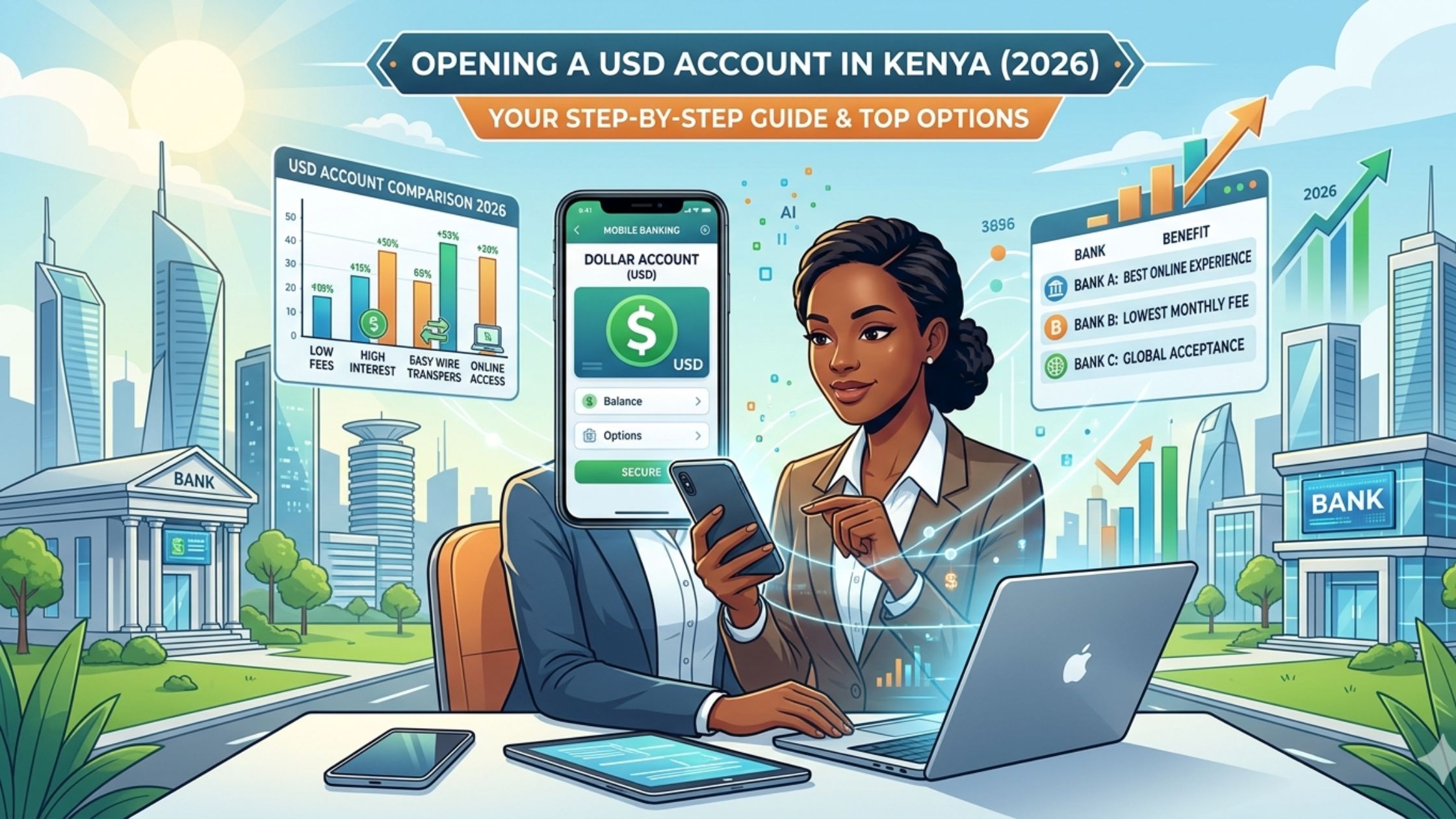
How to Open a Dollar Account in Kenya 2026: Best USD Accounts Compared
A dollar account — formally called a Foreign Currency Account (FCA) — lets you hold, receive, and spend US Dollars without converting them to Kenya Shillings. The money sits in USD until you decide to convert: when the rate is favourable, when you have a USD-denominated expense, or when you want to move it into a KES investment.
The Kenya Shilling has moved significantly against the US Dollar over the past five years — sometimes strengthening, sometimes weakening, always unpredictably. For Kenyans who earn in dollars, receive remittances in dollars, or want to hold savings in a currency that does not depreciate as quickly as the KES, a dollar account in Kenya is the tool that removes the forced conversion problem.
This guide covers the best banks for a dollar account Kenya 2026, what they cost, what documents you need to open one, and the specific situations where a dollar account genuinely saves you money — and the one situation where it does not.
What a Dollar Account Is and How It Actually Works
Before comparing banks, the mechanics matter — because a Foreign Currency Account works differently from a KES savings account in ways that affect every decision you make about it.
What it is. A bank account denominated in US Dollars. Your balance is shown in USD. Money deposited stays in USD until you convert it to KES. Any interest earned is credited in USD.
What it is not. A high-yield savings instrument. USD deposits at Kenyan banks earn approximately 0.5–4% per annum — materially less than KES money market funds earning 10–14%. The value of a dollar account is currency protection, payment flexibility, and rate optionality — not interest income. If you are opening one primarily to earn returns, a KES money market fund will outperform it in most exchange rate scenarios.
How you fund it. International wire transfer from abroad (the most common method), cash deposit in USD notes at the bank’s forex desk, conversion from your KES account at the bank’s selling rate, or via M-Pesa GlobalPay for specific supported transactions.
The Exchange Rate Reality
Every conversion — whether depositing USD or withdrawing KES — involves a spread between the mid-market rate (the real rate you see on XE.com) and your bank’s dealing rate. When you deposit USD, the bank uses the buying rate — what they pay you per dollar, which is lower than mid-market. When you convert USD to KES, the bank uses the selling rate — what they charge you per dollar, which is higher than mid-market. The spread between these rates is typically KES 2–5 per dollar.
On a USD 1,000 conversion, a KES 4 spread costs you KES 4,000 in effective exchange loss. On USD 10,000, the same spread costs KES 40,000. Minimising the number of forced conversions — and timing the ones you do make thoughtfully — is as financially important as choosing the right bank.
SWIFT Codes: What You Need to Receive Dollars from Abroad
This is information that most Kenyan finance articles omit, but every dollar account holder needs it. When someone sends you a USD wire from abroad, they will ask for your bank’s SWIFT/BIC code. Here are the SWIFT codes for every major Kenyan bank offering foreign currency accounts:
| Bank | SWIFT/BIC Code |
|---|---|
| KCB Bank Kenya | KCBLKENX |
| Equity Bank Kenya | EQBLKENA |
| Co-operative Bank | KCOOKENA |
| NCBA Bank Kenya | CBAFKENX |
| Standard Chartered Kenya | SCBLKENX |
| Absa Bank Kenya | BARCKENX |
| Stanbic Bank Kenya | SBICKENX |
| SBM Bank Kenya | STMBKENA |
Keep this table bookmarked — you will use it every time someone sends you an international wire.
Who Actually Needs a Dollar Account — and Who Does Not
Not everyone benefits from a foreign currency account. Being honest about this distinction saves you from opening an account that costs you in fees while earning almost nothing.
You Genuinely Benefit from a Dollar Account If:
You earn income in USD regularly. Upwork freelancers, Fiverr sellers, remote employees paid in USD, and international consultants — receiving USD directly into a dollar account avoids an immediate forced conversion and gives you control over when you convert. Over a year of freelance income, strategic conversion timing versus automatic daily conversion can represent a meaningful difference in effective KES income.
You receive regular USD remittances for a specific purpose. If a family member abroad sends you USD regularly for land purchase, school fees, or business investment, holding in USD until you are ready to pay in KES gives you rate optionality. Converting immediately on arrival means you get whatever rate the bank offers that day — not the most favourable rate you could have achieved.
You have recurring business expenses in USD. Software subscriptions, international supplier payments, import cost settlements, and domain or hosting fees are all USD-denominated expenses. Paying them from a dollar account eliminates a KES-to-USD conversion cost on every transaction.
You are accumulating toward a USD-denominated goal. International university tuition, importing stock from China or the US, or travel savings are all goals where accumulating in USD avoids double conversion loss — converting KES to USD at an unfavourable time when you finally need to pay.
You Probably Do NOT Need a Dollar Account If:
All your income arrives in KES and all your expenses are in KES. In this scenario, a KES money market fund earning 12% per annum beats a USD account earning 1% by a margin that only an extreme and sustained KES depreciation would close. Your money works harder in a KES instrument.
You received a single USD payment and want somewhere to keep it temporarily. Unless more USD income is coming, convert it to KES and put it in a money market fund at 12%. The interest rate differential over even three months more than compensates for any reasonable exchange rate movement.
Best Dollar Accounts in Kenya 2026 — Bank by Bank
Standard Chartered Kenya — Priority Dollar Account
Standard Chartered has long been regarded as the premium option for Kenyan foreign currency accounts. Its international parent gives it correspondent banking relationships that make inbound international wires faster and less prone to correspondent bank delays than most local banks. Minimum balance: USD 1,000–5,000 depending on the account tier. Monthly fee: waived above the minimum balance. Interest rate: approximately 1–2% per annum on USD balances. International wire receipt cost: competitive, particularly for higher-value transfers.
SWIFT: SCBLKENX Verdict: Best for high-balance holders who send and receive international wires frequently. The correspondent network quality justifies the minimum balance requirement for anyone making regular international transactions.
KCB Bank Kenya — Foreign Currency Account
More accessible than Standard Chartered for the mid-market Kenyan customer. Minimum opening balance: approximately USD 500. Monthly maintenance fee: low. KCB’s internet banking and app support FCA management, and the bank’s forex desk at major branches is experienced with FCA transactions. KCB’s large branch network means forex desk access is available outside Nairobi without difficulty.
SWIFT: KCBLKENX Verdict: Best for KCB customers and for Kenyans holding USD 500–5,000. Strong bank with solid FCA infrastructure and reliable wire processing.
Equity Bank Kenya — Foreign Currency Account
Equity offers one of the lower barriers to entry for FCA accounts among major Kenyan banks. Minimum opening deposit: approximately USD 200–500. Monthly fee: moderate. Equity’s vast branch network is less relevant for a USD account (most transactions happen digitally), but the bank’s reliability, large customer base, and mobile banking integration make it a strong and accessible option, particularly for first-time FCA holders.
SWIFT: EQBLKENA Verdict: Best accessible entry point for first-time dollar account holders, or for Kenyans who want an FCA alongside an existing Equity KES account for easy internal transfers.
NCBA Bank Kenya — Foreign Currency Account
NCBA’s digital banking platform is well-regarded, and the bank’s operational relationship with Safaricom (NCBA operates M-Shwari through the M-Pesa ecosystem) makes it a natural fit for Kenyans who want to integrate USD account management with their M-Pesa usage. NCBA also has a strong relationship with international remittance platforms, which can facilitate faster wire receipt from abroad.
SWIFT: CBAFKENX Verdict: Good for tech-savvy Kenyans integrating a USD account with M-Pesa-connected services. Solid digital experience for account management.
Absa Bank Kenya — Foreign Currency Account
Absa’s international parent, Absa Group, gives it strong correspondent banking relationships specifically in the South Africa, UK, and broader African corridors. For Kenyans with regular financial flows to or from South Africa or the UK — business relationships, family connections, or employment — Absa’s network in those markets makes wire transfers smoother and potentially cheaper than routing through banks without those specific relationships.
SWIFT: BARCKENX Verdict: Best for Kenyans with significant UK or South Africa financial relationships. Absa’s correspondent network in those markets is a genuine competitive advantage for that specific use case.
Stanbic Bank Kenya — Foreign Currency Account
Stanbic is the strongest option for business USD accounts, particularly for companies involved in cross-border trade. Trade finance products, Letters of Credit, import/export financing, and structured USD credit facilities are Stanbic’s core competency. For individual savings-oriented dollar accounts, Stanbic is less differentiated.
SWIFT: SBICKENX Verdict: Best for businesses with cross-border trade activity requiring trade finance alongside a USD account. Less focused on individual personal FCA products.
SBM Bank Kenya — Foreign Currency Account
SBM has explicitly marketed competitive interest rates on foreign currency accounts — publishing rates of approximately 4% per annum on USD, 3% on GBP, and 3% on EUR. These are the highest published rates among Kenyan banks for USD deposits, and for dollar account holders who intend to hold significant balances for extended periods without converting, the interest rate differential versus the larger banks is meaningful.
SWIFT: STMBKENA Verdict: Best published USD interest rate among Kenyan banks. If your primary use case is holding a USD balance for medium-term savings rather than frequent transaction processing, SBM’s rate advantage is worth the trade-off of a smaller bank network. Verify current minimum balance requirements and account conditions before opening.
Full Comparison Table
| Bank | Min. Balance (USD) | USD Interest Rate | Monthly Fee | SWIFT Code | Best For |
|---|---|---|---|---|---|
| Standard Chartered | USD 1,000–5,000 | ~1–2% | Waived above min | SCBLKENX | High-balance, frequent wires |
| KCB | ~USD 500 | ~0.5–1% | Low | KCBLKENX | Mid-market, existing KCB clients |
| Equity | ~USD 200–500 | ~0.5% | Moderate | EQBLKENA | Entry-level, first FCA |
| NCBA | ~USD 500 | ~0.5–1% | Moderate | CBAFKENX | Digital-first, M-Pesa integration |
| Absa | ~USD 500 | ~0.5–1% | Moderate | BARCKENX | UK/South Africa corridors |
| Stanbic | ~USD 1,000 | ~0.5–1% | Moderate | SBICKENX | Business trade finance |
| SBM | Verify with bank | ~4% | Low | STMBKENA | Best interest rate on balances |
How to Open a Dollar Account in Kenya — Step by Step
Documents Required
The documents for a Foreign Currency Account are similar to those for a KES account, with one important addition most first-time applicants are not prepared for.
- Passport — preferred over National ID for FCA applications; some banks require a passport specifically for foreign currency accounts due to international banking regulations
- KRA PIN Certificate — required for all bank accounts in Kenya
- Proof of residence — utility bill, bank statement, or tenancy agreement dated within 90 days
- Initial deposit — in USD cash or a confirmed incoming wire
The proof of source of funds requirement. This is where most first-time FCA applicants are caught unprepared. Banks are required under the Proceeds of Crime and Anti-Money Laundering Act (POCAMLA) and CBK regulations to verify where your foreign currency originates. This is standard compliance — not a sign of suspicion toward you personally.
Come prepared with documentation that matches your actual source of USD:
- Upwork or Fiverr freelancers: Print or screenshot your payment history from the platform showing your name, earnings, and payment dates
- Remote employees: Your employment contract or recent payslips showing USD salary
- Diaspora remittances: Transfer records from Wise, Remitly, or your sender’s bank showing the transfer origin
- Business income: Client invoices or export documentation
Being unprepared for this question delays account opening by days. Being prepared means same-day or next-day processing.
Step-by-Step Process
- Call the bank’s forex or international banking desk specifically — not general customer service, which may not have accurate FCA information
- Request the current document checklist for a Foreign Currency Account
- Confirm the current minimum opening balance and any applicable fees
- Gather all documents including source-of-funds evidence
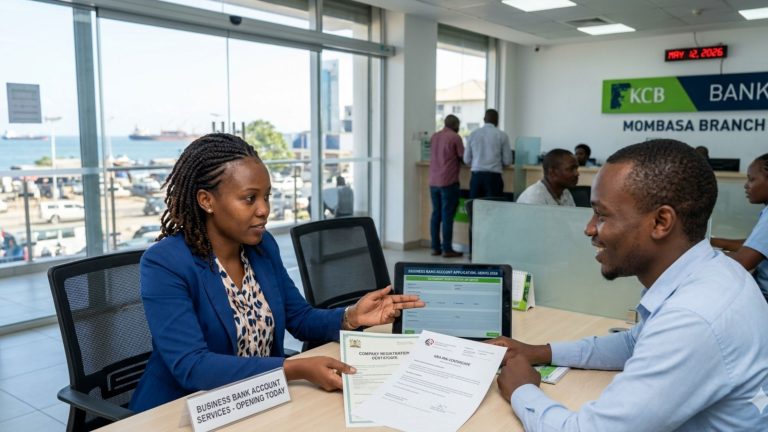
- Visit the bank’s forex desk at a major branch — not a satellite or small branch, which may not process FCA applications
- Complete the FCA application form
- Make your opening deposit in USD cash, or request the bank’s wire receiving details to fund by incoming international transfer
- Receive your account number and internet banking credentials within 3–5 business days
- Confirm your SWIFT code and full account details with the bank — you will need these when providing instructions to anyone sending you an international wire
Receiving USD Into Your Dollar Account
From Upwork and Fiverr
Both platforms support direct bank transfer to Kenyan bank accounts as a payment method. In your platform payment settings, select “Direct to Local Bank” or the equivalent, then enter your bank’s SWIFT code, your account number, and the bank’s address. Upwork typically processes bank withdrawals within 5 business days of request. Fiverr’s revenue card and bank transfer options have similar timelines.
Compare this to the PayPal-to-M-Pesa or Payoneer-to-M-Pesa route that many Kenyan freelancers use: the direct-to-dollar-account route typically involves lower fees over time, particularly for larger amounts, and gives you rate control that immediate M-Pesa conversion does not.
From International Remittances
Wise, Remitly, and WorldRemit all support delivery to Kenyan bank accounts in USD — the sender selects “bank transfer in USD” rather than “M-Pesa delivery.” The flow: sender initiates USD transfer from their foreign account → arrives in your Kenyan dollar account in USD → you convert to KES on your schedule.
This is significantly more efficient than the alternative many diaspora families use: convert to KES abroad → send KES via M-Pesa → KES arrives in Kenya. The double conversion — once abroad and once at the receiving bank — costs more in exchange rate spread than a single conversion at a time of your choosing.
When to Convert Your Dollars — and When to Wait
Convert when you have an immediate KES need. Rent, school fees, staff salaries, supplier payments — convert exactly what you need, when you need it. Never convert more than necessary just because the rate looks good today; it may look better next week.
Hold when the KES is temporarily weak and you have no immediate need. The rate optionality a dollar account provides is its primary value proposition. A week or two of patience during a weak-shilling period can meaningfully improve your KES conversion amount on large balances.
Track the mid-market rate at XE.com or Google. Your bank’s rate will be KES 2–5 lower per dollar than mid-market. When the spread narrows — the gap between mid-market and your bank’s buying rate falls below KES 2 — it is a relatively favourable conversion window.
Dollar account versus money market fund for pure savings: A dollar account paying 1–2% versus a KES money market fund paying 12% — the money market fund wins by 10% per year. For every KES 1,000,000 equivalent in USD that you hold in a dollar account rather than a KES money market fund, you forgo approximately KES 100,000 per year in interest. Only hold USD in a dollar account if you have a specific USD income stream, a USD expense coming, or a particular reason to maintain USD exposure. Move everything else to KES instruments that earn meaningful returns.
Tax Considerations
Income received in USD is taxable in Kenya regardless of whether it arrives in a dollar account or via M-Pesa. Freelance income from Upwork, Fiverr, or any international client paid in USD to a Kenyan dollar account is Kenyan-source income for KRA purposes — it must be declared in your annual individual income tax return. The fact that it arrives in dollars, or sits in a dollar account before conversion, does not change its taxable status.
Interest on USD deposits is subject to withholding tax deducted at source by the bank before crediting to your account. You receive the net amount; no further action is required beyond declaring the gross amount in your annual return if required.
Frequently Asked Questions
Can I open a dollar account in Kenya without a formal job? Yes. Source of funds is the key requirement, not employment status. Freelance income, remittance records, business revenue, or investment proceeds are all acceptable sources. The bank needs to understand where your dollars come from — not that you are employed by a specific company.
What is the minimum amount to open a dollar account? Equity Bank offers entry from approximately USD 200–500. Other banks start from USD 500–1,000. SBM’s minimum varies — confirm directly. There is no Kenyan regulatory minimum, only bank-set policies.
How do I receive Upwork payments into a Kenyan dollar account? In your Upwork account settings under “Get Paid,” select “Direct to Local Bank,” enter your bank’s SWIFT code (see the table in Section 1), your account number, and the bank name and address. Upwork requires a minimum withdrawal amount (currently USD 100) for wire transfers. Processing time is 3–5 business days from withdrawal request.
Do dollar accounts in Kenya earn interest? Yes — but rates are low. Most banks offer 0.5–2% per annum on USD balances. SBM Bank has published rates of approximately 4% per annum. At these rates, a KES money market fund at 12% outperforms by a significant margin unless you have specific reasons to hold USD.
Is my dollar account protected if the bank fails? The Kenya Deposit Insurance Corporation (KDIC) protects deposits up to KES 500,000 per depositor per institution. For a USD account, the protected amount is calculated by converting the KES 500,000 limit to USD at the prevailing exchange rate at the time of a bank failure. At current rates, this equates to approximately USD 3,500–4,000. Balances above this equivalent are not insured — another reason large dollar holdings in a single bank warrant diversification.
What SWIFT code do I give to someone sending me dollars? The SWIFT codes for all major Kenyan banks are in the table at the beginning of this guide. Give the sender your bank’s SWIFT code, your full account number, and the bank’s name and Nairobi branch address. For large international wires, also confirm the intermediary bank details with your forex desk — some international wires route through a correspondent bank before reaching Kenya.
Can I use my dollar account to pay for international subscriptions? Most Kenyan bank dollar accounts issue a USD-denominated debit or prepaid card that works for international online payments — confirm with your specific bank whether a card is available and what the issuance cost is. Alternatively, services like Mpesa GlobalPay and Equity’s Jenga prepaid card provide USD payment functionality without requiring a full FCA.
Conclusion: Open the Right Account for Your Situation
A dollar account in Kenya makes clear financial sense for one type of person: anyone who regularly receives income in USD, has recurring USD expenses, or has a specific USD-denominated goal they are saving toward. For Upwork and Fiverr freelancers, remote workers paid in USD, and Kenyans receiving regular diaspora remittances — a dollar account is a straightforward tool that saves real money on conversion costs and gives you rate control you currently do not have.
For Kenyans earning, saving, and spending entirely in KES, a money market fund at 12% beats a dollar account at 1% by a margin that no reasonable short-term exchange rate movement closes. Open the right account for your situation — not the one that sounds sophisticated.
If you receive USD and do not currently have a dollar account, the one you open this week pays for itself on your next wire transfer.