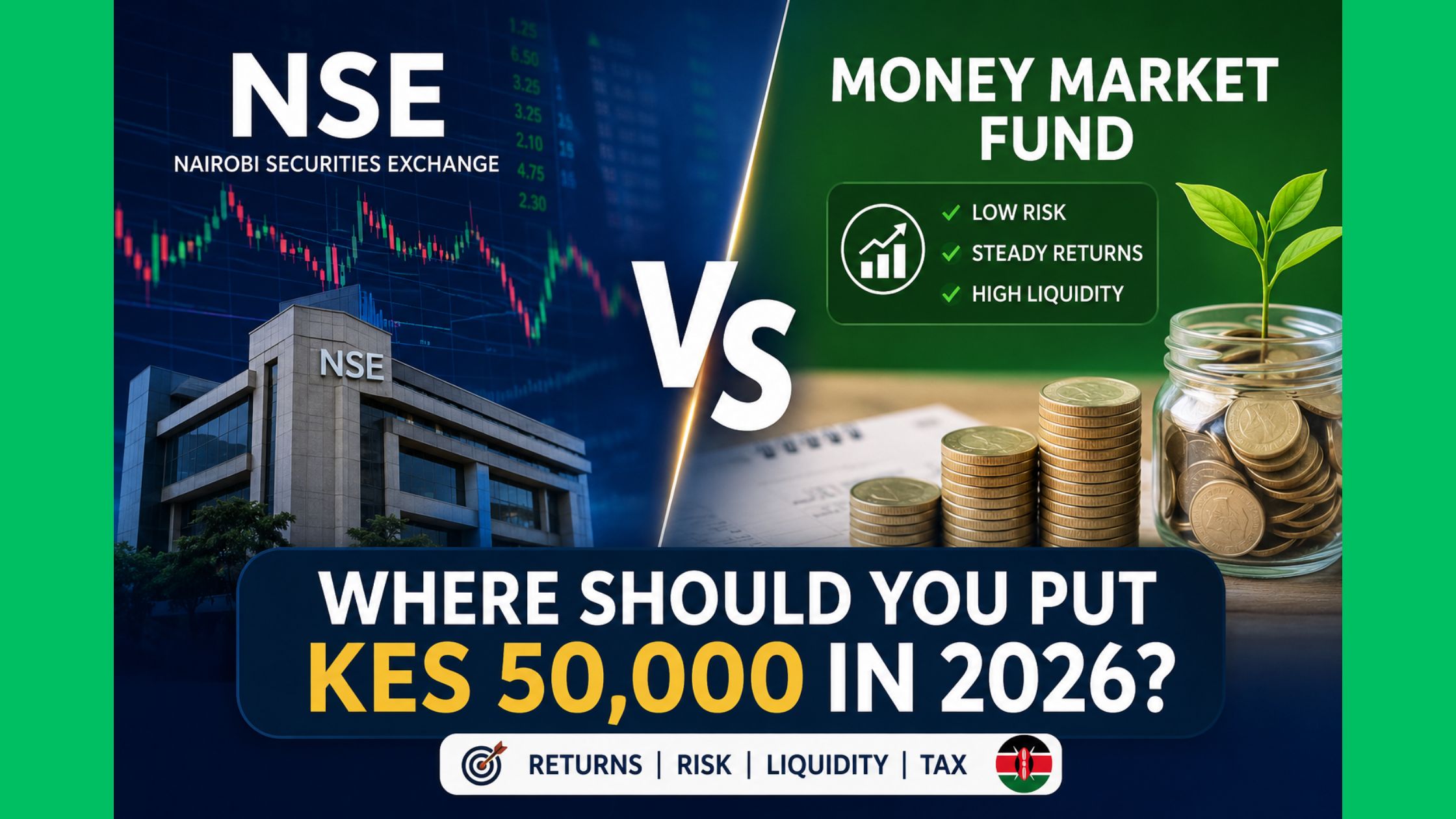
NSE vs Money Market Fund Kenya: Where Should You Put KES 50,000 in 2026?
NSE vs Money Market Fund Kenya. You have KES 50,000 saved. It is sitting in your bank account earning somewhere around 3% per year. You know a money market fund would do better. You have read about NSE stocks paying 9–10% dividends. You cannot decide which one to use — and every article you have read says “it depends on your goals” without actually telling you what to do.
This article gives you the direct answer. Not a hedge. A specific recommendation based on your situation — your timeline, your need for liquidity, and one critical prerequisite that has to come before either investment.
By the end, you will know exactly where to put KES 50,000 in the NSE vs money market fund Kenya debate, and the single factor that determines whether the answer is a money market fund, NSE shares, or both.
The Prerequisite That Must Come First
Before the NSE vs money market fund comparison even begins, there is a more important question.
Do You Have an Emergency Fund?
Before KES 50,000 goes into any investment, confirm you have 2–3 months of living expenses in a liquid, accessible account. If KES 50,000 is your total savings, it is your emergency fund first — and it belongs in a money market fund. Not NSE shares. If a medical emergency, job loss, or unexpected expense forces you to sell shares at the wrong moment, you lock in a loss that could have been entirely avoided.
If KES 50,000 is your emergency fund: put it all in a money market fund. CIC, Sanlam, or ICEA LION will do. Come back to this article once you have saved another KES 50,000 on top of that.
If KES 50,000 is surplus above your emergency fund: continue reading.
Do You Have Expensive Debt?
Before investing anything, check whether you are carrying M-Shwari debt at 90% annualised, Tala debt at 180% annualised, or any high-interest mobile loan balance. Paying off that debt is a guaranteed, risk-free return that no investment can match. Clearing a loan charging 90% per year is equivalent to earning 90% on your money — an outcome no NSE stock or money market fund can offer. Clear expensive debt first, then invest.
What Each Option Actually Returns — Real Shilling Numbers
Percentages are easy to quote and hard to feel. Here is what KES 50,000 actually produces in each option over three years and ten years, in real shillings you can count.
KES 50,000 in a Money Market Fund (3 Years)
Using a representative 12% per annum return from an established fund manager such as CIC, Sanlam, or ICEA LION:
| Year | Balance |
|---|---|
| Start | KES 50,000 |
| Year 1 | KES 56,000 |
| Year 2 | KES 62,720 |
| Year 3 | KES 70,246 |
Total return: KES 20,246 (40.5% total return over 3 years)
- Risk of losing money: essentially zero — money market funds in Kenya invest in government securities and have never lost principal
- Access to funds: 1–3 business days at any time, no penalties
KES 50,000 in NSE Blue-Chip Shares (3 Years)
Using a stock with a 9% dividend yield — consistent with KCB, Equity, or Co-operative Bank — and a conservative 5% annual share price appreciation:
| Year | Dividend (net after 5% WHT) | Share Value |
|---|---|---|
| Year 1 | ~KES 4,275 | KES 52,500 |
| Year 2 | ~KES 4,489 | KES 55,125 |
| Year 3 | ~KES 4,713 | KES 57,881 |
- Total dividends collected: ~KES 13,477
- Capital gain: KES 7,881
- Total return: ~KES 21,358 (42.7% over 3 years)
- Risk of losing money: yes — if share prices fall 15%, the capital loss partially offsets dividend income
- Access to funds: can sell during trading hours, but prices fluctuate and selling during a dip locks in losses
The Honest Finding at 3 Years
Over three years, NSE blue-chip shares slightly outperform a money market fund on total return — but with meaningfully more risk and less liquidity. The money market fund delivers a near-identical return with zero risk to capital. For a short-to-medium horizon, this is a coin flip that the money market fund wins on a risk-adjusted basis.
The 10-Year Picture Is Where NSE Wins Decisively
The 3-year comparison is close. The 10-year comparison is not. At 10 years, compounding dividends reinvested into additional NSE shares, combined with long-run share price appreciation driven by earnings growth, produces materially higher wealth than a money market fund. Historical NSE blue-chip total returns over 10-year periods — including dividends reinvested — have consistently outperformed money market funds by a significant margin.
The money market fund’s 12% is relatively fixed — it moves with Central Bank Rate conditions. NSE equity returns compound on themselves as dividends buy more shares that pay more dividends.
The conclusion from the numbers: for under 3 years, money market fund. For 10 years, NSE shares — by a wide margin.
The Decision Framework: Which One Is Right for You
Choose a Money Market Fund If:
You might need the money within 2 years. Any financial goal with a timeline under two years belongs in a money market fund. Share price volatility over 24 months can produce a loss that wipes out your returns. A money market fund does not lose value — it compounds steadily regardless of market conditions. If you are saving for a business, a house deposit, a car, or a specific purchase, use a money market fund and sleep soundly.
You are investing for the first time. Starting with a money market fund lets you experience the mechanics of investing — watching returns credited to your account, understanding how compounding works — without the anxiety of price fluctuations. Build the habit and the confidence first, then add equities once you understand what you own.
You have a specific target amount on a specific future date. Shares cannot guarantee their value on a named future date. A money market fund can. If the number matters more than the return, use the money market fund.
Choose NSE Shares If:
You have at least 3 years before you need the money — preferably 5 or more. The longer the horizon, the more decisively NSE shares outperform. A 10-year NSE holding period has historically been very difficult to lose money on with blue-chip stocks — and has typically produced returns that significantly beat money market funds.
You already have a money market fund for your emergency fund and short-term savings. This KES 50,000 must genuinely be surplus — money you will not need regardless of what happens over the next few years. If that condition is met, equities are the right vehicle for long-term wealth building.
You are comfortable with price fluctuations. An investor who checks their portfolio daily and feels panic when prices drop 10% will make worse decisions — selling low, buying high, disrupting the compounding process — than one who checks quarterly, stays calm, and does nothing. Be honest about your psychology before choosing equities.
The Combination That Works for Most Young Kenyans
For most readers of this article, the right answer is neither pure money market fund nor pure NSE shares. It is both.
Split KES 50,000 as follows:
- KES 30,000 → money market fund — accessible, compounding, zero risk, available when you need it
- KES 20,000 → NSE blue-chip shares — long-term wealth building, dividend income, real equity ownership
This allocation gives you stability and access from the money market portion, and long-term growth and income from the equity portion. As your income grows and you accumulate more savings, increase the NSE allocation progressively. The money market fund absorbs short-term savings needs; the NSE portfolio compounds over the long term.
How Each Is Taxed in Kenya
Most young investors do not think about tax before they invest. Here is what you need to know.
Money market fund returns are subject to 15% withholding tax on the underlying interest earned from government securities. This is deducted by the fund before declaring your return — meaning the 12% rate quoted to you is already net of this tax. No additional filing is required; you simply earn what is quoted.
NSE dividend income attracts 5% withholding tax for resident Kenyan investors, deducted automatically at source before the dividend is paid to your account. You receive the net amount with no further action needed.
Capital gains on NSE shares are currently zero — you keep 100% of any profit from selling shares above your purchase price. This is a significant and often overlooked advantage of NSE investing over other asset classes.
The net tax position slightly favours NSE shares: 5% WHT on dividends versus the effective 15% embedded in money market fund returns. Not the most important factor in your decision — but worth knowing.
How to Start: Step-by-Step for Each Option
Starting a Money Market Fund with KES 50,000
- Choose a fund manager — CIC Asset Management, Sanlam Investments, or ICEA LION are the established, regulated options
- Register online at the fund manager’s website using your national ID and KRA PIN
- Receive your account details and Paybill number via email
- Send KES 50,000 from your M-Pesa to the fund via Paybill
- Your investment starts earning the next business day
- Track your balance on the fund manager’s app or web portal
Total time: approximately 30 minutes. No branch visit required.
Buying NSE Shares with KES 50,000
- Open a CDS account through a licensed broker — Hisa (hisa.app) is the fastest fully digital option for Kenyan investors
- Complete digital identity verification using your ID and KRA PIN
- Deposit KES 50,000 to your broker’s account via bank transfer
- During NSE trading hours (9:30am–3:00pm on weekdays), place a buy order for your chosen stock
- Shares settle in your CDS account within 3 business days
Total time: 3–5 business days for account setup; under 5 minutes to place your first trade.
The Most Common Mistakes to Avoid
Investing before building your emergency fund. If KES 50,000 is everything you have, invest it in a money market fund and label it as your emergency fund — not your investment portfolio. These are different things.
Buying NSE shares for a 12-month goal. Share prices in 12 months may be higher or lower than today. Never put money in equities that you need on a specific near-term date. This is the single most common investing mistake made by young Kenyans.
Choosing a fund based on last year’s returns. Money market fund rates move with the Central Bank Rate. A fund that paid 14% last year may pay 10% this year if the CBR drops. Compare management fees, fund size, and the fund manager’s regulatory track record — not just the most recent headline rate.
Receiving dividends and spending them. Most Kenyan dividend investors spend the dividends they receive. The investors who build real wealth reinvest dividends — using them to buy more of the same shares, which then pay larger dividends the following year. This reinvestment cycle is the mechanism that drives the majority of long-term NSE wealth accumulation.
Selling NSE shares when prices fall. The instinct to sell a falling stock is the opposite of what creates returns. Quality blue-chip companies — KCB, Equity, Safaricom — have recovered from every major market downturn in Kenyan history. Selling during a dip locks in a loss that would have recovered given time. If you cannot hold through a 20% decline without panicking, size your NSE position accordingly.
Frequently Asked Questions
Can I have both an NSE account and a money market fund? Yes — and you should. These are complementary, not competing. The money market fund handles your short-term and accessible savings; the NSE account builds long-term wealth and dividend income. Most financially healthy young Kenyans have both.
What is the minimum to invest in a money market fund in Kenya? Some fund managers accept as little as KES 100. KES 50,000 is more than sufficient to open any account and begin earning immediately.
What is the minimum to buy NSE shares? Following the single-unit trading policy change on the NSE, the minimum is essentially one share — which can cost a few hundred shillings for some stocks. KES 50,000 buys a meaningful position in most blue-chip counters.
Is a money market fund safer than NSE shares? Yes. Money market funds in Kenya invest primarily in government securities and have never lost principal. NSE share prices fluctuate — they can and do fall. Safety and return potential are the trade-off you are choosing between.
Which gives better returns — NSE or a money market fund? NSE equities over a 10-year horizon, by a significant margin. Money market funds for timelines under 3 years, by a significant margin in risk-adjusted terms. Timeline is the determining variable.
What happens to my money market fund if the fund manager company fails? Your money is held in custodian accounts — separate from the fund manager’s own assets, held by a licensed custodian bank. Even if the fund management company fails, your funds are protected and can be transferred to another manager. This protection is a regulatory requirement in Kenya.
The Direct Answer
If you need the KES 50,000 within 3 years: put it all in a money market fund with CIC, Sanlam, or ICEA LION. You will earn reliably, sleep soundly, and have full access when you need it.
If you can genuinely leave it for 5 years or more: split it. KES 30,000 to a money market fund for stability and access, KES 20,000 to NSE blue-chip shares — KCB, Equity, or Safaricom — for long-term growth and dividend income that compounds over time.
The NSE vs money market fund Kenya debate is not complicated. What makes it feel complicated is the paralysis of deciding rather than the decision itself. KES 50,000 in a money market fund today earns more in its first month than your current bank savings account earns in a year. The compounding begins the day you start.
Start this week. Come back in five years and check the numbers.