
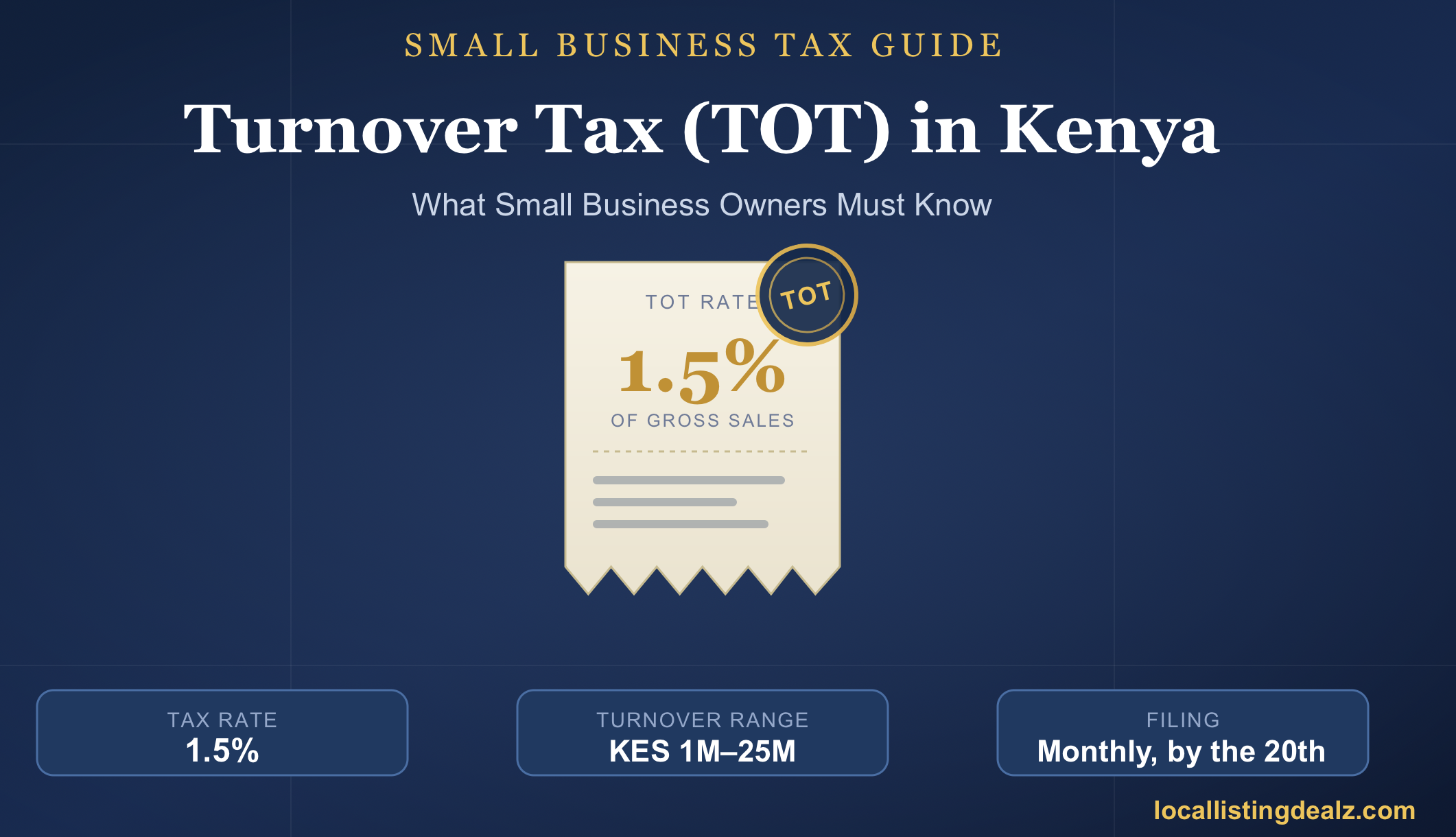
Turnover Tax (TOT) in Kenya: What Small Business Owners Must Know
Turnover Tax (TOT) in Kenya is a simplified tax charged on your total sales, not your profit. If your business turns over between KES 1,000,000 and KES 25,000,000 a year, KRA almost certainly expects you to be paying it, whether you’ve registered for it or not.
Many small business owners in Kenya either don’t know TOT applies to them, or assume it works the same way as VAT or regular income tax. It doesn’t. Here’s exactly who pays it, how much, and the filing rules that trip people up.
What Is Turnover Tax (TOT) in Kenya?
Turnover Tax is a tax on your gross sales, charged under Section 12(C) of the Income Tax Act. It applies to resident individuals, sole proprietors, partnerships and companies whose annual turnover is more than KES 1,000,000 but does not exceed KES 25,000,000.
It’s designed for small traders who don’t keep detailed accounting records. Instead of calculating profit and claiming expenses like a normal business, you simply pay a flat percentage of what you sell.
Turnover Tax Rate in Kenya: How Much Do You Pay?
The current TOT rate is 1.5% of gross sales, effective July 1, 2023, under the Finance Act 2023. This applies to your total sales for the month, before any deductions.
There’s an important catch: no expenses are deductible under TOT. It doesn’t matter how much you spent on stock, rent, or salaries. You pay 1.5% of what came in, full stop. TOT is also a final tax, meaning once you’ve paid it, that income isn’t taxed again and you don’t file a separate annual income tax return for it.
The rate has moved before. It was cut from 3% to 1% in 2020, then raised back to 3% briefly, before settling at the current 1.5% in mid-2023. Always check KRA’s official TOT page for the current figure before filing, since Finance Bills can change it again.
Who Must Pay Turnover Tax?
You’re eligible for TOT if your actual or expected annual turnover falls between KES 1,000,000 and KES 25,000,000. This threshold changed in 2023: it used to run up to KES 50,000,000 before the Finance Act 2023 lowered the ceiling to KES 25,000,000.
If your turnover is below KES 1,000,000, you’re exempt from TOT altogether. If it exceeds KES 25,000,000, you move into the regular corporate or individual income tax regime instead, with normal profit-based taxation and expense deductions.
Watch your numbers closely if you’re near the KES 25 million ceiling. KRA can audit your turnover and back-charge you if you exceeded the limit while still filing under TOT.
What’s Exempt From Turnover Tax?
TOT does not apply to:
- Rental income — taxed separately under Monthly Rental Income tax
- Management, professional or training fees — this exempts consultants, lawyers, doctors, accountants and trainers from TOT specifically
- Income already subject to final withholding tax — such as qualifying dividends or qualifying interest
- Non-resident taxpayers
If your business earns professional or consulting fees, don’t assume TOT applies just because your turnover fits the range. That income category is carved out entirely, and you’d fall under the standard income tax rules instead.
Turnover Tax vs VAT: Do You Need Both?
TOT and VAT are separate taxes, and registering for one doesn’t exempt you from the other. If you’re TOT-registered and dealing in VAT-able supplies, and your turnover reaches KES 5,000,000 or more, you must also register for VAT.
That means a growing business can end up filing both TOT and VAT simultaneously once it crosses that KES 5 million mark, until its turnover eventually exceeds KES 25 million and it exits TOT altogether. Our guide to registering a business in Kenya covers the VAT threshold in the context of setting up correctly from day one.
How to Register for Turnover Tax
Registration happens entirely online through iTax:
- Log in to iTax using your KRA PIN and password.
- Go to the Registration module and select “Amend PIN Details.”
- Under Section A (Basic Information), answer “Yes” to “Do you want to register for TOT?”
- Under Section B (Obligation Details), select your TOT registration date and submit.
You need a KRA PIN before any of this works. If you haven’t registered for one yet, see our guide to getting a KRA PIN in Kenya.
You can opt out. If you’d rather be taxed under the normal Income Tax Act instead of TOT, you can write to the KRA Commissioner requesting exemption, even if your turnover falls within the TOT band.
Turnover Tax Filing Deadline and Penalties
TOT returns and payments are due on or before the 20th day of the month following the end of the tax period. In practice, this means monthly filing: January’s TOT is due by February 20, and so on.
To file:
- Log in to iTax, go to Returns, select “File Return,” then “Turnover Tax,” and download the Excel return template.
- Complete it and submit.
- Go to the Payment menu, select the amount payable, and generate a payment slip.
- Pay at a KRA-partner bank, or through the KRA M-Service App.
Penalties for missing deadlines add up fast:
| Violation | Penalty |
|---|---|
| Late filing of TOT return | KES 1,000 per month |
| Late payment of tax due | 5% of the tax due |
| Interest on unpaid tax | 1% per month on the outstanding balance |
Because TOT has no expense deductions, the tax due is straightforward to calculate, which makes missed deadlines and penalties even less excusable to KRA in an audit.
Why TOT Uptake Has Stayed Low, and What’s Changing in 2026
Despite being designed to simplify tax for small traders, TOT has struggled to gain traction. Only about 30,000 businesses were registered under TOT as of the 2023/24 financial year, collecting just KES 391 million, even after the rate cut from 3% to 1.5%.
Part of the friction has been that TOT-registered businesses have also faced quarterly installment tax obligations on top of their monthly TOT filings, undermining the “simplified” pitch. In its 2026 tax outlook, KRA has signalled plans to exempt micro and small businesses from these quarterly installment requirements and from generating separate payment registration numbers under TOT, specifically to ease compliance. Confirm the current rules on KRA’s TOT page before filing, since this reform was still being rolled out as of early 2026.
Benefits of Turnover Tax for Small Businesses
Despite the low uptake, TOT has real advantages for the right kind of business:
- Minimal record-keeping. You only need daily gross sales and purchase records, not full profit-and-loss accounting.
- Simple, predictable payments. No calculating allowable deductions, capital allowances, or profit margins.
- Mobile-friendly filing and payment, including through the KRA M-Service App.
- No annual income tax return on TOT-covered income, since it’s a final tax.
The tradeoff is that TOT can cost you more than profit-based tax if your margins are thin, since you’re taxed on sales regardless of how much you actually kept. A business with high turnover but low margins should run the numbers both ways, or consider writing to KRA to opt out.
How TOT Fits Into Setting Up Your Business
If you’re still in the early stages of formalising your business, TOT is one piece of a bigger compliance picture. Start with our guides on how to register a business in Kenya and how to write a business plan in Kenya to get the fundamentals right before your turnover grows into TOT territory. If your income includes rental property, that’s taxed separately.
Frequently Asked Questions
What is the current Turnover Tax rate in Kenya? 1.5% of gross sales, effective since July 1, 2023, under the Finance Act 2023.
Who is eligible for Turnover Tax in Kenya? Resident individuals, sole proprietors, partnerships and companies with annual turnover between KES 1,000,000 and KES 25,000,000.
Can I deduct business expenses under Turnover Tax? No. TOT is charged on gross sales with no expense deductions allowed, and it’s a final tax.
Is Turnover Tax filed monthly or quarterly? Monthly. Returns and payment are due by the 20th day of the month following the tax period.
Do consultants and professionals pay Turnover Tax? No. Management, professional and training fees are specifically exempt from TOT, along with rental income and income already subject to final withholding tax.
Do I need to register for VAT as well as TOT? Yes, if your turnover reaches KES 5,000,000 or more and you deal in VAT-able supplies, you must register for VAT in addition to TOT.
What happens if I file TOT late? Late filing costs KES 1,000 per month. Late payment adds a 5% penalty on the tax due, plus 1% monthly interest on any unpaid balance.
Can I opt out of Turnover Tax? Yes. You can write to the KRA Commissioner requesting to be taxed under the standard Income Tax Act instead, even if your turnover falls within the TOT range.
This article is for educational purposes only and does not constitute tax or legal advice. Tax rates, thresholds and rules can change through annual Finance Acts — confirm current details with KRA or a licensed tax agent before filing.