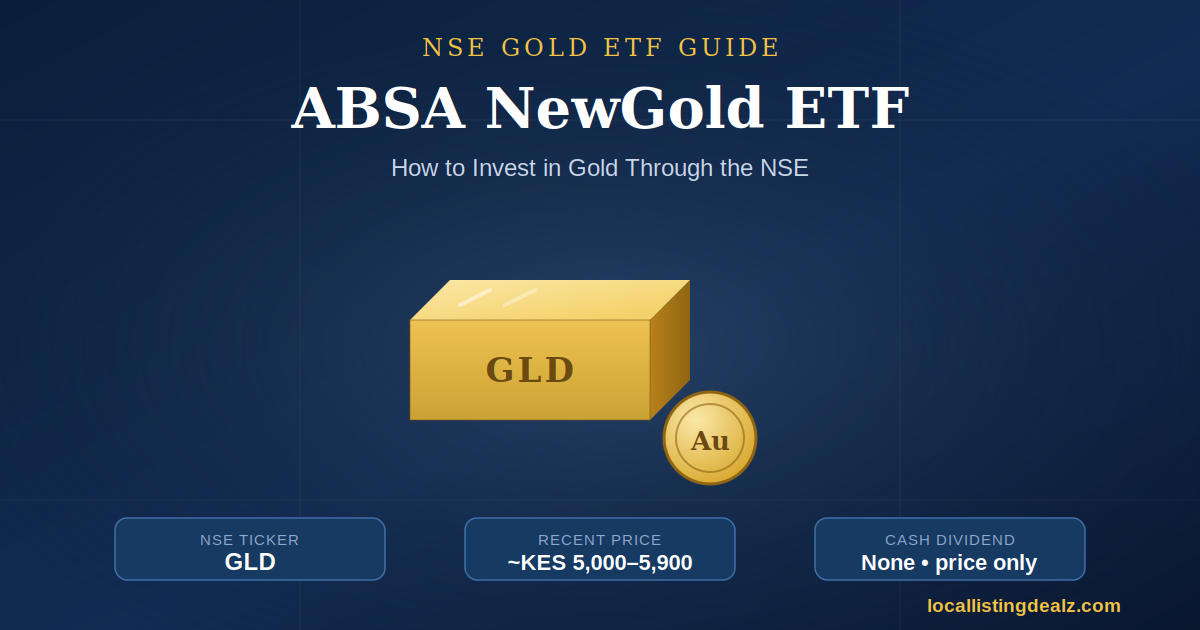
ABSA NewGold ETF: How to Invest in Gold Through the NSE
The ABSA NewGold ETF lets you invest in gold on the Nairobi Securities Exchange, without buying bars, coins or jewellery. It trades under the ticker GLD, and it’s the only gold-backed investment listed on the NSE.
Gold has had an extraordinary run since 2025, and GLD’s unit price has followed it up. Here’s how the ETF works, what it has done recently, and what to weigh before you buy it.
What Is the ABSA NewGold ETF?
The ABSA NewGold ETF is an exchange-traded fund that tracks the spot price of gold bullion, converted into Kenyan shillings. It listed on the NSE in March 2017, becoming Kenya’s first commodity-linked ETF, cross-listed from the Johannesburg Stock Exchange.
Each unit represents about 1/100th of an ounce of physical gold, held in secure vaults by a custodian bank. The fund is fully backed by real gold bullion, not a promise or a derivative contract.
You buy and sell GLD exactly like a share, through a stockbroker, using your CDS account. It settles on the NSE the same way any other listed security does.
How the ABSA NewGold ETF Works
GLD’s unit price moves with two things: the international gold price in US dollars, and the KES/USD exchange rate. When gold rises in dollar terms, or the shilling weakens against the dollar, the ETF’s price in KES tends to rise. Both moving together can amplify gains, or losses.
It pays no dividend. Unlike shares in a company, GLD “capitalises” its returns. Gold’s price gains show up in the unit price itself, not as a cash payout. If you’re comparing it to dividend-paying NSE stocks like the ones in our best dividend stocks in Kenya guide, understand that GLD is a pure price-appreciation play, not an income investment.
ABSA NewGold ETF Price: How Big Has the Gold Rally Been?
GLD listed at roughly KES 1,200 per unit in 2017. It traded around KES 1,975 at the start of 2024. By August and September 2026, it had climbed to somewhere in the KES 5,000 to KES 5,900 range, depending on the day and data source.
That surge tracks one of the biggest gold rallies in history. Spot gold broke above $4,000 an ounce for the first time in October 2025, then went parabolic, hitting an all-time high near $5,500 an ounce in late January 2026. A sharp correction followed, pulling gold down to around $3,994 by June 2026, before it stabilised in the $4,300 to $4,600 range through August and September 2026.
GLD’s KES price reflects that same volatility, amplified further by shilling movements. If you’re buying now, you’re buying near record levels, not at a discount.
Is the ABSA NewGold ETF a Good Investment?
Gold’s appeal is what it isn’t tied to. It doesn’t depend on a Kenyan company’s profits, Kenyan interest rates, or the health of the NSE. Investors typically hold it to diversify away from local shares and bonds, and as a hedge against a weakening shilling or global uncertainty.
Reasons investors buy it:
- Diversification. Gold often moves differently from stocks and Kenyan government bonds.
- Currency hedge. A weaker shilling tends to push GLD’s KES price up, even if the dollar gold price is flat.
- Regulated and physically backed. You’re not relying on an unlicensed dealer or worrying about storing bullion yourself.
- No purity or storage risk. Unlike buying physical gold jewellery or bars, there’s no risk of being sold underweight or fake gold.
Reasons to be cautious:
- No income. GLD pays no dividend. Your only return is a price gain, if it comes.
- Gold is volatile. The 27% correction from January’s peak to June’s low in 2026 shows how sharply gold can swing, even within one year.
- Thin trading. GLD trades far less often than blue-chip NSE stocks like Safaricom or EABL. Large orders can move the price, and buying or selling quickly at a fair price isn’t guaranteed.
- Currency risk cuts both ways. If the shilling strengthens while gold is flat or falling in dollar terms, GLD’s KES price falls too.
- Management fee. Like all gold ETFs, GLD deducts a small annual fee (paid in gold, reducing the amount each unit represents over time) to cover storage, insurance and administration.
How Much Does It Cost to Buy the ABSA NewGold ETF?
At a unit price in the KES 5,000 to KES 5,900 range, GLD is one of the more expensive securities per unit on the NSE. Compare that to a Safaricom share at well under KES 50, or an EABL share at under KES 300.
That means even a small position requires more capital upfront than most NSE shares. Check the minimum order size with your broker, since NSE lot rules can differ from ordinary equities.
Tax Treatment: Is GLD Taxed Like a Share?
Yes. GLD trades on the NSE like an ordinary listed security, and NSE-listed securities are exempt from capital gains tax in Kenya. Instead, trades are subject to the standard NSE transaction levy, the same as buying or selling any listed share.
Because GLD pays no dividend, there’s no dividend withholding tax to worry about either. Your only tax consideration is the transaction levy paid when you buy and sell.
How to Buy the ABSA NewGold ETF
- Open or use your CDS account. New to the NSE? Start with our NSE trading guide or how to buy shares in Kenya.
- Fund your trading account through your broker, by bank transfer or mobile money, depending on the platform.
- Search for GLD on your broker’s trading platform and check the live quote before ordering, since gold prices move throughout the day.
- Place your order, keeping in mind the higher per-unit cost compared to most other NSE stocks.
- Confirm settlement through your CDS account after the trade, as with any NSE purchase.
ABSA NewGold ETF vs Other Ways to Own Gold
The NewGold ETF isn’t the only way to get gold exposure in Kenya, but it’s the simplest regulated route on the stock market.
- Physical gold (bars, coins, jewellery): Requires storage and insurance, carries purity and scam risk, and is harder to sell quickly at a fair price. Always buy from a Ministry of Mining-licensed dealer.
- ABSA NewGold ETF (GLD): Regulated, exchange-traded, no storage needed, but pays no income and can be thinly traded.
- NSE dividend stocks: Pay cash income but carry company-specific and local-market risk. See our blue-chip stocks guide for options.
Most financial advisers treat gold as a small diversifier, not a core holding. Treat GLD the same way: a portion of a broader portfolio, not the whole thing.
Frequently Asked Questions
What is the ABSA NewGold ETF? It’s an exchange-traded fund listed on the NSE under the ticker GLD. Each unit tracks the price of about 1/100th of an ounce of physical gold, priced in Kenyan shillings.
Does the ABSA NewGold ETF pay a dividend? No. GLD capitalises its returns, meaning gold price gains show up in the unit price rather than as a cash payout.
How do I buy the ABSA NewGold ETF? Through any licensed NSE stockbroker, using your CDS account, the same way you’d buy any listed share. Search for the ticker GLD.
Is the ABSA NewGold ETF taxed like a share? Yes. It’s exempt from capital gains tax, like other NSE-listed securities, and subject instead to the standard NSE transaction levy.
Is the ABSA NewGold ETF a good investment right now? It depends on your goals. Gold has already rallied hard, from around KES 1,975 a unit in early 2024 to roughly KES 5,000-5,900 by September 2026, so you’d be buying near record levels. It can still make sense as a small diversifying holding, but it’s not a substitute for income-generating investments.
Is the ABSA NewGold ETF backed by real gold? Yes. It’s fully backed by physical gold bullion held with a secure custodian, not a paper promise or derivative.
This article is for educational purposes only and is not financial advice. Gold and currency prices are volatile and can change quickly. Confirm current prices and details with your stockbroker, ABSA Kenya and the NSE before investing.