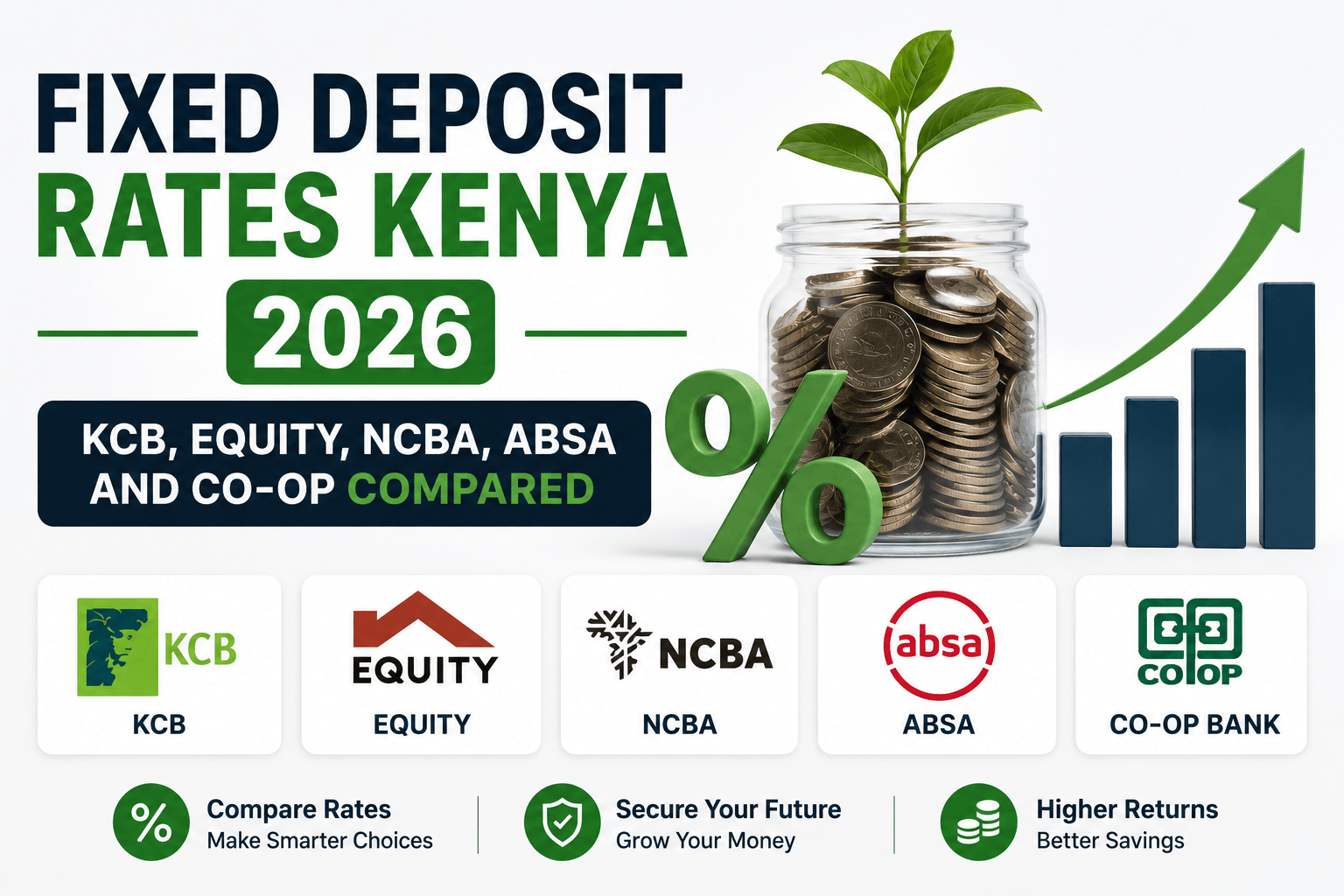
Fixed Deposit Rates Kenya 2026 — KCB, Equity, NCBA, Absa and Co-op Compared
Fixed deposit rates in Kenya in 2026 range from 2.00% to 8.64% — depending entirely on which bank you walk into. Every major Kenyan bank offers a fixed deposit, but only one beats the average money market fund. Here is the honest bank-by-bank comparison, with real 2026 rates, a full net earnings table, and a plain-English verdict on which bank to use and when.
If you have a lump sum sitting in a savings account earning 3% and you are wondering whether to move it into a fixed deposit or a money market fund, this guide gives you the exact numbers to make that decision confidently.
Table of Contents
- What Is a Fixed Deposit in Kenya — and How Does It Work?
- Fixed Deposit Rates Kenya 2026 — Bank-by-Bank Comparison
- Fixed Deposit vs Money Market Fund — The Real Comparison
- Kenya Fixed Deposit Earnings Table — How Much You Actually Earn
- How to Open a Fixed Deposit in Kenya — Step by Step
- Which Bank Has the Best Fixed Deposit Rate in Kenya? Decision Guide
- Frequently Asked Questions
What Is a Fixed Deposit in Kenya — and How Does It Work?
A fixed deposit — also called a term deposit or call deposit — is a savings product where you lock a lump sum of money with a bank for a predetermined period in exchange for a fixed, agreed interest rate. The fixed deposit rates Kenya banks advertise are the gross annual rates — your actual net return is lower after the 15% withholding tax that applies to all deposit interest. The bank pays you interest at the end of the term, and your principal is returned in full.
The four key terms you need to understand before opening one:
Term: The length of time you commit your money. Kenyan banks typically offer 1-month, 3-month, 6-month, and 12-month fixed deposits. Some offer longer terms on request. The longer the term, generally the higher the rate — though this varies by bank.
Minimum deposit: The smallest amount you can place. This ranges from a remarkably low KES 500 at KCB to KES 100,000 at NCBA and Standard Chartered. The minimum directly determines which banks are accessible to you.
KDIC insurance: This is the single most important advantage a fixed deposit holds over a money market fund. The Kenya Deposit Insurance Corporation (KDIC) insures deposits at licensed Kenyan banks up to KES 500,000 per depositor per institution as of 2026. If the bank fails, your deposit is guaranteed to that amount. Money market funds — even the best-managed ones — carry no equivalent government insurance.
Early withdrawal penalty: This is the most important rule to understand before committing. Most Kenyan banks apply a severe penalty for breaking a fixed deposit before its maturity date — and “severe” often means forfeiting 100% of the interest you would have earned. You receive your principal back, but with zero return on the period you held it. KCB, Absa, NCBA, I&M, and Co-operative Bank all apply this strict zero-interest penalty for early withdrawal. Equity Bank is the notable exception — it allows premature withdrawal with a reduced rather than eliminated interest payment, which is why its product attracts liquidity-conscious savers despite offering a lower rate.
Withholding tax: Fixed deposit interest in Kenya is subject to 15% withholding tax, deducted automatically by the bank before the interest is paid to you. You do not need to file anything separately — the bank handles it. All earnings figures in this article are stated after this 15% deduction unless otherwise noted.
Fixed Deposit Rates Kenya 2026 — Bank-by-Bank Comparison
The table below shows every confirmed fixed deposit rate Kenya banks are offering in 2026, ranked from highest to lowest. Published rates range from 2% at Standard Chartered to 8.64% at NCBA. Several banks — including Stanbic, DTB, and Family Bank — do not publish rates at all. If you are depositing KES 500,000 or more, call the bank’s treasury desk directly — you may get rates above the published sheets.
Here is the full bank-by-bank breakdown, ranked by published 12-month rate:
| Bank | Published Rate (12-month) | Minimum Deposit | Early Withdrawal Penalty |
|---|---|---|---|
| NCBA Group | 8.64% | KES 100,000 | Strict — forfeit all interest |
| KCB Bank | 6.30% | KES 500 | Strict — forfeit all interest |
| Absa Kenya | ~6.50% | KES 50,000 | Strict — forfeit all interest |
| I&M Bank | ~6.50% | KES 50,000 | Strict — forfeit all interest |
| Diamond Trust Bank | ~5.00% | KES 100,000 | Moderate — partial interest loss |
| Stanbic Holdings | ~4.70% | KES 20,000 | Strict — forfeit all interest |
| Co-operative Bank | ~4.50% | KES 50,000 | Strict — forfeit all interest |
| Equity Bank | ~2.00% | KES 50,000 | Flexible — reduced interest paid |
| Standard Chartered | ~2.00% | KES 100,000 | Strict — forfeit all interest |
| Family Bank | Negotiable | KES 30,000 | Confirm at branch |
| HF Group | Negotiable | KES 50,000 | Confirm at branch |
All rates sourced from bank product pages, verified March 2026 via Serrari Group fixed deposit comparator. Rates are indicative — confirm with the specific bank before placing a deposit.
NCBA Group — Best Published Rate
NCBA Group PLC provides a yield of 8.64% with a KES 100,000 minimum and a term of more than one month. The penalty is strict — if you withdraw early, you lose all the interest. At 8.64%, NCBA is the only Kenyan bank whose published fixed deposit rate comes close to matching the average money market fund yield. The KES 100,000 minimum rules it out for smaller savers, but for anyone placing a meaningful lump sum for 12 months, this is where to start.
KCB Bank — Best for Accessibility
KCB Group Ltd offers a 6.30% yield and requires a much lower minimum deposit of just KES 500. However, if you decide to take out your money before the end of a 12-month term, you forfeit all the interest. The KES 500 minimum is the lowest of any major Kenyan bank — making this genuinely accessible to a first-time saver building a fixed deposit habit. The rate is lower than NCBA but the entry point is 200 times smaller.
Absa Bank Kenya Fixed Deposit Interest Rates: The 6.50% Mid-Tier Option
Absa Bank Kenya offers a competitive published fixed deposit rate of approximately 6.50% per annum for a 12-month term, with an accessible minimum deposit of KES 50,000. Like many traditional term deposits in Kenya, the early withdrawal penalty is strict—if you break the commitment before maturity, you forfeit all the accrued interest.
However, for serious savers focused on maximizing yield, it is crucial to look beyond standard term deposits. While standard Absa fixed deposit interest rates in Kenya hover around 6.50%, the bank has aggressively increased the yield on its Absa Digital Savings Account, which recently offered interest rates up to 10% per annum for qualifying balances.
If liquidity is a priority alongside wealth building, the digital savings route often outperforms traditional fixed account interest rates by offering higher returns without locking your capital away for a full year.
I&M Bank — The 6.50% Alternative
I&M Bank matches the mid-tier offering with a rate of approximately 6.50% and a KES 50,000 minimum deposit requirement. They also enforce a strict zero-interest penalty for early withdrawal, making it a solid, equivalent alternative if you already operate within I&M’s banking ecosystem and prefer not to use a money market fund.
Diamond Trust Bank — The Middle Ground
Diamond Trust Bank Kenya Ltd offers a 5.00% yield, but the minimum deposit is higher at KES 100,000. The term choices are flexible — available in 1, 6, or 12 months — and the penalty for early withdrawal is only moderate, meaning you might lose part of the interest rather than all of it. DTB’s partial-penalty approach is unique among major banks and makes it worth considering if there is any chance you may need early access.
Co-operative Bank — Modest Rate, Loyal Base
Co-operative Bank of Kenya Ltd provides a yield of 4.50% with a KES 50,000 minimum deposit and terms between 1 and 12 months. Their penalty is strict — if you withdraw early, unless you get special permission, you lose the interest earned. COOP’s fixed deposit will appeal primarily to existing COOP customers and SACCO members who bank there, rather than rate-seekers comparing across institutions.
Stanbic Holdings — Accessible Minimum, Mid Rate
Stanbic Holdings Plc offers a 4.70% yield with a minimum deposit of KES 20,000 over a 12-month term. Like several others, the penalty is strict: you forfeit all the interest if you withdraw early. The KES 20,000 minimum is lower than most banks, making this a reasonable option for savers with a smaller but committed sum.
Equity Bank — Best for Flexibility
At approximately 2.00%, Equity offers the lowest rate among major banks — but it is also the most forgiving on early withdrawal. Equity Group Holdings stands out for its flexibility, allowing premature withdrawal without severe penalties, even though it only pays 2.00% per annum. This option might appeal if liquidity is important to you. For anyone who genuinely cannot afford to lock money away with certainty, Equity’s fixed deposit is the only published product that does not punish you harshly for a change in circumstances.
DTB, Stanbic, Family Bank — Negotiable Rates
Several banks do not publish rates at all — contact branch for terms. If you are depositing KES 500,000 or more, call the bank’s treasury desk directly — you may get rates above the published sheets. For large deposits, the published rate is rarely the final rate. Bring a competing offer from another bank into the negotiation.
Fixed Deposit vs Money Market Fund — The Real Comparison
This is the question every Kenyan saver with a lump sum faces in 2026 — and the answer is more nuanced than most comparison articles acknowledge. When you look at fixed deposit rates Kenya banks publish versus money market fund yields, the gap is smaller than it used to be but still meaningful for most savers.
Most published fixed deposit rates in Kenya (3–9%) are lower than the average MMF yield of approximately 9.4%. Only NCBA at 8.64% comes close. Banks may offer higher negotiated rates for large deposits of KES 1 million or more, but published retail rates rarely beat MMFs. Fixed deposits make sense if you need a locked commitment to avoid spending, want KDIC insurance, or can negotiate a premium rate.
Here is the head-to-head broken down by the factors that actually matter:
| Factor | Fixed Deposit | Money Market Fund |
|---|---|---|
| Best available rate (2026) | 8.64% (NCBA, published) | ~9.4% (Serrari MMF index, May 2026) |
| KDIC government insurance | ✅ Yes — up to KES 500,000 | ❌ No |
| Liquidity | ❌ Locked for the term | ✅ Withdraw in 1–3 business days |
| Minimum investment | KES 500 (KCB) | KES 100 (Ziidi, CIC) |
| Withholding tax | 15% | 15% |
| Early exit penalty | Severe (most banks) | None |
| Suitable for emergency fund | ❌ No | ✅ Yes |
| Suitable for lump sum you won’t touch | ✅ Yes | ✅ Yes |
The verdict by use case:
If you have a large lump sum — say KES 250,000 or more — that you are absolutely certain you will not need for 12 months, NCBA’s 8.64% fixed deposit is worth considering. The rate is the closest to a money market fund of any bank, and the KDIC insurance adds a layer of protection that no MMF can match.
If you are building an emergency fund, saving toward a specific goal with a flexible timeline, or want access to your money within a few days, a money market fund wins on every dimension. Fixed deposits make sense when you want KDIC insurance, you need a locked commitment to avoid spending, or you can negotiate a premium rate for a large deposit. Outside those three scenarios, the average MMF outperforms every published fixed deposit rate in Kenya while keeping your money accessible.
Absa Fixed Deposit Interest Rates in Kenya Calculator (Net Earnings)
Many savers frequently search for an official Absa fixed deposit interest rates in Kenya calculator to predict their actual yields. While you can use automated tools, you can also calculate your exact net returns manually using this standard formula:

Projected Net Earnings at 6.50% Gross (Absa Bank Kenya & I&M Bank)
After accounting for the 15% withholding tax, a 6.50% gross rate yields a 5.525% net annual interest rate.
| Principal (Lump Sum) | Net Return (3 Months) | Net Return (6 Months) | Net Return (12 Months) |
| KES 50,000 | KES 691 | KES 1,381 | KES 2,763 |
| KES 100,000 | KES 1,381 | KES 2,763 | KES 5,525 |
| KES 250,000 | KES 3,453 | KES 6,906 | KES 13,813 |
| KES 500,000 | KES 6,906 | KES 13,813 | KES 27,625 |
| KES 1,000,000 | KES 13,813 | KES 27,625 | KES 55,250 |
All figures below show net interest after 15% withholding tax — what actually lands in your account from Kenya fixed deposit rates at three different banks. Your principal is returned in full separately.
How to Open a Fixed Deposit in Kenya — Step by Step
Opening a fixed deposit in Kenya is simpler than most people expect — and the process is the same regardless of which bank’s fixed deposit rates Kenya you are taking advantage of. The entire process can often be completed in a single branch visit.
Step 1: Choose your bank and confirm the current rate. Do not rely on rates published on a bank’s website without calling to confirm — rates can change, and some banks apply different rates depending on the term and amount. Call the bank’s customer service line or the nearest branch and ask: “What is your current 12-month fixed deposit rate for a deposit of [your amount]?”
Step 2: For large deposits (KES 500,000 and above), call the treasury desk first. If you are depositing KES 500,000 or more, call the bank’s treasury desk directly — you may get rates above the published sheets. Always present a competing offer from another bank when negotiating. “NCBA is offering me 8.64% — what can you do?” is a perfectly reasonable thing to say to a DTB or Stanbic treasury officer.
Step 3: Visit the branch with your National ID and your deposit. Most banks require you to open or use an existing current or savings account to fund the fixed deposit. If you do not already bank there, bring your National ID, KRA PIN, and a passport photo. The account opening and fixed deposit placement can typically be done in the same visit.
Step 4: Get everything confirmed in writing before you sign. Ask the bank to produce a fixed deposit certificate or term sheet stating: the principal amount, the agreed interest rate, the term (start date and maturity date), the maturity amount (before and after withholding tax), and the penalty clause for early withdrawal. Do not proceed without this document. Verbal agreements about rates do not count.
Step 5: Understand the auto-renewal terms before you leave. Most banks auto-renew at maturity unless you instruct otherwise. Check whether the renewal rate is the prevailing rate — which may be different — or the original rate. Some banks give a grace period of 1–7 days after maturity to withdraw without penalty. If you want the money back at maturity, instruct the bank in advance — ideally in writing — rather than assuming you can simply walk in on the day.
Which Bank Has the Best Fixed Deposit Rate in Kenya? Decision Guide
Use this as a quick reference based on your specific situation:
Best fixed deposit rate in Kenya 2026: NCBA at 8.64% Who it suits: savers with KES 100,000 or more who are certain they will not need the money for 12 months and want the closest thing to a money market fund with KDIC insurance. If you can meet the minimum, this is the clear choice on rate alone.
Best for small savers: KCB at 6.30% Who it suits: anyone starting out with less than KES 50,000. The KES 500 minimum is extraordinary — no other major bank comes close. The rate is not the highest, but it is solid for the accessibility it offers, and the discipline of locking money away is often worth more than the extra 1–2% you might get elsewhere.
Best for flexibility: Equity Bank at ~2.00% Who it suits: savers who want the psychological commitment of a fixed deposit — money set aside, out of reach — but cannot be absolutely certain they will not need early access. The rate is low, but the lack of a severe penalty makes Equity the only safe choice for anyone with a moderate probability of needing to break the deposit before maturity.
Best for large deposits (KES 1 million and above): Negotiate with Stanbic or DTB Who it suits: depositors with significant sums who are willing to have a direct conversation with a treasury officer. Published rates are starting points. Bring competing offers. Banks with no published rate — Stanbic, DTB, Family Bank — are often the most willing to negotiate precisely because they have no public rate to defend.
When to skip fixed deposits entirely: most other situations If your deposit is under KES 100,000, your timeline is under 6 months, or you have any uncertainty about needing early access, a money market fund is almost certainly a better fit. Higher average yield, full liquidity, same withholding tax, no penalty for withdrawal. The only thing you give up is KDIC insurance — and most well-managed MMFs backed by government securities carry risk so low that for most Kenyan retail savers, it is a reasonable trade.
Frequently Asked Questions
What are the Absa Kenya fixed deposit rates in 2026?
Absa Bank Kenya’s published fixed deposit rate is approximately 6.50% per annum for a 12-month term, with a minimum deposit requirement of KES 50,000. The early withdrawal penalty on a traditional fixed account is strict—breaking the deposit before maturity results in a total forfeiture of all interest earned.
How do Absa interest rates in Kenya compare across accounts?
When evaluating general Absa interest rates in Kenya, traditional fixed account interest rates (6.50%) are lower than their digital alternatives. For instance, the Absa Digital Savings Account has offered yields up to 10% per annum. If you want a balance of competitive returns and immediate liquidity without rigid lock-in periods, checking the digital savings rate is highly recommended.
What is the best fixed deposit rate in Kenya in 2026?
The highest published fixed deposit rate from a major Kenyan bank in 2026 is NCBA Group at 8.64% for a 12-month term with a minimum deposit of KES 100,000. This is the only published retail rate that comes close to the average money market fund yield of approximately 9.4%. For deposits below KES 100,000, KCB at 6.30% (minimum KES 500) or Absa/I&M at approximately 6.50% (minimum KES 50,000) are the most competitive options.
What is the KCB fixed deposit interest rate in 2026?
KCB Bank Kenya’s published fixed deposit rate for 2026 is 6.30% per annum on a 12-month term. The minimum deposit is KES 500 — the lowest of any major Kenyan bank. Early withdrawal forfeits all accrued interest. After 15% withholding tax, the net return on a KES 100,000 deposit held for 12 months is approximately KES 5,355.
What is the NCBA fixed deposit rate in Kenya?
NCBA Group’s published fixed deposit rate for 2026 is 8.64% per annum for a 12-month term, with a minimum deposit of KES 100,000. This is the highest published rate among major Kenyan banks. After 15% withholding tax, the net return on a KES 100,000 deposit held for 12 months is KES 7,344. Early withdrawal forfeits all interest.
What are the Absa Kenya fixed deposit rates in 2026?
Absa Bank Kenya’s published fixed deposit rate is approximately 6.50% per annum for a 12-month term, with a minimum deposit of KES 50,000. The early withdrawal penalty is strict — breaking the deposit before maturity results in forfeiture of all interest earned. After 15% withholding tax, the net return on a KES 100,000 deposit held for 12 months is approximately KES 5,525.
Is a fixed deposit better than a money market fund in Kenya?
For most Kenyan retail savers in 2026, a money market fund offers a higher yield (approximately 9.4% average vs the best FD rate of 8.64%), better liquidity, and a lower minimum investment. A fixed deposit is better when you want government-backed KDIC insurance up to KES 500,000, you are certain you will not need the money for the full term, or you can negotiate a premium rate above published sheets for a large deposit of KES 1 million or more.
Does Kenya have a fixed deposit withholding tax?
Yes. Fixed deposit interest in Kenya is subject to 15% withholding tax, deducted automatically by the bank before the interest is paid to you. You do not need to file a tax return for this income — the withholding is a final tax for Kenyan resident individuals. The same 15% rate applies to money market fund earnings.
What happens if I withdraw my fixed deposit early in Kenya?
Most major Kenyan banks — including KCB, NCBA, Absa, I&M, Co-operative Bank, and Stanbic — forfeit 100% of your accrued interest if you break a fixed deposit before its maturity date. You receive your original principal back in full, but with zero return for the period you held it. Diamond Trust Bank applies only a partial penalty, and Equity Bank allows early withdrawal with a reduced (rather than eliminated) interest payment. Always check the exact penalty clause before placing a deposit.
The Bottom Line
Fixed deposit rates in Kenya in 2026 range from 2.00% at Standard Chartered and Equity Bank to 8.64% at NCBA — a gap wide enough that choosing the wrong bank costs real money. Understanding the current Kenya fixed deposit rates landscape before you commit is the single most important step you can take.
If you are comparing fixed deposits to money market funds, the honest answer is that most published fixed deposit rates in Kenya currently sit below the average money market fund yield. The exception is NCBA at 8.64% — and even that falls just short of the 9.4% MMF average. What fixed deposits offer in return is KDIC government insurance and a structural commitment that makes early spending impossible.
For most Kenyan savers, the right answer is: money market fund for your emergency fund and accessible savings, fixed deposit for a specific lump sum you have committed to leaving untouched for 6–12 months.
If you are also building an investment portfolio on the NSE, explore how to invest in NSE dividend stocks in Kenya 2026— where yields on blue-chip bank stocks are currently reaching 8–11%, often exceeding both fixed deposits and money market funds on an annual income basis.
And if you are comparing savings vehicles more broadly, see our guide to the best savings accounts in Kenya 2026 and best money market funds in Kenya 2026 to see how fixed deposits fit into the full picture.
All fixed deposit rates sourced from bank product pages, verified via Serrari Group Fixed Deposit Comparator (March 2026). Rates are indicative and subject to change — confirm directly with each bank before placing a deposit. This article is for educational purposes only and does not constitute financial advice. Last updated: June 2026.