Best Savings Account Kenya 2026: Rates Compared
The average Kenyan bank savings account pays 3–4% per year. A money market fund pays 10–14%. On KES 100,000, that difference is KES 7,000–10,000 per year — earned or lost depending entirely on where your money sits.
But not every financial goal suits a money market fund, and not every Kenyan is ready to move beyond a bank account. For salary deposits, loan applications, SACCO contributions, and the practical requirement of a named bank for employer payments — knowing which is the best savings account in Kenya, which pays the most interest, and which has the lowest fees is genuinely worth understanding. This guide makes that comparison in real shillings so you can make the right choice for your specific situation in 2026.
Why Your Current Savings Account Is Probably Costing You Money
Most Kenyans receive their salary into a current or transactional account that pays zero interest. The money sits there, gets spent over the month, and whatever remains earns nothing. The disciplined move — transferring a fixed amount to a savings account on payday — is something most people intend to do and rarely act on because nobody makes the cost of not doing it concrete.
Here is that cost in shillings. On KES 100,000 sitting somewhere for 12 months:
| Where your money sits | Annual return | KES 100,000 after 12 months |
|---|---|---|
| Current account | 0% | KES 100,000 |
| Basic bank savings account | 3–4% | KES 103,000–104,000 |
| Best bank savings account | 7–9% | KES 107,000–109,000 |
| Money market fund | 10–14% | KES 110,000–114,000 |
The difference between doing nothing and using the best savings account available is KES 4,000–9,000 per year on KES 100,000. The difference between a basic savings account and a money market fund is a further KES 3,000–10,000. These are not abstract percentages — they are shillings that either land in your account or quietly disappear.
The hidden fees problem. Many Kenyan savings accounts advertise attractive rates but charge monthly maintenance fees, SMS fees, and minimum balance penalties that consume a meaningful share of the interest earned. A savings account advertising 5% but charging KES 200 per month in fees delivers an effective return of approximately 2.6% on a KES 100,000 balance — far worse than the headline rate suggests. Always calculate effective return after fees, not just the advertised rate.
The minimum balance trap. Several accounts offer competitive rates only on balances above KES 100,000–500,000. For most Kenyans saving KES 10,000–50,000, those headline rates simply do not apply. The comparison below specifies what each account actually pays at realistic balance levels — not just the best-case scenario.
How Kenyan Bank Savings Accounts Actually Work
Three concepts that affect what you earn — worth understanding before comparing specific products.
How interest is calculated. Most Kenyan banks use a daily balance method — interest is calculated on your balance each day and credited monthly or quarterly. This rewards keeping money in the account consistently. Some banks use a monthly average — your average balance over the full month determines interest. Under the monthly average method, withdrawing mid-month reduces your interest even if you replace the funds before month-end.
The three types of savings products. Standard savings accounts allow access at any time but pay lower rates. Goal savings accounts lock your money for a specified period — typically 6 months to 5 years — and pay higher rates in exchange for the commitment. Fixed deposit accounts lock a lump sum for a fixed term at a guaranteed rate, typically the highest available. Understanding which type matches your need prevents putting emergency funds in a locked account you cannot access when you need them.
What “per annum” means in practice. If a bank pays 7% per annum and you have KES 50,000 for 6 months, you earn approximately KES 1,750 — not KES 3,500. Interest is earned proportionally to the time your money is in the account.
The Best Savings Accounts in Kenya 2026: Bank by Bank
1. Absa Bank Kenya — Digital Savings Account
Interest rate: Up to 9% per annum
Absa’s Digital Savings Account stands out with the highest published savings rate among mainstream Kenyan banks at up to 9% per annum, with no service charges and no minimum balance requirements. Interest is compounded and paid monthly. The account is fully managed through the Absa mobile app — no branch visit required to open or operate it.
- Interest: Up to 9% p.a. (compounded monthly)
- Minimum balance: Zero
- Monthly fee: None
- Withdrawals: Flexible
- Access: Fully digital via Absa app
What KES 50,000 earns at 9%: approximately KES 4,500 per year
Verdict: The strongest pure savings rate among mainstream Kenyan banks. The zero minimum balance and zero monthly fee combination makes it accessible to any Kenyan regardless of income level. For someone who wants the best bank savings rate without the complexity of a money market fund, Absa Digital Savings is the strongest option in 2026. Open it through the Absa mobile app with your National ID and KRA PIN.
2. SBM Bank Kenya — Platinum Saver
Interest rate: Up to 8.5% per annum
SBM Bank’s Platinum Saver earns interest of up to 8.5% per year on Kenyan shilling accounts — among the highest published rates from a CBK-licensed Kenyan bank. SBM also offers USD, GBP, and EUR accounts at lower rates (4%, 3%, and 3% respectively).
- Interest: Up to 8.5% p.a. (KES accounts)
- Minimum balance: Confirm directly at sbmbank.co.ke
- Monthly fee: Confirm with bank
- Access: SBM branches and digital banking
- Documents required: National ID or passport, KRA PIN, two passport photos
What KES 100,000 earns at 8.5%: KES 8,500 per year
Verdict: The highest published savings rate among CBK-licensed Kenyan banks. SBM is a smaller institution than KCB or Equity — fewer branches and agents — but for savers with a meaningful lump sum who do not need extensive agent access, the rate differential is real and material. All deposits protected by KDIC up to KES 500,000.
3. KCB Bank Kenya — Simba Savings and Goal Savings
Interest rate: 6–8.5% per annum (tiered)
KCB offers two strong savings products that serve different needs. The Simba Savings Account offers tiered interest rates from 6% to 8.5% depending on your balance, with no monthly fees, free deposits, and the ability to withdraw once a month. The KCB Goal Savings Account offers up to 7% per annum with locked savings between 6 months and 5 years, with zero charges on monthly transfers.
KCB Simba Savings Account:
- Interest: 6–8.5% p.a. (tiered — higher balances earn more)
- Minimum balance: None stated
- Monthly fee: None
- Withdrawals: One per month without penalty
- Digital access: Full KCB app and internet banking
KCB Goal Savings Account:
- Interest: Up to 7% p.a.
- Lock period: 6 months to 5 years (you choose)
- Monthly fee: None
- Transfers in: Zero charge on monthly standing orders
- Additional: Integrates directly with M-Pesa for automatic deposits
- Active promotion: REVVVISSHA na KCB 2026 campaign rewards consistent savers with chances to win KES 50,000 monthly and a one-bedroom apartment at Tatu City
KCB M-Pesa Fixed Savings (via Safaricom):
- Interest: 6.3% per annum for both Fixed and Target Savings
- Minimum: KES 50
- Access: M-Pesa app — no branch visit required
- Lock: 1–12 months
What KES 50,000 earns:
- Simba at 6% (lower tier): KES 3,000 per year
- Simba at 8.5% (higher tier): KES 4,250 per year
- Goal Savings at 7%: KES 3,500 per year
Verdict: KCB’s Goal Savings is the best within-bank savings option for KCB salary account holders. The Simba Savings Account is ideal for those who need occasional access. The KCB M-Pesa Fixed Savings at 6.3% is the most accessible entry point — starting from just KES 50 directly through M-Pesa. Kenya’s largest bank by assets means branch coverage is strong nationally.
4. NCBA Bank Kenya — Gold Savings, Loop, and Junior Savings
Interest rate: Up to 7–8% per annum
NCBA combines strong digital capabilities with competitive savings rates. They offer multiple savings products including the Gold Savings Account (up to 8%), the Loop account (up to 7%), and the Junior Savings Account. NCBA is also the bank behind M-Shwari and Fuliza, making their savings products seamlessly accessible to existing Safaricom M-Pesa users.
NCBA Gold Savings Account:
- Interest: 3–8% p.a. (tiered — higher rates above KES 100,000)
- Minimum balance: KES 100,000 for premium rates; KES 2,000 minimum to open
- Monthly fee: None above minimum balance
- Withdrawals: Transfers to NCBA current account only
- Access: NCBA app and internet banking
- Note: No ATM card on this product
NCBA Loop (Digital Savings):
- Interest: Up to 7% p.a.
- Minimum balance: Zero
- Monthly fee: Zero
- Access: Fully digital app only
- Best for: Tech-savvy savers who want competitive rates without branch visits
NCBA Regular Savings Account:
- Interest: Tiered — earns on amounts above KES 5,000
- Minimum operating balance: KES 2,000
- Monthly fee: None
- Withdrawals: One free per month
- Access: Online and mobile banking, over-the-counter
What KES 50,000 earns:
- NCBA Gold at 8% (requires KES 100,000+ for this tier): not applicable at KES 50,000
- NCBA Loop at 7%: KES 3,500 per year
Verdict: NCBA is best for digital banking and mobile-first savers. The Loop account at 7% with zero minimum balance and zero fees is the strongest no-barrier savings option among major Kenyan banks. For higher balances above KES 100,000, the Gold Savings at 8% is competitive with SBM and Absa.
5. Co-operative Bank Kenya — Savings Account
Interest rate: Up to 7% per annum for cooperative members
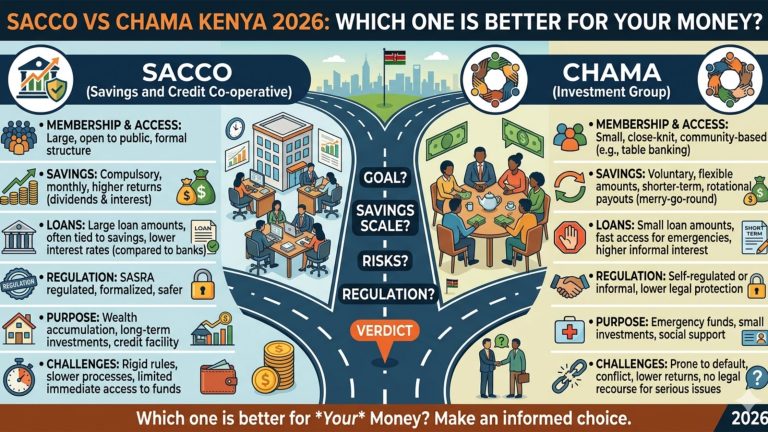
Co-operative Bank is majority-owned by Kenya’s cooperative movement and serves agricultural cooperatives, teacher SACCOs, and community groups. Their savings accounts offer up to 7% per annum for cooperative and SACCO members, with SACCO dividend payments receivable directly to COOP accounts and MCo-op Cash integration for mobile banking.
- Interest: Up to 7% p.a. (cooperative member rate); lower for non-members
- Minimum balance: KES 1,000–2,000
- Monthly fee: Moderate
- Additional benefit: SACCO dividends paid directly to COOP account
- Digital access: MCo-op Cash app
What KES 50,000 earns at 7%: KES 3,500 per year
Verdict: COOP is the natural choice for SACCO members — the integration of SACCO dividends, cooperative member rates, and the MCo-op Cash platform makes it a seamless financial ecosystem for Kenya’s cooperative sector. For non-SACCO members, COOP’s rates are competitive but without the cooperative-member premium, other banks offer comparable or better returns.
6. Equity Bank Kenya — Smart Savings
Interest rate: Approximately 5.5–6% per annum
Equity Bank’s savings account offers around 5.5–6% per annum with zero balance requirements, making it ideal for new savers and students. Interest is earned on any balance above KES 500. The account integrates with the Equity Mobile (EazzyApp) for seamless transactions and with Equity’s 44,000+ agent network across Kenya.
- Interest: ~5.5–6% p.a.
- Minimum balance: Zero (interest on balances above KES 500)
- Monthly fee: Low
- Withdrawals: One free per month
- Digital access: EazzyApp, Equitel, and 44,000+ agents
What KES 50,000 earns at 5.5%: approximately KES 2,750 per year
Verdict: Equity is best for first-time account holders, students, and Kenyans in rural or peri-urban areas. The zero minimum balance removes every barrier to entry, and Equity’s agent network — the largest in Kenya — means accessing your money is never a logistical problem regardless of where you live. The lower interest rate versus Absa or KCB is the trade-off for this accessibility.
7. Standard Chartered Kenya — Safari Savings
Interest rate: Up to 6% per annum
Standard Chartered’s Safari Savings Account offers up to 6% per annum. Higher minimum balance requirements than most competitors make it better suited to customers who need Standard Chartered’s premium services — mortgages, international banking, forex — rather than those optimising purely for savings return.
- Interest: Up to 6% p.a.
- Minimum balance: Higher than most competitors
- Monthly fee: Waived above minimum
- Best for: Clients who need Standard Chartered’s full banking relationship
Verdict: Not the right bank for maximising savings interest at typical Kenyan salary levels. Its advantages lie in mortgage products, international payment capabilities, and private banking. If you need those products, the savings account is a natural by-product of the relationship.
The Master Comparison Table
Rates as at May 2026 — verify current rates directly with each bank before opening.
| Bank | Product | Rate (p.a.) | Min. balance | Monthly fee | KES 50,000/year | Best for |
|---|---|---|---|---|---|---|
| Absa Kenya | Digital Savings | Up to 9% | Zero | None | Up to KES 4,500 | Best rate, digital access |
| SBM Bank | Platinum Saver | Up to 8.5% | Confirm | Confirm | Up to KES 4,250 | High rate seekers |
| KCB | Simba Savings | 6–8.5% tiered | None | None | KES 3,000–4,250 | KCB customers |
| NCBA | Gold Savings | Up to 8% | KES 100,000 | None above min | Up to KES 4,000 | High balance savers |
| NCBA | Loop | Up to 7% | Zero | Zero | Up to KES 3,500 | Digital-first, no fees |
| COOP | Savings Account | Up to 7% | KES 2,000 | Moderate | Up to KES 3,500 | SACCO members |
| KCB | Goal Savings | Up to 7% | None | None | Up to KES 3,500 | Committed savers |
| Equity | Smart Savings | ~5.5–6% | Zero | Low | ~KES 2,750–3,000 | First-time savers |
| Standard Chartered | Safari Savings | Up to 6% | High | Waived | Up to KES 3,000 | Premium clients |
Fixed Deposits: When Locking Your Money Pays More
If you have a lump sum you will not need for 3–12 months, a fixed deposit pays significantly more than a standard savings account — and rivals money market fund rates on the right terms.
Current fixed deposit rates at major Kenyan banks range from approximately 8–12% per annum for 12-month terms. The variables are the term length (longer locks pay more), the amount (larger deposits can negotiate better rates), and the bank’s current funding requirements.
KES 100,000 fixed deposit vs alternatives over 12 months:
| Product | Rate | KES 100,000 earns |
|---|---|---|
| Best fixed deposit (12 months) | ~10–12% | KES 10,000–12,000 |
| Money market fund | 10–14% | KES 10,000–14,000 |
| Best savings account | 8–9% | KES 8,000–9,000 |
| Standard savings | 3–4% | KES 3,000–4,000 |
The critical difference between a fixed deposit and a money market fund at similar rates: a fixed deposit is locked — early withdrawal typically incurs a penalty of 2–3% of the deposit amount. A money market fund can be accessed within 1–3 business days with no penalty. For most Kenyans, the money market fund’s liquidity advantage at similar rates makes it the better choice unless the bank offers a meaningfully higher fixed deposit rate to compensate.
Always negotiate your fixed deposit rate. Banks have more flexibility on fixed deposits than on standard savings products — especially for amounts above KES 500,000. Ask to speak with a relationship manager, not a branch teller.
The Comparison Banks Hope You Never Make: Savings Account vs Money Market Fund
This is the most important section in this article — and the comparison that most Kenyan banks would prefer you not make clearly.
Equity Bank and KCB offer up to 6–7% on savings accounts. However, all Kenyan banks pay significantly less than money market funds at 10–14%. For maximum savings return, a money market fund is superior to any bank savings account.
Here is what that difference means in shillings over five years:
KES 100,000 invested for 5 years:
| Vehicle | Annual return | After 5 years |
|---|---|---|
| Standard bank savings (4%) | 4% | KES 121,665 |
| Best bank savings (9%) | 9% | KES 153,862 |
| Money market fund (12%) | 12% | KES 176,234 |
| Money market fund (14%) | 14% | KES 192,541 |
The difference between the best bank savings account and a money market fund over 5 years on KES 100,000 is KES 22,000–39,000. On KES 500,000, multiply by five. This is not a marginal difference.
Three legitimate reasons to keep money in a bank savings account rather than a money market fund:
Loan eligibility — banks assess your personal loan limit partly based on your savings history at their institution. KES 50,000 in a KCB savings account for 12 months actively builds your KCB loan eligibility. The same amount in a CIC money market fund does not.
Salary and payroll requirements — many employers deposit salaries only to specific banks. Keeping surplus in a savings account at that bank is practically convenient.
Immediate ATM access — bank savings accounts accessible same-day via ATM or branch. Money market fund withdrawals take 1–3 business days. For emergency funds you might need on a Sunday at an ATM, the bank savings account wins on speed.
The practical recommendation: Keep one to two months of expenses in a bank savings account for genuine short-term access and loan profile building. Move everything above that threshold to a money market fund for meaningfully better returns. See our Unit Trust Funds Kenya 2026 guide for the top money market funds and how to open one in under 30 minutes.
The Right Account for Your Specific Situation
If your primary goal is the highest possible return: Absa Digital Savings at up to 9% is the best bank savings rate in Kenya right now — zero fees, zero minimum balance, fully digital. After that, a money market fund at 10–14% outperforms everything.
If you need a savings account that builds loan eligibility: Open a savings account at the same bank that holds your salary — KCB Simba Savings or KCB Goal Savings for KCB salary holders, Equity Smart Savings for Equity customers. Six to twelve months of consistent savings history at your bank is the most powerful loan qualification tool available.
If you are a SACCO member: Cooperative members enjoy higher interest rates and preferential treatment, with dividend payouts in addition to regular interest and free MCo-op Cash services. Co-operative Bank is the natural fit.
If you want zero fees and fully digital management: NCBA Loop at 7% — zero minimum balance, zero monthly fees, no branch visit required. Open it in minutes on the NCBA app.
If you are saving for the first time or have a small amount: Equity Smart Savings has zero balance requirement — ideal for new savers, integrated with Equity Mobile app for seamless transactions, earning interest on any balance above KES 500. The 5.5–6% rate is lower than competitors but the accessibility is unmatched.
If you have a lump sum above KES 100,000 you will not need for 12 months: Compare fixed deposit rates at three banks and negotiate. NCBA Gold Savings at up to 8% or a negotiated 12-month fixed deposit at 10–12% are both worth pursuing.
If your goal is an emergency fund: A money market fund, not a savings account. The 1–3 business day access timeline is adequate for almost all genuine emergencies, and the 10–14% return is significantly better than any savings account.
Your Deposits Are Protected — Up to a Point
The Kenya Deposit Insurance Corporation (KDIC) protects deposits up to KES 500,000 per depositor per bank. This means if a bank fails, you are guaranteed to recover up to KES 500,000. For amounts exceeding this, consider spreading deposits across multiple banks for full protection.
This protection applies to all CBK-licensed Kenyan banks. Money market funds hold assets in government securities rather than bank deposits — a different risk profile that does not fall under KDIC but is regulated by the Capital Markets Authority.
Frequently Asked Questions
Which bank in Kenya pays the highest savings interest in 2026?
Absa Bank Kenya’s Digital Savings Account offers a competitive interest rate of up to 9% per annum with no service charges or minimum balance requirements, with compounded interest paid monthly. Among other banks, SBM Bank’s Platinum Saver offers interest of up to 8.5% per year on Kenyan shilling accounts. However, all bank savings rates remain below money market funds which pay 10–14% per annum.
What is the minimum balance for a savings account in Kenya?
Several banks including Equity and NCBA Loop now offer savings accounts with zero minimum balance, with interest earned on any balance above KES 500. Traditional savings accounts at most banks require KES 1,000–2,000 as a minimum.
Can I lose money in a Kenyan savings account?
No. Bank deposits are capital-protected — your principal cannot decrease due to market movements. The only risks are bank insolvency (covered by KDIC up to KES 500,000) and fee deductions exceeding interest earned (avoidable by choosing fee-free accounts).
Is M-Shwari savings the same as a bank savings account?
M-Shwari is operated by NCBA Bank via Safaricom. The KCB M-Pesa Fixed Savings account offers 6.3% interest per annum for both Fixed and Target Savings accounts, with a minimum of KES 50, and allows users to lock a specific amount or save towards a set goal. These are regulated bank products with KDIC protection accessed through M-Pesa.
Can I open a savings account online in Kenya without visiting a branch?
Yes, most major Kenyan banks now offer online account opening. You can open accounts through bank websites, mobile apps, or USSD codes. You’ll need your ID number, KRA PIN, and sometimes a selfie for verification. Digital accounts like Equity Smart Savings and NCBA Loop can be opened in minutes with zero initial deposit.
Should I keep my emergency fund in a savings account or a money market fund?
A money market fund is better for most Kenyans — higher returns at 10–14% with access in 1–3 business days, which is adequate for most genuine emergencies. Only keep emergency funds in a savings account if you genuinely need same-day ATM access.
The Bottom Line
The best savings account in Kenya in 2026 is Absa’s Digital Savings at up to 9%, followed by SBM Bank’s Platinum Saver at 8.5%. If you want the highest interest rates, choose NCBA Bank. If you prefer flexible savings, go for KCB Bank. If you need digital savings, Equity Bank is a great option. If you want fixed savings plans, Co-operative Bank is best.
But the most important financial comparison is the one between any bank savings account and a money market fund. For most Kenyans who are not constrained by loan-building requirements or immediate ATM access needs, a money market fund at 10–14% outperforms the best savings account in Kenya by a margin that compounds significantly over time.
The action that costs nothing and pays the most: open your bank app today, find the savings rate on your current account, and compare it against the accounts in this guide. If the gap is more than 2%, you have identified money that is working harder for your bank than for you.
Interest rates verified from bank websites and published sources, May 2026. Savings rates change periodically — verify the current rate directly with your chosen bank before opening. All deposits at CBK-licensed banks are protected by KDIC up to KES 500,000 per depositor per bank.
Related reading:
- Unit Trust Funds Kenya 2026: Earn 10–14% on Your Savings
- How to Invest KES 10,000 in Kenya 2026: Best Options Compared
- M-Shwari vs KCB M-Pesa vs Fuliza 2026: Which Is Cheapest?
- How to Save KES 10,000 a Month in Kenya on an Average Salary
- NSE Kenya 2026: How to Invest for Beginners
- Best SACCOs Kenya 2026: Savings, Dividends and Loan Access