How Long Does CRB Clearance Take in Kenya? (2026 Complete Answer)
You paid your debt. You’re waiting. But nothing has changed on your loan app — it still says “Not Eligible.” Here’s exactly why that happens, how long CRB clearance actually takes in Kenya, and what you should be doing while you wait.
This is one of the most searched questions in Kenya’s personal finance space — and one of the most poorly answered. Let’s fix that.
The Short Answer: A CRB Clearance Timeline Breakdown
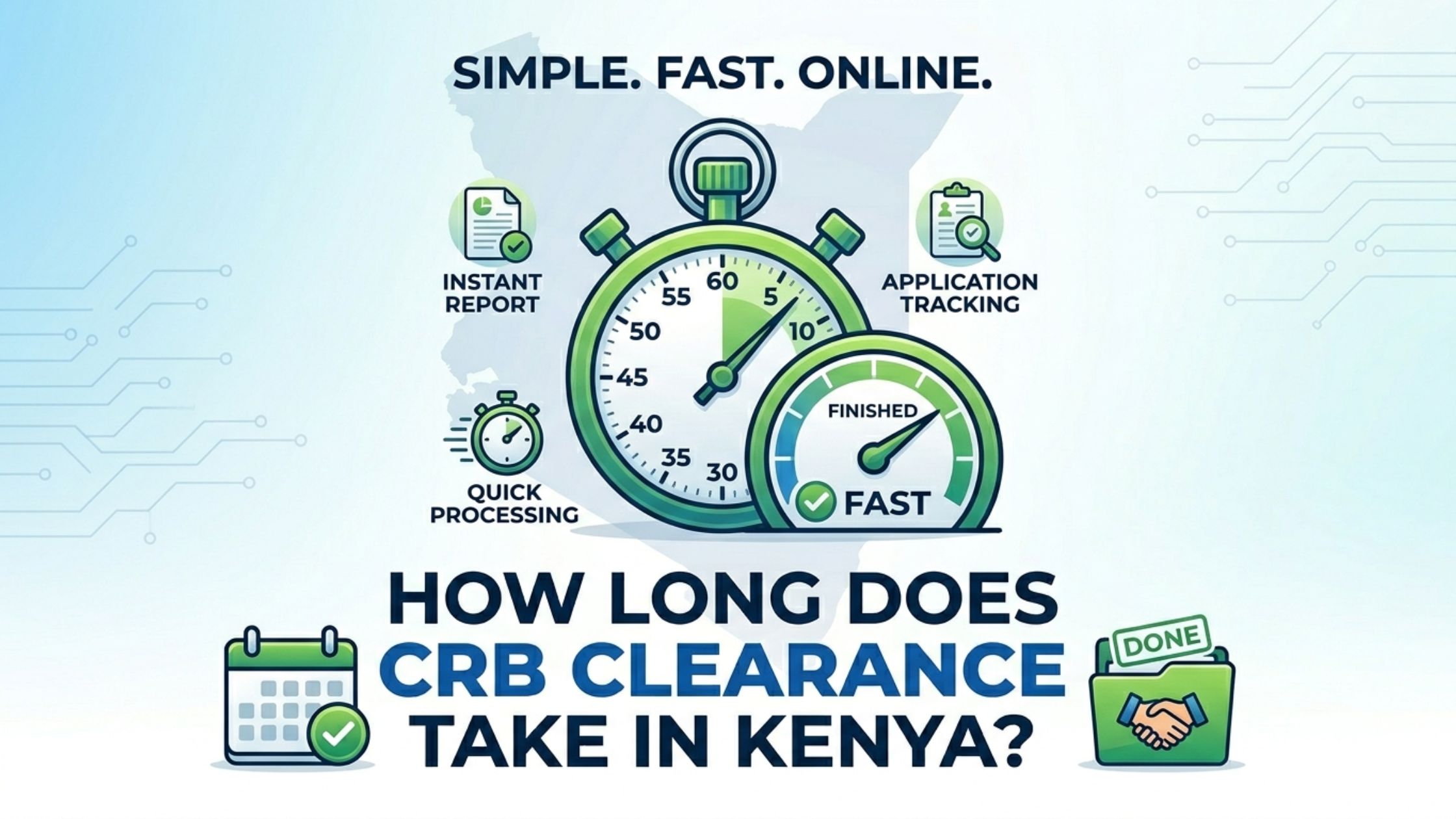
Before getting into the steps, here is a direct, honest timeline so you know what to expect:
| Situation | How Long It Takes |
|---|---|
| Already debt-free — just need the certificate | Same day (instant download or within hours via email) |
| Debt cleared — waiting for lender to report to CRB | 5 to 30 business days (legally required within 30 days) |
| CRB updates its record after lender reports | 1 to 7 business days |
| Error or dispute on your report | Up to 21 working days for resolution |
| Certificate issued once record is clean | Same day — download PDF via app or website |
The CRB clearance certificate itself costs Ksh 2,200 and is available immediately once your record is clean. The delay most Kenyans experience is not in getting the certificate — it is in waiting for their lender to actually update the CRB after a debt is cleared.
That gap between paying your debt and seeing your credit record update is where the frustration lives. Understanding it is the first step to managing it.
What Is a CRB Clearance Certificate — and Why Do You Need One?
A CRB clearance certificate — formally called a Certificate of Clearance (CoC) — is an official document issued by one of Kenya’s three licensed Credit Reference Bureaus confirming that you have no outstanding negative listings on your credit record. It is issued by Metropol CRB, TransUnion Africa, or Creditinfo Kenya.
Kenyans need this certificate for various reasons — applying for a bank loan or mortgage, bidding for a government tender, applying for certain jobs, renting commercial or residential property, and in some cases, for immigration or visa applications. It is effectively proof that you are a reliable financial citizen.
Importantly: you can only receive a clearance certificate if your credit record has no active negative listings. If there is any unresolved default on your record, you will receive a credit status report instead — which shows the listing — not a clearance certificate. You must clear the underlying debt first.
To understand the full picture of what CRBs track and how they work in Kenya, the CRB Kenya 2026 guide is a solid starting point.
The CRB Clearance Process: Step by Step
Step 1: Check Your Current CRB Status
Before doing anything else, find out exactly where you stand. Do not guess — pull your actual credit report. There are three ways to do this depending on which bureau you use:
- Metropol CRB: Dial *433# on a Safaricom line registered under your National ID. Registration costs Ksh 100 via M-Pesa Paybill 220388 (use your ID number as the account number). You can also use the Crystobol app on Android.
- TransUnion Africa: Text your full name to 21272 or download the TransUnion Nipashe app from Google Play Store. Registration costs Ksh 50 via Paybill 212121.
- Creditinfo Kenya: Visit ke.creditinfo.com and register using your ID number to request your credit report online.
Each bureau is required by law to provide you with one free credit report per year. Use it. Checking your status before paying the Ksh 2,200 certificate fee tells you whether you are already clear, or whether you have a debt to resolve first.
Step 2: Identify the Defaulted Lender and Clear the Debt
If your status check reveals a negative listing, your report will show you exactly which institution submitted it — the bank, SACCO, or mobile lender you owe. Contact that institution directly.
Do not contact the CRB to clear the debt. CRBs cannot remove a valid negative listing — they can only act on information submitted by the lender. The lender is the one who reported the default, and only the lender can update that report.
When you contact the lender, ask for the full outstanding balance including any penalties and accrued interest. Negotiate a settlement if you cannot pay in full — many institutions will agree to a structured settlement, particularly for older debts. If you are also looking for the cheapest loan options in Kenya to refinance existing obligations, it helps to understand total cost before approaching any lender.
Step 3: Get a Written Clearance Letter from the Lender
Once you pay, do not leave without a written clearance letter. This is critical — and often overlooked.
The clearance letter should state: your name, your ID number, the loan account number, the amount paid, the date of payment, and confirmation that the account is fully settled. It should be on the lender’s official letterhead and signed by an authorised representative.
Save this letter. Take a photo of it. Email it to yourself. This document is your legal proof of settlement, and you will need it if the CRB record does not update in time.
Step 4: Wait for the Lender to Report to CRB
This is the step where most of the waiting happens. After you clear the debt, the lender must update the CRB — but they are not required to do it immediately. Under the CBK Digital Credit Providers Regulations, lenders must notify borrowers at least 30 days before submitting negative information to a CRB — and the same general framework applies in reverse when clearing listings.
In practice, different lenders report on different schedules. Banks and large MFIs often update CRBs weekly or biweekly. Smaller digital lenders may only batch their updates monthly. This is why some Kenyans wait five days and others wait four weeks — the variance is in the lender’s internal reporting cycle, not in the CRB.
What you can do: After paying, email or call the lender’s credit or collections department and ask for written confirmation of when they will update the CRB. Having this in writing gives you a clear follow-up date.
Step 5: Apply for Your CRB Clearance Certificate
Once the lender has updated your record and the CRB has processed it, your status will change to “cleared” and you can apply for your certificate.
Via Metropol:
- Dial *433# or log into the Crystobol app
- Select “Clearance Certificate”
- Pay Ksh 2,200 via M-Pesa Paybill 220388
- Download your PDF certificate immediately or receive it by email
Via TransUnion:
- Log into the Nipashe app or visit transunionafrica.com
- Navigate to “Clearance Certificate”
- Pay Ksh 2,200 via Paybill 212121, or forward your M-Pesa confirmation to [email protected]
- Receive your certificate by email, usually within a few hours
Via Creditinfo:
- Visit ke.creditinfo.com
- Complete the clearance certificate form and pay the required fee
- Download or receive your certificate digitally
You can also visit any Huduma Centre across the country if you prefer to complete the process in person. Carry your original National ID and a copy.
Why Your Loan App Still Says “Not Eligible” After Clearance
This is the source of the most frustration — and the most questions. You have your clearance certificate. You show it to the loan app. It still says no. Here is why.
Lenders maintain their own internal blacklists. Your CRB record and a lender’s internal database are two different systems. CRB clearance updates the bureau’s central record, but lenders pull and cache that data on their own schedules. A mobile app that syncs with CRBs weekly may not reflect your clean status until its next sync cycle — even if you are technically clean at the bureau level.
The 5-year rule still applies. Clearing a default does not erase your credit history — it changes your status from “defaulted” to “cleared.” Lenders can still see the full repayment history behind that status. Under Kenya’s CRB framework, the CBK has mandated that CRBs not use a negative credit score as the only reason to deny credit — but lenders still use the full picture when making decisions. A recently cleared default may still result in a “no” from cautious lenders, especially for large loans.
What to do: Contact the lender’s customer care directly and present your clearance certificate as proof. Ask them to manually re-evaluate your application or to refresh your credit data from the bureau. Some lenders will do this; others require you to wait for the next automatic sync. If you have been denied a loan even with a clean record, understanding the full reasons why loan applications get rejected in Kenya can help you address the specific barrier in your case.
Important Distinctions Kenyans Often Confuse
The Ksh 2,200 is a certificate fee, not a fine. Many Kenyans believe they are paying Ksh 2,200 to “remove their name from CRB.” That is not what happens. The fee is simply the cost of the official document confirming your clean status. Your name is removed from the negative listing by the lender reporting the clearance — not by any payment to the CRB.
A clearance certificate is not a clean slate. Getting a clearance certificate means you have no active defaults. It does not mean your past repayment history disappears. Lenders who pull a full credit report will see your complete history — including the cleared default — for up to five years. This is why building a strong positive repayment record after clearing is just as important as the clearance itself. See our guide on how to improve your CRB score in Kenya for the steps to take once you are clean.
You clear the debt with the lender, not with the CRB. This is the single most important distinction. Many Kenyans try to call the CRB to have their name removed. The CRB cannot do this for a valid, unresolved listing. Your first and only call is to the institution you owe. The CRB’s role is to record and report what lenders tell them — not to adjudicate debts.
What to Do If the CRB Hasn’t Updated After 10+ Days
If more than 10 business days have passed since you cleared your debt and your CRB record still shows the negative listing, it is time to act — not wait.
Step 1: Contact the lender. Call or email the lender’s credit or collections team. Ask specifically: “Has my account closure been reported to the CRB, and if so, on what date?” Request written confirmation.
Step 2: File a formal dispute with the CRB. You have a legal right to dispute inaccurate or outdated information on your credit report. File the dispute with the bureau that holds the listing — Metropol, TransUnion, or Creditinfo — and provide your settlement letter as evidence. CRBs are required to investigate disputes and resolve them within 21 working days.
Step 3: Escalate to the Central Bank of Kenya. If neither the lender nor the CRB resolves the issue within the legal timeframes, you can file a formal complaint with the CBK. The CBK regulates all three bureaus and has enforcement powers. You can reach the CBK Consumer Protection department via their official website or by visiting their offices in Nairobi.
The escalation path is: Lender → CRB → Central Bank of Kenya. Most disputes are resolved at the lender or CRB stage, but knowing the full path ensures you are never left without recourse.
Frequently Asked Questions
Can I get a CRB clearance certificate if I have a loan I am still repaying? Yes — as long as the loan is not in default. If you have a loan you are still servicing but have not defaulted on, you are eligible for a CRB clearance certificate from any of the three licensed bureaus.
Does the CRB clearance certificate expire? Yes. Most lenders and employers treat a CRB clearance certificate as valid for 90 days from the date of issue, though this varies by institution. Always get a fresh certificate for each significant application.
Can I get CRB clearance from eCitizen? No. It is not currently possible to apply for a CRB clearance certificate via the eCitizen portal in Kenya. CRB services are managed independently by the three licensed bureaus — TransUnion, Metropol, and Creditinfo — and are not part of the eCitizen platform.
What if I lost my clearance certificate? You can re-download it at any time by logging back into the same bureau’s platform (Crystobol for Metropol, Nipashe for TransUnion) where you originally purchased it. No re-payment is required for a re-download within a short period; if your certificate has expired, you will need to purchase a new one.
The Bottom Line
CRB clearance in Kenya is not a single event — it is a chain of events, and each link takes time. Paying your debt starts the clock. The lender then has up to 30 days to report the settlement to the CRB. The CRB updates its record within a few days of receiving that report. Only then can you apply for your clearance certificate, which arrives the same day.
Understanding exactly where you are in that chain — and following up at each step — is how you reduce a potential 30-day wait to a 5-day one.
Once you have your certificate and your credit record is clean, the real work begins: building a credit profile strong enough that you never need to go through this process again. Avoiding CRB listing in Kenya entirely is far easier than clearing one — and it starts with consistent repayment habits and a solid monthly budget that keeps loan repayments from ever slipping.
If you are also exploring where to keep savings that earn interest while you rebuild your financial profile, that is a smart parallel step — a growing savings record signals financial discipline to lenders, even before your credit score fully recovers.
This article is part of a series on credit health in Kenya. Related reading: CRB Kenya 2026 — Everything You Need to Know | How to Avoid CRB Listing in Kenya | How to Get a Loan in Kenya 2026 | Best Savings Accounts Kenya 2026