How to Find the Cheapest Bank Loans in Kenya: All 38 CBK Rates Ranked (2026)
Finding the cheapest bank loans in Kenya in 2026 could save you hundreds of thousands of shillings over the life of your loan. Yet, most Kenyans simply walk into the bank where they have a salary account and accept whatever rate they are offered. That is an expensive mistake.
According to the latest Central Bank of Kenya (CBK) data released in June 2026, the overall average commercial lending rate in Kenya dropped to 14.38%. However, the gap between the cheapest and most expensive lenders remains enormous—ranging from a low of 10.49% to a high of 18.89%.
This guide gives you the full comparison, explains why rates vary so dramatically under the Risk-Based Credit Pricing Model (RBCPM), and tells you exactly how to use this information to negotiate a better deal.
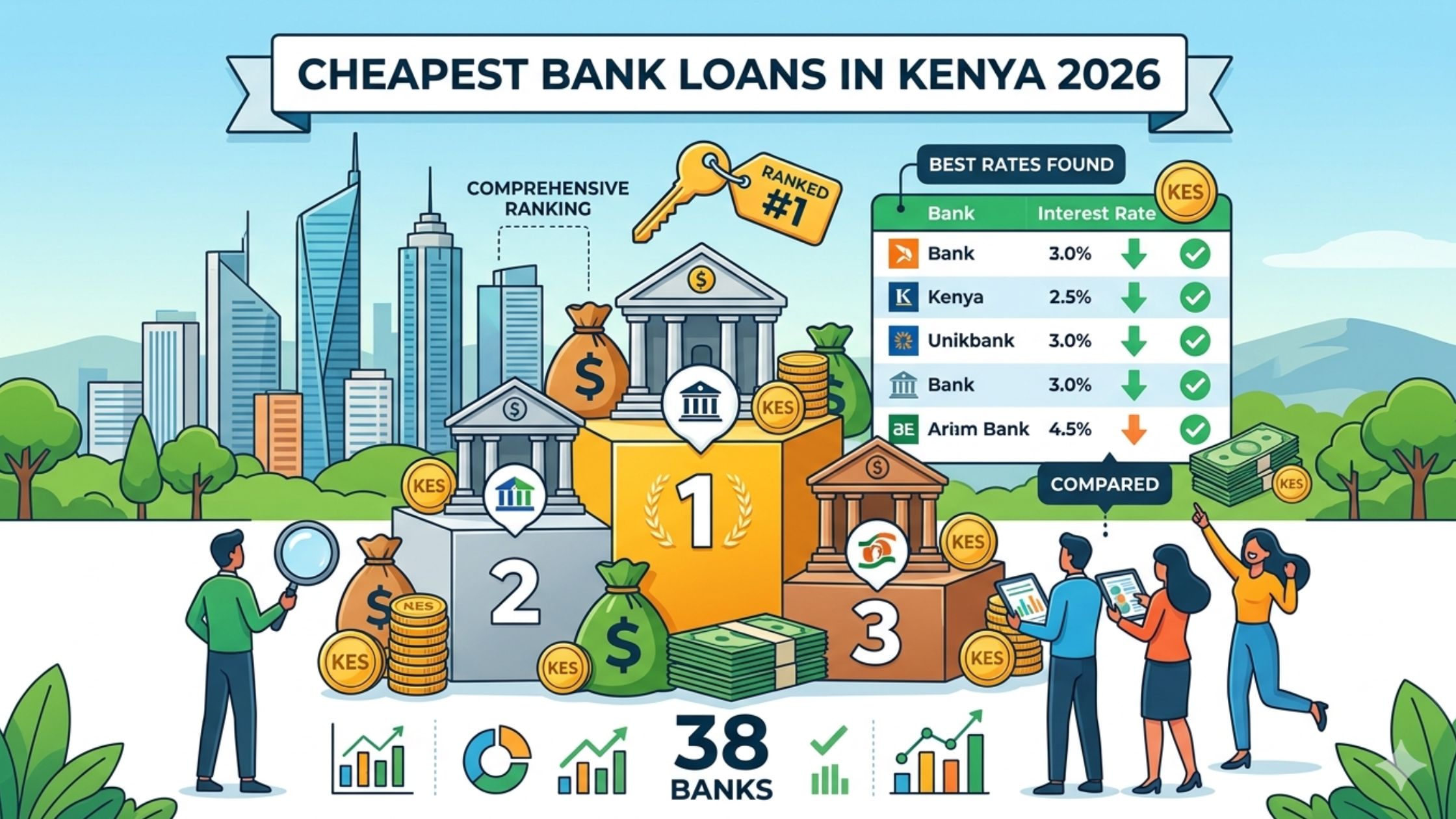
The Short Answer: Who Has the Cheapest (and Most Expensive) Loans?
If you want the bottom line before diving into the full list, here are the extremes of the Kenyan banking sector based on the most recent CBK June 2026 data.
Top 5 Cheapest Banks in Kenya:
- Citibank N.A. Kenya: 10.49%
- Standard Chartered Bank Kenya: 11.49%
- Stanbic Bank Kenya: 11.50%
- Habib AG Zurich: 12.58%
- HFC Limited: 13.01%
Top 5 Most Expensive Banks in Kenya:
- Credit Bank PLC: 18.89%
- Access Bank (Kenya) PLC: 17.57%
- Bank of Africa Kenya: 17.50%
- SBM Bank Kenya: 17.38%
- Kingdom Bank Limited: 17.02%
The Real Cost of High Rates: The difference between Citibank (10.49%) and Credit Bank (18.89%) is 8.4 percentage points. On a KES 1,000,000 personal loan taken over 3 years, choosing the most expensive lender could cost you over KES 140,000 in extra interest.
Why Can’t Everyone Access the 10.49% Rate?
This is the critical caveat. Banks offering the absolute lowest rates—like Citibank and Habib AG Zurich—primarily serve multinational corporations, large local corporates, and high-net-worth individuals. Their low rates reflect a very low-risk client profile backed by solid financials, significant collateral, and long banking relationships.
A typical salaried Kenyan earning KES 80,000 per month will likely not qualify for their retail products. This doesn’t mean comparing is pointless; it means you should compare rates among the banks that actually serve your specific segment (Retail, SME, or Corporate).
Full List: Bank Loan Interest Rates Ranked (June 2026)
The following rates are based on the latest CBK published data regarding average commercial bank lending rates.
Note: These are average rates. Your individual rate may differ based on your unique risk profile.
| Rank | Commercial Bank | Average Lending Rate | Target Market Focus |
| 1 | Citibank N.A Kenya | 10.49% | Corporate / High Net Worth |
| 2 | Standard Chartered Bank Kenya | 11.49% | Premium Retail / Corporate |
| 3 | Stanbic Bank Kenya | 11.50% | Corporate / Retail |
| 4 | Habib AG Zurich | 12.58% | Niche Corporate |
| 5 | HFC Limited | 13.01% | Housing Finance / Retail |
| 6 | Guardian Bank Limited | 13.47% | Retail / SME |
| 7 | Absa Bank Kenya PLC | 13.48% | Personal / Corporate |
| 8 | Paramount Bank Limited | 13.92% | SME Focus |
| 9 | Prime Bank Limited | 13.92% | Corporate Focus |
| 10 | Bank of India | 13.92% | Business Community |
| 11 | Bank of Baroda | 13.97% | Business Community |
| 12 | I&M Bank Limited | 14.00% | Mid-Market / Corporate |
| 13 | Consolidated Bank of Kenya | 14.00% | Retail / Gov-linked |
| 14 | Diamond Trust Bank Kenya | 14.09% | SME / Regional |
| 15 | Guaranty Trust Bank (K) Ltd | 14.22% | Corporate / Retail |
| 16 | Gulf African Bank Limited | 14.22% | Islamic Finance |
| 17 | Victoria Commercial Bank PLC | 14.24% | Corporate Focus |
| 18 | NCBA Bank Kenya PLC | 14.57% | Corporate / Digital |
| 19 | M-Oriental Bank Limited | 14.58% | SME Focus |
| 20 | KCB Bank Kenya | 14.81% | Large Retail / Corporate |
| 21 | Commercial International Bank | 14.81% | Corporate / Investment |
| 22 | Equity Bank Kenya Limited | 14.82% | Large Retail / SME |
| 23 | Ecobank Kenya Limited | 15.00% | Pan-African Network |
| 24 | Co-operative Bank of Kenya | 15.08% | SACCO-linked / Retail |
| 25 | Sidian Bank Limited | 15.19% | SME Focus |
| 26 | Premier Bank Kenya Limited | 15.49% | Islamic Finance |
| 27 | UBA Kenya Bank Limited | 15.65% | Pan-African Network |
| 28 | DIB Bank Kenya Limited | 15.72% | Islamic Finance |
| 29 | National Bank of Kenya | 15.84% | Retail / SME |
| 30 | Family Bank Limited | 15.91% | SME / Retail |
| 31 | Middle East Bank (K) Limited | 16.22% | Niche Focus |
| 32 | Kingdom Bank Limited | 17.02% | SME / Retail |
| 33 | SBM Bank Kenya | 17.38% | Regional Bank |
| 34 | Bank of Africa Kenya | 17.50% | SME Focus |
| 35 | Access Bank (Kenya) PLC | 17.57% | Retail / SME |
| 36 | Credit Bank PLC | 18.89% | SME Focus |
(Note: The active number of standalone lenders fluctuates slightly due to ongoing industry acquisitions and structural mergers, representing the 36 currently active data points tracked in the most recent CBK release).
Why Kenyan Bank Loan Rates Vary: The RBCPM Model
In Kenya, two people applying for the exact same loan at the exact same bank can be offered entirely different interest rates. This is due to the Risk-Based Credit Pricing Model (RBCPM).
Under this system, your loan rate is calculated as:
Base Rate (tracking the CBR at 8.75% + Bank’s Cost of Funds) + Your Risk Premium
Your personal Risk Premium is determined by your creditworthiness. A borrower with a pristine credit score, stable employment, and a longstanding banking relationship will be assigned a lower risk premium than someone with past defaults or irregular income.
The Hidden Costs of “Cheap” Loans
A low headline interest rate is not the whole story. The real cost of a loan is the Total Cost of Credit (TCC). When comparing loan offers, always watch out for:
- Processing / Negotiation Fees: Some banks charge 1% to 3% of the loan amount upfront. This can add KES 10,000 to KES 30,000 to a KES 1 million loan before you even begin repayments.
- Credit Life Insurance: Many lenders bundle mandatory insurance premiums into your monthly repayments. Ask if you can provide your own existing cover.
- Early Repayment Penalties: If you plan to clear the loan ahead of schedule, check the fine print. Some banks penalize early clearance by charging 1% to 3% of the outstanding balance.
How to Negotiate the Lowest Interest Rate
- Get Your CRB Report First: Before approaching any bank, pull your credit report from TransUnion, Metropol, or CreditInfo. Dispute any errors immediately—a single mistake can cost you 1–2 percentage points on your rate.
- Get 3 Written Quotes: Never accept the first offer. Use the table above to identify three competitive banks in your segment. Get written quotes and use them as leverage.
- Start With Your Current Bank: If you have 5+ years of clean history with your current bank, start there. They will often match or beat a competitor’s rate to keep a loyal customer.
- Use Collateral: Secured loans (backed by a vehicle logbook or property title) carry significantly lower risk for the bank, which translates to noticeably cheaper rates for you.
- Check SACCO Rates: For amounts under KES 5 million, a SACCO loan at 10–13% reducing balance is frequently cheaper than any commercial bank alternative.
Frequently Asked Questions
How do I find out my exact loan rate from a bank?
Ask for the loan offer letter and look specifically for the Annual Percentage Rate (APR). The APR includes all hidden costs and fees, not just the advertised interest rate.
Does my salary account bank always give me the best rate?
Not necessarily. While banks offer relationship discounts, they also bank on customer inertia. Always test the market.
Is a digital lender ever cheaper than a bank?
No. While mobile lenders like Fuliza, Branch, or M-Shwari are convenient for rapid, short-term needs (30 days or less), their effective annual interest rates are dramatically higher than traditional bank rates, often exceeding 60%–200%. Never use a digital app for long-term financing.
The Bottom Line – So What is the Cheapest Bank Loan?
The cheapest bank loan in Kenya in 2026 is not the one you find by accident—it is the one you find by comparing, negotiating, and understanding your own credit position.
The data is clear: there is an 8.4 percentage point gap between Kenya’s cheapest lender (Citibank at 10.49%) and the most expensive (Credit Bank at 18.89%). On a significant loan, that gap translates to hundreds of thousands of shillings staying in your pocket rather than going to the bank.
Don’t settle for the first rate your salary bank offers. Get your CRB report, compare at least three banks from the list above, and don’t forget to check your local SACCO. The process takes a few extra days, but it is the single most profitable financial decision you can make this year.
Lending rates in this article are based on CBK published data and market estimates as of June 2026. Individual rates vary by borrower profile, loan type, tenure, and collateral. Always obtain a written loan offer and review the Total Cost of Credit before signing. Rates are subject to change — verify current rates at centralbank.go.ke.