How to Choose a Money Market Fund in Kenya
How to choose a money market fund in Kenya comes down to one habit most people skip: checking the actual net yield before they invest, not just the name on the app they already use. Many Kenyans open an MMF through their bank simply because it’s convenient, and end up earning noticeably less than they would have with a two-minute comparison.
A real example makes this concrete. In 2026, Equity’s money market fund has repeatedly printed among the lowest yields in the industry, often in the 5% range gross, while funds like Sanlam and CIC have paid considerably more for a comparable level of risk. Same CMA regulation, same basic safety profile, very different return. Here’s exactly what to check before you pick one.
Check the Net Yield, Not the Advertised Rate
This is the single most common mistake. Every headline rate you see quoted is the gross effective annual yield, before tax. A money market fund’s interest is subject to a flat 15% withholding tax, deducted automatically before the money reaches your account.
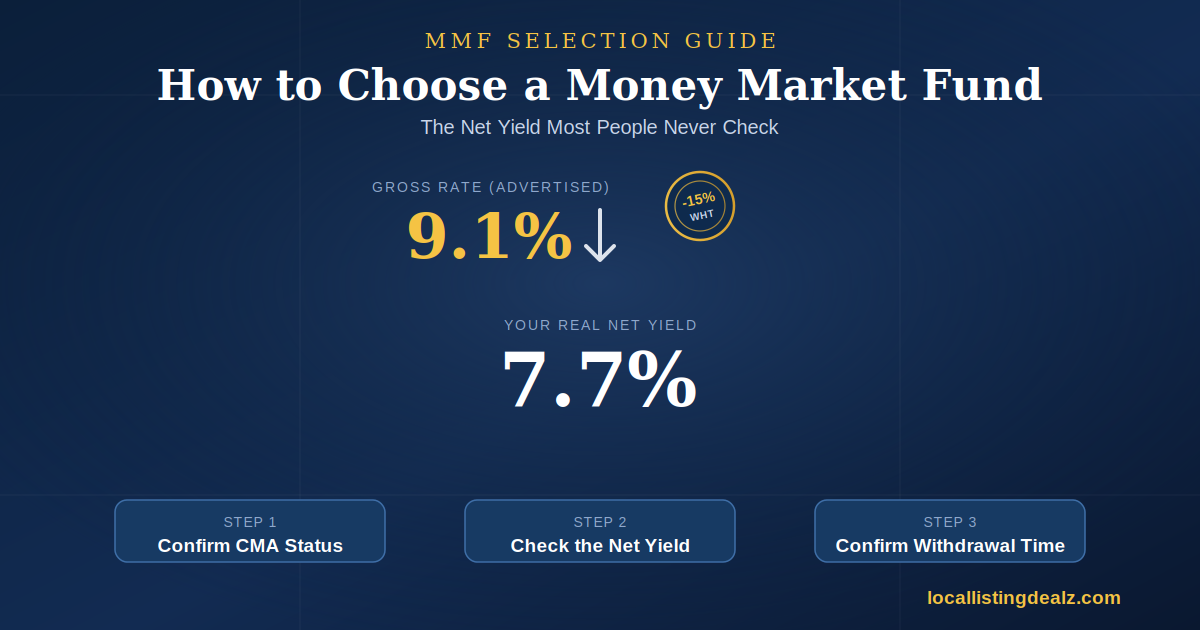
A fund advertising “9.1%” is really paying you roughly 7.7% net. A fund advertising “5.2%” is really paying roughly 4.4% net, which barely outpaces, or can even lose to, inflation in a given year.
When comparing funds, always ask: is this the gross rate or the net rate? If a provider doesn’t make that distinction obvious, do the maths yourself: multiply the quoted gross rate by 0.85 to estimate your real, after-tax return.
Confirm It’s Actually CMA-Regulated
Every legitimate money market fund in Kenya is regulated by the Capital Markets Authority (CMA) under the Capital Markets Act. This isn’t optional, and it’s not hard to check.
Before investing, confirm the fund manager appears on the CMA’s published list of licensed collective investment scheme managers. This single check filters out anything operating outside proper oversight, a necessary step given how many “investment” apps and schemes target Kenyans with promises that don’t hold up to scrutiny.
A genuinely regulated fund will also have a structure you can verify: a licensed fund manager running the portfolio, an independent custodian bank holding the actual assets separately from the manager’s own books, a trustee, and an external auditor. If a platform can’t clearly explain this structure, that’s a red flag, not a technicality.
Look at the Fund Manager’s Track Record and Size
Size alone doesn’t guarantee the best return, Equity’s fund shows that clearly. But a fund manager’s track record and assets under management (AUM) still matter for a different reason: stability and consistency over time.
Sanlam currently runs Kenya’s largest money market fund by AUM, which reflects a long operating history and broad investor trust. That’s not a reason to pick it blindly, you still need to check its current net yield, but a fund with years of consistent performance and a large, established manager behind it carries less uncertainty than a brand-new, thinly-tracked option.
Check how long the fund has operated, and whether its yield has been reasonably consistent over recent months rather than jumping around sharply.
Check the Minimum Investment and Top-Up Flexibility
Minimums vary by fund, typically anywhere from KES 100 to KES 1,000 to open an account, with similarly low minimums for top-ups. If you’re starting small, confirm the specific fund’s minimum before assuming they’re all the same, some are genuinely more accessible than others.
Also check whether top-ups are easy to do from your phone, via M-Pesa or a mobile app, since a fund that’s annoying to add money to quietly discourages the consistent saving habit that makes an MMF worthwhile in the first place.
Check Withdrawal Speed and How You’ll Actually Get Your Money
Kenyan MMFs are liquid, but “liquid” doesn’t mean instant. Withdrawals typically take a few working days to land in your bank account or M-Pesa. Before committing meaningful money, confirm:
- How many working days withdrawals actually take with that specific fund
- Whether withdrawals go to M-Pesa directly, or only to a linked bank account
- Whether there’s any cap on how much you can withdraw at once
If you’re saving for something with a firm deadline, school fees, rent, a planned purchase, build in a buffer of a few extra days rather than assuming same-day access.
Check the Fees, Even Though the Yield Looks “Net”
Most Kenyan money market funds charge no entry fee and no exit fee, and there’s typically no penalty for withdrawing. The main cost is the fund’s management fee, which is already factored into the quoted yield, you don’t pay it separately on top.
That said, management fees do vary between funds, and a higher fee is part of why one fund’s net yield ends up lower than another’s even before tax. You don’t need to track this number obsessively, since it’s baked into the yield you’re already comparing, but if a platform tries to charge you a separate entry or exit fee, that’s unusual enough to question before proceeding.
A Simple Checklist Before You Invest
- Is it CMA-regulated? Confirm the manager is on CMA’s licensed list.
- What’s the net yield, after the 15% withholding tax, not just the headline gross rate?
- How long has the fund operated, and how consistent has its yield been?
- What’s the minimum investment and top-up amount?
- How many days does a withdrawal actually take, and does it reach M-Pesa or only your bank?
- Does it charge any entry or exit fee beyond the standard management fee?
If a fund clears all six, you’ve done more diligence than most people do before investing.
Common Mistakes to Avoid
- Picking your bank’s MMF purely for convenience. Your bank’s fund might be competitive, or it might be Equity’s, quietly near the bottom of the industry. Check before assuming.
- Comparing gross rates across funds without converting to net. A 9% fund and an 8% fund look close until you realise the gap after tax is larger in absolute terms than it first appears.
- Chasing the single highest rate this week. Rates move weekly. A fund with strong, consistent performance over months is generally a safer bet than whichever fund happens to top this week’s table.
- Skipping the CMA check entirely. This takes two minutes and rules out anything operating outside proper regulation.
Where to Compare Current Rates
Rates shift regularly, so rather than quoting a rate table here that goes stale, see our Best Money Market Funds in Kenya 2026 guide for current net yields across major funds, updated as rates change.
Frequently Asked Questions
What is the most important factor when choosing a money market fund in Kenya? The net yield after the 15% withholding tax, not the advertised gross rate. The gap between a fund’s headline number and what you actually receive can be larger than it first appears.
Is a bigger money market fund always better? Not necessarily for yield, smaller or mid-sized funds sometimes outperform larger ones. But a larger, established fund manager with a long track record generally offers more consistency and reduces uncertainty.
How do I know if a money market fund is legitimate in Kenya? Confirm the fund manager is licensed by the Capital Markets Authority (CMA) and appears on CMA’s published list. A legitimate fund also has a clear structure: a licensed manager, an independent custodian bank, a trustee, and an external auditor.
How much do I need to start investing in a money market fund? Most Kenyan MMFs accept a minimum of KES 100 to KES 1,000 to open an account, with similarly low minimums for top-ups, though this varies by fund.
How long does it take to withdraw from a money market fund in Kenya? Typically a few working days, though this varies by fund and whether you’re withdrawing to M-Pesa or a bank account. Confirm the specific timeline before relying on it for an urgent need.
Do money market funds in Kenya charge entry or exit fees? Most don’t. The main cost is the management fee, which is already reflected in the quoted yield. A fund charging a separate entry or exit fee on top is unusual and worth questioning.
This article is for educational purposes only and does not constitute financial advice. Fund yields, fees, and terms change, confirm current figures directly with the fund manager or on the CMA’s website before investing.