Equity Bank vs KCB vs Safaricom: Which Should You Buy?
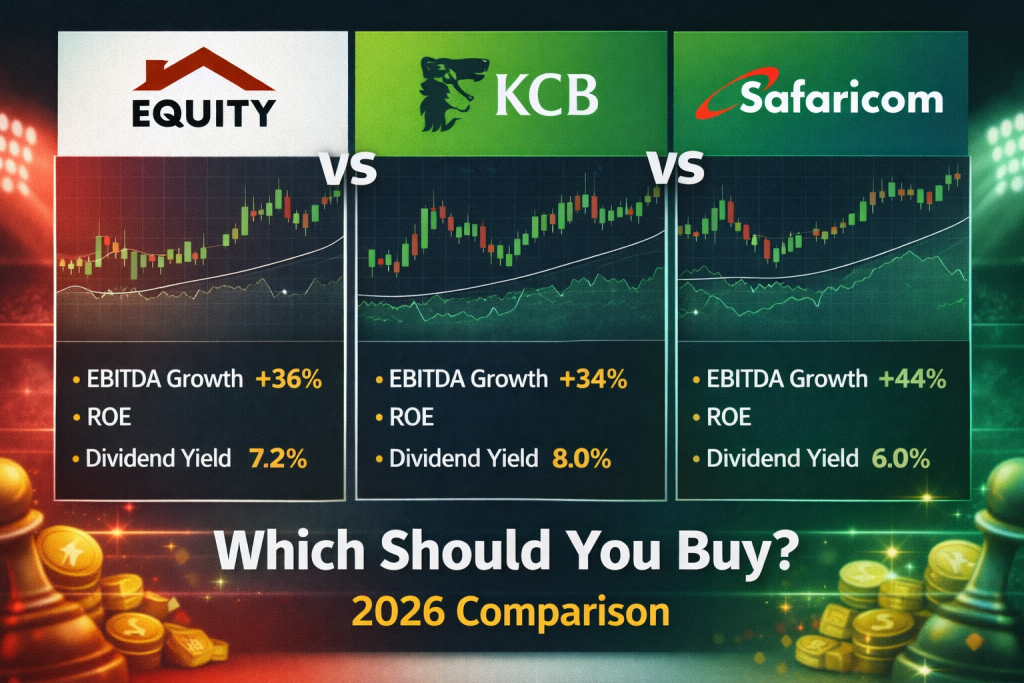
Quick Overview: The Three Giants
Equity Bank EQTY
Sector: Financial Services (Banking)
Founded: 1984
Market Position: Kenya’s largest bank by customer base with over 16 million accounts across East Africa
Known For: Financial inclusion, strong regional presence, digital banking innovation, and consistent dividend payments
Kenya Commercial Bank KCB
Sector: Financial Services (Banking)
Founded: 1896
Market Position: Kenya’s largest bank by assets with operations in seven African countries
Known For: Corporate banking strength, regional expansion, agricultural financing, and strong balance sheet
Safaricom SCOM
Sector: Telecommunications
Founded: 1997
Market Position: Kenya’s largest and most profitable company, dominant telecom provider with over 42 million subscribers
Known For: M-Pesa mobile money platform, high dividend yields, market dominance, and consistent profitability
Financial Performance Comparison
| Metric | Equity Bank | KCB | Safaricom |
|---|---|---|---|
| Market Cap (approx.) | KES 180-200B | KES 140-160B | KES 1.1-1.3T |
| Dividend Yield | 5-7% | 6-8% | 4-6% |
| P/E Ratio | 4-6x | 3-5x | 10-14x |
| 5-Year Growth | Moderate | Moderate | Strong |
| Profitability | High ROE (18-22%) | High ROE (16-20%) | Very High ROE (30-40%) |
| Volatility | Moderate | Moderate | Low to Moderate |
| Regional Presence | 6 countries | 7 countries | 2 countries |
Equity Bank (EQTY): The Financial Inclusion Leader
Strengths and Opportunities
✓ Pros
- Largest customer base in East Africa (16M+ accounts)
- Strong digital banking platform (Equitel)
- Proven financial inclusion model
- Consistent dividend payer
- Growing SME and retail banking segments
- Strong brand recognition
✗ Cons
- Lower dividend yield vs KCB
- Exposure to volatile regional markets
- Asset quality concerns in some markets
- Intense competition in banking sector
- Regulatory pressures on lending rates
Investment Thesis
Equity Bank is ideal for investors who believe in the long-term growth of financial inclusion in Africa. The bank’s massive customer base and digital banking capabilities position it well for future growth, particularly as more Africans enter the formal banking system.
KCB (KCB): The Regional Banking Powerhouse
Strengths and Opportunities
✓ Pros
- Largest bank by assets in East Africa
- Strong corporate and institutional banking
- Higher dividend yield (typically 6-8%)
- Robust regional expansion strategy
- Strong balance sheet and capital adequacy
- Agricultural financing expertise
✗ Cons
- Lower valuation may signal market concerns
- Slower digital transformation vs competitors
- Higher exposure to corporate NPLs
- Integration challenges from acquisitions
- Political and economic risks in some markets
Investment Thesis
KCB appeals to value investors and income seekers. Its low P/E ratio and high dividend yield make it attractive for those seeking immediate returns. The bank’s strong corporate relationships and regional presence provide a solid foundation for long-term growth.
Safaricom (SCOM): The Telecommunications Giant
Strengths and Opportunities
✓ Pros
- Near-monopoly in Kenya telecom (65%+ market share)
- M-Pesa generates massive recurring revenue
- Highest profitability among NSE stocks
- Strong cash flow generation
- Ethiopia expansion opportunity
- 5G network rollout potential
- Diversified revenue streams
✗ Cons
- Higher valuation (P/E 10-14x)
- Ethiopia investment is loss-making
- Regulatory risks and pricing pressures
- Market saturation in core mobile business
- Limited growth opportunities in Kenya
- Potential for dividend cuts to fund Ethiopia
Investment Thesis
Safaricom is the premium choice for quality-focused investors. Despite higher valuations, the company’s market dominance, M-Pesa ecosystem, and strong cash generation make it a defensive stock with growth potential through Ethiopia and digital services expansion.
Key Considerations for 2026
Economic Environment
- Interest Rates: CBK policy affects bank profitability and Safaricom’s debt costs
- Currency Volatility: Shilling fluctuations impact all three companies’ regional operations
- Regulatory Changes: New banking and telecom regulations could affect operations
- Economic Growth: Kenya’s GDP growth drives loan demand and mobile money usage
Industry Trends
- Digital Banking: Banks investing heavily in digital channels to compete
- Fintech Competition: New players challenging traditional banks and M-Pesa
- Regional Integration: EAC integration creating opportunities and challenges
- 5G and Connectivity: Next-generation networks opening new revenue streams
Which Stock Should You Buy?
For Conservative Income Investors:
KCB is your best choice. With the highest dividend yield (6-8%) and low valuation, KCB offers immediate income and potential capital appreciation as the market re-rates the stock. The bank’s strong balance sheet provides downside protection.
For Growth-Oriented Investors:
Equity Bank offers balanced growth. The bank’s massive customer base, digital banking leadership, and focus on financial inclusion position it well for long-term growth as African economies develop.
For Quality and Stability Seekers:
Safaricom is the premium choice. Despite higher valuations, Safaricom’s market dominance, M-Pesa moat, and consistent profitability make it the safest bet. Ethiopia’s success could unlock significant upside.
For Diversified Portfolios:
Buy all three. Each stock offers unique strengths: KCB for income, Equity for growth, and Safaricom for quality. A balanced allocation reduces sector risk while capturing opportunities across Kenya’s economy.
The Verdict: Our Recommendation
If forced to choose just one stock, Safaricom emerges as the top pick for 2026. Here’s why:
- Unmatched competitive moat through M-Pesa and network dominance
- Superior profitability and cash generation
- Defensive characteristics during economic uncertainty
- Ethiopia provides asymmetric upside potential
- Consistent dividend payments with room for growth
However, the optimal strategy is a diversified approach: 40% Safaricom, 30% Equity Bank, 30% KCB. This allocation captures Safaricom’s quality, Equity’s growth, and KCB’s income while reducing single-stock risk.
Investment Checklist Before You Buy
- Review the latest quarterly earnings reports for all three companies
- Monitor dividend announcement dates and payment schedules
- Check current market prices against historical valuations
- Assess your risk tolerance and investment timeline
- Consider tax implications of dividend income
- Evaluate your overall portfolio diversification
- Set clear price targets for entry and exit
- Stay informed about regulatory developments
Conclusion
Equity Bank, KCB, and Safaricom each represent compelling investment opportunities with distinct characteristics. KCB offers value and income, Equity provides growth through financial inclusion, and Safaricom delivers quality and stability.
The right choice depends on your investment goals, risk tolerance, and time horizon. Income investors may prefer KCB’s high yield, growth investors might favor Equity’s potential, and quality-focused investors will appreciate Safaricom’s dominance.
Regardless of your choice, all three companies are fundamentally strong businesses with proven track records. By understanding their unique strengths and challenges, you can make an informed decision that aligns with your financial objectives.