
How Much Do You Need to Retire Comfortably in Kenya?
To retire comfortably in Kenya, NSSF alone will not get you there. Most Kenyans avoid thinking seriously about retirement — not because they do not care, but because the numbers feel impossibly large and the timeline feels impossibly far away. That avoidance is expensive. Every year of delay on retirement planning compounds into a significantly larger gap between the retirement you want and the one you can afford.
Here is the uncomfortable truth: to retire comfortably in Kenya, NSSF alone will not get you there. Neither will a bank savings account, or the vague plan to “sort it out later.” What will get you there is knowing your number — and building toward it systematically, starting from where you are today.
This guide gives you the retirement numbers for Kenya in 2026 — adjusted for lifestyle, inflation, and realistic returns — and a clear roadmap for building them at every income level and age.
What Does “Comfortable” Actually Mean in Kenya?
Comfortable retirement looks different depending on where you live and how you choose to live. Before you can calculate your number, you need to define what retirement looks like for you.
Here are three realistic lifestyle tiers for retired Kenyans in 2026:
Tier 1 — Basic (Upcountry or Low-Cost Urban)
Monthly need: KES 30,000–50,000
This covers modest but dignified living — food, utilities, basic healthcare, transport, and occasional leisure — typically outside Nairobi or in a smaller county town. It assumes you own your home (no rent) and have family support for some major costs.
Tier 2 — Comfortable (Middle-Class Nairobi/Urban)
Monthly need: KES 80,000–150,000
This covers rent or mortgage-free living in a mid-tier Nairobi suburb, private medical cover, regular leisure (dining out, travel within Kenya), and support for adult children or grandchildren without financial strain. This is the aspirational middle-class retirement that most formally employed Kenyans are working toward.
Tier 3 — Comfortable Couple
Monthly need: KES 120,000–250,000
Two people living comfortably in urban Kenya — medical cover, travel, leisure, home ownership costs, and the ability to handle unexpected expenses without panic. A couple’s retirement is not simply double a single person’s costs — shared housing and utilities create some economies of scale — but healthcare and leisure spending tends to be significantly higher.
Your Retirement Number: The 4% Rule Applied to Kenya
The most practical framework for calculating your retirement savings target is the 4% rule — a guideline derived from long-term investment research showing that a diversified portfolio can sustain annual withdrawals of 4% indefinitely without depleting the principal.
In Kenya’s context, where inflation can be volatile and investment options carry different risk profiles, the 4% rule is a starting framework — not a guarantee. Think of it as a conservative planning baseline.
The formula:
Annual retirement expenses ÷ 4% = Total savings needed
Here is what the numbers look like for each lifestyle tier:
| Lifestyle Tier | Monthly Need | Annual Need | Retirement Savings Target |
|---|---|---|---|
| Basic (upcountry) | KES 40,000 | KES 480,000 | KES 12 million |
| Comfortable (urban single) | KES 100,000 | KES 1.2 million | KES 30 million |
| Comfortable (urban couple) | KES 150,000 | KES 1.8 million | KES 45 million |
| Affluent (Nairobi, premium) | KES 250,000 | KES 3 million | KES 75 million |
These numbers assume your savings are invested in instruments earning at least 4% real return annually — meaning returns above inflation. At a 10% nominal return with 5% inflation, you get approximately a 5% real return — comfortably above the 4% withdrawal threshold.
The critical insight: these are portfolio targets, not cash under the mattress. KES 30 million in a SACCO generating 15% dividends annually produces KES 4.5 million per year — KES 375,000 per month — without touching the principal. This is how retirement income works when built correctly.
The Inflation Problem: Why Your Number Is Larger Than You Think
Here is the retirement planning reality that stops most Kenyans cold.
A lifestyle that costs KES 100,000 per month today will, in 10 years, cost approximately KES 400,000 to maintain. You will need that KES 400,000 to live exactly like you are living now. This is the effect of inflation.
This is not an exaggeration. At Kenya’s historical inflation rates, the purchasing power of money roughly halves every 10 years. This means:
- If you want KES 80,000/month in today’s money at retirement in 15 years, you actually need to plan for KES 200,000–250,000/month in 2041 prices
- If your retirement is 25 years away, your KES 100,000 comfortable lifestyle requires KES 350,000–400,000/monthin future prices
The adjusted retirement savings targets (for retirement 15–20 years from now):
| Today’s Monthly Need | Inflation-Adjusted Monthly Need (15 yrs) | Inflation-Adjusted Savings Target |
|---|---|---|
| KES 50,000 | ~KES 120,000 | ~KES 36 million |
| KES 80,000 | ~KES 190,000 | ~KES 57 million |
| KES 100,000 | ~KES 240,000 | ~KES 72 million |
| KES 150,000 | ~KES 360,000 | ~KES 108 million |
Assumes approximately 6% average annual inflation over 15 years. Actual inflation will vary.
This is why starting early is not just advice — it is arithmetic. Every decade of delay approximately doubles the amount you need to save monthly to reach the same outcome.
What NSSF Will Actually Give You (And Why It Is Not Enough)
The National Social Security Fund underwent a significant reform in February 2026, entering Year 4 of the phased implementation of the NSSF Act 2013.
From February 2026 payrolls onward, the Tier I Lower Earnings Limit increased to KES 9,000, and the Tier II Upper Earnings Limit increased to KES 108,000.
The maximum employee contribution rose from KES 4,320 to KES 6,480, with employers matching this amount — bringing the total maximum monthly contribution to KES 12,960 for workers at the top tier.
For a worker earning KES 80,000/month contributing at the maximum employee rate of KES 6,480/month, with employer matching:
- Monthly total into NSSF: KES 12,960
- Annual total: KES 155,520
- Over 30 years (without investment growth): KES 4.66 million
Even with modest investment growth from NSSF’s fund management, a 30-year contributor at maximum rates will likely accumulate KES 6–10 million in NSSF benefits. Against a retirement savings target of KES 30–45 million for a comfortable urban lifestyle, NSSF covers roughly 15–25% of what you need.
This is not a criticism of NSSF — it is a mandatory baseline, and the 2026 reforms are meaningfully improving it. But it cannot be your only plan. It is the foundation on which you build, not the building itself.
The Kenyan Retirement Portfolio: How to Build Your Number
The most effective retirement portfolios for Kenyan professionals in 2026 combine four vehicles, each serving a different role:
1. SACCOs — The Core Wealth Engine
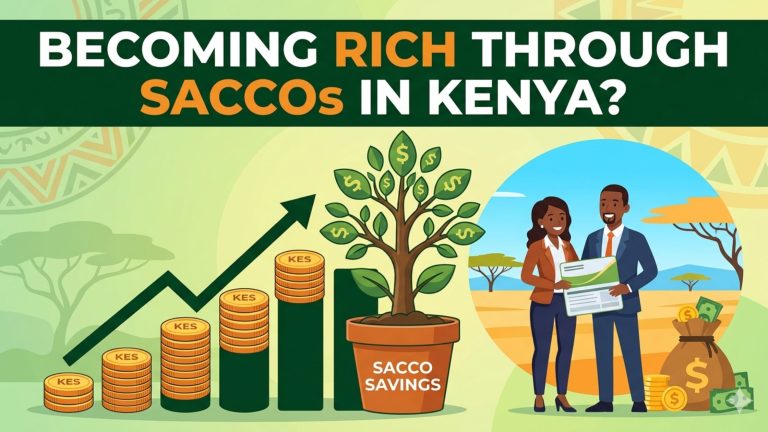
SACCOs are the most underutilised retirement vehicle in Kenya, yet the numbers they produce for disciplined long-term members are extraordinary.
For the 2025 Financial Year, Tower SACCO announced 20% dividends on share capital and 13% interest on deposits. Stima SACCO announced dividends on shares at 16% and interest on deposits at 11%. Kenya National Police DT SACCO announced a dividend on members’ share capital at 17%, while Ports SACCO announced dividends at 20% and interest on SACCO deposits at 12.5%.
Regulated SACCO assets reached KES 1.13 trillion by late 2025, accounting for over 6.4% of Kenya’s GDP.
Here is what consistent SACCO saving does over time:
- KES 10,000/month in SACCO share capital at 16% annual dividend
- After 10 years: share capital of ~KES 1.2 million, earning KES 192,000/year in dividends
- After 20 years: share capital of ~KES 2.4 million + compounding; dividend income approaching KES 400,000/year
- After 30 years: a member with KES 4–5 million in share capital earning KES 700,000–1,000,000/year in dividends alone — KES 58,000–83,000/month without touching the principal
The SACCO loan advantage multiplies this further: KES 1 million in share capital typically qualifies a member for a loan of KES 3–5 million at 12–14% per annum — Kenya’s cheapest formal credit — which can be used to purchase a productive asset (land, a rental unit) that generates additional retirement income.
How to pick a SACCO for retirement: Only join SASRA-regulated societies. Verify regulation at sasra.go.ke. Look for consistent dividend history over at least 5 years, clear published financial statements, and AUM (total assets) above KES 5 billion for institutional stability. Open-membership SACCOs — Stima, Harambee, Cosmopolitan — do not require you to be in a specific profession.
2. Government Bonds and Infrastructure Bonds — Tax-Advantaged Returns
Kenya’s infrastructure bonds offer tax-exempt returns of 12–14% annually — higher than most MMFs and fully exempt from the 15% Withholding Tax that applies to other investment income. This makes them one of the most efficient long-term savings vehicles available to Kenyan individuals.
For retirement planning, infrastructure bonds held over 5–15 years provide:
- Predictable, coupon income at fixed rates
- Full capital return at maturity
- Tax-free returns that preserve purchasing power better than taxable alternatives
Access via the Central Bank of Kenya’s DhowCSD platform (dhowd.csd.ke), which allows individuals to purchase bonds from KES 50,000 minimum directly.
3. Money Market Funds — Liquidity and Compounding
MMFs are not the highest-returning asset in a retirement portfolio, but they serve a critical function: they keep your liquid reserves growing while remaining accessible. In the 5–10 years before retirement, gradually shifting capital from higher-risk investments into MMFs reduces sequence-of-returns risk — the danger of a market downturn wiping out a significant portion of your savings just as you start drawing down.
Current MMF net yields of 7.65–10.2% (after WHT) provide meaningful real returns above Kenya’s current inflation rate. KES 5 million in an MMF earning 10% net generates KES 500,000/year — KES 41,000/month — as a reliable liquid retirement income stream.
4. Real Estate — Rental Income
Owning a rental property is the retirement plan many Kenyans execute best — because it is tangible, understood, and generates monthly income without requiring active management. A rental unit in Nairobi’s middle suburbs generating KES 25,000–50,000/month provides a stable income floor in retirement that is not dependent on portfolio management or investment decisions.
The SACCO-to-property pipeline is the most proven Kenyan wealth path: SACCO savings → SACCO loan → land purchase → construction → rental income → retirement.
Retirement Planning by Age: What You Should Be Doing Now
Age 25–35: Start. The Amount Is Almost Secondary.
At 25, KES 3,000/month in a SACCO compounding at 16% for 35 years produces a sum that will genuinely fund a comfortable retirement. Time is your most valuable asset — more powerful than income level.
Priority at this stage:
- Join a SACCO and contribute consistently, even small amounts
- Build an emergency fund in an MMF (3 months of expenses)
- Open an NSSF-complementary personal pension if your employer does not offer one
- Avoid lifestyle inflation as income grows; redirect increments to savings
Age 35–45: Ramp Up Aggressively
At 35, you have roughly 25 years to retirement. The compounding is still powerful, but the window for effortless accumulation is narrowing.
Priority at this stage:
- Target minimum 15–20% of gross income into retirement savings
- Maximise SACCO contributions; leverage SACCO loans for property acquisition
- Invest in infrastructure bonds for tax-efficient returns
- Diversify: SACCO (core) + MMF (liquid) + bonds (fixed income) + property (income)
Age 45–55: Shift Toward Capital Preservation
At 45, with 15 years to retirement, the composition of your portfolio matters as much as the growth rate. Excessive concentration in volatile assets (NSE equities, corporate paper) creates sequence-of-returns risk.
Priority at this stage:
- Consolidate: do you know your total retirement savings number? Calculate it now.
- Gradually increase allocation to bonds and MMFs for stability
- Ensure rental property is generating positive cash flow
- Review your SACCO membership: are you maximising share capital?
- Check if you have a gap — and calculate what monthly saving is needed to close it
Age 55–65: Focus on Income, Not Growth
Ten years from retirement, the priority shifts from accumulation to income generation.
Priority at this stage:
- Calculate exactly what your monthly retirement income will be from all sources
- Compare that income to your inflation-adjusted monthly need
- Close any gap: delay retirement by 2–3 years if necessary (every year of delay adds 2+ years of compounding to your portfolio)
- Convert growth assets to income-generating assets gradually
- Ensure medical cover is in place independently of employer
The Most Common Retirement Mistakes Kenyans Make
Relying entirely on NSSF. Even the upgraded 2026 contributions produce a fraction of what a comfortable urban retirement requires. NSSF is necessary and valuable — but it is the floor, not the building.
Cashing out SACCO savings for emergencies or school fees. Every KES 200,000 withdrawn from a SACCO at age 40 costs far more than KES 200,000 in retirement income. The compounding lost on that withdrawal over 20 years can be hundreds of thousands of shillings.
Not accounting for healthcare costs. Medical expenses in retirement are frequently the largest variable cost — and they are rising faster than general inflation. Every retirement plan must include provision for comprehensive medical cover independently of employment.
Using the current cost of living as the retirement savings target. Planning to retire on what KES 80,000 buys today without adjusting for 15–20 years of inflation is one of the most common and most damaging planning errors Kenyans make.
Starting too late and then overcorrecting. Starting at 45 with nothing saved does not mean retirement is impossible — but it does mean the monthly savings requirement is dramatically higher, and some lifestyle adjustments will be necessary. A realistic plan started at 45 is still far better than no plan at 55.
A Simple Retirement Planning Checklist for 2026
Step 1: Calculate your inflation-adjusted monthly retirement need — use today’s lifestyle cost and multiply by 2.5 if retirement is 15–20 years away.
Step 2: Apply the 4% rule: (annual need ÷ 0.04) = your portfolio target.
Step 3: Inventory what you have: NSSF balance + SACCO share capital + MMF savings + property equity + any employer pension.
Step 4: Calculate the gap between your current trajectory and your target.
Step 5: Calculate what monthly saving is needed to close that gap over your remaining working years.
Step 6: Join or increase SACCO contributions. Open government bond purchases via DhowCSD. Keep 3–6 months liquid in an MMF.
Step 7: Review annually — not just on your birthday, but whenever your income changes significantly.
The Bottom Line
Retiring comfortably in Kenya requires a portfolio target of KES 12 million for a basic lifestyle to KES 45 million or more for a comfortable urban retirement — figures that rise significantly when adjusted for the inflation you will experience before you stop working.
NSSF is an important starting point but covers only a fraction of what most Kenyans will need. The gap is filled by disciplined, long-term participation in SACCOs, government bonds, money market funds, and property — vehicles that are accessible to almost any formally employed Kenyan who starts early and contributes consistently.
The single most important action is the same regardless of your age: start today, with whatever you can. The Kenyan who begins saving KES 5,000/month at 30 will be in a fundamentally different position at 60 than the one who waits for a “better time” that never quite arrives.
Calculate your retirement number today using the 4% rule formula above, then verify your SACCO membership at sasra.go.ke and compare government bond yields at cbk.go.ke.
Disclaimer: All financial projections are illustrative estimates based on 2026 data and historical averages. Retirement needs are personal and vary significantly based on individual circumstances. This article is for informational purposes only and does not constitute financial advice. Consult a licensed financial advisor or retirement planning specialist for personalised guidance.
Sources: Maclean Odiesa Retirement Calculator Kenya (August 2025), Biznakenya Retirement Age Kenya (January 2025), Money254 SACCO Dividends 2026 (March 2026), Tuko.co.ke SACCO Dividends 2026 (March 2026), Livelife.ke Best SACCOs Kenya 2026 (January 2026), Eliacc.co.ke NSSF Rates February 2026 (January 2026), Pulse Kenya NSSF Explainer (December 2025), Accurex NSSF Rates 2026 (February 2026).