How to Escape the Kenyan Salary-to-Salary Cycle
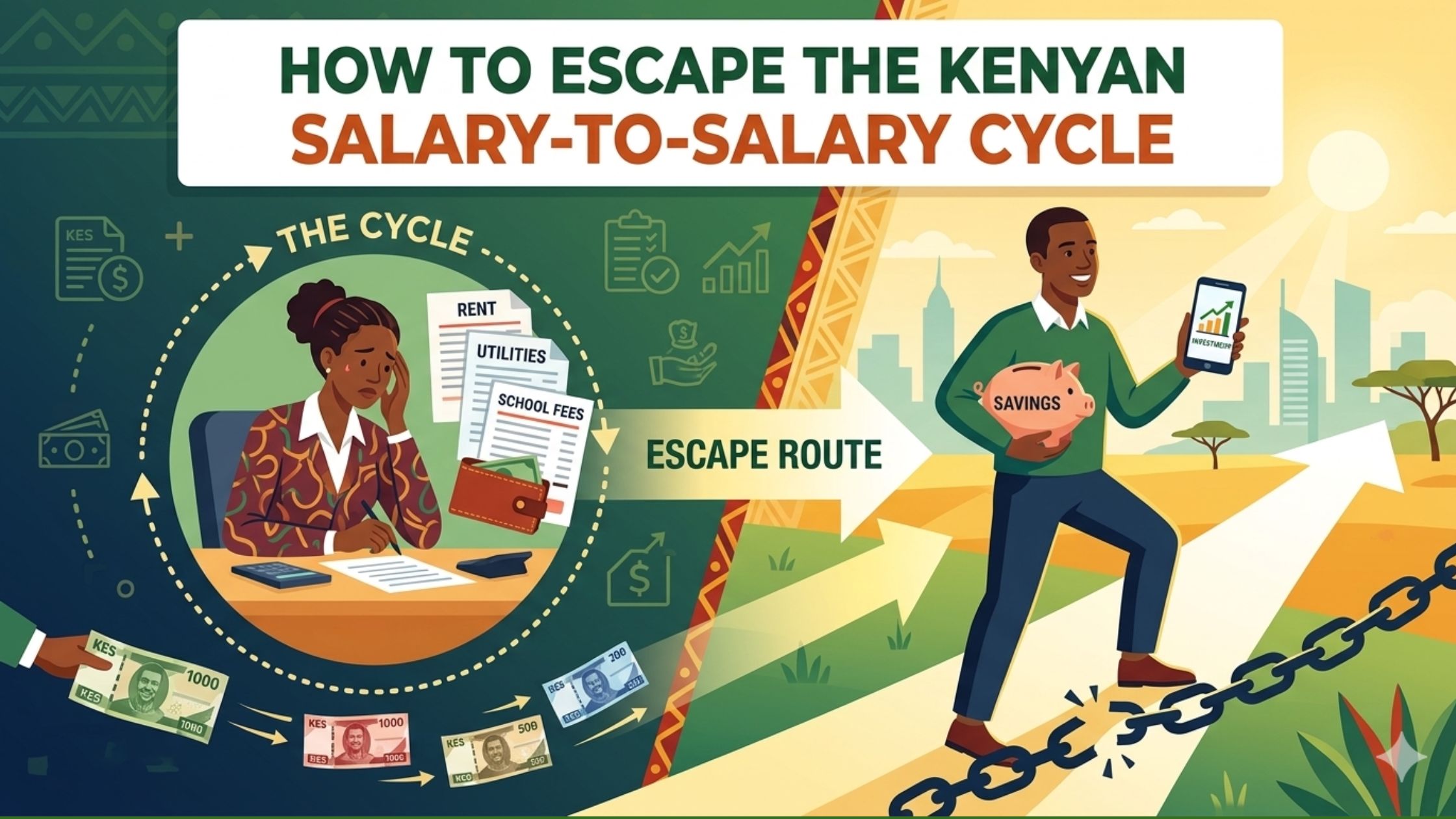
This is the Kenyan salary-to-salary cycle, and it affects workers across all income levels. It is not a problem unique to people earning KES 30,000. Kenyans earning KES 100,000, KES 200,000, and more report the same exhausting pattern. Which tells you something important: the cycle is not primarily caused by how much you earn. It is caused by how your money is structured.
The pattern is familiar to millions of Kenyan workers: salary arrives on the 25th, rent goes on the 1st, Fuliza is triggered by the 10th, and by the 15th you are counting days to the next payday. Repeat, month after month, year after year — even as your salary grows.
The good news is that a structural problem has a structural solution. This guide explains exactly why the cycle happens, what is silently bleeding your finances, and the step-by-step framework that actually breaks it.
Why the Salary-to-Salary Cycle Happens: An Honest Diagnosis
Before you can fix something, you need to understand it accurately. Here are the six real reasons Kenyan workers stay stuck in the cycle — most of which have nothing to do with income level.
1. No Budget Means Money Decides Where It Goes
Most Kenyans do not have a monthly budget. This is not a moral failing — it is a system failure. When money arrives with no pre-assigned plan, it flows to whatever is most urgent, most visible, or most emotionally compelling at that moment: the landlord who is calling, the relative who needs help, the weekend out with colleagues, the data bundle when yours runs out.
By the time the month ends, there is nothing left — not because there was not enough, but because every shilling had somewhere “important” to go.
2. Fuliza Has Become a Salary Extension, Not an Emergency Tool
Safaricom’s Fuliza disbursements rose 49% to KES 1.47 trillion in the financial year ended March 2026, with 17.7 million active users turning to the overdraft facility to complete M-Pesa transactions when they had insufficient balances. The average loan size has actually declined — to around KES 254, signalling small amounts used with increasing frequency and deepening dependence on digital liquidity.
This data tells a story: Fuliza is no longer being used for emergencies. It is being used for everyday transactions — food, transport, bills — by people whose salary has already been spent before the month ends. The overdraft has become a de facto salary extension.
The trap is structural. Because Fuliza auto-deducts from incoming M-Pesa, any money received first goes to repay Fuliza before reaching your balance. This means your salary arrives, Fuliza takes the first slice automatically, and you start the month already behind — making it more likely you will need Fuliza again before the next payday. The cycle feeds itself.
3. Savings Live in the Wrong Place
The most common place Kenyans keep their savings is M-Pesa — which earns zero returns and is frictionlessly easy to spend. When your savings and your spending money occupy the same wallet, the savings always lose. There is no psychological barrier, no delay, no friction between your savings and an impulse purchase.
This is not a willpower problem. It is an architecture problem. Money kept in M-Pesa will be spent. That is what M-Pesa is designed for.
4. No Emergency Fund Means Every Crisis Hits Savings
Without a dedicated emergency fund, every unexpected cost — a hospital bill, a car repair, school fees that were due last week, a funeral contribution — destroys savings progress. You build up KES 50,000. Something happens. You drop to KES 8,000. You start over. Six months of progress disappears in one week.
Most Kenyans have never had three uninterrupted months of savings growth in their life — not because they do not save, but because crises keep resetting the clock.
5. Lifestyle Creep Matches Every Salary Increment
When a Kenyan worker gets a raise — from KES 50,000 to KES 70,000, or from KES 100,000 to KES 140,000 — there is an almost universal tendency to upgrade lifestyle immediately: better rent, better phone, more eating out, more social commitments. The savings rate stays flat even as the income grows.
Over a 10-year career, this pattern means someone who has earned millions of shillings in total income has almost nothing to show for it in savings or investments.
6. Social and Community Financial Pressure
Kenya has a uniquely powerful culture of communal financial obligation. Harambees, wedding contributions, funeral funds, chama commitments, and the pressure to “not be found wanting” when a family member needs help are real and significant. These obligations are not wrong — they are part of what makes Kenyan communities function.
But without a financial plan that accounts for them explicitly, they become unpredictable drains that destroy savings targets month after month. The solution is not to stop contributing — it is to budget for contributions before they arrive.
The Fuliza Trap: What It Is Actually Costing You Per Year
Most Fuliza users dramatically underestimate what the product costs them. Fuliza charges a daily access fee of approximately 1.083% of the outstanding overdraft balance — meaning a KES 1,000 Fuliza costs roughly KES 10.83 per day until fully repaid.
Here is what that means in practice for a typical user:
| Scenario | Monthly Fuliza Usage | Annual Fee Cost |
|---|---|---|
| Light user: KES 200, 7-day repayment, 8x/month | KES 200 × 8 uses | ~KES 2,400/year |
| Average user: KES 500, 14-day repayment, 10x/month | KES 500 × 10 uses | ~KES 5,400/year |
| Heavy user: KES 1,000, 20-day repayment, 12x/month | KES 1,000 × 12 uses | ~KES 7,800–10,000/year |
A KES 200 Fuliza held for 30 days costs KES 60 in access fees — equivalent to a 30% monthly rate.
That KES 5,000–10,000 per year in Fuliza fees is money that could have been saved. Invested in a money market fund at 10% net annual return over 5 years, even KES 5,000 per year becomes over KES 30,000 — from fees you stopped paying, reinvested into something that grows.
The deeper cost is not just the fee. It is the auto-repay loop: every incoming payment is intercepted by Fuliza before you can allocate it. Your salary arrives, Fuliza takes its share, and you are making decisions with a smaller base — which makes every financial plan harder to execute.
The Framework That Actually Breaks the Cycle
Breaking the salary-to-salary cycle is not about discipline or willpower. It is about building a system that makes the right financial decisions automatic — so that your money goes where you intend it to go before anything else can claim it.
Here is the step-by-step framework:
Step 1: Pull Your M-Pesa Statement and Face the Truth
You cannot fix what you have not measured. Pull your M-Pesa statement for the last 3 months — dial *334# → My Account → Statement — and download it. Go through every transaction and categorise it:
- Fixed needs: Rent, utilities, school fees, transport
- Variable needs: Food, airtime, data
- Fuliza and loan repayments: Every fee, every auto-deduction
- Social and communal: Contributions, harambees, chamas
- Wants: Eating out, entertainment, subscriptions, impulse purchases
Most Kenyans who do this for the first time are surprised. Not by how much they spend on luxuries — but by how much disappears in small, invisible amounts: Fuliza fees, M-Pesa transaction charges, small purchases that do not feel significant in the moment but add up to thousands per month.
This exercise gives you the real number you are working with — and shows exactly where the gaps are.
Step 2: Pay Yourself First — Before Anyone or Anything Else
This is the single most important structural change you can make. On the day your salary arrives — before rent, before food, before any other transaction — move your savings amount to a money market fund.
Not what is left at the end of the month. The first thing you do on payday.
This works because it changes the default. Instead of spending first and saving whatever remains (which is usually nothing), you save first and spend what remains. The amount you can live on adjusts to what is available — because it always has to.
Start with whatever you can: even KES 2,000–3,000 is a meaningful beginning. As the habit builds and you identify spending leaks, increase the amount.
Most money market funds allow you to set up a standing order or recurring M-Pesa transfer — use this to automate the transfer so it happens without you making a decision each month.
Step 3: Open a Money Market Fund Today
Your savings should not live in M-Pesa or a bank savings account. Here is why:
| Savings Vehicle | Annual Return | Temptation Risk | Daily Compounding |
|---|---|---|---|
| M-Pesa wallet | 0% | Very High (same wallet as spending) | No |
| Bank savings account | ~2.55–3.4% net | Medium | No |
| Money Market Fund | ~7.65–10.2%+ net | Low (separate platform) | Yes |
A money market fund puts physical and psychological distance between you and your savings. To spend it, you have to log in, request a withdrawal, and wait 24 hours. That friction eliminates impulse spending from savings. Meanwhile, your money accrues interest every single day — including weekends and public holidays.
At a net yield of 10%, KES 10,000 saved every month for 3 years grows to approximately KES 419,000 — versus KES 360,000 sitting flat in M-Pesa with no returns. That is KES 59,000 extra for doing nothing but choosing the right container.
CMA-regulated funds to consider: Cytonn Money Market Fund, Arvocap, Nabo Africa, Lofty-Corban. Compare current yields at Money254 or Serrari before choosing.
Step 4: Build Your Emergency Fund Before Anything Else
Before investing, before paying off debt aggressively, before any other financial goal — build an emergency fund.
Target: 3 months of your total monthly expenses, held in your money market fund (accessible but separate from your spending).
Why 3 months? It is enough to cover most crises — job loss, medical emergency, car breakdown, sudden family obligation — without touching long-term savings or resorting to mobile loans.
How to build it fast:
- Direct any windfalls (bonus, tax refund, side income) straight into the emergency fund until it is complete
- Sell anything unused and idle — old electronics, clothes, household items you no longer need
- During the emergency fund phase, reduce all non-essential spending temporarily
Once the emergency fund is fully funded, it sits there earning returns and never gets touched except for genuine emergencies. When you do use it, rebuilding it becomes the next immediate priority.
Step 5: Break the Fuliza Dependency Structurally
You cannot pay off Fuliza while continuing to use it. The auto-repay loop means every attempt to clear the balance is immediately followed by another draw when your balance runs short.
The only way out is to build a buffer that makes Fuliza unnecessary:
- Deposit extra into M-Pesa specifically to clear your outstanding Fuliza balance completely
- Keep a minimum M-Pesa float of KES 1,000–2,000 at all times for small transaction shortfalls
- Transfer your emergency buffer to an MMF — accessible in 24 hours when you genuinely need it, but not sitting in M-Pesa where it will be spent
Once you have cleared Fuliza and built a float, opt it out of auto-activation: dial *234# and manage your Fuliza settings. Use it only as a true last resort, and always repay within 48 hours to minimise fees.
Step 6: Build a Monthly Spending Plan (Not a Punishment Budget)
The word “budget” feels restrictive. A spending plan feels intentional — and that distinction matters.
A spending plan is simply a decision, made in advance, about where your money will go each month. Not a restriction — a direction. Here is a simple structure that works for most Kenyan income levels:
The 50-30-20 Framework (adapted for Kenya):
- 50% — Needs: Rent, food, transport, school fees, utilities, NHIF/SHA
- 30% — Savings and debt repayment: MMF savings, loan repayment, chama contributions
- 20% — Wants and social: Eating out, entertainment, harambees, personal spending
This is a guide, not a rule. On KES 30,000 a month in Nairobi, 50% barely covers rent and food — and that is fine. Adjust the percentages to your reality, but the principle holds: give every shilling a destination before the month begins.
Budget for social obligations explicitly. If you know there is a wedding in March and a harambee in April, allocate a monthly “social fund” of KES 1,000–3,000 that builds toward those commitments without surprising your monthly savings plan.
Step 7: Grow Your Income — Because Cutting Has Limits
There is a floor to how much you can cut. There is no ceiling to how much you can earn. Once your system is in place, income growth becomes the accelerator.
Negotiate your salary — most Kenyans accept the first offer and then wait for annual increments. Research market rates on LinkedIn Salary Insights or Glassdoor Kenya before your next review, and make a data-backed case. On average, you can expect to earn around 10% more when switching to a new company. Sometimes the fastest raise is a job change.
Add a side income of KES 5,000–10,000/month. The mathematics are compelling: an extra KES 5,000 per month saved in an MMF at 10% net compounds to over KES 103,000 extra in a year — not from your salary, but from a side hustle and returns. Options accessible to employed Kenyans include freelance writing, social media management, tutoring, and weekend product activation work.
Direct every income increase into savings first. When you get a raise, increase your automatic savings transfer before you increase your spending. This is how salary growth actually builds wealth instead of being absorbed by lifestyle inflation.
The Timeline: What to Expect with The Kenyan salary-to-salary cycle
Breaking the salary-to-salary cycle is not instant. Here is a realistic timeline:
Month 1: Pull your statement. Open your MMF. Make your first savings transfer. Clear or start clearing Fuliza. This month will feel tight — you are building new habits against old patterns.
Month 2–3: The system starts to feel normal. Your MMF balance is visible and growing. Emergencies that used to require Fuliza are handled by your growing buffer. The cycle is weakening.
Month 4–6: Emergency fund reaches 1 month of expenses. Fuliza dependency is significantly reduced or eliminated. Monthly spending feels more controlled because you planned for it.
Month 6–12: Emergency fund reaches 3 months. Automatic savings are flowing consistently. You begin experiencing the compound effect — your MMF balance growing faster each month than the month before.
Year 2+: The cycle is broken. Your money goes where you decided it would go. Side income, if added, is accelerating the savings rate. The financial anxiety that defined the first of each month starts to lift.
The Bottom Line: The Kenyan salary-to-salary cycle
The Kenyan salary-to-salary cycle is a system problem, not an income problem and not a character problem. It is maintained by the wrong structures: no spending plan, savings in the wrong place, Fuliza as a lifestyle tool rather than an emergency one, and no buffer between you and every financial crisis.
The solution is to build better structures — pay yourself first, automate savings into an MMF, build an emergency fund, and remove Fuliza from your monthly routine. None of these steps require a higher salary to begin. They require a decision, and then a system.
Start with Step 1 today: pull your M-Pesa statement. What you find will tell you everything you need to know about where to begin.
Compare money market funds and open an account at Money254 or Serrari — most accounts can be opened in under 10 minutes via M-Pesa.
Disclaimer: All financial projections in this article are illustrative estimates based on current data and should not be taken as financial advice. Fuliza fee structures and MMF yields are subject to change. Consult a licensed financial advisor for personalised guidance.
Sources: AllAfrica / Daily Nation Fuliza Report (May 2026), Safaricom Financial Services Data FY2026, PesaTrail Fuliza Guide 2026, Credizen Fuliza Review 2026, TechCabal Kenya Overdraft Market Report (November 2025), World Salaries Kenya 2026, World Bank Kenya Economic Update (2026).