
How Much Should You Save Before Leaving Employment in Kenya?
How much should you save before leaving employment in Kenya? The answer is specific, and it has three components that most people who quit too early get wrong: your personal survival runway, your business startup fund, and the income replacement benchmark that tells you whether you are actually ready to go.
Every month, thousands of Kenyans submit their resignation letters with a business idea, a freelance client, or simply the conviction that employment is no longer working for them. Within 12 months, a significant portion are back in formal employment — not because the idea was bad, but because they left before they were financially positioned to survive the gap.
This guide gives you the complete financial checklist for leaving employment in Kenya — with real KES figures, the administrative steps most people forget, and a staged exit strategy that dramatically improves your odds of not having to go back.
Why Most Kenyans Who Leave Employment Return Within 12 Months
The pattern is consistent: someone leaves a job with savings, a plan, and high motivation. Month 1 is exciting. Month 2 is productive. Month 3, the first real expenses hit — a client does not pay on time, a family obligation arrives, business is slower than projected. By month 6, the savings are depleted. By month 9–12, they are job-hunting again, often for roles below their previous level because the career gap looks unexplained.
The failure point is almost never the idea. It is the financial foundation — specifically:
- No separate emergency fund — personal savings and business capital were one pot
- Underestimating the income gap — most businesses or freelance practices take 3–6 months to reach consistent revenue
- Ignoring fixed obligations — rent, school fees, loan repayments, and health cover do not pause because your income has
- No income validation before quitting — leaving before proving that anyone will pay for what you are selling
Each of these is fixable — but only before you leave, not after.
The Three Numbers You Must Know Before You Leave
Number 1: Your Personal Monthly Survival Cost
This is not your current monthly spending. It is the minimum amount required to maintain your household — rent, food, transport, school fees, utilities, health cover, and essential loan repayments — without any discretionary spending.
For most formally employed Kenyans, this number looks something like this:
| Expense Category | Nairobi (Single) | Nairobi (Family of 4) |
|---|---|---|
| Rent | KES 15,000–30,000 | KES 25,000–50,000 |
| Food | KES 8,000–12,000 | KES 15,000–25,000 |
| Transport | KES 3,000–6,000 | KES 4,000–8,000 |
| Utilities (water, electricity, data) | KES 3,000–5,000 | KES 5,000–8,000 |
| Health cover (SHA/private) | KES 1,000–5,000 | KES 3,000–10,000 |
| School fees (monthly allocation) | — | KES 5,000–20,000 |
| Loan repayments (if any) | Varies | Varies |
| Approximate monthly minimum | KES 30,000–58,000 | KES 57,000–121,000 |
Calculate your number precisely — not an approximation. Pull your last 3 months of M-Pesa statements, strip out every non-essential category, and what remains is your survival floor.
Number 2: Your Emergency Runway (6 Months of Survival Cost)
The minimum personal savings requirement before leaving employment is 6 months of your survival cost — held in a money market fund, not M-Pesa or a current account.
Why 6 months, not 3?
- Businesses and freelance practices consistently take longer to generate reliable income than founders expect
- Client payment cycles create gaps — even a client who pays monthly may take 30–45 days after invoice
- Unexpected personal emergencies do not stop occurring because you changed your employment status
- The psychological confidence of 6 months in reserve measurably improves decision-making quality during the transition
For a Nairobi single adult with a KES 40,000/month survival cost: minimum runway = KES 240,000 For a Nairobi family with a KES 80,000/month survival cost: minimum runway = KES 480,000
This fund lives in a money market fund — not a SACCO (too illiquid), not M-Pesa (too easy to spend, no returns). A money market fund earns 7.65–10.2% net annually while providing T+1 to T+3 access. It grows while it waits, and it is genuinely accessible within 24–72 hours when needed.
Critical rule: This fund is for personal survival. It is not business capital. Mixing them is the single most common financial mistake people make when leaving employment.
Number 3: Your Business Startup Runway (3–6 Months of Operating Costs)
Separate from your personal runway, your business needs its own capital to cover:
- Initial setup: business registration (KES 950 via eCitizen), equipment, software, website, branding
- Marketing and client acquisition costs for the first 3 months
- Any inventory, materials, or tools required for your product or service
- Professional services: accountant, lawyer (if structuring contracts)
- A buffer for the months when revenue is lower than projected
For a service-based freelancer or consultant with low overhead, this number may be as small as KES 30,000–80,000. For a product-based business requiring stock, a physical location, or staff, it could be KES 200,000–1,000,000 or more.
Calculate this number honestly, based on your actual business model — not an optimistic version of it. Then add 30% as a contingency buffer, because almost everything costs more and takes longer than planned.
Total savings needed before leaving employment:
| Situation | Personal Runway (6 months) | Business Runway (3–6 months) | Total Minimum |
|---|---|---|---|
| Single, low-cost lifestyle, service freelancer | KES 180,000 | KES 50,000 | KES 230,000 |
| Single, Nairobi, professional freelancer | KES 240,000 | KES 100,000 | KES 340,000 |
| Family of 4, Nairobi, service business | KES 480,000 | KES 200,000 | KES 680,000 |
| Family of 4, product/physical business | KES 480,000 | KES 500,000+ | KES 980,000+ |
The Income Replacement Benchmark: Are You Actually Ready?
Savings alone do not make you ready to leave employment. Your income replacement benchmark does.
Before you submit your resignation letter, your business, freelance practice, or alternative income source should already be generating a minimum of 30–50% of your current net salary, consistently, for at least 2–3 months.
Why 30–50%? It is not enough to live on — which is why you also need the 6-month personal runway. But it proves three critical things that savings alone cannot prove:
- There is genuine market demand for what you are selling — real clients are paying real money
- You can actually close deals and collect payment — the hardest skill gap in leaving employment
- Your income projections are grounded in evidence, not optimism
The Kenyan who quits with zero existing revenue is running a pure startup experiment — which requires a much larger financial cushion and a much higher tolerance for risk. The Kenyan who quits with 40% of their salary already replaced is making a calculated transition with a proven revenue base to grow from.
The readiness matrix:
| Alternative Income (% of salary) | 6-Month Runway | Verdict |
|---|---|---|
| 0% | Yes | High risk — business unproven; consider 12-month plan |
| 0% | No | Do not leave yet |
| 10–20% | Yes | Proceed with caution; set a 90-day revenue milestone |
| 30–50% | Yes | Strong position — proceed with a clear 6-month plan |
| 50%+ | Yes | Excellent position — runway supports growth investment |
| 50%+ | No | Pause — build the personal runway before leaving |
The Administrative Checklist: What to Sort Before Day One of Freedom
Most people focus entirely on finances and miss the administrative changes that matter equally. Here is what to sort before you hand in your notice:
1. Health Cover (SHA/SHIF)
Under employment, your SHA (Social Health Insurance Fund, the 2024 replacement for NHIF) contributions are deducted from your payroll and remitted by your employer. The moment your employment ends, so does this automatic coverage.
Self-employed Kenyans must register and contribute independently to SHA/SHIF. The Social Health Insurance Fund (SHIF) replaced NHIF in 2024 and now operates through the Afya Yangu portal. Register at sha.go.ke or the Afya Yangu app. You can choose to pay monthly, weekly, or daily instalments.
Do this before your last day of employment. There should be zero gap in your health cover.
Additionally, consider whether a private medical insurance top-up is necessary — SHA coverage has limits, and an unexpected hospitalisation in the first months of self-employment without adequate cover can destroy a business runway overnight.
2. NSSF / Personal Pension
Your employer was contributing to NSSF on your behalf. As a self-employed person, you must register as a voluntary contributor and remit both the employee and employer portion yourself.
More importantly, if your previous employer had a pension scheme, understand your entitlements clearly before leaving. If you have been employed for over 10 years, you may have significant pension savings that should be transferred to a personal pension plan — not withdrawn and spent. Withdrawing pension savings on resignation is one of the most financially damaging decisions Kenyans make when leaving employment.
Contact the Retirement Benefits Authority (rba.go.ke) if you are unsure about your pension entitlements and transfer options.
3. SACCO Membership
Do not exit your SACCO. Exiting and re-joining means starting your share capital accumulation from zero and losing your loan eligibility history. Instead, reduce your monthly contribution to a sustainable level for your projected income — even KES 1,000–2,000/month maintains membership while reducing the cash flow burden during your transition.
Many SACCOs have provisions for members who transition from employment to self-employment. Ask your SACCO treasurer or manager about your options before making any decisions.
4. Outstanding Loans and Debt
Any loans structured around salary-based repayments — SACCO loans, bank loans, mobile loans — become harder to service on variable income. Before leaving:
- List every outstanding loan with its monthly repayment obligation and remaining balance
- Assess whether the debt-to-income ratio is sustainable on your projected self-employment income
- If not, consider whether there is a way to clear or restructure debt before leaving, or negotiate terms with lenders
Never leave employment with high-interest mobile loan debt outstanding. Tala, Branch, and similar products charge monthly rates that compound painfully on variable income.
5. KRA Tax Registration as Self-Employed
Your PAYE tax deductions end with your employment. As a self-employed person, your income tax obligations change:
- Register as self-employed with KRA via iTax (itax.kra.go.ke)
- Turnover Tax (TOT): If your annual gross revenue is between KES 1 million and KES 25 million, TOT applies at 1.5% of gross revenue — a simplified final tax with no further income tax
- Individual income tax: Progressive rates from 10% to 35% on taxable profit if you choose standard business income taxation
- VAT registration: Mandatory if annual turnover exceeds KES 5 million
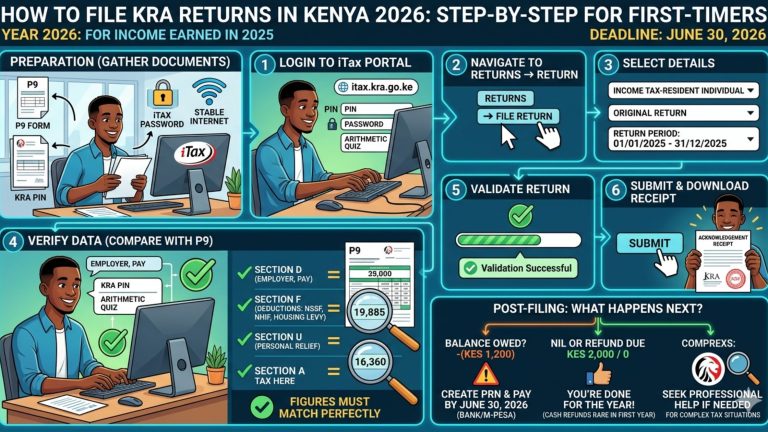
- Annual returns: File by June 30 of the following year (e.g., 2025 income filed by June 30, 2026)
- eTIMS compliance: Mandatory electronic invoicing via KRA-certified eTIMS for all KRA-registered businesses since 2024 — set this up from day one
Late filing penalties start at KES 2,000 per return. Get tax compliance right from the start — it is far cheaper than catching up on penalties a year later.
Register your business as a sole proprietor via eCitizen for approximately KES 950. Obtain a Single Business Permit from your county government. Open a separate business bank account — mixing personal and business finances is the most common bookkeeping mistake that creates tax complications later.
The Staged Exit: The Most Underused Strategy in Kenya
The cleanest path from employment to self-employment is not a sudden leap — it is a planned, staged transition that most Kenyans never consider.
The 12-month staged exit:
Months 1–6: Build your savings runway to the target amount. Develop your business model, test it with real clients, and begin generating revenue — all while still employed. Build your portfolio, your first client relationships, and your evidence of demand.
Months 6–9: Your alternative income has reached 30–50% of your salary. Your personal runway is fully funded. You are now financially positioned to leave. Before doing so, have the conversation with your employer.
Months 9–12: Negotiate your exit terms. Many employers will offer a consulting or part-time arrangement for a transitional period — particularly if you are in a specialised role and your replacement will take time to find. This gives you:
- Continued income during the final savings build-up
- Time to hand over properly, protecting your professional reputation
- A potential first client: your former employer as a consultant
The exit conversation most Kenyans avoid: “I am planning to transition to independent consulting in the next 6 months. I wanted to give you adequate notice and explore whether there is a consulting arrangement that could work for us both after my last day.”
Most managers are far more receptive to this conversation than employees expect — particularly when it is framed as a professional transition rather than a resignation. The goodwill generated by a planned, transparent exit is professionally and financially valuable.
Signs You Are Ready vs. Signs You Are Running Away
This is the most important distinction in the entire decision. Many Kenyans who leave employment prematurely are not entrepreneurs — they are employees who have become unhappy with a specific job, a specific manager, or a specific organisation. The solution to that problem is usually a job change, not leaving employment entirely.
| You Are Ready to Leave | You Are Running Away |
|---|---|
| 6+ months personal expenses saved in MMF | Frustrated with your boss or workplace |
| Alternative income already generating 30%+ of salary | No paying clients; business is still a plan |
| Business model tested and validated with real transactions | Vague idea with no proven demand |
| SHA/SHIF, NSSF, KRA registrations sorted | Assuming you will “sort the admin later” |
| Clear revenue projection for months 1–6 | Expecting the business to “take off quickly” |
| Loans either cleared or confirmed sustainable on variable income | Outstanding high-interest mobile debt |
| Leaving with professional goodwill and possible consulting bridge | Burning bridges; dramatic resignation |
If three or more items in the right column apply to you, the answer is not to cancel your entrepreneurial plans — it is to build the left column before submitting your letter.
What the First 6 Months of Self-Employment Actually Looks Like
Knowing what to expect reduces the emotional volatility that causes most people to give up too early.
Month 1: Slower than expected. First client is harder to close than you thought. Administrative setup — KRA, SHA, bank account — takes more time than anticipated. This is normal.
Month 2–3: Rhythm begins to establish. First invoice paid. Second client acquired. The business model is being tested against real conditions — some assumptions need adjustment. Income is irregular but present.
Month 4–5: Word of mouth begins. If you delivered quality work in months 1–3, referrals start arriving without active selling. Revenue becomes more predictable. The psychological shift from “employee” to “business owner” completes.
Month 6: You either have enough consistent revenue to sustain the transition without touching your personal runway, or you have a clear picture of what is not working and a decision to make about pivoting or returning to employment. This is not failure — it is information.
The Kenyans who succeed through this transition share two characteristics: they left with an adequate financial foundation, and they stayed patient through months 1–3 when almost everyone who quits prematurely gives up.
The Bottom Line: How much should you save?
How much should you save before leaving employment in Kenya? The minimum is 6 months of your personal survival cost in a money market fund, plus 3–6 months of business operating capital kept separately, with at least 30% of your salary already being replaced by alternative income.
For most Kenyans, this means leaving employment is a 12–18 month preparation process, not a spontaneous decision. That preparation period is not a delay — it is the investment that determines whether you leave once and succeed, or leave and return.
The Kenyan who builds their financial foundation deliberately, validates their income model before quitting, sorts their health cover and tax obligations in advance, and negotiates a staged exit from their employer will have a dramatically higher chance of sustaining their independence than the one who quits on an emotional high with two months of savings and a great idea.
Leaving employment is not a leap of faith. It is the most calculated move of your financial life — and it deserves to be treated that way.
Start your preparation by opening an MMF today for your personal runway fund at Money254, and register your business name at eCitizen when you are ready.
Disclaimer: Tax rates, SHA/SHIF contribution structures, KRA registration processes, and regulatory requirements are subject to change. All financial figures are illustrative estimates based on 2026 Kenyan market conditions. This article is for informational purposes only and does not constitute financial, legal, or tax advice. Consult a licensed financial advisor, accountant, or legal professional for personalised guidance.
Sources: Deel.com Sole Proprietorship Kenya Guide, ClearTax Kenya Freelancer Tax Guide 2026 (March 2026), Iambeezy KRA PIN Kenya 2026 (April 2026), CityNews Kenya KRA Returns Guide 2026, Tuko.co.ke SHA Registration Self-Employed (March 2026), MoneyIssues.co.ke FIRE Kenya Guide, Bloosomup Financial Planning Before Quitting Job (April 2025), RBA Kenya Individual Pension Plan Guide.