Safaricom Book Closure 2026: Everything You Need to Know
The Safaricom book closure 2026 date is August 4, 2026 — and understanding exactly how it works is the difference between collecting KES 1.15 per share in September and watching someone else collect the dividend you thought you had secured.
This guide covers the book closure mechanics in full: what the date actually means, why July 30 is your real deadline (not August 4), what happens to the share price on July 31, and the three mistakes that cause Kenyan investors to miss payouts they were entitled to.
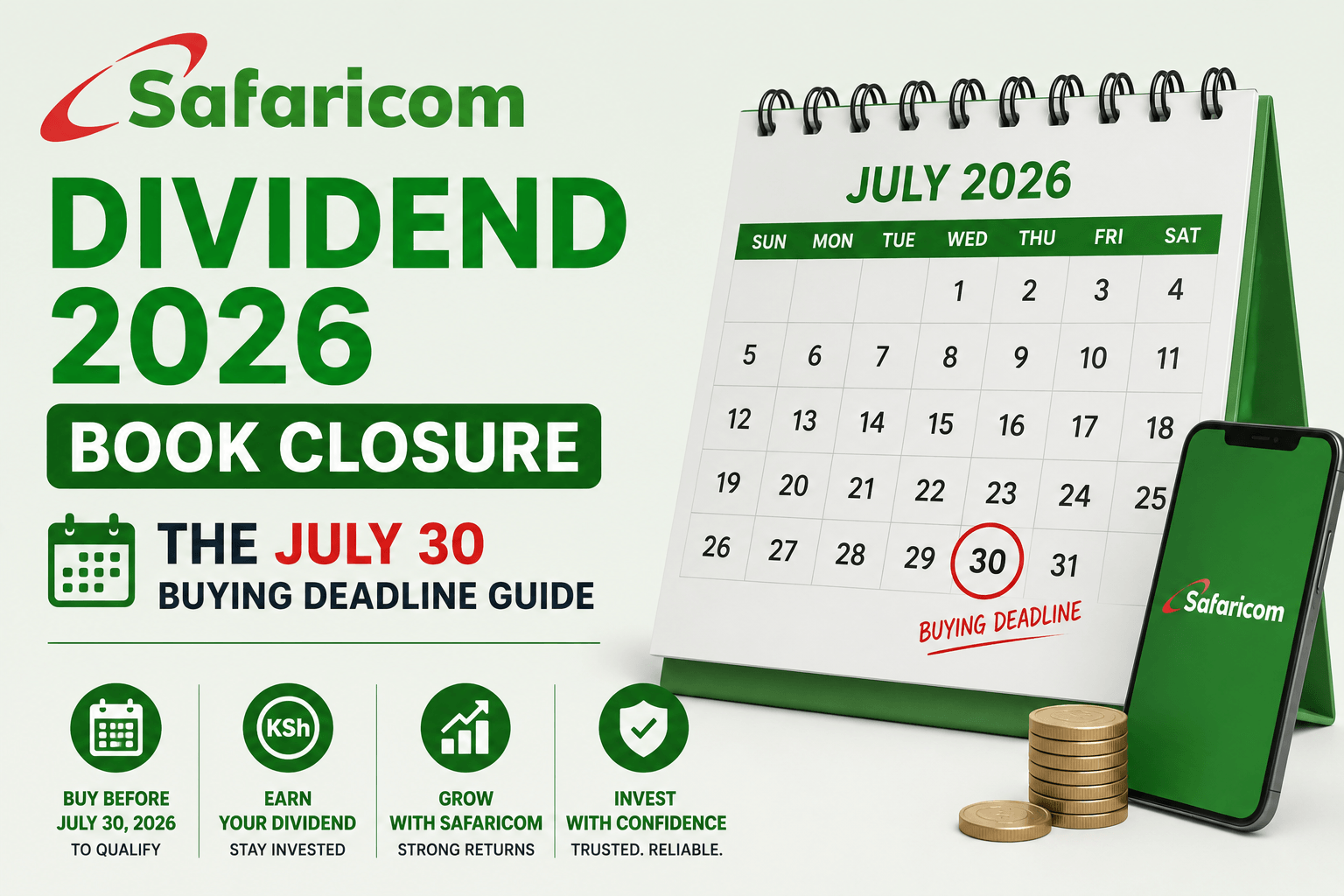
⚠️ Time-sensitive: The Safaricom book closure is August 4, 2026. Under T+3 settlement rules, your absolute last day to buy shares and qualify is July 30, 2026 — 9 days away. After July 30, new buyers do not qualify for the KES 1.15 final dividend.
For the full payout amounts, earnings calculator, and dividend history, see our companion article: Safaricom Dividends 2026 Payout Date: Everything You Need to Know.
What Is the Safaricom Book Closure Date 2026?
A book closure date is the specific moment when a listed company officially locks its shareholder register to determine who qualifies for the declared dividend. On August 4, 2026, Safaricom PLC will close its share register at the end of the business day. Every shareholder whose name appears in the Central Depository and Settlement Corporation (CDSC) registry at that moment will receive the KES 1.15 final dividend on September 4, 2026.
If your name is not on that register — regardless of whether you held shares the day before, or buy shares the day after — you receive nothing from this payout cycle.
This is not a technicality. It is the central mechanism of dividend investing on the NSE, and every detail in this guide exists to make sure you are on the right side of it.
When Is the Safaricom Book Closure? — The Full Date Pipeline
Most investors focus on the wrong date. The book closure is August 4 — but that is not when you need to act. Here is the complete sequential timeline:
THE SAFARICOM FY2026 FINAL DIVIDEND PIPELINE

[May 7, 2026]      [July 30, 2026]     [July 31, 2026]     [August 4, 2026]    [Sept 4, 2026]
  Declaration       Buying Deadline     Ex-Dividend Date     Book Closure         Payment Date
 KES 1.15 Gross    Last day to buy     Price adjusts down   Register locks       Cash disbursed
May 7, 2026 — Declaration Safaricom’s Board of Directors announced the KES 1.15 final dividend alongside audited full-year results showing KES 100 billion in net income for FY2026.
July 30, 2026 — Buying Deadline ⚠️ The absolute last trading session where you can buy Safaricom shares and have them settle in time to appear on the CDSC register before book closure. This is your real action deadline — not August 4.
July 31, 2026 — Ex-Dividend Date The stock begins trading “ex-dividend.” Anyone buying on or after this date does not qualify for the KES 1.15 payout. The dividend belongs to the seller, not the buyer.
August 4, 2026 — Book Closure The official share register locks. Whoever is documented in the CDSC registry at close of business receives the dividend.
September 4, 2026 — Payment Date Cash is credited directly to your registered bank account or M-Pesa wallet. No action required.
Why July 30 Is Your Real Deadline — The T+3 Rule Explained
This is the most misunderstood fact in Kenyan dividend investing, and it costs investors their payouts every single cycle.
When you buy shares on the Nairobi Securities Exchange, those shares do not immediately appear in your name on the CDSC register. Under the NSE’s T+3 settlement system, it takes the trade date plus three full business days for the transaction to clear and the CDSC to officially record the shares in your name.
The practical implication for Safaricom:
| Buy Date | Settlement Date | Qualifies? |
|---|---|---|
| Monday July 28 | Thursday July 31 | ✅ Yes — settles before Aug 4 |
| Tuesday July 29 | Friday August 1 | ✅ Yes — settles before Aug 4 |
| Wednesday July 30 | Monday August 4 | ✅ Yes — settles on book closure day |
| Thursday July 31 | Tuesday August 5 | ❌ No — settles after book closure |
| Friday August 1 | Wednesday August 6 | ❌ No — too late |
| Monday August 4 | Thursday August 7 | ❌ No — three days after book closure |
July 30 is your hard deadline. Buying on July 31 — even one day late — means your shares settle on August 5, one business day after the register has already locked.
The five-day safety buffer: Most experienced NSE investors and brokers recommend buying at least five business days before book closure, not three. This creates a buffer for any processing delays, broker backlogs, or system issues. Five business days before August 4 takes you back to July 28. If you are planning to buy, July 28 is the safer target.
Book Closure for Safaricom — What Happens to the Share Price on July 31?
On the morning of July 31, 2026 — the ex-dividend date — the trading system automatically adjusts Safaricom’s opening price downward by the exact value of the declared dividend.
This is called the ex-dividend price adjustment, and it is a mechanical, predictable event that happens on the ex-dividend date of every NSE-listed stock. It is not a sign that something has gone wrong. It simply reflects the fact that new buyers on that date are no longer entitled to the upcoming payment.
The math:
If Safaricom closes at KES 32.60 on July 30, the opening price on July 31 will adjust to approximately:
KES 32.60 − KES 1.15 = KES 31.45
Long-term investors hold through this adjustment without concern — the dividend they receive offsets the paper reduction in share price. The stock then recovers over subsequent weeks as the market reprices based on fundamentals rather than the dividend entitlement.
The Ex-Dividend Trap — Why Dividend Stripping Does Not Work
Every dividend cycle, some investors try to exploit the book closure by buying shares just before July 30, collecting the dividend, and immediately selling on July 31 for what they think will be a risk-free profit. This strategy is called dividend stripping, and it consistently loses money.
Here is why:
Step 1 — You buy at KES 32.60 on July 30 You pay KES 32,600 for 1,000 shares, plus approximately 2.1% in brokerage fees = approximately KES 33,285 total cost.
Step 2 — The price drops to KES 31.45 on July 31 You sell 1,000 shares at KES 31.45, minus 2.1% brokerage fees = approximately KES 30,785 received.
Step 3 — You receive the dividend in September 1,000 shares × KES 1.15 × (1 − 5% WHT) = KES 1,092.50 net
Step 4 — Calculate total result:
| Item | Amount |
|---|---|
| Sale proceeds | KES 30,785 |
| Dividend received | KES 1,092.50 |
| Total received | KES 31,877.50 |
| Total cost | KES 33,285 |
| Net loss | −KES 1,407.50 |
The brokerage fees on both sides of the trade (buy + sell) consume not just the dividend but part of your original capital. Dividend stripping on the NSE is a money-losing strategy every time.
The right approach: Buy Safaricom because you want to own part of Kenya’s dominant digital network, collect consistent dividends twice a year, and allow your portfolio to compound over years. The KES 1.15 dividend is not a quick profit — it is one payment in a stream of consistent payouts that rewards patient investors.
Step-by-Step: How to Qualify for the Safaricom Book Closure 2026
If you have never bought NSE shares before, here is the complete process from zero to qualified shareholder — all from your smartphone.
Step 1: Open a CDS Account
You need a Central Depository and Settlement Corporation (CDSC) account before you can hold any NSE shares. Modern CMA-regulated apps allow you to open one without visiting a physical office.
Download a licensed app such as Hisa App or Mali App from the official Google Play Store or Apple App Store. Register with your Safaricom phone number, upload a clear photo of your National ID (front and back) and a selfie. Your CDS account number is typically assigned within 24–48 hours.
Important: If you are opening a CDS account fresh today (July 21), factor in 2–5 business days for activation. This means you should start the process today, not on July 28.
Step 2: Fund Your Account via M-Pesa
Once your account is active, deposit your investment capital via the app’s M-Pesa Paybill number. At approximately KES 30.60 per share:
| Target Shares | Approx. Cost (incl. 2.1% fees) |
|---|---|
| 100 shares | ~KES 3,124 |
| 500 shares | ~KES 15,618 |
| 1,000 shares | ~KES 31,236 |
| 5,000 shares | ~KES 156,180 |
The NSE requires trades in multiples of 100 shares minimum. Your order must be 100, 200, 300 shares and so on — odd numbers are not accepted.
Step 3: Search for SCOM and Place Your Buy Order
Navigate to the NSE Stocks section of your app, search for the ticker SCOM, and place a market or limit buy order. Ensure your order is fully matched and executed on or before July 30, 2026.
Place orders mid-morning (9:30–11:00am) when NSE liquidity is highest and execution is fastest. Avoid placing orders after 2:30pm — the NSE closes at 3:00pm and orders placed late risk rolling to the next trading day, which shifts your T+3 settlement window.
Step 4: Confirm Settlement in Your CDS Account
Log into your CDS account within 3 business days of your purchase and confirm the shares appear under your name. Do not assume settlement happened automatically — verify it. If there is any discrepancy, contact your broker immediately while there is still time to resolve it before August 4.
Step 5: Verify Your Bank Account Details
The September 4 dividend will be credited to the bank account registered on your CDS record — not necessarily your M-Pesa number. Log into your broker’s platform and confirm your registered bank details are current and the account is active. If you have changed banks since opening your CDS account, submit an update immediately.
A correctly timed trade with an outdated bank account is the most common reason dividend payments fail for Kenyan investors. The correction process after a bounced payment can take 4–8 weeks.
Withholding Tax on the Safaricom Dividend — Resident vs Non-Resident
The 5% withholding tax for Kenyan resident individuals is deducted automatically before payment. You do not file anything separately.
For non-resident investors — including Kenyans in the diaspora who hold shares but are tax-resident abroad — the withholding tax rate is 15%.
Net dividend per share by tax status:
| Investor Type | Gross Dividend | WHT Rate | Net Per Share |
|---|---|---|---|
| Kenyan resident | KES 1.15 | 5% | KES 1.0925 |
| Non-resident | KES 1.15 | 15% | KES 0.9775 |
If you are a Kenyan in the diaspora holding SCOM shares, confirm your tax residency status is correctly recorded on your CDSC account. An incorrectly recorded non-resident status means 15% is deducted instead of 5% — a meaningful difference on larger holdings.
The Three Mistakes That Cost Kenyan Investors Their Safaricom Dividend
These errors occur every single dividend cycle without exception.
Mistake 1: Buying on the book closure date itself The most common and most costly error. Buying on August 4 means your T+3 settlement lands on August 7 — three days after the register closed. You do not qualify. Your buy deadline is July 30, not August 4.
Mistake 2: Outdated bank account on your CDS record You bought in time. You are on the register. The payment is processed on September 4. And then it bounces — because your bank account was closed when you switched banks two years ago and you forgot to update the CDS record. This happens to hundreds of Kenyan shareholders every cycle. Check your registered bank details today, while you still have time to update them before book closure.
Mistake 3: Assuming a broker confirmation means you’re on the register A broker’s trade confirmation tells you the trade was executed — not that it has settled. Settlement and registration take three business days. Always log into your CDSC portal directly at cdsckenya.com and verify shares appear under your CDS number within T+3 of purchase. If they don’t, escalate immediately.
Frequently Asked Questions
When is the Safaricom book closure 2026? The Safaricom final dividend book closure date is August 4, 2026. The share register locks at close of business on this date. Shareholders on the register receive the KES 1.15 final dividend on September 4, 2026.
When is the book closure for Safaricom — what is my real deadline? Your real buying deadline is July 30, 2026 — not August 4. Under the NSE’s T+3 settlement system, shares bought on July 30 settle on August 4 (book closure day). Buying on July 31 or later means your shares settle after the register has closed.
What is the Safaricom book closure date and ex-dividend date? The ex-dividend date is July 31, 2026. The book closure date is August 4, 2026. They are different: the ex-dividend date is when the stock starts trading without the dividend entitlement; the book closure is when the share register officially locks. Buy before July 31 to qualify.
What happens if I buy Safaricom shares on August 4? Your trade will settle on August 7 — three business days after book closure. You will not receive the KES 1.15 final dividend. The dividend goes to whoever held the shares before the register locked on August 4.
What happens to the Safaricom share price after book closure? On July 31 (the ex-dividend date), the opening price automatically adjusts downward by approximately KES 1.15 — the value of the declared dividend. This is a normal, mechanical adjustment, not a sign of company problems. The stock typically recovers over the following weeks.
How do I make sure my Safaricom dividend reaches my M-Pesa? By default, dividends are sent to the bank account registered on your CDS record. To route payment to M-Pesa directly, update your payment preferences through your broker’s app or submit a CDSC Mandate Form at any licensed broker listing your Safaricom number as the primary payment method. Do this before August 4.
Can I sell my Safaricom shares right after July 30 and still get the dividend? Yes — if you buy before July 30 and sell after July 31 (the ex-dividend date), you retain the dividend. However, the share price will have dropped by approximately the dividend amount on July 31, so you will not profit from the sale by the dividend amount. Dividend stripping (buying to collect the payout and immediately selling) is a money-losing strategy after brokerage fees are factored in.
What Comes After the Safaricom Book Closure
Once August 4 passes, the Safaricom final dividend window closes for this cycle. The next Safaricom dividend opportunity will be the FY2027 interim dividend, typically declared in November and with a book closure around February 2027.
In the meantime, the H2 2026 NSE calendar still has meaningful opportunities:
- EABL final dividend — book closure expected September 2026
- KCB interim dividend — book closure expected August/September 2026
- KenGen annual dividend — book closure projected November 26, 2026
- COOP interim dividend — book closure expected November 2026
See our full NSE Book Closure Dates 2026 tracker for every upcoming date and T+3 buy deadline in one place.
More NSE Dividend Guides
- Safaricom Dividends 2026 Payout Date — full earnings calculator, dividend history, and yield analysis
- NSE Book Closure Dates 2026 — every company, every deadline, updated tracker
- KCB Dividends 2026 — record KES 7.00 per share
- COOP Dividends 2026 — KES 2.50, largest in bank history
- How to Invest in NSE Kenya 2026 — open a CDS account from your phone
- Best Money Market Funds Kenya 2026 — where to park dividend cash between cycles
Safaricom FY2026 final dividend declared May 7, 2026. Book closure August 4, 2026. Payment date September 4, 2026, subject to AGM approval July 31, 2026. Share price approximately KES 30.60–32.60 as of July 2026. Always verify current dates at nse.co.ke and cdsckenya.com before making investment decisions. This article is for educational purposes only and does not constitute financial advice.