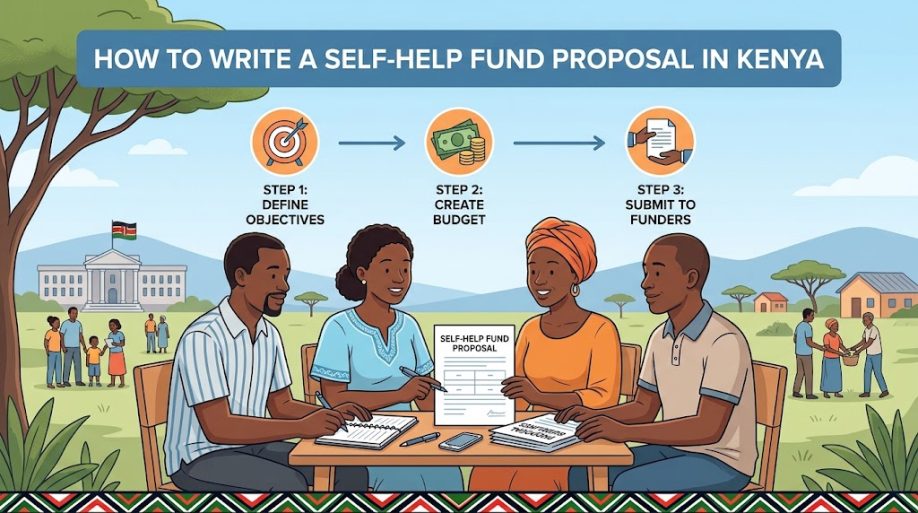
How to Write a Self-Help Fund Proposal in Kenya (With Sample Budget and Beneficiary Table)
A strong Self-Help Fund proposal in Kenya shows a real problem, a registered group, a clear budget and a community that is putting in its own effort.
The U.S. Embassy’s Ambassador’s Self-Help Fund is competitive. Weak budgets and vague projects are common reasons proposals fail.
This guide shows how to prepare your proposal, with a sample budget and beneficiary table you can adapt. The tables use made-up numbers, so replace them with your own.
Important: only proposals on the official application form are considered. Applicants must email the embassy to receive the official application materials. Treat this guide as preparation, not a replacement for the form.
What the Self-Help Fund Looks For
Published guidance on the Kenya fund says:
- It supports registered self-help groups, youth groups, community organisations and certain schools and medical facilities.
- It does not fund the start of a project, but may fund expansion of an existing one.
- Projects should be finished and serving the community within one year.
- Proposals range from $1,000 to $10,000, and the average award is $3,000 to $7,000.
- The group and community must contribute 25% or more of the project cost. Confirm the exact percentage on the official form.
Not registered yet? Start with our guide to registering a self-help group.
Before You Write: Eligibility Checklist
- Your group is registered, with a valid certificate
- You already run the project you want to expand
- A community, not a few individuals, benefits
- You can show cash, labour or materials from your own group
- You can finish within about a year
- You can explain how the project keeps going afterwards
If any answer is no, fix that before you apply.
Proposal Outline
Other U.S. Embassy Self-Help programmes use a similar structure. Nairobi’s form may differ, so use it as a guide to what to prepare:
- Application summary: project title, amount requested, value of community contribution, number of beneficiaries, group name, number of active members, and whether the group has received a Self-Help grant before.
- Problem and need: what is wrong now, who is affected, with numbers.
- Project description: what you will buy or build, where, and the timeline.
- Community involvement: how members and the wider community help plan, contribute and benefit.
- Sustainability: how the project continues after the grant.
- Budget: split between what the Embassy pays and what your group contributes.
- Attachments: registration certificate, quotations and other documents the form requests.
How to Write Each Part
Problem statement. Be specific and use numbers. Example (illustrative):
“Tumaini Youth Group has 25 members who run a small poultry unit with 80 hens. Eggs sell out within days, but the unit cannot expand. Without more housing and feed, members earn too little to support their families.”
Project description. Say what you will do with the money. Avoid vague words like “empower” or “uplift”. Name the items, quantities and dates.
Community involvement. Show who contributes what: land, labour days, materials or cash. Funders want to see ownership, not dependence.
Sustainability. Explain how income will pay for feed, repairs and replacement. Mention records and who manages money.
Sample Budget (Illustrative Only)
Example: a youth group expanding an existing poultry unit. The group contributes 25% of the total.
| Item | Embassy ($) | Group contribution ($) |
|---|---|---|
| Poultry house materials (iron sheets, timber, wire mesh) | 1,800 | |
| Starter feed stock | 1,200 | |
| Feeders and drinkers | 400 | |
| Water tank and piping | 800 | |
| Land use (valued) | 500 | |
| Labour (members’ volunteer construction days) | 600 | |
| Existing structures and tools (valued) | 300 | |
| Totals | 4,200 (75%) | 1,400 (25%) |
Total project cost: $5,600. Check every figure against supplier quotations. Value contributions honestly, because inflated numbers are easy to spot.
Quotations. Attach supplier quotations for every item you ask the Embassy to buy. Some Self-Help programmes require quotations from three suppliers, so check what Nairobi’s form asks for.
Sample Beneficiary Table (Illustrative Only)
| Group | Number | How they benefit |
|---|---|---|
| Group members (direct) | 25 (15 women, 10 men) | Income from egg sales and group dividends |
| Youth members under 35 | 18 | Skills training and steady income |
| Households buying eggs (indirect) | 150 | Affordable local protein |
| Local feed suppliers (indirect) | 3 | More regular orders |
Count direct beneficiaries honestly. Show how you counted them.
Simple Ways to Measure Results
Pick a few measures you can actually track:
- Number of hens housed and laying
- Eggs sold per week
- Monthly group income
- Number of members earning regular income
Say who collects the numbers and how often.
Common Mistakes
- Applying to start a new project instead of expanding an existing one
- A budget that doesn’t match the quotations
- No clear community contribution
- Vague beneficiary numbers
- Asking for more than the project needs
- Missing certificate or attachments
- Submitting after the deadline
Submission Checklist
- Registered group with valid certificate
- Official application form completed fully
- Budget and quotations match
- Community contribution stated in cash, labour or materials
- Beneficiary numbers and method explained
- Timeline within about a year
- Signed by the right officials
- Submitted before the deadline, with a copy kept
Never pay anyone to “write” or “fast-track” your application. Applications are free. Read our guide to fake grant offers.
Frequently Asked Questions
How do I write a Self-Help Fund proposal in Kenya?
Get the official form, then describe a real problem, your existing project, a clear budget with quotations, your community contribution and how the project will last.
How much can I ask for?
Published guidance gives a range of $1,000 to $10,000, with an average award of $3,000 to $7,000. Ask only for what your project needs.
Can individuals apply?
No. It funds registered groups and community organisations. See our $7,000 grant explainer.
Does the group have to contribute?
Yes. Published guidance says 25% or more of the cost. Confirm on the official form.
Can I start a brand-new project?
The fund is described as supporting expansion of existing projects, not new starts.
Where do I get the application form?
From the U.S. Embassy Nairobi, using the contact details on its official website.
Programme rules and forms change. Always use the current official application and confirm requirements with the embassy. The budget and beneficiary numbers above are examples, not official templates. This article is for information only.