
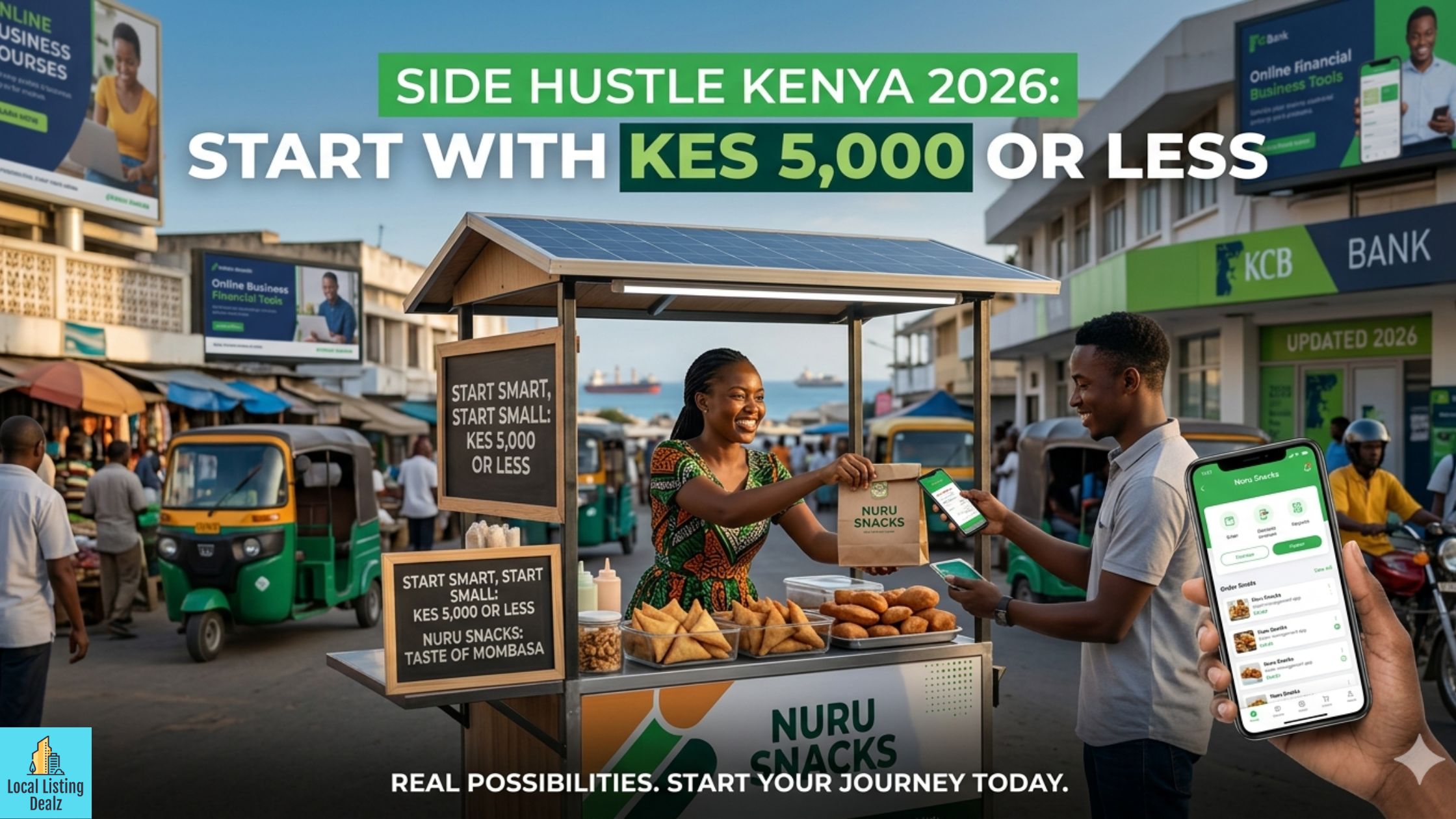
Side Hustle Kenya 2026: Start with KES 5,000 or Less
KES 5,000 is five days of a KES 1,000-per-day hustle. It is two months of a KES 2,500-per-month side income building quietly alongside your main job. The question is never whether KES 5,000 is enough to start a side hustle in Kenya — it almost always is. The question is which starting point matches your existing skills, your available time, and the market you actually live in.
Most side hustle articles for Kenya list thirty ideas with no guidance on which ones work, which require no prior experience, and which can realistically be started this weekend. This one does the opposite. It covers twelve specific side hustles, each with a real startup cost in shillings, an honest first-month income estimate, and the exact first step to take today — not someday, today.
One rule governs every choice on this list: nothing requires a loan to start, nothing costs more than KES 5,000 to begin, and nothing is a scheme. Every hustle here generates real income from real people paying for real value.
Before You Pick an Idea: The 3 Questions That Determine What Works for You
The most common side hustle failure in Kenya is not picking a bad idea — it is picking a good idea that does not fit your actual situation. These three questions prevent that.
Question 1: How many hours per week can you honestly commit?
A side hustle that requires 20 hours a week from someone working a demanding 9-to-6 in Nairobi, commuting two hours daily, and managing a household is not a hustle — it is a burnout plan. Be precise about the hours available before choosing. Five hours a week and twenty hours a week lead to completely different options. The hustles in this article are grouped partly by time demand so you can match to your real availability.
Question 2: Do you need income now, or are you building something that pays later?
Time-for-money hustles — tutoring, CV writing, delivery services, freelance writing — generate income within days of starting but stop the moment you stop. Scalable hustles — mitumba reselling, content creation, affiliate marketing — take longer to build but continue generating income when you are not actively working. Both are legitimate. The right choice depends entirely on whether you need money this month or are willing to invest two to six months building something that pays for years. Be honest about which situation you are actually in.
Question 3: What do you already know that someone else would pay for?
The fastest side hustle is always the one built on a skill you already have — not one you plan to acquire. A secondary school teacher who starts tutoring earns in week one. The same teacher who decides to first learn graphic design earns in month four or five. Start with what you know. The skill you undervalue because it feels ordinary to you is genuinely scarce to someone who does not have it.
Section 1: Side Hustles You Can Start This Weekend
These four require minimal or zero startup capital and can generate income within the first two weeks. They trade your time for money directly — which means immediate income and no waiting period.
1. Private Tutoring — KES 0–2,000 Startup Cost
What it is: Teaching primary or secondary school students in your home, their home, or via video call after your working hours.
Startup cost: Effectively zero if you have existing knowledge and access to the relevant textbooks. KES 1,000–2,000 for printed revision materials if needed.
Realistic first-month income: KES 8,000–25,000. The range depends on how many students you take on and what rate you charge. The typical Nairobi market rate is KES 800–2,000 per student per week for two one-hour sessions. Four students at KES 1,200 per week each generates KES 19,200 per month working roughly eight hours weekly.
Who it works for: Anyone with a university degree or a demonstrably strong background in a specific secondary school subject — mathematics, sciences, English, Kiswahili, or business studies. Tutoring demand is strongest in Nairobi’s middle-class residential estates where parents actively budget for academic support and routinely ask for recommendations through WhatsApp groups and school networks.
First step today: Post in three WhatsApp groups you are already in — school parents groups, estate community groups, or professional groups with parents — offering tutoring services for primary or secondary students. State your subject, your availability, your location, and your rate. Three posts. Ten minutes. The first inquiry typically arrives within 48 hours in active groups.
2. CV Writing and LinkedIn Profile Service — KES 0 Startup Cost
What it is: Writing, restructuring, and formatting CVs and LinkedIn profiles for job seekers. The Kenyan job market generates permanent, year-round demand for this service — tens of thousands of Kenyans apply for new roles every month.
Startup cost: Zero. You need a computer and Microsoft Word or Google Docs. If you do not have a personal computer, a cyber cafe at KES 50–100 per hour works for the first few clients while you save for your own device.
Realistic first-month income: KES 5,000–20,000. The Nairobi market rate for a well-written CV is KES 500–2,000 depending on seniority level and turnaround time. Senior professional CVs command KES 2,000–5,000. Ten CVs per month at KES 1,000 average generates KES 10,000 alongside a full-time job.
First step today: Identify one person in your network who is actively job hunting. Offer to rewrite their CV for free in exchange for an honest written testimonial. Use that testimonial — and the before-and-after versions with their permission — as your portfolio for the next paying client.
3. M-Pesa Mobile Money Assistant — KES 3,000–5,000 Startup Cost
What it is: Acting as an informal mobile money service point in an area with low M-Pesa agent density — helping community members send money, pay bills, buy airtime, and withdraw cash for a small service fee above the standard tariff.
Startup cost: KES 3,000–5,000 as float — working capital to facilitate transactions. No formal registration is required to operate at the informal community level.
Realistic first-month income: KES 5,000–15,000 in areas with genuine demand and limited formal agent coverage. The income is directly proportional to transaction volume. Charging KES 20–50 above the standard M-Pesa fee per transaction and handling 200 transactions per month generates KES 4,000–10,000 on top of serving your community.
Who it works for: Kenyans in peri-urban areas, estate edges, rural market centres, or any location where the nearest licensed M-Pesa agent requires significant travel. The business model depends entirely on proximity advantage — you are providing convenience, not a unique service.
First step: Identify the closest location where people regularly wait or travel to access M-Pesa services. That gap is your market. Start with float from your own savings — do not borrow to fund float unless you are using the Hustler Fund for a legitimate business purpose, which this qualifies as.
4. Delivery and Errands Service — KES 0–3,000 Startup Cost
What it is: Picking up groceries, delivering documents, collecting prescriptions, dropping off packages, or running household errands for busy professionals and households in Nairobi.
Startup cost: Zero if you are operating independently on foot or by public transport. KES 2,000–3,000 for basic printed flyers if you want to market beyond your immediate network.
Realistic first-month income: KES 8,000–20,000 depending on volume, area, and whether you operate independently or through a platform.
Platform route: Glovo Kenya accepts delivery partners through their website at glovoapp.com/en/courier. Requirements are minimal — a valid ID, a working smartphone, and a means of transport. Glovo handles the client acquisition; you handle the deliveries. Income is commission-based and variable but provides a steady stream of orders from day one.
Independent route: Message estate WhatsApp groups, church groups, and professional networks offering a personal errands service. Charge KES 300–500 per errand or KES 1,000–1,500 per hour depending on the task. This route pays more per job but requires you to find your own clients. The two routes are not mutually exclusive — many people start on Glovo for steady volume while building their own client list simultaneously.
Section 2: Side Hustles Built on a Specific Skill
These three require an existing or quickly acquirable skill. They pay more per hour than the weekend starters and have stronger growth potential — but they take slightly longer to get the first client.
5. Freelance Writing — KES 0 Startup Cost
What it is: Writing articles, blog posts, website copy, product descriptions, or social media content for Kenyan businesses and international clients.
Startup cost: Zero. You need a phone or computer and an internet connection to pitch clients and submit work.
Realistic first-month income: KES 5,000–30,000 depending on where you find clients and how much you produce. Kenyan market rates are KES 500–3,000 per article depending on length and topic. International rates on platforms like Upwork are USD 15–100 per article — at KES 130+ per dollar, even the lower end is KES 1,950 per piece.
For Kenyan clients: Find businesses with active websites but outdated or sparse blogs. Your pitch is direct: “I noticed your blog has not been updated in several months. I write finance and business content for Kenyan companies at KES [X] per article. Here are two samples.” This approach works because you are solving a visible problem, not selling an abstract service.
For international clients: Create an Upwork profile, write three sample articles in a specific niche — personal finance, health, technology, or travel — and apply to ten job listings on your first week. Expect one or two wins in the first month. The first job is the hardest; after that, your profile’s completion percentage and job success score make each subsequent application significantly easier.
6. Canva-Based Graphic Design — KES 0–2,000 Startup Cost
What it is: Creating social media graphics, business flyers, event posters, and basic branding materials for small Kenyan businesses using Canva — a free, browser-based design tool that requires no prior design training.
Startup cost: Canva’s free version is sufficient to start. Canva Pro at approximately KES 1,300 per month unlocks premium templates and assets — worth paying for once you have two consistent clients covering the cost.
Realistic first-month income: KES 8,000–25,000. Nairobi market rates are KES 1,000–5,000 per design project depending on complexity. A set of five social media templates for a small business pays KES 3,000–8,000. One client with monthly retainer work pays KES 5,000–10,000 monthly for ongoing content.
Who it works for: Anyone with a basic visual eye and three hours to spend on YouTube tutorials learning Canva. No formal design qualifications are required for the level of work most small Kenyan businesses need. Salons, restaurants, boutiques, churches, event planners, and small retailers all need content for Instagram and Facebook and most currently do it poorly or inconsistently.
First step: Create five sample designs for fictional businesses — a flyer for an imaginary restaurant, an Instagram post for an imaginary boutique, a business card template. These become your portfolio. Show them to three small business owners you know personally and offer your services at a reduced rate for the first job.
7. Social Media Management — KES 0 Startup Cost
What it is: Managing the Instagram, Facebook, TikTok, or X presence of small Kenyan businesses — creating and posting content, responding to comments, growing the audience, and reporting on results monthly.
Startup cost: Zero. Every tool you need — the social media platforms themselves, Canva for graphics, and WhatsApp for client communication — is free.
Realistic first-month income: KES 5,000–20,000 per client per month, depending on the scope of work and the client’s budget. Managing two clients at KES 8,000 each generates KES 16,000 monthly for work you can complete in eight to ten hours per week.
Who it works for: Anyone who uses social media actively and understands intuitively what makes content perform — what gets saved, what gets shared, what drives comments versus passive scrolling. The learning curve for client social media management is low if you are already an active user; the gap between what you know and what most Kenyan SME owners know is larger than you might expect.
First step: Identify three local businesses with Instagram or Facebook accounts that are updated inconsistently or have low engagement relative to their follower count. Approach the owner with a specific observation: “I noticed your last post was three weeks ago. I manage social media for small businesses in Nairobi — I can show you what a consistent month of content looks like.” Offer one month at a reduced rate or free. Use the results as your portfolio.
Section 3: Product-Based Hustles
These two involve buying and selling physical products. They require a small amount of upfront capital for stock but have strong income potential in the Kenyan market.
8. Mitumba Reselling — KES 2,000–5,000 Startup Cost
What it is: Buying second-hand clothing in bulk from Gikomba, Muthurwa, or other wholesale mitumba markets and reselling individual items at a profit through WhatsApp Status, Instagram, or local market stalls.
Startup cost: KES 2,000–5,000 for initial stock, plus transport to the source market. A bale of children’s clothing from Gikomba typically costs KES 1,500–3,000 and contains 30–60 items, each of which resells for KES 100–500.
Realistic first-month income: KES 5,000–20,000 depending on the niche you choose, your markup, and your sales volume. Children’s clothing, office wear, and sportswear move fastest online. A KES 3,000 bale resold at an average of KES 200 per item across 40 items generates KES 8,000 — a KES 5,000 gross profit on one bale in one month.
First step: Visit Gikomba Market on a Monday morning — Monday is when fresh stock arrives and selection is widest before the week’s traders have picked through it. Choose one specific clothing category that you understand the market for. Buy one bale. Sort it at home, wash and photograph the best items, and list them on your WhatsApp Status and Instagram the same day. Sell locally first. Use the proceeds to buy two bales next time.
9. Home Baking and Food Preparation — KES 1,000–5,000 Startup Cost
What it is: Baking cakes, mandazi, chapati, pilau, or other prepared foods for sale to neighbours, colleagues, office supply accounts, and WhatsApp orders.
Startup cost: KES 1,000–3,000 for ingredients using your existing kitchen equipment. Additional KES 500–1,000 for packaging if you are selling for retail or office delivery rather than informal neighbourhood sales.
Realistic first-month income: KES 5,000–20,000 depending on what you make, how much you produce, and whether you supply individual customers or offices. An office that orders lunch for fifteen people three times a week at KES 200 per portion generates KES 9,000 weekly from a single client.
First step: Make ten units of whatever you make best — ten mandazi, one large cake cut into portions, ten chapatis. Photograph them clearly with good natural light. Offer free samples to five neighbours or colleagues. Take orders from whoever responds positively. Buy more ingredients from the first payment. Reinvest 70% of early profits back into stock and scale gradually.
Regulatory note: Selling food commercially at scale eventually requires a food handler’s certificate from your county government. At small neighbourhood scale within your personal network, this is typically not enforced. As you grow and supply offices or events, factor compliance costs into your pricing.
Section 4: Digital Hustles That Scale Beyond Your Time
These three take longer to generate meaningful income but continue earning when you are not actively working. They are the right choice for people who can invest six to twelve months before expecting significant returns.
10. Content Creation — KES 0–3,000 Startup Cost
What it is: Building an audience on YouTube, TikTok, or a blog in a specific niche — personal finance, cooking, Nairobi life, comedy, career advice — and eventually earning through AdSense, brand partnerships, or affiliate links.
Startup cost: Zero for TikTok and YouTube — your phone camera is sufficient. KES 2,000–3,000 for a basic ring light and clip-on microphone improves quality meaningfully once you have confirmed you will continue.
Realistic first-month income: KES 0. This is the honest answer, and it is important to state it clearly. Content creation in Kenya typically takes three to twelve months of consistent posting before generating any meaningful income. Include this hustle only if you have genuine patience for delayed returns and find the creation process inherently worthwhile.
Realistic six-month income with consistency: KES 5,000–50,000 per month depending on niche, platform, audience size, and monetisation method. Finance and business content in Kenya monetises particularly well through AdSense because the advertiser rates for financial topics are significantly higher than lifestyle or entertainment content.
Why it belongs on this list despite the wait: Content is the only hustle here that earns while you sleep. A YouTube video posted today can generate AdSense income in 2028 and 2029. Nothing else on this list offers passive income at that scale. The investment is time and consistency, not money.
First step: Choose one specific niche narrow enough to be distinctive — not “Nairobi lifestyle” but “personal finance for young Kenyans” or “Kenyan recipes under KES 500.” Post one piece of content per week for ninety days before evaluating whether to continue. Ninety days of consistent effort tells you far more than three days of enthusiasm.
11. Affiliate Marketing — KES 0 Startup Cost
What it is: Earning a commission by sharing links to products or services. When someone makes a purchase or signs up through your link, you earn a percentage of the value.
Startup cost: Zero. You share links through WhatsApp groups, social media, or a blog you already have.
Realistic first-month income: KES 0–5,000. Affiliate income depends almost entirely on the size and relevance of your existing audience. With a small audience and no existing content platform, first-month results are modest. With an active WhatsApp group of 200+ people or an established social media following, results arrive faster.
Kenya-specific affiliate programs worth starting with: Jumia Kenya’s affiliate program pays 3–11% per sale depending on category — register at jumia.co.ke/affiliates and share product links in relevant WhatsApp groups. International options including Amazon Associates and ClickBank both accept Kenyan affiliates and pay in USD to your bank account or M-Pesa.
First step: Register for Jumia Kenya’s affiliate program today — it takes under fifteen minutes. Share three product links in WhatsApp groups where the products are genuinely relevant. Track which generate clicks and purchases using the affiliate dashboard. Refine based on what converts.
12. Virtual Assistant Services — KES 0 Startup Cost
What it is: Providing remote administrative support to businesses — email management, calendar scheduling, research, data entry, customer service, and basic content tasks. Most virtual assistant work comes from international clients who pay in USD.
Startup cost: Zero beyond a computer and internet connection.
Realistic first-month income: KES 5,000–15,000 from Kenyan clients. KES 15,000–50,000 from international clients at USD rates. International clients pay USD 10–25 per hour for VA work. At KES 130+ per dollar, ten hours per week at USD 15/hour generates KES 19,500 monthly alongside a full-time job.
Why this earns more than almost any other hustle on this list: The exchange rate arbitrage is real. Work that commands USD 15 per hour internationally is equivalent to KES 1,950 per hour — rates most Kenyan employers do not pay for administrative work. The internet removes the geography barrier, and your skills as a professional Kenyan with strong English are genuinely valued in international markets.
First step: Create a profile on Upwork at upwork.com and on Fiverr at fiverr.com. List three to five specific VA services — email management, research, data entry, scheduling, social media scheduling. Write a profile that clearly states your availability in hours per week and your professional background. Apply to five job listings on your first day. The first client is the hardest to win. After the first, your profile completion and job history make every subsequent application easier.
How to Manage Side Hustle Income: The Financial Setup
Many Kenyans start a side hustle, generate extra income for two or three months, and then find it has disappeared into daily spending without ever building financial momentum. The setup below prevents this.
Separate your side hustle money from the start. Open a dedicated M-Pesa Goal Savings account or a business Till Number specifically for side hustle income. When a client pays, it goes there — not to your personal M-Pesa where it blends with your salary and disappears into food and transport. The separation is not about being rigid; it is about making the income visible so you can track it and decide deliberately what to do with it.
Apply the 30% rule from the first payment. Before spending anything from your first side hustle income, move 30% to a money market fund. CIC, Sanlam, and ICEA Lion all accept KES 1,000 minimum deposits via M-Pesa. This 30% becomes your savings and investment base — the pool that eventually covers business growth, emergencies, and longer-term goals. Spend the other 70% as you choose.
Track income and expenses from day one. A notebook works. A Google Sheet works better. Write down every payment received, every business expense spent, and the net profit each month. This habit takes five minutes per week and gives you the data to know whether your hustle is actually growing, whether a particular service or product is worth continuing, and what your tax obligations are.
Declare your income to KRA. If your side hustle income across the year brings your total earnings above the KRA tax threshold, you are legally required to declare it in your annual return filed by June 30. A small side hustle earning KES 5,000–15,000 per month may or may not cross the threshold depending on your employment income — consult a registered tax agent or review our KRA Returns Kenya 2026 guide to understand your specific obligation.
Use consistent side hustle income to join a SACCO. A stable KES 2,000–5,000 monthly side hustle income is the perfect foundation for SACCO contributions. After six months of consistent contributions, most SACCOs will lend you three times your saved shares at 12% annual interest — dramatically cheaper than any mobile loan. The side hustle that starts as supplemental income becomes the foundation of your loan access and eventually your wealth building.
Frequently Asked Questions
What is the most profitable side hustle in Kenya in 2026?
Virtual assistant services for international clients offer the highest hourly rate at KES 1,300–3,250 per hour for established practitioners. Freelance writing for international platforms is a close second at KES 2,000–15,000 per article. For people without existing skills in these areas, private tutoring offers the fastest path to KES 10,000–20,000 per month from a standing start.
Can I do a side hustle while employed in Kenya?
Yes — unless your employment contract specifically prohibits operating a competing business or working for competitors. Review your contract before starting. Most Kenyan employment contracts restrict working for direct competitors but do not restrict unrelated income-generating activities. When in doubt, consult a labour lawyer or HR professional.
Do I need to register a business for a side hustle in Kenya?
Not immediately for most of the hustles on this list. At small scale within your personal network, informal operation is common and not generally enforced. As you grow, business registration via eCitizen (KES 1,050 for a business name) opens access to business bank accounts, business M-Pesa Paybill numbers, and business loan products including the Hustler Fund’s business tier with limits up to KES 500,000.
How do I declare side hustle income to KRA?
Side hustle income is declared as “other income” or “business income” in your annual individual income tax return filed on iTax at itax.kra.go.ke by June 30 each year. If you have registered a business, you also file a separate business return. Keep records of all income received and business expenses incurred — internet costs, equipment, transport related to the business — as these are allowable deductions. See our KRA Returns Kenya 2026 guide for the complete filing process.
What side hustles work in rural Kenya, not just Nairobi?
Private tutoring works everywhere there are school-going children — demand is often higher in areas with fewer qualified tutors. Mobile money assistance works better in rural and peri-urban areas than in Nairobi where agent density is already high. Home baking and food preparation works anywhere there is a community willing to buy. Freelance writing, virtual assistant services, and affiliate marketing are location-independent — they require internet access but not proximity to Nairobi.
Can I start a side hustle with KES 1,000?
Yes. Tutoring, CV writing, social media management, freelance writing, content creation, affiliate marketing, and virtual assistant services all require zero capital beyond what you already have. Home baking can start with KES 1,000 in ingredients. Even mitumba reselling is possible at very small scale — buying ten to fifteen loose items at Gikomba rather than a full bale.
Start This Weekend
The most common reason people do not start a side hustle is not lack of money or ideas. It is the paralysis that comes from having too many options and no forcing function to choose.
The solution is deliberately simple: pick the one hustle from Section 1 of this article that requires the fewest new skills and the least capital for your specific situation. Commit to it for thirty days before evaluating. Thirty days of real effort with a mismatched idea teaches you more about what works for you than thirty days of planning the perfect idea ever will.
Before you close this page: choose one. Take the first step described — post the WhatsApp message, write the Upwork profile, visit Gikomba on Monday, or make the batch of whatever you bake best. The first step is always the hardest and always the smallest.
Once the income starts, put the system in place to grow it. See our How to Save KES 10,000 a Month guide for managing what you earn, our KRA Returns Kenya 2026 guide for declaring it correctly, and our Unit Trust Funds Kenya 2026 guidefor growing it into something that works harder than you do.
Income estimates are based on current Nairobi market rates as of March 2026 and represent realistic ranges, not guaranteed outcomes. Results depend on effort, skill level, local market conditions, and consistency.
Related reading:
- Salary Negotiation Kenya 2026: Scripts That Actually Work
- How to Save KES 10,000 a Month in Kenya on an Average Salary
- How to File KRA Returns in Kenya 2026: Step-by-Step for First-Timers
- M-Pesa Paybill vs Till Number: What Every Small Business Owner Must Know
- Unit Trust Funds Kenya 2026: Ranked by Returns
- Hustler Fund Kenya 2026: Real Interest Rate and How to Access It