Business Bank Account Kenya 2026: How to Open One
A supplier wants your business bank account details before they can process your order. A potential corporate client asks for your company account number for payment. Your accountant tells you that mixing personal and business transactions on the same M-Pesa line is creating a KRA audit problem. Or KCB has declined your business loan application because there is no business transaction history on file — only personal M-Pesa entries.
All of these are the same problem. A business bank account in Kenya is not a bureaucratic formality — it is the foundation of your business credit profile, your financial credibility with suppliers, and your eligibility for every formal business loan product in Kenya. The businesses that open accounts early and run all income through them build loan eligibility that others cannot access.
This guide covers how to open a business bank account in Kenya in 2026 — what documents every bank requires, which banks are best for which business types, and the step-by-step process that gets you approved quickly.
Why a Business Bank Account Is Not Optional for a Growing Business
Many Kenyan small business owners use a personal M-Pesa line for business transactions because it starts working immediately and avoids the documentation process. This is understandable as a starting point. It becomes a serious financial liability within six to twelve months.
The business credit history argument. Every major Kenyan bank — KCB, Equity, COOP, NCBA — uses business bank transaction history as a primary input when calculating your business loan limit. The Hustler Fund business loan (up to KES 500,000 at 8% per annum) similarly considers your business M-Pesa and bank transaction history. A business that processes KES 400,000 per month through a personal M-Pesa line has exactly the same business loan profile as a business that started yesterday — because from a lender’s perspective, that transaction history belongs to you personally, not to your business. See our Hustler Fund Kenya 2026 guide for how business transaction history directly affects your loan limit.
The KRA and tax argument. Business income received through a personal M-Pesa account creates an accounting problem when you file your KRA return. Personal transfers, salary, and business income all appear as undifferentiated credits on the same statement. A business bank account produces a clean, auditable record of business income and business expenses — which is what KRA expects when you declare business income. See our KRA Returns Kenya 2026 guide for how to declare business income correctly.
The credibility and procurement argument. Government tenders above KES 500,000 require a business bank account. Corporate procurement departments routinely require supplier bank account details — a personal M-Pesa number does not meet this requirement. High-value clients and formal supply chains expect the payment infrastructure that a registered business with a business account provides.
The practical transaction limits. M-Pesa’s receive limit of KES 500,000 per transaction and KES 500,000 per day can constrain fast-growing businesses during good months. A business bank account with no equivalent ceiling grows with your business rather than limiting it.
Types of Business Bank Accounts in Kenya
Not all business accounts are the same product. Understanding which type you need before walking into a bank saves you a wasted visit.
Sole proprietor current account: The simplest business banking product. Opened in your personal name trading as your registered business name. Requirements are lighter than for a limited company — primarily your registered business name, owner’s ID, and KRA PIN. Best for freelancers, sole traders, market vendors with county business permits, and informal sector businesses that have registered a business name.
Limited company current account: For businesses registered as a limited company under the Companies Act. Requires company-specific documents including the Certificate of Incorporation, CR12, and Memorandum and Articles of Association. Opens the full suite of business banking products — trade finance, LPO financing, invoice discounting, and higher loan limits. Required for any business that wants to tender for government contracts.
Partnership account: For registered partnerships. Requires a partnership deed plus all partners’ IDs and mandate documentation. All signatories must be present at account opening or provide notarised authorisation.
NGO and CBO account: For registered non-profits and community-based organisations. Requires the registration certificate, constitution, and committee member IDs. Several banks have specific non-profit current account products with reduced or zero maintenance fees.
The most important decision before visiting any bank: Know your entity type. Look at your business registration certificate. If it says “Business Name Registration,” you are a sole proprietor. If it says “Certificate of Incorporation,” you are a limited company. The document requirements are entirely different and arriving at a bank with the wrong set causes delays of one to two weeks while you gather the correct documents.
Documents Every Bank Requires: The Complete Checklist
Gather everything on this list before your first bank visit. A complete application processes significantly faster than one that requires follow-up.
For Sole Proprietorships
- National ID (original plus two clear copies) — the ID must match the name on your business registration exactly
- KRA PIN Certificate — your personal KRA PIN; some banks also require the business KRA PIN if separately registered
- Business Name Registration Certificate — obtained from the Business Registration Service via eCitizen at ecitizen.go.ke; costs KES 1,050 and takes 3–5 business days; this is the most common missing document
- County Single Business Permit — your current year business permit from your county government; some banks accept it, others require the formal registration certificate
- Two passport-sized photographs
- Proof of business address — a utility bill, lease agreement, or a signed letter from your landlord confirming your business operates at the stated address; must be current (within 3 months)
- Initial deposit — varies by bank (KES 0–10,000 depending on account type)
For Limited Companies
Everything above, plus:
- Certificate of Incorporation — issued by the Business Registration Service; if your company was incorporated before the Companies Act 2015, you may have a different format — both are acceptable
- Company KRA PIN Certificate — the PIN registered in the company’s name (different from the director’s personal PIN)
- CR12 — a list of current directors issued by the Business Registration Service via eCitizen; costs KES 600 and takes 3–5 business days; this is the most commonly forgotten document
- Memorandum and Articles of Association — your company’s founding documents; if you cannot find yours, a copy can be retrieved from the Business Registration Service
- Board Resolution to Open Account — a formal company resolution authorising the opening of the bank account and specifying who can operate it; your bank will provide a template
- ID and KRA PIN for all directors named in the CR12
- Company stamp — some banks require this; have it made before your visit if you do not have one
The document that delays most applications: the CR12
The CR12 is a current list of company directors obtained from the Business Registration Service. Most business owners forget to apply for it until they are sitting at the bank’s business desk. The CR12 takes 3–5 business days from eCitizen and costs KES 600. Apply for it before your bank visit, not after. If your application is otherwise complete and the CR12 is missing, most banks will hold your file for 7–10 days while you retrieve it — delaying the account opening by nearly two weeks.
Pro tip before any bank visit: Call the bank’s dedicated business banking line — not the general customer service number — and ask them to confirm their current document requirements for your specific entity type. Requirements occasionally update and banks sometimes have bank-specific additions to the universal list above. Arriving with the complete set is always faster than a second visit.
Best Business Bank Accounts in Kenya 2026: Bank by Bank
KCB Bank Kenya — SME Current Account and Entrepreneurs Account
KCB offers two strong business account options that serve different business stages.
KCB Entrepreneurs Account (for startups): KCB’s Entrepreneurs Account is ideal for business customers just starting out. It requires no opening balance, no minimum operating balance, no ledger fee, and no maintenance charge. It provides a cheque book, access to financing, and free monthly statements.
- Opening balance: Zero
- Minimum balance: Zero
- Monthly ledger fee: None
- Maintenance charge: None
- Access: KCB app, internet banking, branch
- Best for: Newly registered businesses in their first year
KCB SME Current Account (for growing businesses): The SME Current Account is designed for businesses with frequent transactions and multiple payments. It provides cheque book access, access to financing up to KES 3,000,000 unsecured, overdraft facilities, and free monthly statements.
- Cheque book: Yes
- Unsecured loan access: Up to KES 3,000,000
- Overdraft: Available
- Monthly statements: Free
- Access: Full KCB digital and branch banking
KCB M-Pesa integration for business: KCB business accounts integrate directly with KCB M-Pesa for business — payments received via your business KCB M-Pesa settle directly to the business bank account, creating automatic transaction records. This produces clean, verifiable business income statements that KCB uses to assess loan eligibility. Every month of consistent business transaction processing through KCB builds your business credit profile directly within the system that determines your next loan limit.
Verdict: KCB is best for businesses that want seamless M-Pesa and bank account integration, access to trade finance and LPO financing, and plan to apply for a business loan within 12 months. The Entrepreneurs Account’s zero-fee structure makes KCB the most accessible major bank for a new business with no initial capital to place as a minimum deposit.
Equity Bank Kenya — Equitel Business Account and Business Current Account
Equity Bank has the strongest track record for SME banking in Kenya — more small businesses have accessed their first formal loan from Equity than from any other Kenyan bank. Their business accounts reflect this orientation.
Equity Business Current Account:
- Minimum opening balance: Low (confirm current requirement at equitybank.co.ke)
- Monthly fee: Low tier available for small businesses
- M-Pesa integration: Available via EazzyBiz
- Access: EazzyApp, Equitel, 44,000+ agents nationwide
- Loan access: Equity’s SME lending track record is the strongest in Kenya for flexible-documentation businesses
Equity’s SME advantage: Equity’s loan officers are trained to assess businesses with irregular cash flows, seasonal income, and informal sector characteristics. A business with strong M-Pesa and bank transaction history but less formalised accounting has a better chance of loan approval at Equity than at most other banks. This is by design — Equity’s founding philosophy was financial inclusion for businesses that formal banking has historically excluded.
Verdict: Best for SMEs outside Nairobi (Equity’s 44,000+ agents are unmatched for rural and peri-urban business banking), businesses below KES 5 million annual revenue that need flexible documentation for loan assessment, and first-time business banking customers.
Co-operative Bank Kenya — Business Current Account and SME Bizwise
COOP’s business accounts reflect the bank’s cooperative sector roots — designed for agricultural businesses, cooperative societies, and businesses whose members already bank with COOP.
Business Current Account:
- Minimum opening balance: KES 5,000 for individuals; KES 10,000 for registered businesses
- Documents: Standard sole proprietor or company documents as above
- MCo-op Cash: Full mobile banking integration
- Best for: Cooperative sector businesses, agricultural enterprises, and businesses whose suppliers and customers predominantly use COOP
SME Bizwise Account: Specifically designed for growing SMEs, the Bizwise account offers business banking tools tailored to businesses with regular supplier and customer payments.
Verdict: COOP is the natural choice for businesses connected to Kenya’s cooperative sector — agricultural cooperatives, teacher-owned businesses, and SMEs that bank alongside their SACCO. For businesses outside the cooperative ecosystem, KCB or Equity typically offer comparable products with broader digital banking reach.
NCBA Bank Kenya — Business Current Account
NCBA targets established SMEs rather than startups. Their business accounts suit businesses with monthly turnovers above KES 300,000 and those needing integration with NCBA’s digital lending products (M-Shwari for business, Fuliza for business).
- Minimum balance: Moderate — higher than KCB or Equity
- Monthly fee: Mid-range
- Best for: Established SMEs with consistent high-volume transactions and businesses using NCBA’s mobile lending ecosystem
Absa Bank Kenya — Business Account
Absa’s business accounts are strongest for businesses with international payment needs — import/export, international supplier relationships, or cross-border e-commerce. Absa’s parent company (Absa Group) has correspondent banking relationships that make international wire transfers faster and cheaper for transactions to South Africa, UK, and other Absa Group markets.
- Best for: Importers, exporters, and businesses with international client or supplier relationships
Stanbic Bank Kenya — Business Account
Similar profile to Absa for international business. Stanbic is particularly strong for trade finance — Letters of Credit, documentary collections, and structured import/export financing. For a Kenyan business with significant cross-border trade, Stanbic’s trade finance desk is worth a conversation before choosing a bank.
The Comparison Table
| Bank | Opening Balance | Monthly Fee | Best for | Loan Track Record |
|---|---|---|---|---|
| KCB (Entrepreneurs) | Zero | None | New businesses, M-Pesa integration | Strong — trade finance, LPOs |
| KCB (SME Current) | Zero | Low | Growing businesses, frequent transactions | Strong — up to KES 3M unsecured |
| Equity | Low | Low | SMEs, rural access, flexible lending | Strongest for SME flexibility |
| COOP | KES 5,000–10,000 | Moderate | Cooperative sector, agricultural businesses | Strong for cooperative businesses |
| NCBA | Moderate | Mid-range | Established SMEs, NCBA mobile lending users | Good for digitally active businesses |
| Absa | Moderate | Moderate | International payments, corporate clients | Strong for trade finance |
| Stanbic | Higher | Higher | Cross-border trade, large corporates | Best for trade finance |
Step-by-Step: How to Open a Business Bank Account in Kenya
Step 1: Choose Your Bank
Use the comparison above. For most new Kenyan SMEs, the decision is between KCB (for M-Pesa integration and zero-fee startup account) and Equity (for SME lending flexibility and rural agent access). Call both banks’ business desks and ask one question: “What documents do I need to open a business current account as a sole proprietor / limited company?” Their answer and the speed at which they answer it tells you something about their business banking orientation.
Step 2: Register Your Business If You Have Not
You cannot open a business bank account without a registered business. Two options:
Business Name Registration (for sole proprietors): Go to ecitizen.go.ke. Create an account. Navigate to Business Registration Service. Apply for a business name. Cost: KES 1,050. Processing: 3–5 business days. You will receive a Business Name Registration Certificate by email — download and print it.
Limited Company Registration (for formal companies): Also via ecitizen.go.ke. Navigate to Companies Registry. Cost: KES 10,650 for a private limited company. Processing: 5–7 business days. You receive a Certificate of Incorporation, Memorandum and Articles of Association, and a CR12.
If you are not yet registered and want to start banking quickly, business name registration at KES 1,050 is the fastest path. You can always convert to a limited company later when the business grows.
Step 3: Gather All Documents
Using the checklist above for your entity type. For sole proprietors: ID, KRA PIN, business registration certificate, business permit, two passport photos, proof of business address, initial deposit amount.
The two documents that most commonly delay applications:
- The CR12 for limited companies (apply at eCitizen 5 days before your bank visit)
- The business KRA PIN (apply separately from your personal PIN if your bank requires it — also via itax.kra.go.ke)
Step 4: Visit the Business Banking Desk — Not the General Queue
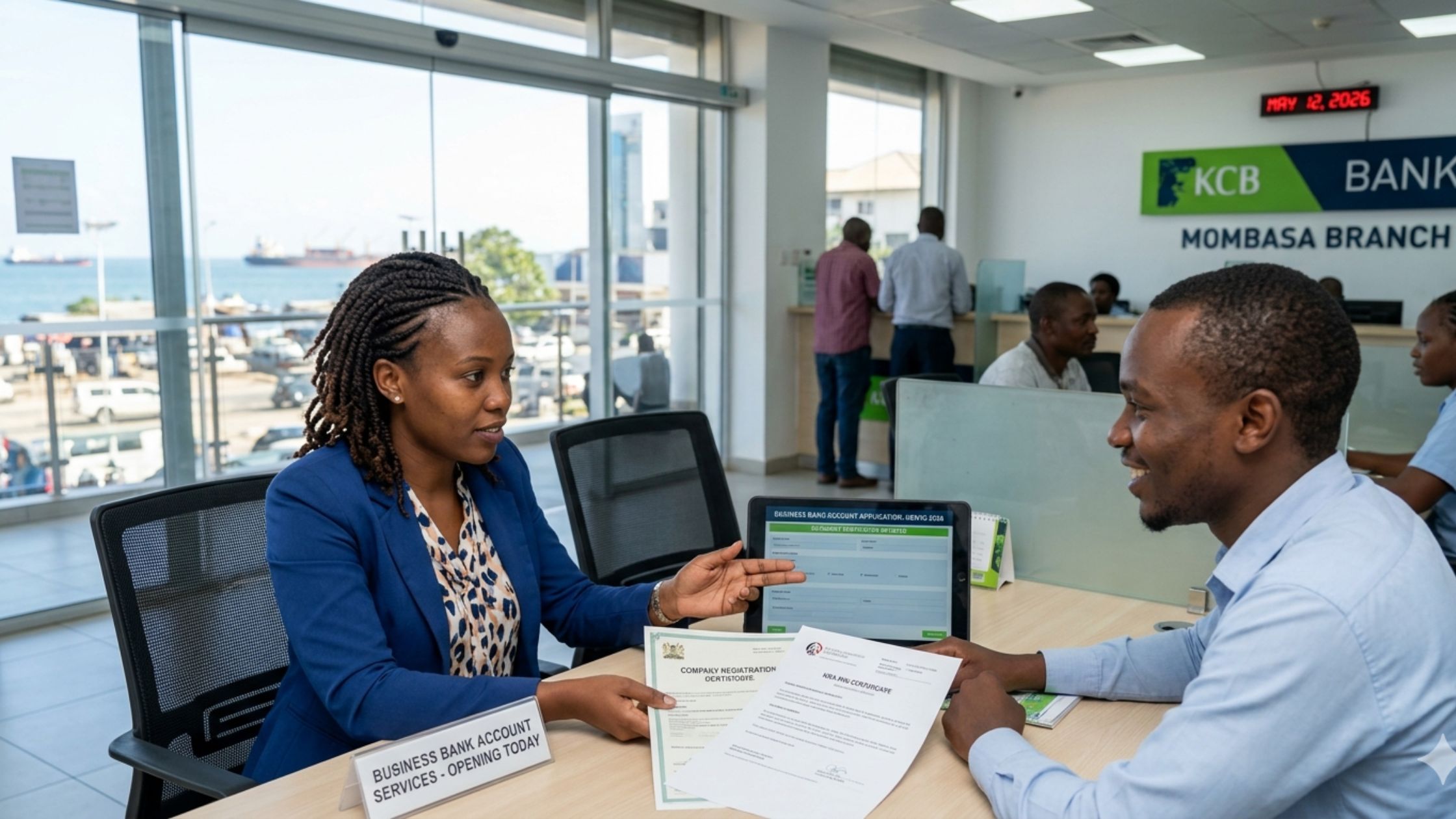
This is the step most people get wrong. Business account opening is handled by dedicated business banking staff, not tellers or general customer service representatives. At the branch entrance, specifically tell security or reception: “I am here to open a business current account — I need to see the business banking desk.” In larger branches, there is often a separate entrance or floor for business customers.
At some banks — including KCB for the Entrepreneurs Account — you can open the account digitally via the bank’s app or website without a branch visit. Call ahead to confirm whether your chosen account type supports digital opening.
Step 5: Complete the Application Form
The bank provides its own business account application form. Key sections to complete carefully:
- Account mandate: Who is authorised to operate the account? For sole proprietors, this is usually just you. For companies, specify all authorised signatories and the transaction limits each can authorise individually versus jointly.
- Business description: Brief description of what your business does. Be accurate — some banks use this to flag accounts for industry-specific compliance requirements.
- Expected monthly turnover: Estimate honestly. This affects what transaction limits the bank sets initially and how the relationship manager calibrates service for your account.
Step 6: Make the Initial Deposit
Have cash or a bank card for the initial deposit. KCB’s Entrepreneurs Account requires zero — you can fund it later. Equity and COOP typically require KES 1,000–10,000 to activate the account. Keep the deposit receipt.
Step 7: Collect Your Account Details and Activate Digital Banking
You will receive:
- Your business account number
- Internet banking login credentials (or instructions to set them up)
- Debit card for the account (typically dispatched within 3–5 business days)
On first login to internet banking or the bank’s app: set a strong password, enable two-factor authentication, and register your phone number for SMS alerts on all transactions. Never share your business banking credentials with staff, agents, or anyone else.
Step 8: Link Your M-Pesa Paybill or Till Number to the Business Account
This is the step most business owners forget — and it is the step that makes the account actually useful for your business.
Once your account is active, contact your bank’s business desk or Safaricom Business to link your existing M-Pesa Paybill or Till Number to the business bank account. Payments received via your Paybill or Till will then settle automatically to the business bank account on a schedule you set — daily, weekly, or per transaction above a threshold.
If you do not yet have a Paybill or Till Number, see our M-Pesa Paybill vs Till Number guide for exactly which one your business needs and how to get it.
After Opening: Making Your Account Work for Loans
The business loan game starts the day you open the account. Banks do not assess your loan eligibility based on what you tell them about your business — they assess it based on your transaction history. Here are three habits that build your loan eligibility from month one:
Run all business income through the account. Every KES 50,000 payment received via personal M-Pesa rather than your business account is a KES 50,000 credit that does not build your loan case. Every KES 50,000 that flows through your business bank account builds it. The discipline of routing all business income through the correct account — even when it is more convenient to use personal M-Pesa — compounds significantly over six to twelve months.
Set up automatic Paybill/Till settlement to the business account. Every payment received via your business M-Pesa should sweep to your business bank account automatically — daily or weekly. This creates a continuous flow of credit entries on your bank statement. Lenders see a business that receives and manages money consistently as lower risk than one with sporadic large deposits.
Maintain an operating buffer. Aim to keep a minimum balance equal to 20–30% of your average monthly credit. A business account that always sweeps to zero tells a lender the business has no buffer — which raises credit risk assessments. A business account that consistently maintains a buffer shows financial management maturity.
Request an overdraft facility after 6 months. Even if you do not need it. A KES 50,000–100,000 overdraft approved and unused creates a credit facility on your business file that makes future, larger loan applications significantly easier and faster. Banks view a business that has been assessed and approved for an overdraft differently from one that has never engaged with lending.
For the full picture on business loans — KCB, Equity, COOP rates and requirements — see our How to Get a Personal Loan in Kenya 2026 guide and our Hustler Fund Kenya 2026 guide for the government business loan at 8% per annum.
Frequently Asked Questions
Can I open a business bank account without a business registration in Kenya?
No. Every licensed Kenyan bank requires proof of business registration — at minimum a Business Name Registration Certificate from the Business Registration Service via eCitizen. There are no exceptions. If you are not yet registered, the registration process takes 3–5 business days and costs KES 1,050 for a business name. Do this before approaching any bank.
How long does it take to open a business bank account in Kenya?
With all documents complete, most banks process a business current account in 1–3 business days. Without complete documents, expect 7–14 days of delays while missing items are gathered. The CR12 for limited companies is the most common cause of delay — it takes 3–5 business days from eCitizen and must be applied for separately.
What is the minimum balance for a business account in Kenya?
KCB’s Entrepreneurs Account requires zero minimum balance — no opening deposit, no minimum operating balance, no monthly fee. Equity Bank’s business account has a low minimum. COOP requires KES 5,000 for individuals and KES 10,000 for registered businesses. Check the current requirement directly with your chosen bank before visiting.
Can I use my personal M-Pesa for business instead of a business account?
You can — many Kenyan businesses do, especially in their early stages. The financial cost is the business credit history you are not building. Every month of business income processed through personal M-Pesa rather than a business bank account is a month of loan eligibility evidence that does not exist. The practical rule: use personal M-Pesa for business transactions in your first 1–3 months while you set up the business account. After that, run everything through the business account.
Do I need a business account to apply for a Hustler Fund business loan?
The Hustler Fund business loan (up to KES 500,000 at 8% per annum) considers your business M-Pesa transaction history and business registration as key eligibility inputs. A business bank account is not strictly required to apply but significantly strengthens your application and your limit over time. See our Hustler Fund Kenya 2026 guide.
Can a sole proprietor open a business account in Kenya?
Yes. A sole proprietor business account — opened in your name trading as your registered business name — is one of the most common business banking products in Kenya. The documentation requirements are simpler than for a limited company. Your business name just needs to be formally registered via eCitizen.
What happens if my business account stays dormant?
Banks classify accounts with no transactions for 6–12 months as dormant. Dormant accounts may attract reactivation fees when you resume use and lose any preferential relationship status built with the bank. More importantly, a dormant business account builds zero loan eligibility — the transaction history that matters to lenders only exists when the account is actively used. Open the account, set up the M-Pesa settlement link, and route all business income through it from day one.
Your Action Plan
Opening a business bank account in Kenya is a single afternoon of work with the right preparation. Here is the sequence:
Today: Decide on your bank. Call their business banking desk and confirm the current document requirements for your entity type. If you need a CR12 or business registration, apply for both on eCitizen today — they take 3–5 days.
This week: Gather every document on the checklist. Make clear photocopies of everything. Apply for a company KRA PIN if your bank requires it for limited companies.
Next week: Visit the business banking desk with your complete document set. Complete the application form carefully, specifying the account mandate and expected monthly turnover. Make the initial deposit. Leave with your account number and internet banking login.
Within one week of account opening: Set up the M-Pesa Paybill or Till settlement link. Activate internet banking. Set up SMS transaction alerts. Begin routing all business income through the account from this point forward.
Every month of consistent business banking from this point builds a financial history that unlocks loan access you cannot otherwise achieve. The account costs you an afternoon to open. The compounding loan eligibility it builds costs nothing beyond that.
Business banking requirements verified from bank websites and direct sources, May 2026. Requirements are updated periodically — confirm current document requirements directly with your chosen bank before visiting. Business registration costs and timelines verified from eCitizen.go.ke.
Related reading:
- M-Pesa Paybill vs Till Number: What Every Business Owner Must Know
- Hustler Fund Kenya 2026: Business Loans Up to KES 500,000 at 8%
- Equity Bank vs KCB Kenya 2026: Which Is Better for Your Money?
- How to Get a Personal Loan from KCB, Equity or COOP in Kenya 2026
- CRB Kenya 2026: How to Check, Clear and Protect Your Credit Record
- How to File KRA Returns in Kenya 2026