What Happens If You Never Use Fuliza Again for 12 Months?
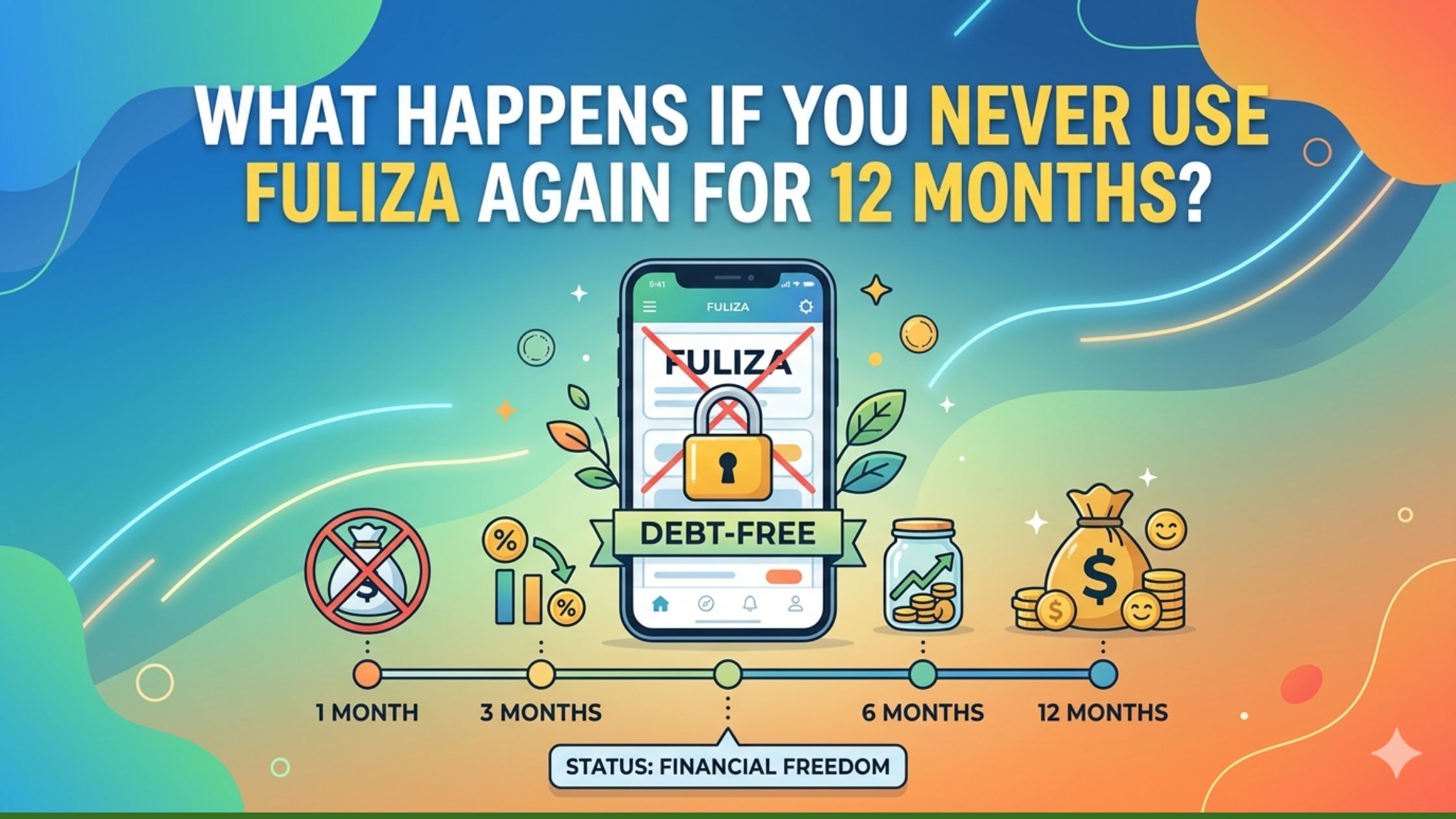
But what if you stopped? What actually happens — to your M-Pesa, to your money, to your credit record, to your Fuliza limit — if you never use Fuliza again for 12 months?
Over 9 million Kenyans use Fuliza actively. Most of them use it not for emergencies — but for everyday transactions: buying food, paying for transport, topping up airtime, settling bills when the salary has already run out. For millions, it has quietly moved from a convenience tool to a monthly necessity.
This is not a lecture about avoiding debt. It is a factual, month-by-month breakdown of what changes — financially and practically — when you go Fuliza-free for a full year. And for those who decide to quit, there is a step-by-step plan at the end.
First: How Fuliza Actually Works (The Part Most People Skip)
Before discussing what happens when you stop, it is important to understand precisely how Fuliza works — because most users significantly underestimate what it is costing them.
Fuliza is not simply an M-Pesa feature. It is a credit facility operated by Safaricom in partnership with NCBA Bank and KCB Bank. When your M-Pesa balance is insufficient to complete a transaction, Fuliza automatically covers the shortfall — no application, no approval delay, no decision required.
The cost structure has two components:
1. A one-time access fee of 1% of the borrowed amount (plus 20% Excise Duty on that fee), charged the moment Fuliza activates.
2. A daily maintenance fee that accrues every midnight until the full balance is cleared:
| Outstanding Fuliza Balance | Daily Fee |
|---|---|
| KES 10–500 | KES 2/day |
| KES 501–1,000 | KES 5/day |
| KES 1,001–2,500 | KES 10/day |
| KES 2,501–5,000 | KES 20/day |
| KES 5,001–10,000 | KES 25/day |
| KES 10,001–20,000 | KES 30/day |
| Above KES 20,000 | KES 30/day |
A KES 1,000 Fuliza balance held for 30 days costs over KES 300 in maintenance fees alone — an effective monthly rate of over 30%. A KES 5,000 Fuliza balance left unpaid for a full month costs over KES 1,600 in fees — 32% of the borrowed amount.
The auto-repay trap: Any money that enters your M-Pesa — salary, client payment, family transfer, anything — is intercepted by Fuliza at midnight and applied to your outstanding balance before reaching your spendable funds. This means you never truly start the month with your full income. You start the month with your income minus whatever Fuliza takes first.
Fuliza was launched in January 2019 and has since grown to serve over 9 million active users, making it one of Kenya’s most widely used credit products. It is not going anywhere. But used carelessly and chronically, it is one of the most expensive financial habits a Kenyan can maintain.
What Fuliza Is Costing You Every Year
Most Fuliza users dramatically underestimate their annual cost because they focus on the daily fee amount — which looks small — rather than the cumulative yearly total.
Here is what chronic Fuliza usage actually costs across common usage patterns:
| Usage Pattern | Monthly Fee Estimate | Annual Cost |
|---|---|---|
| KES 200 used 8x/month, 7-day repayment each time | ~KES 130 | ~KES 1,560 |
| KES 500 used 10x/month, 10-day repayment | ~KES 350 | ~KES 4,200 |
| KES 1,000 used 8x/month, 14-day repayment | ~KES 700 | ~KES 8,400 |
| KES 2,000 rolling balance, partial repayments | ~KES 900 | ~KES 10,800 |
| KES 5,000 balance, slow repayment (20+ days) | ~KES 1,600/month | ~KES 19,200 |
The average Fuliza user likely falls in the KES 300–700/month range — which is KES 3,600–8,400 per year. That is money spent on the privilege of borrowing small amounts of your own future income, slightly in advance.
Invested in a money market fund at 10% net annual return, even KES 5,000 per year in redirected Fuliza fees grows to over KES 32,000 in five years. From money you stopped paying in fees.
Month by Month: What Actually Happens When You Quit
Months 1–2: The Friction Phase
The first thing most people notice when they stop using Fuliza is not financial — it is psychological. The safety net is gone. When M-Pesa balance runs short mid-transaction, the transaction fails. This is uncomfortable, particularly if you are used to Fuliza activating automatically without you having to make a decision.
Practically, here is what happens:
Your Fuliza remains active unless you opt out. Stopping using Fuliza does not mean opting out — your limit stays available. The difference is that you are choosing not to draw on it. You can opt out by dialling *334# → Fuliza → Opt Out, but you must have a zero balance first and must clear all outstanding amounts to the last shilling before Safaricom will process the opt-out.
You may face 2–3 failed transactions. This is the friction that reveals exactly where your M-Pesa buffer was too thin. Most people discover they were relying on Fuliza for transactions of KES 50–500 — genuinely small amounts that a KES 1,000–2,000 standing M-Pesa float would have covered without any borrowing.
Action in Month 1: Deposit a deliberate float of KES 1,000–2,000 into M-Pesa that you treat as untouchable — a minimum balance, not spending money. This single change eliminates 80% of the small-transaction Fuliza triggers.
Move any actual savings out of M-Pesa and into a money market fund. Savings in M-Pesa earn nothing and are too easy to spend. In an MMF, they earn 7.65–10.2% net annually and require a deliberate withdrawal process — providing both returns and friction against impulse access.
Months 3–4: The Adjustment Normalises
By month 3, most people who have committed to quitting Fuliza report that the habit has normalised. The mental shift from “I will use Fuliza if I run short” to “I need to stay within my balance” has occurred.
Several practical things are happening in your finances at this stage:
Your incoming money is arriving intact. Without Fuliza auto-repay intercepting your salary or incoming transfers, the full amount reaches your spendable balance. For heavy Fuliza users, this can feel like a meaningful increase in income — even though nothing has changed except the absence of automatic deductions.
Your M-Pesa statement is cleaner. Pull your statement now — *334# → My Account → Statement — and compare it to 3 months ago. The midnight Fuliza debit entries are gone. What you spent on fees is now visible as money that stayed in your account.
Your Fuliza limit may start to decline. Safaricom reviews Fuliza limits periodically — typically every 30–60 days based on M-Pesa usage patterns and repayment behaviour. Non-use of Fuliza is one of the factors that can lead to a gradual reduction in your limit. This is not a penalty — it is the system recalibrating to your actual credit demand.
Some people are alarmed by a declining Fuliza limit. If you have built a proper M-Pesa float and have savings in an MMF, a reduced Fuliza limit is irrelevant. You do not need it.
Months 5–6: Financial Breathing Room Begins
By the halfway point of your Fuliza-free year, the compounding effect of not paying daily fees is becoming visible. Depending on your previous usage pattern, you have saved between KES 1,500 and KES 5,000+ in fees that have stayed in your account.
More significantly, your financial behaviour has likely shifted in a way that addresses the root cause of Fuliza dependency:
You are managing within your income — because Fuliza is no longer available as a pressure valve. This forced constraint, while uncomfortable in month 1, is one of the most effective financial discipline mechanisms available.
Your emergency buffer (if you built one) is working. A KES 5,000–10,000 emergency buffer in your MMF, accessible within 24 hours, handles the situations that previously triggered Fuliza. The difference: the MMF buffer is yours, earns returns, and does not charge you daily fees for using it.
Your CRB record is clean. With zero Fuliza activity, there are no new credit events from Fuliza. If you had a positive Fuliza repayment history before stopping, that positive record remains. If you had a negative history, the six-month period without any new defaults is a meaningful step toward rebuilding.
Months 7–9: The System Has Changed
By month 7, most people who have reached this point are not thinking about Fuliza at all. The habit is broken. The system has changed.
What is happening financially:
Your Fuliza limit has likely decreased significantly — possibly to zero or near-zero for non-active users with no recent usage. Safaricom explicitly states that opting out and back in frequently damages your limit, and extended non-use has a similar effect. Again: if your MMF emergency fund is built and your M-Pesa float is maintained, this is a positive outcome. You are no longer at risk of the auto-repay loop even if you do dip back in by accident.
The money you have not paid in Fuliza fees is compounding. If you redirected even KES 500/month (a conservative estimate of saved fees) into an MMF from month 1, by month 9 you have approximately KES 4,500 in principal plus returns growing daily.
Your spending is more intentional. Without the Fuliza cushion, you have had to plan transactions more carefully for 9 months. This is not a limitation — it is a skill. Kenyans who break the Fuliza habit consistently report that their overall financial awareness and control improves dramatically once the automatic overdraft is no longer absorbing the slack.
Months 10–12: The Full-Year Picture
By month 12, the financial picture is clear and measurable.
Total fee savings: Depending on your previous usage pattern, you have avoided paying KES 3,600–19,200 in Fuliza access and maintenance fees over the year.
Compounded savings: If you redirected those fees into an MMF, the actual accumulated amount — fees saved plus returns on those savings — is modestly higher.
Your M-Pesa relationship is healthier. M-Pesa is now a transaction tool, not a credit facility. Your balance reflects money you have, not money you have borrowed.
Your credit picture: Unpaid Fuliza beyond 90 days results in a CRB listing. Unpaid Fuliza beyond 120 days results in Safaricom referring the account to a collection agency. With 12 months of zero Fuliza usage and a cleared balance, you have no new negative credit events from this product. If you maintained positive repayment histories with other lenders (SACCOs, banks, M-Shwari), your overall credit standing has likely improved.
The Better System to Replace Fuliza
Quitting Fuliza works permanently only when you replace the function it was serving — providing a buffer for small transaction shortfalls — with something that serves the same function without the daily fee structure.
The M-Pesa Float
Keep a deliberate minimum balance in M-Pesa of KES 1,000–2,000 at all times. Treat this as untouchable spending money — it is there to cover small transaction shortfalls, not as discretionary spending. This eliminates the most common Fuliza trigger: transactions that fail by KES 50–500.
The MMF Emergency Buffer
Keep 1–3 months of monthly expenses in a money market fund. This is your true emergency fund — accessible within 24 hours, earning 7.65–10.2% net annually while it waits, and not subject to daily fees when you use it.
For a Nairobi resident spending KES 30,000/month, a 1-month buffer in an MMF is KES 30,000 — approximately KES 250/month in returns while it sits there, growing.
M-Shwari for Planned Borrowing
If you genuinely need short-term credit for a period beyond 48 hours, M-Shwari charges a flat facilitation fee of 7.5% of the loan amount — with no daily compounding. For any borrowing you know you cannot repay within 2 days, M-Shwari is structurally cheaper than Fuliza.
A KES 2,000 M-Shwari loan for 30 days: KES 150 flat fee. A KES 2,000 Fuliza loan for 30 days: KES 600 in daily fees.
The difference is KES 450 — from a single transaction. Over a year of occasional borrowing, this adds up to thousands.
SACCO Emergency Loans
For employed Kenyans in a SACCO, emergency loans of KES 5,000–50,000 are available at 12–14% per annum on a reducing balance — the cheapest formal credit in Kenya. If you are not yet in a SACCO, Articles 6 and 9 in this series explain how to choose one and what the long-term returns look like.
How to Quit Fuliza: The Step-by-Step Plan
Step 1 — Check your Fuliza balance first Dial *334# → Fuliza M-PESA → Check Balance. If you have any outstanding balance, you must clear it completely before anything else. You cannot opt out while you owe even one shilling.
Step 2 — Clear the outstanding balance Deposit enough into M-Pesa to cover both the principal and all accumulated daily maintenance fees. Check the balance again after depositing — the system updates at midnight, so check the following morning to confirm it reads zero.
Step 3 — Build your M-Pesa float Immediately deposit KES 1,000–2,000 into M-Pesa as your untouchable transaction float. This is your replacement for Fuliza’s small-shortfall coverage.
Step 4 — Open or top up your MMF emergency buffer If you do not have a money market fund account, open one with a CMA-regulated fund (Cytonn, Arvocap, Nabo Africa, Lofty-Corban). Most accounts open in under 10 minutes via M-Pesa. Deposit your first emergency savings contribution — even KES 2,000 to start.
Step 5 — Opt out (optional but recommended) Dial *334# → Fuliza → Opt Out and confirm. This removes the auto-activation of Fuliza for future shortfall transactions. Note that opting out and back in frequently damages your limit — so only opt out if you are committed to the change.
Step 6 — Redirect saved fees into your MMF monthly Whatever you were previously paying in Fuliza fees — KES 300, KES 500, KES 1,000/month — set up a recurring transfer of that amount into your MMF. It goes from a monthly cost to a monthly investment.
The 30-Day Fuliza-Free Challenge
If 12 months feels overwhelming, start with 30 days. Here is what to track:
- Day 1: Check and clear your Fuliza balance. Build your M-Pesa float.
- Week 1: Note every transaction that would previously have triggered Fuliza. Were they covered by your float? Did any fail?
- Week 2: Pull your M-Pesa statement. How many midnight Fuliza fee deductions appear compared to the same period last month?
- Week 3: Calculate your 30-day Fuliza fee saving. Transfer that amount to your MMF.
- Day 30: Decide: extend to 60 days, or evaluate whether selective use (same-day repayment only) makes more sense for your situation.
The Bottom Line: Never Use Fuliza again for 12 months
Never using Fuliza again for 12 months produces a specific, measurable set of outcomes: KES 3,600–19,200 in avoided fees, an M-Pesa balance that arrives intact on payday, a CRB record with no new negative events, and — perhaps most importantly — a financial habit that works within your income rather than borrowing against it.
Fuliza is not the enemy. Used correctly — for genuine shortfalls, repaid within 24–48 hours, and only when no cheaper alternative exists — it is one of Kenya’s most convenient credit tools. The problem is chronic use: small amounts, slow repayment, repeated every month, with the daily fee quietly compounding in the background.
The 12-month Fuliza-free experiment is not about punishing yourself. It is about discovering how much of your current financial stress is manufactured by a product that profits from your daily balance, and how much lighter things feel when it is gone.
Track your Fuliza fees automatically and see exactly what the product is costing you at PesaTrail — free on Google Play.
Disclaimer: Fuliza fee structures, daily rates, and CRB reporting thresholds are subject to change by Safaricom, NCBA Bank, and KCB Bank. All fee calculations in this article are based on published 2026 rates and are for illustrative purposes only. This article is informational and does not constitute financial advice.
Sources: PesaTrail Fuliza Guide 2026 (February 2026), Credizen Fuliza M-Pesa Review Kenya 2026 (February 2026), mpesa.or.ke Fuliza Guide 2026 (April 2026), LoanApp.co.ke Fuliza Daily Charges 2026 (January 2026), Scholar Media Africa Fuliza Analysis (October 2025), Tuko.co.ke Fuliza Opt-Out Guide, LoanAppsKenya.com Fuliza CRB Guide.