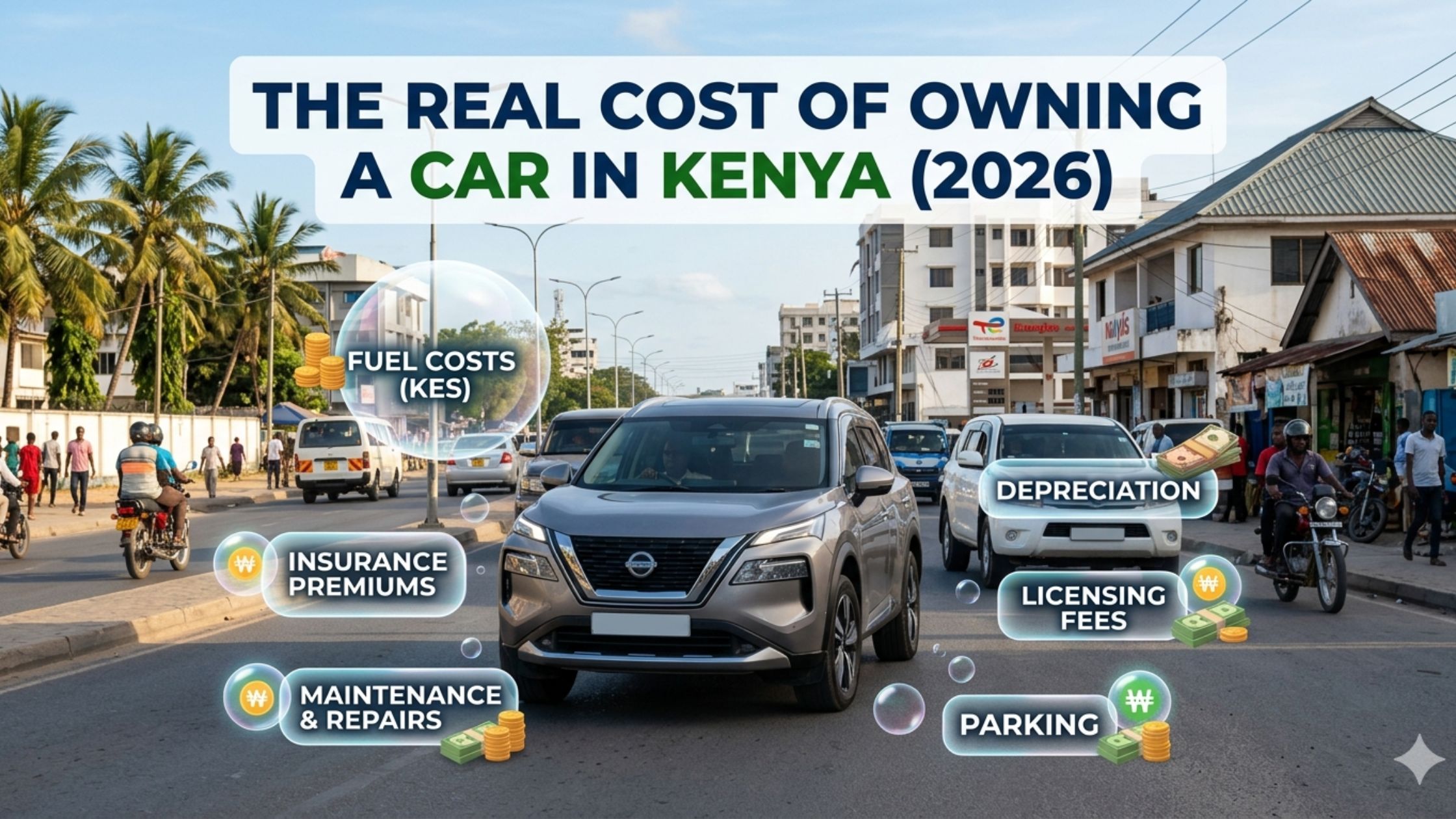
The Real Cost of Owning a Car in Kenya (2026)
The real cost of owning a car in Kenya is not the sticker price. For most Kenyans, the purchase price is only 30–40% of what the car will cost them over five years. The rest arrives month after month — quietly, in ways nobody told you to prepare for before you signed the logbook.
You saved for two years, got the car, and felt the pride of that first drive out of the yard. Then, three months later, you started wondering why you still feel broke. The insurance bill arrived. The service was due. A tyre blew. Parking in town cost more than you remembered. And fuel — fuel in May 2026 costs KES 214.25 per litre in Nairobi, the highest it has been since early 2024.
This guide gives you the complete, honest picture of car ownership costs in Kenya in 2026 — every category, with real KES figures — and the calculation that will help you decide whether a car is actually worth it at your income level right now.
The Purchase Price Is Just the Entry Fee
Before you spend a single shilling on fuel or insurance, the car itself costs more than most buyers realise — particularly for imported used vehicles.
New cars in Kenya range from approximately KES 1 million for an entry-level hatchback to KES 20 million or more for premium SUVs. Most new cars sold in Kenya come with a manufacturer warranty, a clean service history, and no hidden mechanical surprises — but you pay a premium for those certainties.
Imported used Japanese cars are the most common purchase for middle-income Kenyans, typically priced KES 500,000–1.5 million for a dependable daily driver. But the landed cost — what you actually pay to get it on Kenyan roads — includes:
- Import Duty: 25% of the customs value (CIF)
- Excise Duty: 20–35% depending on engine size and age
- VAT: 16% on the total of customs value + import duty + excise duty
- Import Declaration Fee (IDF): 3.5% of CIF value
- Railway Development Levy: 2% of CIF value
- Motor Vehicle Tax: 2.5% of current market value (introduced in 2024)
For a KES 800,000 CIF vehicle, total landed cost after all duties, taxes, and levies commonly reaches KES 1.3–1.6 million — 60–100% above the overseas purchase price.
Add registration fees, NTSA transfer costs, and first insurance premium, and the true day-one cost is significantly higher than what appeared in the dealership listing.
Fuel: Your Biggest Monthly Variable — and It Just Got Bigger
Fuel is the single largest recurring cost for most Kenyan car owners, and 2026 has been a particularly painful year at the pump.
Current EPRA fuel prices (May 19–June 14, 2026, Nairobi):
- Super Petrol: KES 214.25/litre
- Diesel: KES 232.86/litre (revised down after May 19 protests from a record KES 242.92)
- Kerosene: KES 191.38/litre
These prices reflect a Middle East-driven supply shock that pushed diesel to its highest price in Kenya’s recorded history in mid-May 2026 — KES 242.92/litre — before EPRA revised it downward following nationwide transport sector protests that halted matatu services across the country. Super petrol at KES 214.25 remains at its highest level since January 2024.
Fuel prices are adjusted monthly by EPRA based on global oil prices, exchange rate movements, and government levy decisions. They will change again on June 14, 2026.
What Fuel Costs You Per Month: By Car Type
The fuel consumption gap between vehicle types is one of the most underappreciated financial decisions in car ownership. Here is what the current petrol price means in monthly spend across common vehicles:
| Vehicle Type | Fuel Efficiency | Monthly km (urban) | Litres/month | Monthly Fuel Cost (KES 214.25/L) |
|---|---|---|---|---|
| Toyota Vitz / Honda Fit | 15–18 km/L | 1,500 km | 85–100 L | KES 18,211–21,425 |
| Toyota Axio / Fielder | 13–16 km/L | 1,500 km | 94–115 L | KES 20,140–24,639 |
| Toyota Harrier / Prado | 8–11 km/L | 1,500 km | 136–188 L | KES 29,138–40,279 |
| Land Cruiser V8 / Large SUV | 5–8 km/L | 1,500 km | 188–300 L | KES 40,279–64,275 |
The annual fuel gap between a Toyota Vitz and a Toyota Harrier — driven the same distance — is KES 132,000–228,000 per year. That is money that either goes to fuel or to savings and investments, depending purely on which vehicle you chose.
At KES 214.25/litre, the driver of a fuel-efficient vehicle (15 km/L, 1,500 km/month) spends approximately KES 257,000 per year on fuel alone. The SUV driver spending the same monthly kilometres pays KES 390,000–480,000 per year.
Insurance: What You Must Pay vs. What You Should Pay
Car insurance is mandatory in Kenya. Driving without at minimum third-party cover is a criminal offence.
Third-Party Only (TPO)
The minimum legal requirement. Covers damage you cause to other people’s vehicles or property and bodily injury to third parties — but covers nothing on your own vehicle in the event of an accident, theft, fire, or flood.
Annual cost: KES 5,000–15,108 depending on vehicle type and insurer.
TPO is the cheapest option, but it is a false economy for most car owners. If your vehicle is worth KES 800,000 and you have an at-fault accident, you bear the full repair cost yourself.
Comprehensive Insurance
Covers your vehicle for accident damage, theft, fire, and third-party liability. The standard in Kenya for vehicles worth KES 500,000 or more.
Annual cost: 3%–7.5% of the vehicle’s current market value, plus mandatory IRA levies (training levy, policyholder protection fund levy, stamp duty).
For a vehicle valued at KES 1.2 million:
- At 3.5%: KES 42,000/year
- At 5%: KES 60,000/year
- At 7%: KES 84,000/year
Factors that affect your premium: vehicle make and model (common models like the Toyota Fielder are cheaper to insure due to widely available parts), driver age and history, No Claims Discount (NCD) for consecutive claim-free years, and insurer pricing strategy.
How to reduce your insurance cost:
- Build your NCD — every claim-free year earns a discount of 10–15%
- Choose a higher excess (the amount you pay on each claim) in exchange for lower premiums
- Compare quotes from at least three insurers; rates for the same vehicle can vary by 30–40%
- Consider telematics-based policies from newer insurers if you are a low-mileage driver
Maintenance: The Cost Most Buyers Underestimate
Car maintenance in Kenya is significantly more expensive in 2026 than it was three years ago. Import duties on spare parts, global supply chain disruptions, a weakened shilling, and rising skilled labour costs have pushed annual maintenance costs for mid-range vehicles to an average of KES 200,000 per year for 1,500cc–2,000cc engine vehicles, according to AutoMag’s 2026 analysis.
Here is the breakdown:
Routine Servicing
| Service Type | Frequency | Cost per Visit |
|---|---|---|
| Minor service (oil, filters, inspection) | Every 5,000–7,500 km | KES 12,000–15,000 |
| Major service (full system check, fluids, belts) | Every 20,000 km | KES 30,000–35,000 |
| Annual scheduled total | 4 minor + 1 major | KES 78,000–95,000 |
Tyres
A full set of replacement tyres for a medium passenger car costs KES 25,000–50,000. For a typical driver covering 18,000–20,000 km/year, tyres need replacement every 2–3 years — an annualised cost of KES 8,000–25,000/year.
Brakes
Brake pad and rotor replacement: KES 20,000–40,000 per axle. On a well-maintained car driven primarily on Nairobi roads, budget for a brake job every 2–3 years per axle.
Unexpected Repairs
Kenya’s roads — potholes, speed bumps, flooding — are harder on vehicles than most manufacturers designed for. Budget a minimum of KES 20,000–40,000 per year for unplanned repairs: suspension components, shock absorbers, alignment, exhaust systems, and the ubiquitous stolen side mirror (KES 1,000–2,500 each, plus riveting to deter repeat theft).
The Hidden Costs Nobody Mentions Before You Buy
These are the costs that catch most first-time car owners off guard — not because they are secret, but because nobody thinks to mention them when you are excited about the purchase.
Parking
If you work in Nairobi CBD or a commercial district and park 4 days per week: KES 200–400/day × 4 days × 52 weeks = KES 41,600–83,200/year. The midpoint — KES 62,400 — is commonly cited as a realistic Nairobi parking budget for a working professional.
Car Wash
Once or twice a week: KES 300–600 per wash. Annual cost: KES 15,600–31,200.
Tracker and Security
A GPS tracker installation costs KES 10,000–20,000 plus a monthly monitoring fee of KES 500–1,500. Annual security cost: KES 16,000–38,000. In Nairobi’s vehicle theft environment, this is not optional for most car owners.
NTSA Inspection and Compliance
Motor vehicle inspection is mandatory annually for commercial vehicles and for private vehicles older than 4 years. Inspection fee: KES 1,000–3,000 depending on vehicle category. Failure means re-inspection costs and potential impoundment.
Motor vehicle licence (annual road licence): KES 1,600–7,000 depending on engine size.
Depreciation: The Invisible Cost
Depreciation is real money, even though it does not show up as a monthly payment. A KES 1.2 million used vehicle loses approximately:
- Year 1: 15–20% of value (KES 180,000–240,000)
- Year 2–3: 10–15% per year (KES 120,000–180,000/year)
- Year 4–5: 8–12% per year
Over 5 years, a KES 1.2 million vehicle may be worth KES 550,000–700,000. That is a KES 500,000–650,000 loss in asset value — not including a single shilling of running costs.
The Full Annual Cost Breakdown: A KES 1.2 Million Sedan in Nairobi
Here is the complete, honest picture for a typical urban Kenyan driving a KES 1.2 million used sedan approximately 1,500 km per month:
| Cost Category | Annual Cost (KES) |
|---|---|
| Fuel (15 km/L, 1,500 km/month, KES 214.25/L) | 257,100 |
| Comprehensive insurance (4% of KES 1.2M) | 48,000 |
| Routine maintenance (minor + major services) | 85,000 |
| Unexpected repairs | 30,000 |
| Tyres (annualised) | 12,000 |
| Parking (4x/week, KES 300/day) | 62,400 |
| Car wash (weekly, KES 400/wash) | 20,800 |
| Tracker and security | 24,000 |
| NTSA and road licence | 5,000 |
| Depreciation (Year 2–3, ~12%) | 144,000 |
| Total Annual Cost | KES 688,300 |
That is KES 57,358 per month — before any loan repayments.
If you financed the car at 13–16% per annum over 4 years, add KES 30,000–40,000/month in loan repayments. Total monthly car cost: KES 87,000–97,000/month on a KES 1.2 million vehicle.
For context: this is the full monthly cost of owning and operating a mid-range sedan in Nairobi in 2026. Not the cost of the car. The cost of having the car.
Is Car Ownership Worth It? The Honest Alternative Calculation
Before you decide, run this comparison honestly.
Monthly cost of car ownership (KES 1.2M sedan, no loan): KES 57,358 Monthly cost of public transport (Nairobi urban commuter): KES 6,000–12,000
Monthly savings from choosing public transport instead: KES 45,000–51,000
If you invest that difference — KES 45,000/month — in a money market fund at 10% net annual return:
- After 1 year: KES 566,000
- After 3 years: KES 1.88 million
- After 5 years: KES 3.5 million
The opportunity cost of owning a non-essential car in Nairobi — money that could have been building wealth instead — is over KES 3.5 million in 5 years.
This calculation is not an argument against car ownership. It is the calculation you should run before deciding.
When a Car IS Worth It
Cars are worth their full cost in specific situations:
- Business necessity: Client visits, field work, transport that directly generates income
- Family logistics: Children in school, family members with mobility needs, multiple daily routes that public transport cannot serve efficiently
- Safety: Late night work schedules where public transport is genuinely unsafe or unavailable
- Rural areas: Where public transport is infrequent, unreliable, or non-existent
If none of these apply, the car is a lifestyle choice — and that is fine, as long as you enter it with full visibility of what the choice costs.
How to Reduce Car Ownership Costs in Kenya
If you already own a car, or have decided that ownership is right for you, here is where the savings are:
Choose fuel-efficient models. The difference in annual fuel cost between a Toyota Vitz and a Toyota Harrier is KES 132,000–228,000 — choosing the efficient option once funds the next year’s insurance and maintenance.
Find a trusted independent mechanic. Authorised dealers charge 40–70% more for labour than skilled independent garages. A mechanic you trust who uses genuine or quality compatible parts is the single biggest maintenance savings opportunity.
Insure with a higher excess. If you are a careful driver with a clean record, increasing your insurance excess from KES 15,000 to KES 30,000 can reduce your annual premium by 15–25%.
Join a SACCO with car loan facilities. SACCO loans for vehicle purchase carry interest rates of 12–14% per annum on reducing balance — significantly cheaper than the 18–24% charged by most commercial banks and finance companies. If you are financing a car purchase, the lending institution makes an enormous difference to total cost.
Track every expense monthly. Most car owners dramatically underestimate what their vehicle costs them because they only count fuel and insurance. Track every expense — including car wash, parking, and the KES 500 tyre pressure check — for 3 months. The total is usually a shock that motivates better decision-making.
Keep a maintenance fund. Set aside KES 5,000–8,000/month specifically for vehicle maintenance and repairs. When the repair bill arrives — and it always does — it hits your maintenance fund, not your salary. This one habit eliminates the most financially destabilising aspect of car ownership: unpredictable large repair costs.
The Bottom Line: Real Cost of Owning a Car in Kenya
The real cost of owning a car in Kenya in 2026 is approximately KES 57,000–97,000 per month for a mid-range sedan, depending on whether you have a loan. Over five years, the running costs of a KES 1.2 million vehicle will comfortably exceed the original purchase price.
None of this means car ownership is wrong. It means car ownership is a major financial commitment that deserves the same analysis you would give to any investment of this size. The Kenyan who buys a car knowing exactly what it will cost them per month — and has budgeted for it deliberately — will not be blindsided. The one who only counted the purchase price will be back to feeling broke by month three.
Before you buy: calculate your realistic monthly running cost using the figures in this guide. If that number fits comfortably within 25–30% of your take-home pay, the purchase is financially sound. If it does not, the decision deserves more time.
Check current EPRA fuel prices before any purchase decision at epra.go.ke and compare insurance quotes across providers at the Insurance Regulatory Authority portal at ira.go.ke.
Disclaimer: All cost figures in this article are estimates based on current market data as of May 2026 and will vary based on vehicle make, model, driving patterns, and market conditions. Fuel prices are reviewed monthly by EPRA and will change. This article is for informational purposes only and does not constitute financial advice.
Sources: AutoMag.co.ke Car Maintenance Costs Kenya 2026 (January 2026), AutosKenya.com True Cost of Owning a Car Kenya (March 2026), EPRA Fuel Price Review May 19–June 14 2026, Kenyan Wallstreet Diesel Record High April 2026, AutoMag.co.ke Kenya Car Insurance 2026 (January 2026), ProntoWash/Autobarn Real Cost of Car Ownership Kenya, AutoMag.co.ke Car Maintenance Budgeting Guide (February 2025).