Kenya’s Capital Markets Gap Traps Growing Businesses
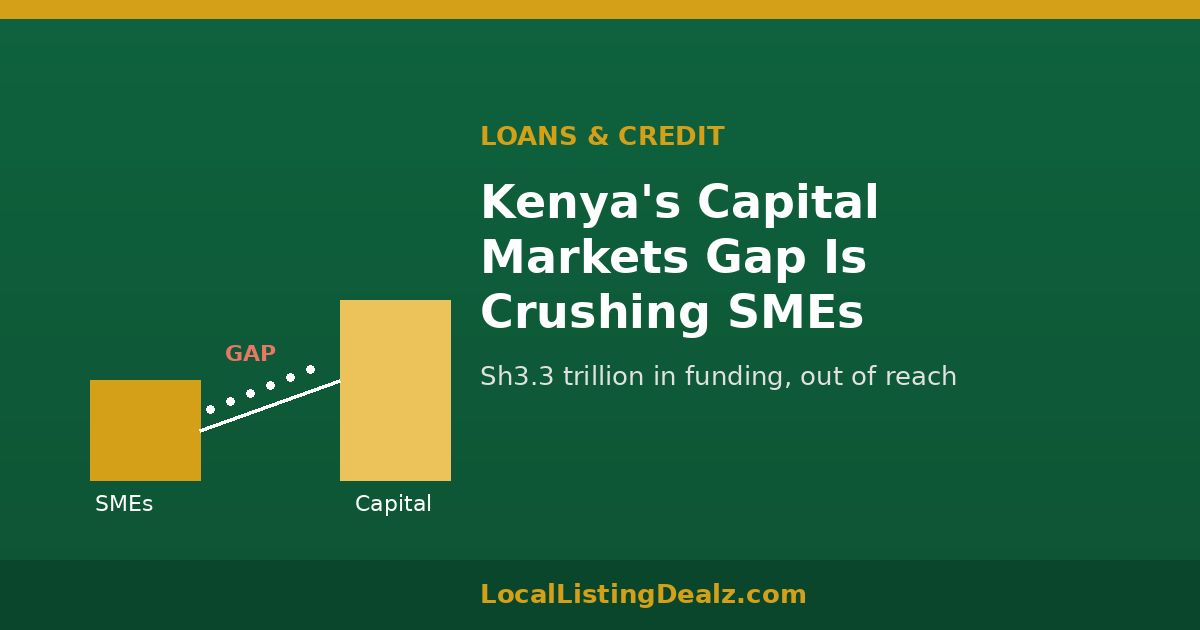
Kenya’s capital markets gap is leaving a huge segment of the country’s businesses stranded between two worlds — too large for microfinance or informal lending, but not yet attractive enough for the main investment market.
If you run a growing Kenyan business and have found yourself rejected by banks despite a solid track record, this gap is very likely the reason.
What Is Kenya’s Capital Markets Gap, Exactly?
It describes the space between two very different groups of businesses. Very small businesses can access microfinance, informal financing, or basic bank loans. Large companies can issue shares or bonds directly on the Nairobi Securities Exchange.
Sitting in between is a huge collection of growing businesses that need patient, long-term capital but lack the size, financial records, or corporate structures traditional capital markets demand.
As one analysis put it: “Kenya’s biggest problem is not necessarily a lack of money. It is the gap between businesses that are too large for ordinary bank financing and businesses that are not yet attractive enough for the main market.”
The Size of Kenya’s Capital Markets Gap Is Staggering
- The IFC originally estimated the gap at approximately Sh2.2 trillion.
- More recent policy reviews now place it above Sh3.3 trillion.
- A separate widely cited figure places it at Sh2.5 trillion.
MSMEs account for roughly 80% of businesses in Kenya and employ millions — this is a structural constraint on the entire economy, not a niche problem.
Why Kenya’s Capital Markets Gap Exists
From the bank’s perspective: lenders price loans by perceived risk. Businesses lacking audited statements, cash flow history, or collateral face higher rates or outright rejection. As Sameer Raja of I&M Capital put it: “The biggest financing gap today falls within the SME sector because many businesses lack sufficient collateral or cash flows.”
From the business owner’s perspective: as Eronja Linda of Linkaya Cleaning Services described it: “When you walk to the banks, they need a background which you don’t have. You have a story, but they need data and bank statements.”
From the capital markets side: getting investor-ready requires proper accounts, credible governance, and a willingness to open the books — many family-owned SMEs resist this due to fears of losing control.
What’s Being Done to Close the Gap
- The NSE’s SME Market Segment — a pathway to patient capital without a full main-market listing.
- The government’s Credit Guarantee Scheme — banks share lending risk on viable SMEs.
- The Movable Property Security Rights framework — machinery, inventory, and receivables as collateral instead of land titles.
- Digital lenders (Tala, Branch, KCB M-Pesa, M-KOPA) — 7.5 million loans worth Sh133.5 billion issued by February 2026, though poorly suited to long-term growth capital.
- SACCOs — member savings and guarantor systems instead of physical collateral.
- Securitisation — converting future income streams into investable securities.
Why This Matters for the Wider Economy
Charles Miano of Nabo Capital: Kenya has one of East Africa’s largest pools of long-term domestic savings, but too much finances government borrowing rather than productive private investment.
What This Means If You’re a Kenyan SME Owner
- Start building records now — proper accounts and governance open doors later.
- Consider SACCOs or the Movable Property framework if you lack traditional collateral.
- Understand digital credit’s real role — a bridge, not a substitute for long-term capital.
- Watch the NSE’s SME Market Segment as it matures.
Frequently Asked Questions
How big is Kenya’s SME financing gap?
Sh2.2 trillion to over Sh3.3 trillion, depending on the estimate.
Why can’t Kenyan SMEs just get a bank loan?
They often lack audited statements, cash flow records, or collateral banks require.
What alternatives exist beyond bank loans?
SACCOs, digital credit providers, the Credit Guarantee Scheme, Movable Property Security Rights, and the NSE’s SME Market Segment.
Is the NSE realistic for small businesses?
Yes, but governance and disclosure requirements mean it suits businesses that have already built strong financial foundations.
This article is for educational purposes only. Figures reflect the most recent publicly available estimates as of mid-2026.