KPLC Kenya Power Dividend 2026: Everything You Need to Know
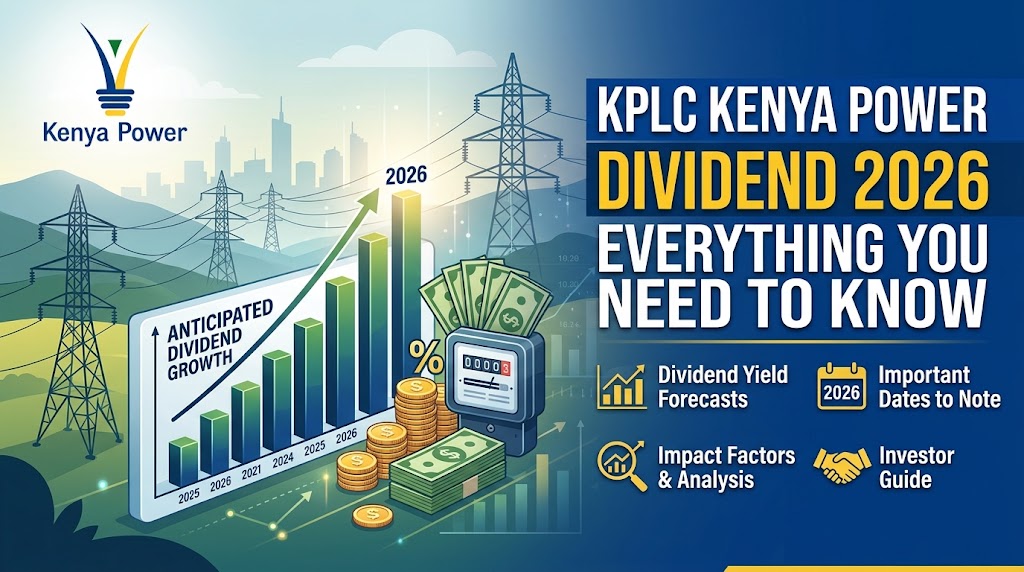
KPLC’s Kenya Power dividend has made a genuine comeback after years of drought, and 2026 has already brought real payouts to shareholders — with another decision still ahead. If you’re searching for exactly what Kenya Power has paid, what’s been confirmed so far this year, and what to watch for next, here’s the complete breakdown.
KPLC’s Dividend Comeback: A Quick History
For context on just how significant this is: Kenya Power went six full years without paying a dividend before finally resuming payouts for the financial year ended June 2024, when the company posted a record turnaround profit of KES 30.08 billion (up from a KES 3.19 billion loss the year before). That result triggered a KES 0.70 per share dividend, paid in January 2025 — the company’s first payout since 2017.
The momentum continued into the next financial year. For FY2024/25 (year ended June 2025), Kenya Power posted a profit after tax of KES 24.47 billion and paid a combined dividend of KES 1.00 per share — made up of a KES 0.20 interim dividend paid earlier in the year, plus a KES 0.80 final dividend, with shareholders on the register as of 2nd December 2025 qualifying, and payment made on or about 30th January 2026. That combined KES 1.00 was a solid increase from the KES 0.70 paid the previous year.
The KPLC Dividend Story So Far in 2026
Kenya Power’s momentum has carried straight into the current financial year. For H1 FY2025/26 (the six months to December 2025), the company reported profit before tax of KES 14.83 billion, up 5.5% year-on-year, driven by a 6.9% rise in electricity revenue to KES 114.87 billion and a 10.5% increase in units sold. Finance costs also fell by KES 492 million, with total borrowings down 6% to KES 84.23 billion.
On the back of these results, Kenya Power’s board raised its interim dividend by 50%, to KES 0.30 per share (up from KES 0.20 the previous year). The register closed on 23rd February 2026, with payment made on or about 27th March 2026. The board specifically highlighted that “the continued growth in electricity sales, supported by rising demand, improved distribution efficiency, and lower finance costs, lays a solid foundation for improved profitability.”
What hasn’t happened yet: Kenya Power’s final dividend for FY2025/26 has not yet been declared. Based on the company’s established pattern — final results typically reported around October, with book closure in early December and payment the following January — the final dividend decision is expected in that same window, likely with an announcement around October/November 2026 and payment around late January 2027.
KPLC Dividend Yield and What It Means for Shareholders
Kenya Power’s dividend currently carries a yield estimated between roughly 5.6% and 7.8% depending on the data source and exact share price at time of calculation — a genuinely attractive yield by NSE standards. What makes this particularly notable is the payout ratio of around 8%, meaning Kenya Power is currently distributing only a small fraction of its earnings as dividends. This has two implications worth understanding:
- The current dividend is very safely covered by earnings — an 8% payout ratio leaves enormous room before the dividend would be at any risk from a earnings downturn.
- There may be room for further dividend growth if the board chooses to distribute a larger share of profits in future years, though this is not guaranteed and depends entirely on board discretion and the company’s capital needs (including its ongoing debt repayment programme).
Kenya Power’s dividend has grown at a rate of roughly 10.9% based on recent trend data, reflecting the company’s broader turnaround from loss-making utility to a consistently profitable, dividend-paying stock.
A Note on Preference Shares
Separately from the ordinary share dividends covered above, Kenya Power also pays half-yearly dividends on its 4% and 7% cumulative preference shares — a distinct share class held by a smaller group of investors. For 2026, this preference dividend had a register closure of 2nd June 2026, with payment due 30th June 2026. If you hold Kenya Power’s ordinary shares (the ones most commonly traded on the NSE), this preference share dividend does not apply to you — it’s a separate, fixed-rate instrument.
Why Kenya Power’s Dividend Turnaround Matters
Kenya Power’s return to consistent dividend payments reflects a genuine operational and financial turnaround, not a one-off:
- A stronger Kenyan shilling has significantly reduced the cost of servicing Kenya Power’s foreign-currency-denominated debt, since roughly 90% of its borrowings are in foreign currency — a stronger shilling directly cuts this burden.
- Falling expected credit losses (ECL) provisioning under IFRS 9 accounting has reduced operating expenses meaningfully year-over-year.
- Rising electricity consumption and new connections — the company added hundreds of thousands of new customer connections in recent years, growing its revenue base.
- Active debt reduction — Kenya Power has been steadily paying down its loan book, with total borrowings falling 6% in the most recent half-year alone.
What This Means If You’re a KPLC Shareholder
- Two dividend payments have already landed in 2026 — the FY2024/25 final dividend (KES 0.80, paid January) and the FY2025/26 interim dividend (KES 0.30, paid March). If you held shares through both record dates, you’ve already received both.
- A further decision is still pending — the FY2025/26 final dividend hasn’t been announced. Watch NSE Corporate Actions or Kenya Power’s own investor relations page for the announcement, expected around October-November 2026.
- The low payout ratio suggests dividend safety, not necessarily dividend size — don’t assume future dividends will automatically be larger; Kenya Power may choose to retain more earnings for debt repayment or infrastructure investment instead.
- Position ahead of any future book closure — as with any NSE dividend, buying shares purely to catch a book closure requires accounting for the standard T+3 settlement period, so plan to buy several business days ahead of any announced date, not on the day itself.
Frequently Asked Questions
What dividend has Kenya Power (KPLC) paid in 2026? Two payments so far: a KES 0.80 final dividend for FY2024/25 (paid 30th January 2026) and a KES 0.30 interim dividend for FY2025/26 (paid on or about 27th March 2026).
Has Kenya Power declared its final dividend for FY2025/26? Not yet, as of this update. Based on the company’s typical timeline, an announcement is expected around October-November 2026, with payment likely in late January 2027.
What is Kenya Power’s current dividend yield? Estimates place it between approximately 5.6% and 7.8%, depending on the data source and share price at the time of calculation — a strong yield relative to the broader NSE market.
Why did Kenya Power stop paying dividends for six years? The company posted losses in prior years, including a KES 3.19 billion loss for the year ended June 2023, driven partly by foreign exchange losses on its dollar-denominated debt. A stronger shilling and operational improvements since then reversed this trend.
Is Kenya Power’s dividend safe? The company’s payout ratio is currently very low (around 8%), meaning the dividend is well covered by earnings — a genuinely conservative, low-risk payout level by NSE standards.
Are KPLC preference share dividends the same as ordinary share dividends? No. Kenya Power’s 4% and 7% cumulative preference shares are a separate share class with their own fixed dividend schedule, distinct from the ordinary share dividends most retail investors hold.
This article is for educational purposes only and does not constitute financial or investment advice. Dividend amounts, dates, and yields can change — confirm current details via the Nairobi Securities Exchange Corporate Actions feed or Kenya Power’s own investor relations page before making investment decisions.