Best Dividend: Standard Chartered, Absa, or Stanbic?
Payouts for Standard Chartered vs Absa vs Stanbic dividend on NSE come from foreign banks and move in three directions. Meanwhile, one raised its interim sharply, one nudged it up modestly, and one cut it by more than half.
If you’re choosing between these three for dividend income, the headline yield tells only part of the story.
Here’s how Standard Chartered vs Absa vs Stanbic dividend compares on payout, yield, and the direction each is heading.
Standard Chartered vs Absa vs Stanbic Dividend: Quick Comparison
| Metric | Standard Chartered (SCBK) | Absa Bank Kenya (ABSA) | Stanbic Holdings (SBIC) |
|---|---|---|---|
| FY2025 total dividend | KES 31.00 | KES 2.05 | KES 22.35 |
| FY2025 profit after tax | KES 12.4 billion (down 38%) | KES 22.9 billion (up 10%) | KES 13.72 billion (roughly flat) |
| Payout ratio | ~95% of earnings | ~49% of earnings | ~64% of earnings |
| Recent share price | ~KES 335–345 | ~KES 33–34 | ~KES 290–295 |
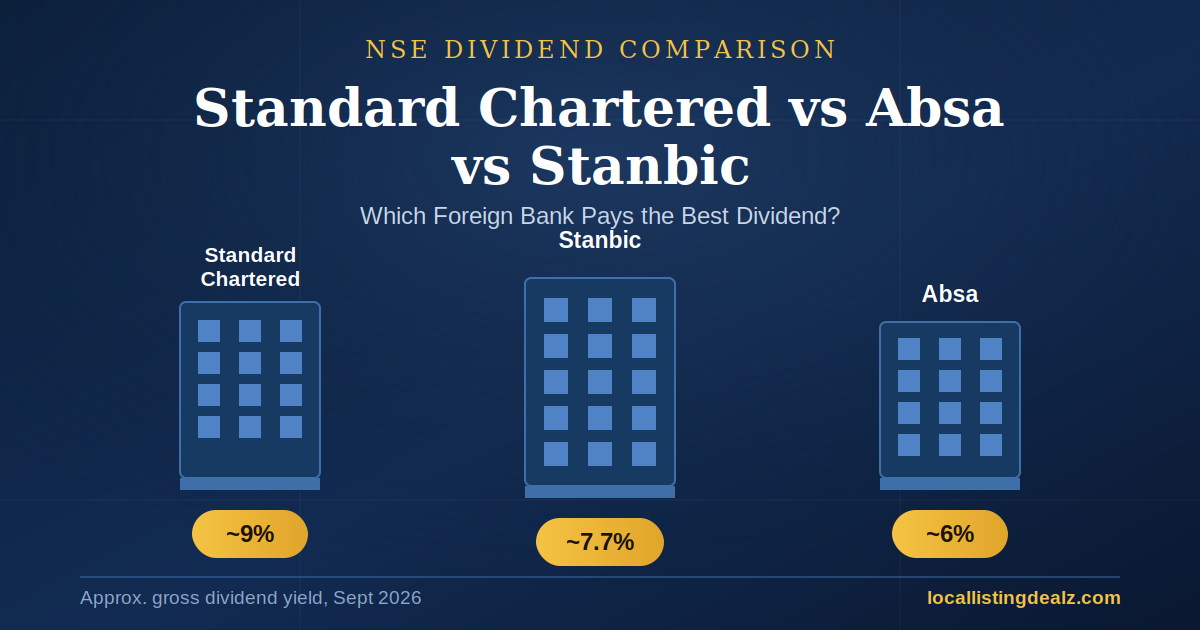
| Approx. gross yield | ~9% | ~6% | ~7.7% |
| 2026 interim dividend move | Up 6.3% (KES 8.00 → 8.50) | Up 150% (KES 0.20 → 0.50) | Down 56.8% (KES 3.80 → 1.64) |
| Parent | Standard Chartered PLC (~74%) | Absa Group Limited (~68.5%, seeking more) | Standard Bank Group |
Yields shift with share prices daily, so treat these as a snapshot, not a live quote.
Standard Chartered Bank Kenya: The Highest Yield, the Highest Payout Ratio
Standard Chartered paid a total FY2025 dividend of KES 31.00 per share (KES 8.00 interim plus KES 23.00 final), even as full-year profit after tax fell 38% to KES 12.4 billion, down from KES 20.1 billion in 2024. That profit drop followed a one-off pension charge.
The bank still distributed KES 11.7 billion to shareholders, a payout ratio of about 95% of earnings. That’s a deliberately aggressive policy: outgoing CEO Kariuki Ngari called it a commitment to “consistently deliver sustainable returns,” and most of the payout flows to parent Standard Chartered PLC, which holds roughly 74% of the bank.
For 2026, the board raised the interim dividend again, to KES 8.50 from KES 8.00, even as H1 2026 profit fell a further 16.8% to KES 6.73 billion. Kenya’s banking sector carried KES 695.4 billion in non-performing loans by March 2026, and Standard Chartered’s corporate lending book sits exposed to delayed government payments.
The takeaway: Standard Chartered offers the highest yield of the three, funded by paying out almost all its profit. That’s great for income today, but a payout ratio near 95% leaves very little room if earnings keep falling.
Absa Bank Kenya: Raising Dividends Fastest, With Room to Spare
Absa delivered the standout profit growth of the three. FY2025 net profit rose 10% to KES 22.9 billion, and the board lifted the total dividend 17% to KES 2.05 per share (KES 0.20 interim, KES 1.85 final), the highest payout since the bank’s 2011 share split.
Absa openly targets a payout ratio of around 55% of net profit, and FY2025’s actual payout of about 49% sits comfortably under that. That gives it more room to keep raising dividends than a bank paying out nearly all its earnings.
The clearest signal came in August 2026. Even though H1 2026 profit fell 9.8% to KES 10.53 billion on lower interest income, the board still raised the interim dividend 150%, from KES 0.20 to KES 0.50. Management called it confidence in the bank’s capital position rather than current earnings.
Absa Group, the parent, is also in the middle of a KES 30.9 billion tender offer to raise its stake in Absa Bank Kenya from 68.5% to 85%, at KES 34.50 per share, a 20% premium to the 30-day average at the time. Confirm the outcome of that offer with Absa or the NSE before you trade, since deal terms and completion dates can shift.
The takeaway: Absa has the lowest per-share dividend of the three, but the fastest dividend growth and the most conservative payout ratio, meaning the most room to keep raising it.
Stanbic Holdings: Biggest Historical Payout, But 2026 Is Pulling Back
Stanbic declared a record total dividend of KES 22.35 per share for FY2025 (KES 3.80 interim, KES 18.55 final), up 7.8% from KES 20.74 in 2024. Group profit after tax was roughly flat at KES 13.72 billion, and the bank’s share price rose over 40% in both 2024 and 2025.
That payout used about 64% of FY2025 earnings per share of KES 34.73, a comfortable ratio, well covered by profit.
But 2026 tells a different story. H1 2026 profit after tax rose just 1% to KES 6.61 billion, as rising costs offset a sharp drop in credit impairment charges. The board responded by cutting the interim dividend 56.8%, from KES 3.80 to KES 1.64, a much bigger swing than the profit numbers alone would suggest.
Read more in Kenyan Wallstreet’s H1 2026 coverage and its full-year 2025 report. Stanbic itself flags early electioneering, slow private-sector credit uptake and global trade shocks as risks heading into the rest of 2026.
The takeaway: Stanbic paid the biggest dividend of the three last year, but its sharp interim cut this year is the clearest sign of caution among the group, even though profit didn’t fall.
Why the Same Sector Is Sending Different Signals
All three are foreign-owned Kenyan banks facing the same headwinds: falling interest rates compressing margins, and a banking sector carrying a high non-performing loan ratio. Yet their dividend decisions in 2026 moved in opposite directions.
- Standard Chartered and Absa raised dividends despite falling profit, signalling confidence in their capital bases and, for Absa, room under a conservative payout target.
- Stanbic cut its dividend even though profit barely moved, suggesting more caution about the rest of the year, or a correction after an unusually generous prior-year base.
Neither approach is automatically “better.” A bank paying out almost everything, like Standard Chartered, offers a higher yield today but less of a buffer. A bank with room to spare, like Absa, may keep raising dividends for longer. A bank that just cut, like Stanbic, may simply be resetting expectations before growth in interest income and lending returns.
How to Qualify for These Dividends
The process is the same for all three banks:
- Hold shares in your own CDS account. New to the NSE? Start with our NSE trading guide or how to buy shares in Kenya.
- Buy before the T+3 deadline. Trades settle three business days later, so buy at least three business days ahead of any announced book closure.
- Link a valid KRA PIN for the correct 5% resident withholding tax rate.
- Keep your bank details current with your broker or CDSC.
Track every payout date on our NSE dividend calendar.
How Much Would You Earn? (1,000 Shares, Illustrative)
Using each bank’s FY2025 total dividend and 5% resident withholding tax:
| Bank | Gross dividend on 1,000 shares | Net after 5% tax |
|---|---|---|
| Standard Chartered (KES 31.00) | KES 31,000 | KES 29,450 |
| Absa (KES 2.05) | KES 2,050 | KES 1,947.50 |
| Stanbic (KES 22.35) | KES 22,350 | KES 21,232.50 |
Remember the entry cost differs hugely: 1,000 Standard Chartered shares costs roughly KES 335,000 to 345,000, 1,000 Stanbic shares roughly KES 290,000 to 295,000, and 1,000 Absa shares only about KES 33,000 to 34,000. Compare yield, not just the cash amount, and use our NSE dividend calculator for your own holding size.
More NSE Bank Dividend Comparisons
This isn’t the only bank dividend match-up worth checking. See our best dividend stocks in Kenya and blue-chip stocks guide for the wider NSE income picture, or browse all NSE stocks and dividends coverage. You can also read our I&M Holdings, DTB and KCB dividend guides individually.
Frequently Asked Questions
Which pays the highest dividend yield: Standard Chartered, Absa or Stanbic? Standard Chartered has the highest yield, at roughly 9% at recent prices, because it pays out about 95% of its earnings. Stanbic follows at around 7.7%, and Absa at around 6%.
Which bank cut its dividend in 2026? Stanbic Holdings cut its 2026 interim dividend by 56.8%, from KES 3.80 to KES 1.64 per share, even though profit was roughly flat.
Which bank raised its dividend the most in 2026? Absa Bank Kenya raised its 2026 interim dividend by 150%, from KES 0.20 to KES 0.50 per share, despite a 9.8% drop in first-half profit.
Which of these banks has the safest dividend? Absa’s payout ratio of about 49% is the most conservative of the three, leaving the most room to sustain or grow the dividend if profit dips. Standard Chartered’s roughly 95% payout ratio leaves the least room.
Are Standard Chartered, Absa and Stanbic all foreign-owned? Yes. Standard Chartered Bank Kenya is majority owned by UK-based Standard Chartered PLC, Absa Bank Kenya by South Africa’s Absa Group, and Stanbic Holdings by South Africa’s Standard Bank Group.
How much tax is deducted from these dividends? Resident individuals pay 5% withholding tax on dividends from all three banks, deducted at source.
This article is for educational purposes only and is not financial advice. Dividends are decided by each bank’s board, subject to shareholder approval, and can change. Confirm current figures with Standard Chartered Kenya, Absa Kenya, Stanbic Bank Kenya, the NSE and CDSC before investing.