CBK’s 20 & 25-Year Bonds Explained: Should Everyday Kenyans Buy Long-Dated Government Debt?
CBK’s 20 & 25-year bonds have become a focal point of Kenya’s fixed-income market, headlined by a KSh 40 billion auction in the 2026/27 financial year offering exclusively these two long-dated Treasury instruments.
If you’re used to Treasury bills and shorter bonds and are wondering whether it’s worth locking your money up for two decades or more, here’s exactly what CBK’s 20 & 25-year bonds are, what they pay, and who they actually make sense for.
What CBK’s 20 & 25-Year Bonds Actually Are
In its second bond auction of FY2026/27, the Central Bank of Kenya reopened two existing long-dated fixed-coupon Treasury bonds worth a combined KSh 40 billion:
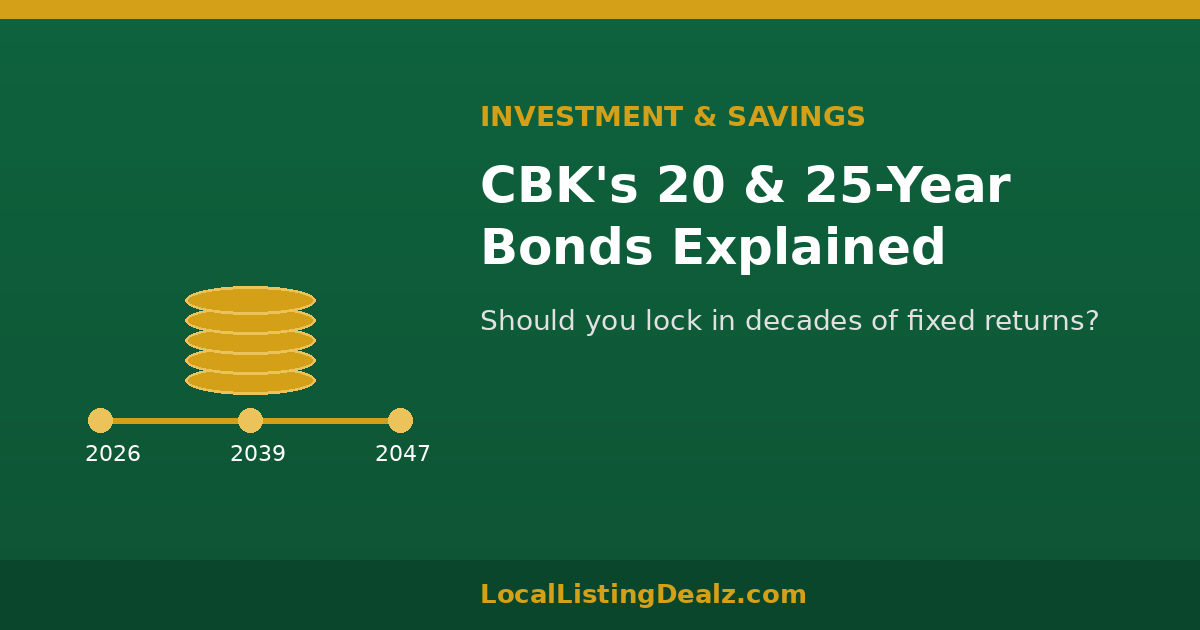
- FXD1/2019/020 — the 20-year bond, with approximately 12.8 years remaining to maturity, carrying a 12.873% coupon, maturing 21st March 2039.
- FXD1/2022/025 — the 25-year bond, with approximately 21.4 years remaining to maturity, carrying a 14.188% coupon — the highest coupon on offer among the government’s securities that month — maturing 23rd September 2047.
Notably, CBK excluded any shorter-dated instrument from this particular auction of its 20 & 25-year bonds entirely, a deliberate move to test whether investors would commit capital to the far end of the yield curve without a shorter bond available to anchor demand.
Why CBK Is Pushing Its 20 & 25-Year Bonds Over Shorter Debt
This isn’t a one-off decision — it reflects Kenya’s 2026-2029 Medium-Term Debt Strategy, which is explicitly aimed at extending the government’s debt maturity profile. There’s a clear logic behind favouring CBK’s 20 & 25-year bonds:
- Reducing refinancing risk. Shorter-dated debt has to be rolled over more frequently, exposing the government to the risk of higher rates or weaker demand at each rollover point. Longer bonds lock in funding for decades, smoothing out that risk.
- Following a regional and continental trend. Across Africa, governments are increasingly trying to deepen local-currency debt markets specifically to reduce reliance on foreign-currency borrowing and the exchange-rate risk that comes with it.
- Testing genuine investor appetite. By excluding shorter bonds from this auction, CBK could see clearly whether banks, pension funds, and insurers are willing to go long without a shorter instrument to fall back on.
Who’s Actually Buying CBK’s 20 & 25-Year Bonds?
In practice, CBK’s 20 & 25-year bonds are overwhelmingly bought by institutional investors — banks, pension funds, and insurance companies — rather than individual retail investors.
This makes sense given their structure: pension funds and insurers have liabilities that stretch decades into the future, so a 20-25 year bond is a natural match for their investment horizon. That said, CBK does allow individual investors to participate directly.
Can an Everyday Kenyan Actually Buy CBK’s 20 & 25-Year Bonds?
Yes. CBK’s long-dated bond auctions are open to individual investors, with a minimum investment of KSh 50,000 and a maximum of KSh 50,000,000 per bid.
Bonds are purchased through the CBK DhowCSD investor portal or app, and successful bonds are listed on the Nairobi Securities Exchange, meaning they can also be bought or sold on the secondary market rather than only held to maturity.
Should You Buy CBK’s 20 & 25-Year Bonds?
This is where the decision gets genuinely personal, because the right answer depends heavily on your own financial timeline and goals:
CBK’s 20 & 25-year bonds may make sense if:
- You have a genuinely long investment horizon — for example, you’re investing toward retirement decades away, or building a fund you don’t expect to need for 15-20+ years.
- You want to lock in a high, fixed coupon rate for a very long period, insulating yourself from future interest rate declines.
- You value the option of secondary market liquidity through the NSE if your plans change, rather than needing full commitment to maturity.
CBK’s 20 & 25-year bonds are probably not right for you if:
- You might need this money in the next 5-10 years for something concrete — school fees, a house deposit, a business investment. Locking money into a 20-25 year instrument for a near-term goal creates unnecessary interest rate risk if you need to sell early.
- You’re uncomfortable with the idea of your capital being committed for multiple decades, even with secondary market access as a theoretical exit.
- You haven’t yet built a shorter-term emergency fund or more liquid investments — these should generally come first. Our guide to the best money market funds in Kenya is a good starting point for shorter-term, liquid savings.
CBK’s Long Bonds vs Money Market Funds: A Different Kind of Risk
It’s worth being clear that CBK’s 20 & 25-year bonds and a money market fund serve very different purposes, even though both are considered relatively safe, government-backed-adjacent investments in the Kenyan context:
- Money market funds are highly liquid, let you withdraw within days, and are ideal for money you might need on short notice.
- CBK’s 20 & 25-year bonds offer a fixed coupon locked in for decades, are less liquid (though tradeable on the NSE secondary market), and are better suited to genuinely long-term, patient capital.
Neither is inherently “better” — they answer different financial questions.
Frequently Asked Questions
What is the minimum amount to buy CBK’s 20 & 25-year bonds? KSh 50,000, with a maximum of KSh 50,000,000 per bid, through the CBK DhowCSD investor portal or app.
What coupon rate do CBK’s 20 & 25-year bonds currently pay? Recent reopenings carried coupons of 12.873% (20-year) and 14.188% (25-year) — among the highest available in Kenya’s fixed-income market, reflecting the premium investors demand for locking up capital over such a long period.
Can I sell CBK’s 20 & 25-year bonds before they mature? Yes. They’re listed on the Nairobi Securities Exchange, so they can be sold on the secondary market before maturity, though pricing will depend on prevailing interest rates at the time of sale.
Why is CBK focusing on 20 & 25-year bonds instead of shorter ones? This reflects Kenya’s 2026-2029 Medium-Term Debt Strategy, which aims to extend the government’s debt maturity profile and reduce refinancing risk.
Are CBK’s 20 & 25-year bonds risk-free? They carry very low default risk as government securities, but they do carry interest rate risk — if you need to sell before maturity and market rates have risen, the bond’s market price may be lower than what you paid.
This article is for educational purposes only and does not constitute financial or investment advice. Bond terms, coupon rates, and auction availability change regularly — confirm current details directly through the CBK DhowCSD portalbefore investing.