NSE Performance 2026 — Is the Nairobi Stock Exchange a Good Investment Right Now?
NSE performance in 2026 has surprised most observers. The Nairobi All Share Index hit record highs above 202 points in early February 2026, pulled back briefly, and has since pushed further to 209 points as of June 2026 — continuing to set new all-time highs on the back of record corporate profits, a stable shilling, and dividend yields that are attracting capital away from money market funds and fixed deposits. So is now a good time to invest in the NSE? Here is what the data actually says — including what has changed, what the risks are, and which opportunities remain open right now.
Table of Contents
- NSE Performance 2026 — Where the Market Stands Today
- What Drove the 2026 NSE Rally — and Why It Matters for New Investors
- Is the NSE Cheap or Overvalued Right Now? The Honest Valuation Picture
- Best NSE Dividend Stocks by Yield in 2026 — The Full Rankings
- NSE vs Money Market Funds vs Fixed Deposits — The Real Comparison
- Two New NSE Listings in 2026 — Kenya Pipeline Company and ALP REIT
- How to Start Investing in the NSE in 2026 — Practical Steps
- Frequently Asked Questions
NSE Performance 2026 — Where the Market Stands Today
NSE performance in 2026 has been the strongest in the exchange’s recent history. The Nairobi All Share Index (NASI) — the broadest measure of market performance — currently sits at approximately 209 points as of June 11, 2026, above the February 2026 all-time high of 202 points. The NSE 20 Share Index, which tracks the 20 largest companies, reached 3,558 points by early April 2026 — 68% higher than a year ago.
The market capitalisation of the Nairobi Securities Exchange stood at KES 3.5 trillion (approximately USD 26.9 billion) as of June 11, 2026 — representing a significant expansion of the exchange’s total value over the past 18 months.
Key NSE performance metrics for 2026:
| Metric | Value / Status |
|---|---|
| NASI current level | ~209 points (June 2026) |
| NASI February 2026 high | 202 points |
| NSE 20 Share Index | ~3,558 points (April 2026) |
| NSE 20 year-on-year gain | +67.89% |
| Market capitalisation | KES 3.5 trillion |
| Average P/E ratio | ~7.8x |
| Average dividend yield | ~5.1% |
Year-to-date standouts among individual stocks:
- COOP Bank: +31.9% year-to-date
- NCBA Group: +100%+ from its 2025 low
- Equity Group: consistently near all-time highs
- KCB Group: strong performance driven by record FY2025 profits
The NSE 2026 rally has been broad-based but banking sector-led. The story of NSE performance this year is essentially the story of Kenya’s banking sector recording record profits across the board — and the market repricing those earnings upward.
Two major new listings have also expanded the exchange’s reach in 2026: Kenya Pipeline Company (KPC), Kenya’s largest IPO since Safaricom’s 2008 debut, and the ALP Industrial Real Estate Investment Trust (ALP REIT), which debuted on March 11 following a 115% oversubscribed offer. Both signal healthy market confidence.
What Drove the 2026 NSE Rally — and Why It Matters for New Investors
Understanding NSE performance in 2026 requires understanding the four forces that drove it. For new investors, this context determines whether those forces are still in play — and therefore whether the rally has more room to run.
1. Record Banking Sector Profits
The foundation of the 2026 NSE rally is straightforward: Kenya’s listed banks had their best financial year in history in 2025, and investors bid their shares up accordingly.
- Equity Group: profit after tax KES 75.5 billion (+55%) — the most profitable year in Kenyan corporate history
- Co-operative Bank: profit after tax KES 29.75 billion (+16.9%)
- KCB Group: profit after tax KES 60+ billion (+11%)
- NCBA Group: H1 2025 profit KES 11 billion (+12.6%)
Record profits produced record dividends. KCB paid KES 7.00 per share total — its largest ever. Equity paid KES 5.75, COOP paid KES 2.50. Income investors followed the dividends into these stocks, driving prices up.
2. CBK Rate Cuts — A Double Benefit
The Central Bank of Kenya cut its benchmark rate by 400 basis points over 2024–2025, settling at 8.75% by March 2026. Rate cuts affect the stock market in two ways simultaneously.
First, they make fixed-income alternatives (government bonds, fixed deposits) less attractive — investors rotate toward equities for income. Second, they improve bank asset quality by reducing loan default rates and increase loan demand from borrowers who can now afford to borrow. Both effects boosted the banking sector and, through it, the broader NSE.
3. Shilling Stability and Disinflation
The Kenyan shilling stabilised at approximately KES 129 to the US dollar by December 2025 — a dramatic improvement from the KES 160+ levels seen in 2023. Inflation fell to 4.4% by March 2026. For equity investors, currency stability reduces the risk that local-currency profits are eroded when converted to hard currency; for the economy, disinflation creates room for higher real household spending.
4. Post-Finance Bill 2024 Recovery
The Finance Bill 2024 protests and its eventual withdrawal created significant uncertainty in Kenya’s market in mid-2024. Equity markets tend to price in political risk — and then un-price it once that risk resolves. The 2026 rally partly represents the unwinding of that 2024 discount as investor confidence in policy continuity recovered.
Why this matters for new investors: All four drivers above are partly or substantially still in place. Rate cuts have largely run their course (CBK has paused), but profit growth, shilling stability, and political confidence remain supportive. The question is whether current valuations already price in the good news.
Is the NSE Cheap or Overvalued Right Now? The Honest Valuation Picture
NSE performance in 2026 has been strong — but does that mean you are buying at the top? The valuation picture is nuanced.
The P/E Argument: NSE Still Looks Undervalued
The NSE’s average price-to-earnings ratio of approximately 7.8x is below the historical average of 10–12x for the exchange and well below comparable emerging market indices (the MSCI Emerging Markets index trades at approximately 12–13x). On a P/E basis, the NSE as a whole still looks undervalued relative to its own history and global peers.
A market that has risen 68% in a year while corporate earnings grew 50%+ is not necessarily expensive — if earnings grew faster than prices, P/E ratios can actually fall even as share prices rise. That is partly what has happened in Kenya’s banking sector.
The Individual Stock Reality
Not every NSE stock is cheap. The P/E average masks meaningful variation:
- Standard Chartered Kenya: P/E stretched after profit fell 38% in FY2025 and a further 26% in Q1 2026 — the share price has not corrected proportionally
- KCB Group: trading near Morningstar’s fair value estimate of KES 58.67 while at KES 66–67 — not cheap but not wildly overvalued
- Equity Group: strong earnings growth justifies a higher multiple; trading at reasonable levels given 55% profit growth
- COOP Bank: at KES 31.60, one of the more fairly valued positions given the 16.9% profit growth
The lesson: buy the NSE selectively in 2026, not as a monolithic bet.
The Dividend Yield Cross-Over Risk
The NSE’s average dividend yield of approximately 5.1% is competitive — but money market funds are currently yielding approximately 9.4% (Serrari index). For a pure income comparison, MMFs still win on yield alone. The NSE wins only if you include capital appreciation in the total return calculation — which is reasonable for a 3–5 year horizon, but requires patience and tolerance for short-term price volatility.
The Domestic Borrowing Risk
The Kenya Budget 2026/27 plans to borrow a record KES 1.1 trillion from the domestic market. Heavy government borrowing competes with private credit, keeps interest rates elevated, and can pressure bank margins — especially relevant for an NSE dominated by banking stocks. This is a headwind for the market in H2 2026 that investors should factor in. See our Kenya Budget 2026/27 guide for the full picture.
Best NSE Dividend Stocks by Yield in 2026 — The Full Rankings
NSE performance in 2026 is partly a dividend story. Here are the most relevant dividend stocks ranked by yield — with the critical context that yield alone does not tell you whether the dividend is safe.
| Stock | FY2025 Dividend | Yield (approx.) | Payout ratio | Safety assessment |
|---|---|---|---|---|
| Standard Chartered | KES 23.00 | ~7% | ~63% | Monitor — profits fell 38% FY2025, further 26% Q1 2026 |
| Stanbic Holdings | KES 18.55 | ~11.3% | ~64% | Solid — stable profits, reasonable payout |
| KCB Group | KES 7.00 | ~10.3% | ~33% | Strong — highest dividend in history, well covered |
| Equity Group | KES 5.75 | ~8.0% | ~29% | Strongest — 55% profit growth, very conservative payout |
| COOP Bank | KES 2.50 | ~7.9% | ~49% | Good — consistent profit growth, manageable payout |
| Safaricom (final) | KES 1.15 | ~3.7% on final | — | Book closure August 4, 2026 — still open |
| NCBA Group | KES 4.60 (FY2025) | ~5% | ~36% | Good — digital banking franchise provides earnings stability |
The yield-safety trade-off: The highest yields are not always the safest dividends. Standard Chartered’s ~7% yield comes after a 49% dividend cut in FY2025 and with Q1 2026 profits down a further 26%. Equity’s ~8% yield comes from a 29% payout ratio on 55% profit growth — a vastly different risk profile.
For income investors, Equity Group offers the strongest combination of yield and safety in 2026. KCB at 10.3% on a 33% payout is the best high-yield option. Stanbic at 11.3% is worth examining if you want maximum yield without the sustainability concerns of Standard Chartered.
The one opportunity still open to new investors: Safaricom’s final dividend book closure is August 4, 2026 — the last major NSE book closure date still open for new investors in 2026. The KES 1.15 final dividend is part of a total FY2026 payout of KES 2.00 per share — the largest absolute corporate dividend payout in Kenyan corporate history at KES 80.13 billion. T+3 buy deadline: approximately July 29, 2026. See our NSE book closure dates 2026 guide for the full forward calendar.
NSE vs Money Market Funds vs Fixed Deposits — The Real Comparison
This is the question every Kenyan investor faces in 2026. NSE performance has been strong — but how does the exchange compare to the alternatives?
| Investment | Current yield | Liquidity | Capital risk | KDIC insurance |
|---|---|---|---|---|
| NSE dividend stocks | 5–11% + capital gain | T+3 days | Yes — prices move | No |
| Money market funds | ~9.4% average | 1–3 days | Very low | No |
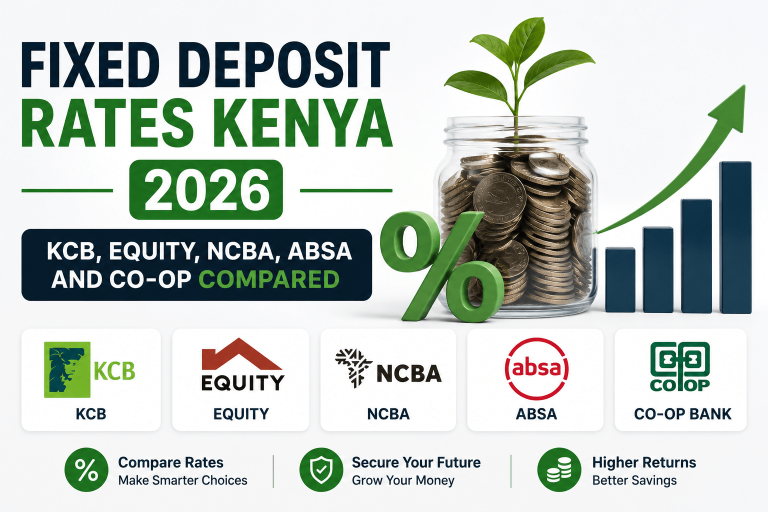
| Fixed deposit (NCBA) | 8.64% (best) | Locked for term | No (principal safe) | Yes (up to KES 500K) |
| Government bonds | ~14–15% | Illiquid | No (if held to maturity) | Implicit government backing |
The case for NSE investing in 2026: Total return — dividend yield plus capital appreciation — has historically beaten MMFs and fixed deposits over 5+ year periods for quality NSE stocks. An investor who bought Equity Group shares in January 2024 at approximately KES 50 and held through June 2026 at approximately KES 72 has earned approximately 44% in capital gains plus three years of dividends. No MMF comes close to that combined return.
The case against (or for patience): The NSE requires patience that many Kenyan investors underestimate. A KES 100,000 NSE investment can be worth KES 85,000 three months later — even in a generally rising market — due to short-term volatility. Anyone who needs that money within 12–18 months should not be in equities. For savings with a shorter horizon, a money market fund remains the right vehicle. See our best money market funds Kenya 2026 guide for the current yield comparison.
The honest verdict: The NSE makes sense for a 3–5 year investment horizon, for money you will not need in the short term, and for investors who can hold through temporary price declines without panic-selling. In that context, the 2026 NSE — despite recent highs — still offers reasonable value in the banking sector at 7.8x P/E versus history.
Two New NSE Listings in 2026 — What They Signal
Two significant new listings in early 2026 are worth noting for what they signal about NSE momentum and investor confidence.
Kenya Pipeline Company (KPC) — March 10, 2026 Kenya Pipeline Company made its debut on March 10, 2026, following what was described as Kenya’s largest IPO since Safaricom’s landmark listing in 2008. The offer was slightly oversubscribed, confirming strong investor appetite for new listings. KPC provides exposure to Kenya’s fuel logistics infrastructure — a different risk profile from the banking-heavy NSE.
ALP Industrial Real Estate Investment Trust (ALP REIT) — March 11, 2026 The ALP Industrial REIT debuted the following day, following an offer oversubscribed by 115%. REITs offer income investors exposure to commercial real estate yields — typically more stable than equity dividends and uncorrelated with banking sector performance. The 115% oversubscription rate signals that Kenya’s investor base is hungry for yield-generating alternatives to banking stocks.
Both listings expand the NSE’s sectoral diversity beyond the banking and telecoms concentration that has dominated the exchange — and give investors more tools to build a diversified Kenyan equity portfolio.
How to Start Investing in the NSE in 2026 — Practical Steps
NSE performance in 2026 rewards investors who are already in the market. For those who are not yet invested, here is how to start.
Step 1: Open a CDS account A Central Depository and Settlement Corporation account is how you hold NSE shares in your name. Open one through a licensed stockbroker — the process takes 5–10 business days and requires your National ID and KRA PIN. Faster routes: the Mali App and Hisa App allow you to open a CDS account and place your first order entirely via smartphone, with the process taking a few days.
Step 2: Link a current Kenyan bank account to your CDS Dividend payments go directly to the bank account registered on your CDS record. Use an active account you check regularly. This is critical — outdated bank details are the single most common reason dividend payments fail to arrive.
Step 3: Start with a proven core holding For most first-time NSE investors in 2026, KCB, Equity Group, or COOP Bank represent the most logical entry points — well-researched, highly liquid, with strong dividend histories and reasonable valuations. See our KCB dividend 2026 guide and Equity dividend 2026 guide for the detailed breakdowns.
Step 4: Check book closure dates before every buy decision The NSE dividend calendar determines when you need to be invested to qualify for income. The Safaricom final dividend book closure on August 4, 2026 is the last major opportunity of the year. KCB’s H1 FY2026 interim book closure is expected in August/September 2026. For the full forward calendar, see our NSE book closure dates 2026 complete guide.
Step 5: While building toward your NSE position, park savings in an MMF If you are accumulating cash toward an NSE investment but are not yet ready to buy, a money market fund earning 9.4% keeps your money working while you research. Withdraw from the MMF within 1–3 days when you are ready to move into equities. See our best money market funds Kenya 2026 guide and fixed deposit rates Kenya 2026 comparison for where to park funds at the best rates.
Frequently Asked Questions
What is the NSE performance in 2026? NSE performance in 2026 has been exceptionally strong. The Nairobi All Share Index (NASI) reached a new all-time high of 209 points by June 2026, up from the previous high of 202 in February. The NSE 20 Share Index reached 3,558 points by early April — 68% higher than a year prior. The rally has been driven primarily by record banking sector profits, CBK rate cuts, shilling stability, and record dividend payouts by major listed companies.
Is the Nairobi Stock Exchange a good investment in 2026? For long-term investors (3–5 year horizon), the NSE offers attractive opportunities in 2026 — particularly in the banking sector where dividend yields of 8–11% are backed by genuine profit growth and conservative payout ratios. The P/E of 7.8x is below historical averages, suggesting the market is not overvalued relative to its own history. For short-term investors or anyone who may need funds within 12–18 months, money market funds at 9.4% yield are lower-risk. NSE investing requires tolerance for short-term price volatility.
What are the best NSE stocks to invest in for dividends in 2026? Based on the combination of yield, payout sustainability, and profit growth, the strongest NSE dividend stocks in 2026 are: Equity Group (8% yield, 29% payout, 55% profit growth), KCB Group (10.3% yield, 33% payout, record FY2025 dividends), COOP Bank (7.9% yield, 49% payout, 16.9% profit growth), and Stanbic Holdings (11.3% yield, 64% payout, stable earnings). Safaricom’s August 4 book closure remains the one open opportunity for new investors in 2026.
How does NSE investing compare to money market funds in Kenya 2026? Money market funds offer approximately 9.4% average yield with full liquidity and no capital loss risk. NSE dividend stocks offer 5–11% yield plus potential capital gains — making total return potentially higher over a 5-year horizon. NSE is better for long-term wealth building; MMFs are better for shorter-term savings and emergency funds. Both serve different purposes in a well-constructed personal finance strategy.
What is the NSE All Share Index (NASI) today? The NASI currently stands at approximately 209 points as of June 11, 2026 — above the previous all-time high of 202 reached in February 2026. This represents continued upward momentum from the broad rally that began in mid-2025, driven by banking sector re-rating and record corporate earnings. Verify the current level at nse.co.ke or mystocks.co.ke for real-time data.
The Bottom Line
NSE performance in 2026 tells a clear story: Kenya’s stock market is at all-time highs, driven by record corporate earnings, generous dividends, and investor rotation toward equities in a lower-interest-rate environment. The NASI at 209 points is not cheap by historical standards — but it is not expensive either, at 7.8x P/E with dividend yields of 8–11% still available from quality banking stocks with conservative payout ratios.
The Safaricom August 4 book closure is the last significant dividend opportunity of 2026 for new investors. The KCB H1 FY2026 interim cycle, expected August/September 2026, is the next wave for existing holders.
For investors who are ready: open a CDS account, start with a quality banking stock, check the book closure dates, and invest with a 3–5 year horizon. For investors who are not ready yet: a money market fund at 9.4% keeps your money working while you do the research.
The NSE in 2026 rewards the patient and the prepared — not the reactive.
NASI level of 209.04 sourced from myStocks (June 11, 2026). NSE 20 Share Index data from Trading Economics (April 2026). Market capitalisation KES 3.5 trillion from NSE trading summary (June 11, 2026). NSE 20 year-on-year gain of 67.89% from Trading Economics. KPC and ALP REIT listing details from African Markets database. All dividend and earnings data from individual company FY2025 annual results. This article is for educational and informational purposes only and does not constitute investment or financial advice. Last updated: June 13, 2026.