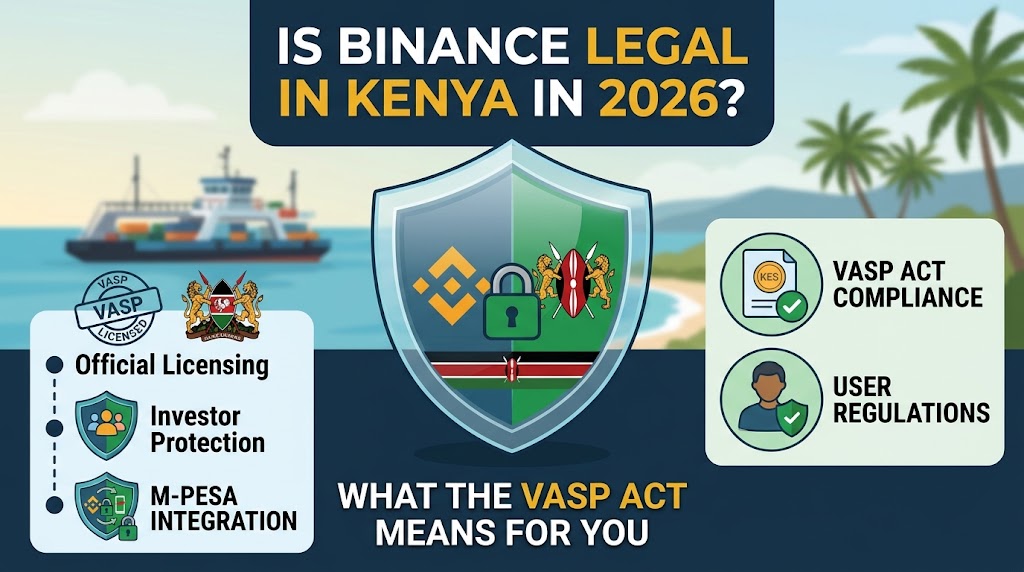
Is Binance Legal in Kenya in 2026? What the VASP Act Means for You
Is Binance legal in Kenya in 2026? The short answer is that Kenya has not banned crypto. It now regulates it, and the question is whether each platform is licensed.
The picture changed in 2025 and 2026. This guide explains what the law says, where Binance stands according to the sources I found, and what users should do.
Quick answer
- Kenya regulates crypto under the Virtual Asset Service Providers (VASP) Act, 2025.
- Platforms must be licensed. Binance has said it intends to apply for a Kenyan licence.
- I could not confirm that Binance holds a licence. Check the regulators’ lists before you rely on any platform.
What the VASP Act Does
The Virtual Asset Service Providers Act, 2025 licenses and regulates crypto exchanges, wallet providers, brokers and payment processors, and puts them under the CBK and the CMA. It came into effect on 4 November 2025.
The two regulators split the work. The CBK supervises virtual asset-to-fiat conversion services and stablecoin issuers, while the CMA regulates exchanges, token issuance platforms and tokenisation.
P2P services are also in scope. The framework covers exchanges, wallet custodians, stablecoin issuers, peer-to-peer desks and other intermediaries operating in or from Kenya.
Timeline
| Date | What happened |
|---|---|
| October 2025 | VASP Act signed and gazetted |
| 4 November 2025 | Act takes effect |
| 18 November 2025 | The CBK and CMA said no VASP had been licensed yet and that licensing would start once regulations were issued. |
| July 2026 | The VASP Regulations, 2026 were gazetted, so firms can begin the licence application process. |
| August 2026 | Binance, Luno, Yellow Card, VALR and Kotani Pay were reported to be preparing licence applications. |
| 4 November 2026 | A compliance deadline for existing providers, according to one legal commentary. Confirm this with the regulators. Kenya: CBK – Licensing of Crypto Service Providers to Begin After New Regulations Are Issued +3 |
Where Does Binance Stand?
Based on the sources I found, Binance has said it plans to apply. It took part in the public consultation and said it intends to apply for a Kenyan licence. I did not find confirmation that a licence has been granted.
Foreign platforms are covered. The rules apply to anyone providing virtual asset services “in or from Kenya”, including foreign platforms that target Kenyan consumers.
Regulators are also active. Kenya has frozen Binance user accounts as part of a money laundering investigation.
What This Means for Users
Using a platform before it is licensed is not the same as breaking the law yourself, but it carries risk. Rules can change, and an unlicensed platform may be restricted. What happens after the deadline depends on how the regulators enforce the law.
What to Do
- Check the licence. Look up the platform on the CMA’s licensee portal at licensees.cma.or.ke and check CBK notices.
- Don’t keep more than you can afford to lose on any platform.
- Keep records of deposits, trades and withdrawals.
- Have an exit plan. Know how you would withdraw if access changed.
- Be careful with P2P. Read our guide to Binance P2P scams in Kenya.
- Check tax rules on the KRA website, because crypto tax rules have changed.
Frequently Asked Questions
Is Binance legal in Kenya?
Kenya has not banned crypto. It regulates it, and platforms need a licence. I could not confirm that Binance has one.
Has Binance been banned in Kenya?
I found no sign of a ban. I did find reports of account freezes in an investigation.
Is Binance P2P legal?
P2P services are covered by the regulatory framework. Check current rules.
Who regulates crypto in Kenya?
The CBK and the CMA, under the VASP Act.
How do I check if a crypto platform is licensed?
Use the CMA’s licensee portal and CBK announcements.
Crypto rules change quickly. Check current notices from the CBK and CMA. This article is for information only and is not legal, tax or financial advice.