
The 50/30/20 Budget Rule in Kenya 2026: Does It Actually Work on a Kenyan Salary?
The 50/30/20 budget rule is one of the most popular personal finance frameworks in the world. Financial influencers love it. International personal finance books swear by it. But does the 50/30/20 rule actually work on a Kenyan salary in 2026 — or is it advice designed for people earning in dollars and pounds?
This guide gives you an honest answer, shows you the maths on real Kenyan salaries, and tells you how to adapt the rule if the original version doesn’t fit your life.
What Is the 50/30/20 Rule?
The 50/30/20 rule was popularised by US Senator Elizabeth Warren in her book All Your Worth. The idea is simple:
- 50% of your net income → Needs (rent, food, transport, utilities, insurance)
- 30% of your net income → Wants (entertainment, eating out, subscriptions, holidays)
- 20% of your net income → Savings and debt repayment
The appeal is its simplicity. No complicated spreadsheets. No tracking every shilling. Just three buckets.
But here is the problem: it was designed for American middle-class incomes in a country where housing costs around 25–30% of income and food is relatively cheap. Kenya is a very different environment.
The 50/30/20 Rule Applied to Kenyan Salaries: The Honest Maths
Let’s run the numbers on three real Kenyan salary levels.
Scenario 1: KES 40,000 Gross (Net ≈ KES 33,000)
This is close to the median formal sector salary in Kenya.
| Category | 50/30/20 Allocation | Reality |
|---|---|---|
| Needs (50%) | KES 16,500 | Rent alone in Nairobi: KES 12,000–18,000 |
| Wants (30%) | KES 9,900 | Almost nothing left after needs |
| Savings (20%) | KES 6,600 | Impossible if rent exceeds allocation |
Verdict: The 50/30/20 rule completely breaks at KES 40,000 in Nairobi. Rent alone consumes 36–54% of net income before food, transport, or anything else. The 30% “wants” bucket is a fantasy. The 20% savings target is unreachable for most people at this income level in an expensive city.
What actually works at this level: A 70/20/10 split — 70% needs, 20% needs overflow and debt, 10% savings. Survival first, savings when possible.
Scenario 2: KES 80,000 Gross (Net ≈ KES 63,000)
This is solidly lower-middle-class in Nairobi.
| Category | 50/30/20 Allocation | Reality |
|---|---|---|
| Needs (50%) | KES 31,500 | Tight but workable outside Nairobi CBD |
| Wants (30%) | KES 18,900 | Reasonable — covers modest lifestyle |
| Savings (20%) | KES 12,600 | Achievable with discipline |
Verdict: The rule starts to become workable at KES 80,000 net, but only if you live outside the most expensive Nairobi neighbourhoods. In Ngong, Ruaka, Rongai, or Kitengela, rent of KES 18,000–22,000 keeps you within the needs allocation. In Westlands or Kilimani, it falls apart again.
Adjustment needed: Many Kenyans at this level need a 60/20/20 split — 60% needs, 20% wants, 20% savings — especially in the first few years of building a financial foundation.
Scenario 3: KES 150,000 Gross (Net ≈ KES 110,000)
Upper middle class by Kenyan standards.
| Category | 50/30/20 Allocation | Reality |
|---|---|---|
| Needs (50%) | KES 55,000 | Comfortable — rent, food, transport, insurance covered |
| Wants (30%) | KES 33,000 | Good lifestyle — dining out, travel, entertainment |
| Savings (20%) | KES 22,000 | Strong — KES 264,000/year in savings |
Verdict: The 50/30/20 rule works well at KES 150,000+ in Kenya. The proportions align with what a Nairobi middle-class household can realistically achieve. At this income, the challenge shifts from survival to discipline — the wants bucket can easily creep into savings territory.
The Core Problem With 50/30/20 in Kenya
The rule assumes your needs consume roughly half your income. In Kenya, housing alone often consumes 30–45% of income for low-to-middle earners — before food, transport, or utilities are added.
A quick reality check on Nairobi rent:
| Neighbourhood | 1BR Monthly Rent |
|---|---|
| Mathare, Korogocho | KES 5,000 – 10,000 |
| Kahawa, Githurai | KES 8,000 – 15,000 |
| Ruaka, Rongai | KES 15,000 – 25,000 |
| South B, South C | KES 20,000 – 35,000 |
| Kilimani, Westlands | KES 35,000 – 70,000 |
| Lavington, Runda | KES 60,000 – 150,000+ |
If you earn KES 60,000 net and live in South B, rent alone is 33–58% of income — and that’s before food (KES 8,000–12,000), transport (KES 4,000–8,000), and utilities (KES 2,000–4,000). You are already at 80–90% of income on pure needs.
The Kenyan Adaptation: The 60/20/20 Rule
Given the realities of Kenyan housing costs and cost of living, a more realistic framework for most Kenyan earners — especially those earning KES 40,000–100,000 — is:
60% → Needs Rent, food, transport, utilities, insurance, loan repayments, school fees.
20% → Wants Eating out, entertainment, clothing, subscriptions, social events.
20% → Savings and investments Emergency fund, money market fund, SACCO contributions, NSE investments, pension.
This acknowledges the reality that housing and basic living costs in Kenya consume more than 50% of income for most earners, while still protecting a meaningful savings rate.
The Most Important Number: Your Savings Rate
Whether you use 50/30/20, 60/20/20, or any other framework, the number that actually determines your financial future is your savings rate — the percentage of income you save and invest consistently.
Here is what different savings rates mean over 10 years, assuming 12% annual returns (achievable through money market funds, T-Bills, and NSE dividend stocks in Kenya):
| Monthly Savings | Annual Amount | Value After 10 Years (12% return) |
|---|---|---|
| KES 5,000 | KES 60,000 | ~KES 1.17 million |
| KES 10,000 | KES 120,000 | ~KES 2.35 million |
| KES 20,000 | KES 240,000 | ~KES 4.69 million |
| KES 30,000 | KES 360,000 | ~KES 7.04 million |
The vehicle matters less than the habit. KES 5,000/month saved consistently beats KES 20,000 saved irregularly every time.
How to Actually Implement a Budget in Kenya
Knowing the right percentages means nothing without a system. Here is a practical implementation:
Step 1: Know your exact net income Calculate what actually lands in your bank account after PAYE, SHA, NSSF, and Housing Levy. This is your baseline, not your gross salary.
Step 2: List your fixed needs first Rent, loan repayments, insurance, school fees — amounts that don’t change month to month. Add these up. This is your fixed needs floor.
Step 3: Estimate variable needs Food, transport, utilities — these vary but have a realistic range. Be honest, not optimistic.
Step 4: What’s left is for wants and savings After fixed and variable needs, whatever remains is split between wants and savings. If there is nothing left, you have a housing or income problem — not a budgeting problem.
Step 5: Automate your savings Set up a standing order to your money market fund or SACCO on the same day your salary arrives. Pay yourself first. What you don’t see, you don’t spend.
Budgeting Tools That Work for Kenyans
M-Pesa statement: Download your monthly M-Pesa statement from the Safaricom app. It is the most honest record of your spending because most Kenyan transactions flow through M-Pesa.
Simple notebook or spreadsheet: Old fashioned but effective. Write every expense for one month. Most Kenyans are shocked by what they find.
Wallet app: Apps like Wallet by BudgetBakers or Money Manager work offline and allow you to categorise spending easily.
YNAB (You Need A Budget): A more sophisticated tool for those serious about budgeting. Has a monthly subscription but many users find it pays for itself quickly.
The Wants vs Needs Debate in a Kenyan Context
One area where 50/30/20 requires cultural adaptation is in what counts as a “need” in Kenya.
Harambee contributions: In Kenya, family and community financial obligations are real. Attending a fundraiser, contributing to a funeral, or supporting a sibling’s school fees are not optional in the way Western personal finance assumes. Budget for these explicitly — treat them as a needs or separate community obligation category.
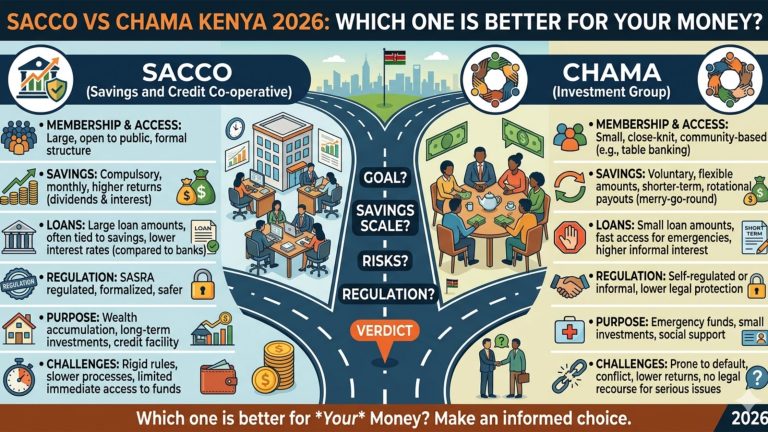
Chama contributions: Many Kenyans participate in investment chamas. Depending on how the chama invests, this can count fully toward your savings bucket.
Upcountry fare: For Kenyans who travel upcountry regularly for family obligations, this transport cost is closer to a need than a want.
Adapt the framework to your actual life, not an idealised version of it.
Frequently Asked Questions
What if 50% isn’t enough for my needs? You have two options: increase income or reduce needs. Reducing needs usually means housing — moving somewhere cheaper. Increasing income means a raise, side income, or career move. The percentages are a target, not a magic formula.
Should I include SHA and NSSF in my needs bucket? These are deducted before you receive your net salary, so they don’t need to appear in your budget — they’re already gone. If you make voluntary contributions beyond what is deducted, include those in savings.
Is a chama contribution savings or wants? If the chama invests in assets (shares, land, money market funds), it’s savings. If it’s a merry-go-round that you spend when you receive your payout, it’s closer to forced saving with consumption. Either way, budget for it explicitly.
How much should I save before investing? Build 3 months of expenses as an emergency fund first — kept liquid in a money market fund. Then begin investing. Don’t invest money you might need in an emergency.
The Bottom Line
The 50/30/20 rule works in Kenya — but only for those earning above roughly KES 100,000 net per month, living outside the most expensive Nairobi areas, or both.
For most Kenyans earning KES 40,000–80,000 net, the more honest framework is 60/20/20 — acknowledge that needs consume more than half your income, protect a 20% savings rate, and live modestly on the remaining 20% for wants.
The framework matters far less than the habit. Pick a system, implement it, automate your savings, and review it every three months. Financial discipline built on a realistic Kenyan budget will serve you far better than perfect adherence to a rule designed for a different economy.
Start where you are. Save what you can. Increase it when you can.
This article is for informational and educational purposes only and does not constitute financial advice. Individual circumstances vary. For personalised financial planning, consult a certified financial planner registered with the Kenya Institute of Bankers or a CMA-licensed investment adviser.