Money Market Funds and Savings Products: Which Fits Your Goal in Kenya
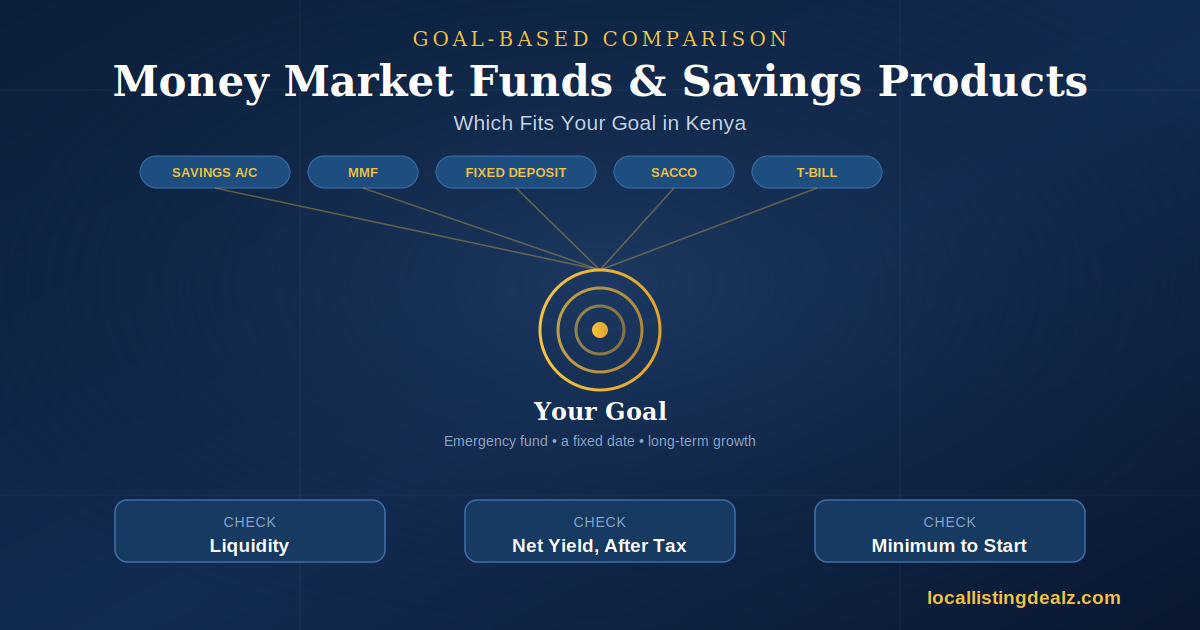
Money market funds and savings products in Kenya aren’t competing for the same job. A money market fund, a fixed deposit, a regular savings account, a SACCO, and a Treasury bill all hold your money safely, but they do it on very different terms: how fast you can get it back, how much it actually earns after tax, and how much you need to start.
Most comparisons online look at one product at a time. This one starts from the other direction: what are you actually saving for, and which vehicle fits that goal. Along the way, we’ll correct a tax claim that’s wrong on several Kenyan finance sites.
The Five Savings Vehicles, Compared Honestly
| Vehicle | Typical net yield | Liquidity | Minimum to start | Tax treatment |
|---|---|---|---|---|
| Regular bank savings account | ~3% (industry average ~3.53% gross) | Instant | Usually none | 15% WHT on interest |
| Money market fund (MMF) | ~7.7% net (from ~9.1% gross) | A few working days | KES 100-1,000 | 15% WHT on interest |
| Fixed deposit account | ~6-7.5% net (from ~7-9% gross) | Locked for term, penalty if early | Often KES 10,000+ | 15% WHT on interest |
| SACCO deposits/shares | Variable, dividend-based (~8-15% historically, not guaranteed) | Often restricted, tied to membership | Varies by SACCO | Dividend tax rules apply |
| Treasury bill (91/182/364-day) | ~7.4-7.5% net (from ~8.76-8.87% gross) | Locked for the full term | KES 100,000 typical minimum | 15% WHT on interest, same as MMFs |
Rates move regularly. For current MMF figures specifically, see our Best Money Market Funds in Kenya 2026 guide.
The T-Bill Tax Myth You’ve Probably Seen
Here’s something worth correcting directly: several Kenyan finance sites claim Treasury bills are tax-exempt for individual investors. They aren’t. The Central Bank of Kenya’s own published FAQ, and multiple independent tax guides, confirm T-bill discount income carries the same 15% withholding tax as money market funds and fixed deposits, deducted automatically before you receive your return.
The confusion likely comes from genuinely tax-exempt products, specifically long-term infrastructure bonds, being lumped in with T-bills because they’re both government securities. They’re not the same thing. If a site tells you T-bills beat MMFs because they’re untaxed, that claim doesn’t hold up against CBK’s own documentation.
What IS true: T-bills and MMFs currently sit close enough in gross yield that, after the same 15% tax applies to both, the real difference often comes down to liquidity and minimum investment, not a tax advantage either way.
Which One Fits Your Goal?
Emergency fund (money you might need tomorrow)
A money market fund, or a regular savings account if you want zero friction. You need same-week access, and an MMF’s few-day withdrawal window is about as close to instant as you get while still earning meaningfully more than a bank account sitting idle.
A goal 3-12 months out (school fees, a planned purchase)
A money market fund is usually still the best fit. The yield beats a regular savings account by a wide margin, and the liquidity means you’re not penalised if your timeline shifts.
A goal with a fixed, known date (12+ months, no chance you’ll need it early)
A fixed deposit or a Treasury bill, if the rate at the time is genuinely better than an MMF’s net yield, and you’re confident you won’t need the money early. Both lock your funds, and breaking a fixed deposit early typically costs you in penalties or forfeited interest. Only commit money here you’re certain you won’t need.
Building toward a large lump-sum goal, and you’re also eligible for loans against your savings
A SACCO, specifically for the loan-leverage feature no other option here offers: your deposits can serve as collateral for a loan at favourable rates. The dividend isn’t guaranteed the way an MMF’s yield effectively is, so this fits best as part of a mix, not your only savings vehicle.
Maximum safety, minimum complexity, and you’re not chasing the top rate
A regular bank savings account, specifically if your balance is modest enough that a few percentage points of extra yield isn’t worth the extra steps of opening and managing a separate MMF or fixed deposit account.
What to Check Before You Commit Money Anywhere
- Is it regulated, and by whom? MMFs fall under the Capital Markets Authority (CMA). Bank products fall under the Central Bank of Kenya (CBK). SACCOs fall under the SACCO Societies Regulatory Authority (SASRA). Confirm the specific provider is properly licensed before investing meaningfully.
- Gross vs net. Every rate advertised to you is gross, before the 15% withholding tax that applies to most of these products. Always compare net figures, not headlines.
- What happens if you need the money early? This is the real differentiator between these five options, not the yield. A fixed deposit or T-bill broken early can cost you real money. An MMF generally doesn’t.
Frequently Asked Questions
Are Treasury bills tax-free in Kenya? No. This is a common misconception. T-bill discount income is subject to the same 15% withholding tax as money market funds and fixed deposits, for resident individual investors. Only specific long-term infrastructure bonds carry genuine tax-exempt status.
What’s the difference between a money market fund and a savings account? A regular savings account is a bank product regulated by CBK, instantly accessible, and typically pays a low rate (averaging around 3.5% currently). A money market fund is a CMA-regulated unit trust that pools investor money into short-term instruments, usually paying a meaningfully higher yield with only a few days’ wait for withdrawal.
Is a SACCO better than a money market fund? They serve different purposes. A SACCO’s dividend can be competitive but isn’t guaranteed, and access to your money is often more restricted. Its real advantage is using your deposits as loan collateral, something an MMF doesn’t offer.
Which is safer: a money market fund or a Treasury bill? A Treasury bill is backed directly by the Government of Kenya, making it about as safe as an investment gets. An MMF is CMA-regulated with an independent custodian holding the underlying assets, which is also considered low-risk, though not identical to a direct government guarantee.
Should I split my savings across more than one of these? Many people do, an MMF for accessible, short-term money, and a fixed deposit, T-bill, or SACCO for funds earmarked for a longer, fixed timeline. Matching the vehicle to the goal usually works better than picking one option for everything.
This article is for educational purposes only and does not constitute financial advice. Rates, tax rules, and product terms change, confirm current figures directly with CBK, CMA-licensed fund managers, or your SACCO before investing.