How to Invest KES 1,000 Per Month in Kenya 2026 (Step-by-Step for Beginners)
How to Invest KES 1,000 Per Month in Kenya 2026 (Step-by-Step for Beginners)
How to invest KES 1,000 per month in Kenya 2026 is the most common personal finance question from working Kenyans who want to start — and are told, constantly, that they do not have enough to begin. That advice is wrong. KES 1,000 per month is enough to start five different investment vehicles in Kenya today, some of which require even less.
Last updated: April 2026 | Reading time: 7 minutes
This guide is not about getting rich overnight. It is about what KES 1,000 per month actually becomes over time if you invest it consistently — and exactly how to do it, step by step, with specific platforms, minimums, and realistic return expectations.
Why KES 1,000 Per Month Is More Powerful Than It Feels
Before the options, the maths that most Kenyans have never seen laid out plainly.
KES 1,000 per month sounds small. Over 12 months that is KES 12,000. But invested consistently at Kenya’s current money market fund average of 9% annually, compounding monthly, here is what happens:
| Year | Total contributed | Value with 9% annual return |
|---|---|---|
| Year 1 | KES 12,000 | KES 12,560 |
| Year 3 | KES 36,000 | KES 40,700 |
| Year 5 | KES 60,000 | KES 75,400 |
| Year 10 | KES 120,000 | KES 193,000 |
You contributed KES 120,000 over ten years. You ended up with KES 193,000. The extra KES 73,000 was earned by your money — not by your labour. This is compound interest, and it is the only wealth-building mechanism available to ordinary people.
Now imagine you increase that to KES 2,000 or KES 3,000 per month as your income grows. The numbers multiply accordingly. The habit is what matters. Start with KES 1,000. Scale from there.
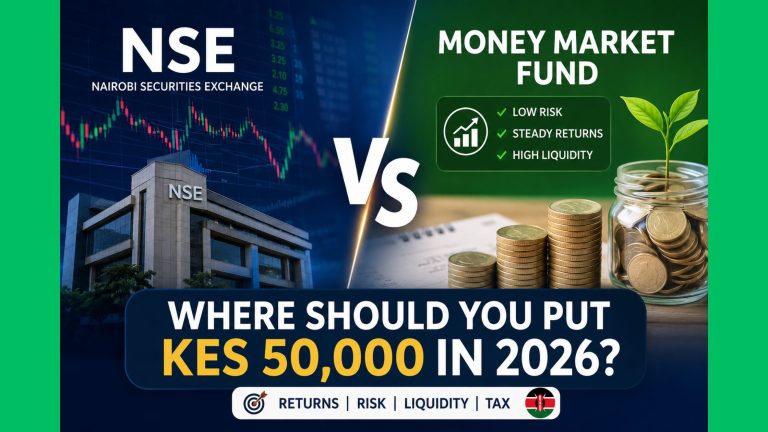
Option 1: Money Market Fund — The Best Starting Point
Minimum to start: KES 100 (Zimele/Old Mutual) or KES 500 (Ndovu, Cytonn) Monthly commitment: KES 1,000Expected return: 9%–11% gross annually (7.6%–9.3% net after 15% withholding tax) Liquidity: 1–4 business daysRisk: Very low
A money market fund is a CMA-regulated pool of investors’ money that earns daily interest by investing in government treasury bills and fixed bank deposits. You invest via M-Pesa, your money earns interest every single day including weekends, and you can withdraw within days if you need it.
This is the right starting point for most Kenyans because it has no lock-up period, no penalty for missing a month, and no paperwork. You can start and stop as your cash flow allows — but the right mindset is to treat it like a salary deduction and transfer it the moment your salary arrives.
How to start today:
Open the Zimele (Old Mutual), Cytonn, or Britam app on your phone. Register with your ID and KRA PIN. Deposit KES 1,000 via M-Pesa. Done — you are an investor. Set up a monthly standing order reminder on your phone for payday.
What KES 1,000/month looks like in a money market fund:
After 12 months at 9% return: approximately KES 12,560 After 3 years: approximately KES 40,700
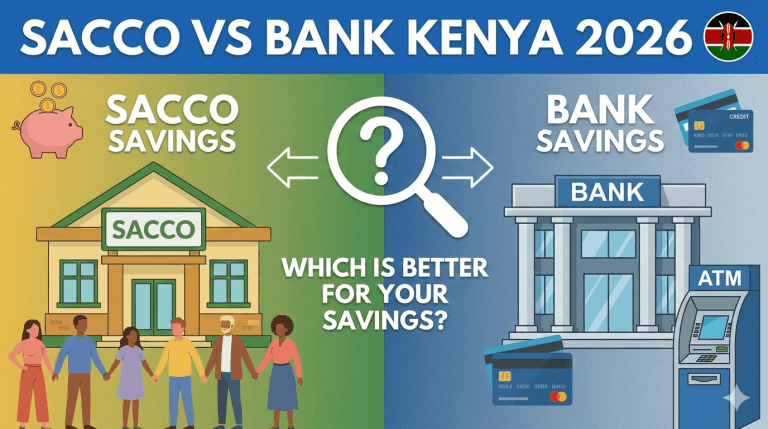
Option 2: SACCO Share Capital — Best for Future Loan Access
Minimum to join: KES 1,000–5,000 initial deposit depending on SACCO Monthly commitment: KES 1,000+Expected return: 8%–13% annual dividend Loan benefit: After 6 months, borrow up to 3X your savings at 1% per month Risk: Low (SASRA regulated)
Contributing KES 1,000 per month to a SACCO builds share capital that does two things simultaneously: it earns an annual dividend of 8%–13%, and it builds your borrowing capacity. After 12 months of KES 1,000/month contributions (KES 12,000 in shares), you qualify for a loan of up to KES 36,000 at 1% per month — the cheapest formal credit available to ordinary Kenyans.
For most people, the loan access is actually more valuable than the dividend. Using a SACCO loan to buy an asset — a plot, stock inventory, equipment for a side business — creates more wealth than the interest earned alone.
Best SACCOs for someone starting at KES 1,000/month:
Unaitas SACCO (KES 1,000 minimum, open membership, digital services) or Tower SACCO (KES 2,500 minimum, strong loan products). See our Best SACCOs Kenya 2026 guide for the full comparison.
Option 3: NSE Shares via Ziidi Trader — Best for Long-Term Growth
Minimum to start: No fixed minimum — buy what you can afford Monthly commitment: KES 1,000 Expected return: 8%–20%+ long-term (not guaranteed; market-dependent) Liquidity: T+3 days (3 business days to sell) Risk:Medium (prices fluctuate)
In 2025, Safaricom launched Ziidi Trader — an M-Pesa integrated platform that allows any Kenyan with a phone to buy and sell shares on the NSE directly. You do not need a broker, a CDS account set up in person, or large capital. You buy what you can afford, when you can afford it.
With KES 1,000 per month, you can accumulate shares in Kenyan blue-chip companies: Safaricom, Equity Bank, KCB, Co-operative Bank, EABL. These companies pay annual dividends and their share prices have historically appreciated over 5–10 year periods despite short-term volatility.
The key rule for a KES 1,000/month investor in shares: buy consistently every month regardless of whether prices are up or down. This is called rand-cost averaging and it is the single most effective strategy for small investors — you automatically buy more shares when prices are low and fewer when they are high.
What to avoid: Do not try to time the market or buy speculative stocks chasing quick gains. At KES 1,000/month, your strategy is consistency in quality companies over 5+ years.
How to start: Download the Ziidi app or access via M-Pesa, register with your ID and KRA PIN, link your M-Pesa, and place your first order. Processing takes minutes.
Option 4: Treasury Bills — Best When You Have KES 100,000 Saved
Minimum: KES 100,000 (the one barrier for small monthly investors) Return: 7.4%–8.5% — but zero withholding tax (equivalent to 8.7%–10% pre-tax) Lock-up: 91 days, 182 days, or 364 days Risk: Zero (government-backed)
T-Bills are not where you start with KES 1,000/month — the minimum is KES 100,000. But they are where you graduate to. Use your money market fund for the first 8–10 months, accumulating KES 8,000–10,000. Then combine with other savings to hit the T-Bill minimum, after which you can redirect your monthly contributions to top up.
The reason T-Bills deserve a place in this guide: they are currently exempt from withholding tax for individual investors, meaning a 7.4% T-Bill rate is equivalent to roughly 8.7% pre-tax on a taxable instrument like an MMF. For money you do not need for 3–12 months, T-Bills beat most MMFs on a net basis.
How to invest: Download the CBK DhowCSD app, open a free account with your ID and KRA PIN, and bid via M-Pesa Paybill 200222 on auction day (Wednesdays for 91-day and 182-day T-Bills).
Option 5: Chama Contributions — Best for Collective Investment Goals
Minimum: Whatever your group agrees (often KES 500–2,000/month) Monthly commitment: KES 1,000 Return:Depends entirely on what the chama invests in Risk: Medium — depends on group governance
If you are not already in a chama, this is the moment to either join one or start one. A group of ten people each putting in KES 1,000/month has KES 120,000 per year to invest collectively — enough to start building toward a plot purchase, a group NSE portfolio, or a money market fund account that earns interest while the group decides its next move.
The advantage of a chama over investing alone at KES 1,000/month is speed — you reach investment thresholds (like a T-Bill minimum or a land deposit) much faster as a group. The disadvantage is that you need trustworthy members and proper governance. See our SACCO vs Chama guide for the safety checklist.
The Smartest Allocation for KES 1,000/Month
You do not have to choose just one option. Here is how a beginner can split KES 1,000 intelligently across two vehicles:
If you are just starting out (Month 1–6): Put the full KES 1,000 into a money market fund. Build a buffer. Learn how your money earns daily interest. Get comfortable. Do not complicate things.
After 6 months (Month 7 onwards): Split: KES 600 to MMF (emergency fund building) + KES 400 to SACCO share capital (loan access building). As income grows, increase the SACCO contribution.
After 12–18 months: Add NSE shares via Ziidi Trader with whatever you can set aside beyond your MMF and SACCO contributions — even KES 500/month.
After 24 months: Reassess. By this point your MMF may have enough to bridge toward a T-Bill minimum. Your SACCO shares should qualify you for a meaningful loan. You have options you did not have two years earlier.
The One Rule That Matters More Than Which Option You Choose
Consistency beats product selection every time.
KES 1,000/month invested in an average MMF for 10 years outperforms KES 1,000 invested once in the best-performing NSE stock of the year. The person who invests every month without fail — even in boring, average-return products — builds more wealth than the person who waits for the perfect investment or invests in bursts and then stops.
The reason most Kenyans do not build wealth is not that they picked the wrong product. It is that they stopped. Life intervened. The money was needed. The habit was never strong enough to survive one bad month.
The solution is to make the investment automatic and invisible. Transfer KES 1,000 to your MMF or SACCO on the same day your salary arrives — before you pay rent, before you buy anything. Treat it like a bill you cannot skip. In ten years, you will not remember the sacrifice. You will only see the result.
Getting Started This Week — The 3-Step Action Plan
Step 1 (Today): Download the Zimele (Old Mutual), Cytonn, or Britam app and deposit your first KES 1,000. The account opens in minutes. This is your money market fund — your base.
Step 2 (This month): Visit the Unaitas or Tower SACCO website, download their membership form, and gather your ID, KRA PIN, and employer letter. Submit your application and pay your initial share capital.
Step 3 (Month 3): Download the Ziidi Trader app and buy your first KES 500 worth of Safaricom or Equity Bank shares. Not because KES 500 will make you rich — because starting the habit of owning businesses matters more than the amount.
The journey from KES 1,000/month to financial security is not dramatic. It is methodical, consistent, and available to anyone who starts today.
This article is for informational and educational purposes only. Investment returns quoted are historical and not guaranteed. All figures are approximate. Consult a licensed financial advisor for advice specific to your situation. Sources: Serrari Kenya MMF Index, CBK DhowCSD, SASRA Kenya, NSE Kenya, CMA Kenya.