SHA vs Private Health Insurance Kenya 2026: Honest Comparison (Which One Do You Actually Need?)
Most articles about health insurance in Kenya tell you to “get cover.” Few tell you the truth about what government cover actually gives you — and what it doesn’t.
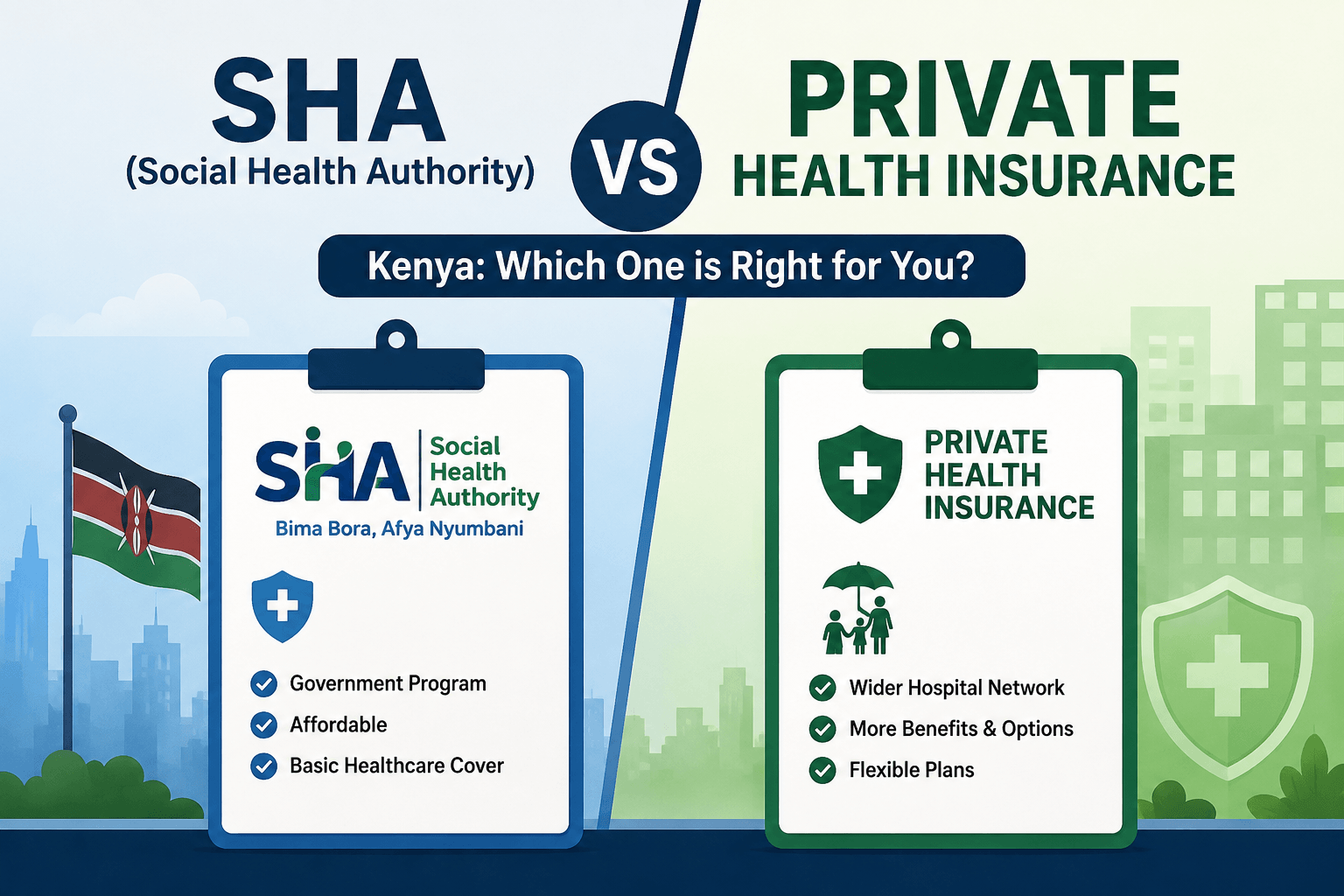
This is an honest comparison of SHA (the Social Health Authority, which replaced NHIF) versus private health insurance in Kenya in 2026. By the end, you’ll know exactly which one you need, whether you need both, and how to avoid paying for something that won’t help you when you’re actually sick.
First: What Happened to NHIF?
NHIF was officially dissolved and replaced by the Social Health Authority (SHA) in 2023 under the Social Health Insurance Act. SHA is now the mandatory government health scheme in Kenya.
SHA operates through three funds:
- Primary Healthcare Fund — covers basic outpatient care at community health centres
- Social Health Insurance Fund (SHIF) — covers hospitalisation and specialist care at contracted facilities
- Emergency, Chronic & Critical Illness Fund — covers cancer, dialysis, and other high-cost conditions
If you’re formally employed, your employer deducts 2.75% of your gross salary every month for SHA. If you earn KES 50,000, that’s KES 1,375/month.
SHA in 2026: What It Actually Covers
SHA has improved considerably from the old NHIF model, but it still has significant limitations most Kenyans only discover when they’re sick.
What SHA covers well:
- Inpatient care at public hospitals (KNH, Kenyatta, county referral hospitals)
- Maternity care at contracted facilities
- Cancer treatment at public oncology centres
- Dialysis at contracted facilities
- Some specialist consultations at public hospitals
What SHA covers poorly or not at all:
- Most private hospitals (Aga Khan, Nairobi Hospital, MP Shah, Gertrude’s are partially contracted but with limits)
- Outpatient consultations at private clinics
- Dental and optical care
- Private ward upgrades
- Most specialist procedures outside the approved list
- Prescription drugs beyond the Essential Medicines List
The real-world problem: Getting SHA approval for private hospital treatment is slow. Pre-authorisation requests can take days. If you’re in an emergency and taken to a private hospital, SHA may not cover you at all.
Private Health Insurance in Kenya 2026: What It Covers
Private health insurance from insurers like AAR, Jubilee, Britam, CIC, and others works differently. You pay a monthly or annual premium, and in return get access to a network of private hospitals with faster, more predictable coverage.
What private insurance typically covers:
- Inpatient care at private hospitals
- Outpatient consultations, lab tests, prescriptions
- Maternity (after waiting period)
- Dental and optical (at mid-to-high tiers)
- Faster pre-authorisation — often within hours
- Private ward options
The limitations of private insurance:
- Premiums increase as you age
- Pre-existing conditions are typically excluded for 1–2 years
- Annual limits can be exhausted for serious illness
- Some plans have co-payments (you pay a portion of every bill)
SHA vs Private Insurance: Direct Comparison
| Factor | SHA | Private Insurance |
|---|---|---|
| Monthly cost | 2.75% of salary (employed) or KES 500 (voluntary) | KES 500–5,000+ |
| Hospital access | Mainly public hospitals | Private hospitals |
| Outpatient cover | Basic primary care only | Yes (mid-tier plans) |
| Speed of approval | Slow (days) | Fast (hours) |
| Maternity | Yes | Yes (after waiting period) |
| Dental & optical | No | Yes (higher tier plans) |
| Cancer treatment | Yes (public facilities) | Depends on plan |
| Pre-existing conditions | Covered | Excluded for 1–2 years |
| Private ward | No | Yes |
The Real Question: Do You Need Both?
For most Kenyans in formal employment, the answer is yes — and here’s why.
SHA gives you a foundation. It covers serious emergencies at public hospitals, cancer treatment, and maternity at contracted facilities. You can’t opt out of it if you’re employed, so you’re already paying for it.
But SHA alone leaves serious gaps. If you want to see a doctor at a private clinic, get a specialist opinion without a public hospital referral, or be admitted to a private hospital, SHA won’t reliably cover you.
Private insurance fills those gaps. The right strategy is to treat SHA as your emergency/catastrophic cover and private insurance as your day-to-day healthcare access.
If you’re self-employed or in the informal sector: You can contribute voluntarily to SHA at KES 500/month. Do this first — it gives you access to the Emergency and Critical Illness Fund, which covers things like cancer and dialysis regardless of plan tier. Then add a private plan on top if you can afford it.
Who Should Rely on SHA Only?
SHA alone makes sense if:
- You live near a well-functioning public hospital
- You’re comfortable using public health facilities
- Your income is very tight and KES 1,500+ for private insurance is genuinely unaffordable
- You’re young and healthy with low healthcare utilisation
The risk: one serious illness or surgery at a private hospital could cost you KES 100,000–500,000 out of pocket if SHA doesn’t cover that facility.
Who Should Get Private Insurance on Top of SHA?
You should add private insurance if:
- You prefer private hospitals or clinics for your primary care
- You have children who need frequent outpatient visits
- You’re planning a pregnancy in the next 2 years (start cover now to clear the waiting period)
- You have a chronic condition that needs regular specialist monitoring
- Your employer doesn’t provide group medical cover
The Cheapest Way to Have Both
If you’re employed: SHA is automatic. Add a private plan from KES 1,500/month (CIC Afya Bora or Jubilee Linda Jamii) and you have genuine dual cover for under KES 3,000/month total.
If you’re self-employed: Pay KES 500/month to SHA voluntarily, then add Linda Jamii at KES 500/month. You have basic cover for KES 1,000/month total — less than most Kenyans spend on airtime.
Common Mistakes to Avoid
Buying outpatient-only cover and skipping inpatient. Outpatient visits cost hundreds of shillings. Hospitalisation costs hundreds of thousands. Always prioritise inpatient cover first.
Not checking your hospital is on the network. Before buying any plan, go to the insurer’s website and search for hospitals near your home and workplace. A plan that doesn’t cover a hospital you can actually reach is useless.
Waiting until you’re sick to buy cover. Pre-existing conditions are excluded. If you’re diagnosed with diabetes and then try to buy insurance, that condition won’t be covered for at least a year. Buy when you’re healthy.
Assuming your employer’s group cover is enough. Group medical schemes often have low limits and stop when you leave the job. Have your own individual plan as a backup.
The Bottom Line
SHA is not enough on its own for most Kenyans who want reliable healthcare access. It’s a foundation, not a complete solution.
Private health insurance fills the gaps SHA leaves — faster access, private hospitals, outpatient care, and more predictable cover. The two work best together.
If you can only afford one thing: pay your SHA contributions, even voluntarily. If you can afford KES 1,500–5,000 more per month: add private cover. The peace of mind is worth more than almost anything else you can spend that money on.
This article is for informational purposes only. SHA rates and benefits are subject to government policy changes. Always verify current benefits at sha.go.ke. Private insurance terms vary by insurer — read your policy document carefully before purchasing.