Tax on Investments in Kenya: How to Protect Your MMF and Bond Returns
Tax on Investments in Kenya: Imagine logging into your Money Market Fund (MMF) app or reviewing your Central Bank of Kenya (CBK) statement at the end of the year. The headline rate you signed up for was a juicy 14% per annum. You invested KES 100,000, so in your head, you’ve already budgeted for KES 14,000 in interest gains.
When the actual payout hits your account, however, you only see KES 11,900.
Where did the missing KES 2,100 go?
It went straight to the Kenya Revenue Authority (KRA).
Most retail investors in Kenya make the mistake of evaluating investments based solely on Gross Yield (the headline rate before taxes) rather than Net Yield (what actually lands in your pocket). Without realizing it, tax friction can quietly erode up to 15% of your annual gains before you ever touch them.
Key Takeaway: Tax optimization isn’t tax evasion. Tax evasion is illegal; tax optimization is the strategic, legal choice to use government-sanctioned tax incentives to keep more of your money working for you.
Here is a breakdown of how investment taxes work in Kenya and how you can structure your portfolio to protect your wealth.
The 15% Friction: How Fixed Income Is Taxed in Kenya
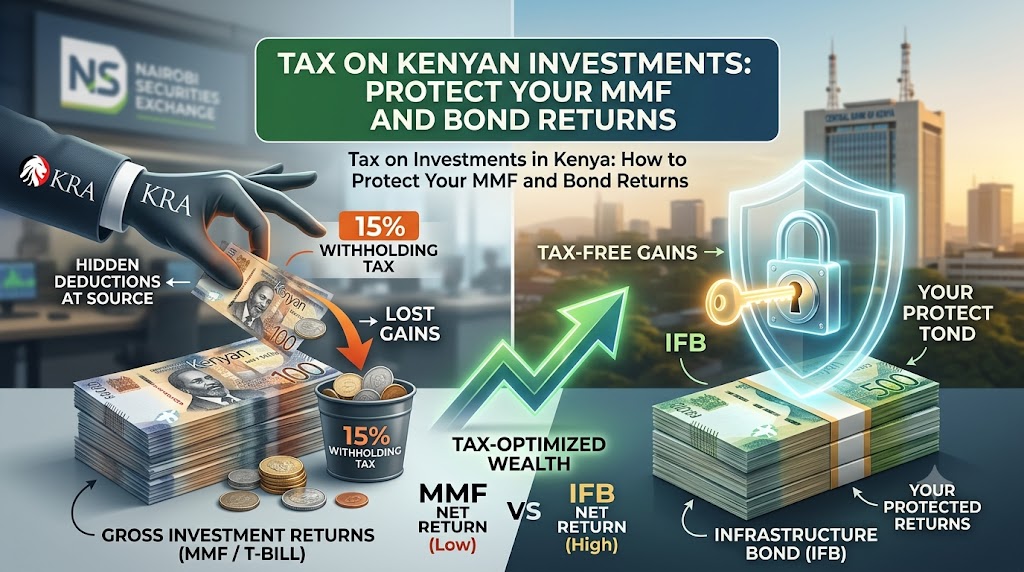
When you earn interest from traditional fixed-income instruments in Kenya, KRA collects a Withholding Tax (WHT). This tax is deducted “at source,” meaning the institution—whether a fund manager or the CBK—remits the tax directly to KRA before sending you your net earnings.
Standard Fixed-Income Tax Rates
- Money Market Funds (MMFs): Interest distributions are subject to a 15% Withholding Tax.
- Treasury Bills (91, 182, 364-day): The discount/interest earned upon maturity is subject to 15% Withholding Tax.
- Standard Treasury Bonds: Bonds with a maturity of under 10 years are taxed at 15% WHT, while bonds with a tenor of 10 years or longer enjoy a lower rate of 10% WHT.
The Math in Action: The KES 100,000 Scenario
Suppose you invest KES 100,000 in a 364-day T-Bill or an MMF yielding a 14% gross return:
Gross Interest = KES 100,000 X 14% = KES 14,000
KRA Withholding Tax (15%) = KES 14,000 X 15% = KES 2,100
Net Earnings = KES 14,000 – KES 2,100 = KES 11,900
Your actual net return isn’t 14%—it is 11.9%.
Net Yield = Gross Yield X (1 – WHT)
Net Yield = 14% X (1 – 0.15) = 11.9%
Over a single year, KES 2,100 might feel like a minor annoyance. But over 5 to 10 years, losing 15% of your compounding gains every year drastically reduces your ultimate portfolio size.
Kenya Investment Tax Calculator
Calculate your true net returns after KRA Withholding Tax (WHT).
Gross Interest
KES 0
KRA Tax Paid (WHT)
– KES 0
Net Return
KES 0
Effective Annualized Net Yield
0.00%
Total Net Payout (Principal + Net Profit)
KES 0
The Holy Grail of Tax-Free Yields: Infrastructure Bonds (IFBs)
If you want to eliminate tax friction entirely from your fixed-income portfolio, you need to understand Infrastructure Bonds (IFBs).
What Makes IFBs Special?
Infrastructure Bonds are issued by the Central Bank of Kenya specifically to raise capital for public infrastructure projects like roads, energy, and water system development. To encourage public participation and lower the government’s cost of borrowing, the Income Tax Act explicitly grants IFBs a 0% Withholding Tax status.
Every single shilling of coupon interest paid on an IFB goes straight into your bank account—100% tax-free.
Head-to-Head: The KES 500,000 Test
Let’s compare two options over a 1-year period: a standard 14% gross MMF/T-Bill versus a 14% Infrastructure Bond on an investment of KES 500,000.
┌────────────────────────────────────────────────────────────────────────┐
│                   THE KES 500,000 TAX COMPARISON                       │
├───────────────────────────────────┬────────────────────────────────────┤
│ Standard 14% MMF / T-Bill         │ 14% Infrastructure Bond (IFB)      │
├───────────────────────────────────┼────────────────────────────────────┤
│ Gross Interest: KES 70,000        │ Gross Interest: KES 70,000         │
│ Less 15% WHT:  -KES 10,500        │ Less 0% WHT:      KES 0            │
├───────────────────────────────────┼────────────────────────────────────┤
│ Net Payout:    KES 59,500         │ Net Payout:    KES 70,000          │
└───────────────────────────────────┴────────────────────────────────────┘
By shifting KES 500,000 into an Infrastructure Bond at the exact same gross interest rate, you put an extra KES 10,500 in your pocket every year—without taking on any additional market or credit risk.
How to Buy IFBs in Kenya
- Primary Market (CBK Auctions): Open a CSD account via CBK’s DhowCSD mobile app or web portal. When CBK floats an IFB auction, place your bid. The minimum bidding threshold is KES 50,000.
- Secondary Market (NSE): If an IFB is not actively being auctioned by CBK, you can buy existing IFBs through a licensed stockbroker on the Nairobi Securities Exchange (NSE) secondary market.
The Equities Angle: NSE Dividends vs. Fixed Income
Stock investing is often treated purely as a growth game, but for income-focused investors, listed equities on the Nairobi Securities Exchange (NSE) offer a massive tax advantage over standard MMFs.
Lower Dividend Withholding Tax
- Dividend WHT Rate: Dividend payouts from listed companies in Kenya for resident individual investors attract a 5% Withholding Tax.
- Retention: You retain 95% of your dividend income, compared to 85% on standard MMF interest payouts.
For instance, if you hold dividend-paying blue-chip stocks (such as Safaricom, Equity Group, or Co-operative Bank) and receive KES 50,000 in gross dividend payouts, KRA’s cut at 5% is just KES 2,500—leaving you with KES 47,500 net.
Capital Gains Tax (CGT) Advantage
As an added bonus for equity investors, capital gains realized from trading shares listed on the Nairobi Securities Exchange are exempt from Capital Gains Tax (CGT). If you buy stock at KES 20 and sell it at KES 35 on the NSE, your entire profit of KES 15 per share is yours to keep.
Investment Tax Matrix in Kenya
Use this summary table to evaluate how different assets in Kenya treat your money:
| Asset Class | Typical Gross Yield | Withholding Tax (WHT) | Effective Net Yield | Best Role in Portfolio |
| Money Market Funds (MMFs) | 8% – 12% | 15% | ~6.8% – 10.2% | Emergency funds & high liquidity |
| Treasury Bills (91–364 days) | 10% – 13% | 15% | ~8.5% – 11.05% | Short-term cash parking (< 1 year) |
| Standard T-Bonds (< 10 yrs) | 12% – 15% | 15% | ~10.2% – 12.75% | Medium-term income reserve |
| Infrastructure Bonds (IFB) | 13% – 16% | 0% (Tax-Exempt) | 13% – 16% (Full) | Long-term compounding & cash flow |
| NSE Dividend Stocks | 6% – 10% (div yield) | 5% | ~5.7% – 9.5% | Growth + low-tax income |
The Tax-Optimized Investor’s Playbook
To stop losing returns to unnecessary taxes, structure your portfolio using this 4-step framework:
Step 1: Use MMFs for Liquidity, Not Wealth Building
MMFs are unbeatable for emergency funds because you can access your cash within 24–48 hours. However, keeping KES 1,000,000 in an MMF for 5 years means handing over tens of thousands of shillings to KRA unnecessarily. Treat MMFs as a landing pad for cash, not the final destination.
Step 2: Graduate to IFBs Once You Reach KES 50,000
As soon as your MMF balance or liquid savings surpass KES 50,000—the minimum entry threshold for CBK Treasury Bonds—start shifting long-term capital into Infrastructure Bonds. You immediately jump from keeping 85% of your interest to keeping 100%.
Step 3: Reinvest Low-Tax Dividend Cash Flows
If you hold dividend-paying equities on the NSE, elect to automatically reinvest your payouts. Because dividend WHT is only 5%, almost all of your payout goes back into acquiring more shares, creating a powerful compounding engine.
Step 4: Leverage Pension Tax Relief
If you are formally employed or running a business, voluntary contributions to a registered pension scheme are tax-deductible against your gross income (up to statutory limits under KRA regulations). This reduces your taxable PAYE income while simultaneously growing retirement wealth tax-free.
Frequently Asked Questions
Do I need to manually file investment taxes on iTax?
No. For individual resident investors, withholding tax on MMF distributions, T-Bills, T-Bonds, and NSE dividends is a final tax. The fund manager, CBK, or company secretary deducts it automatically before paying you. You do not need to perform manual calculations or make payments on iTax for these payouts.
Are all Treasury Bonds in Kenya tax-free?
No. Only specifically designated Infrastructure Bonds (IFBs) carry a 0% tax rate. Standard fixed-coupon Treasury Bonds are subject to 15% WHT if maturity is under 10 years, or 10% WHT if maturity is 10 years or longer.
Is structuring my investments to pay less tax legal?
Yes. This is called tax avoidance, which means choosing legal investment options created by parliament specifically to encourage investment in key sectors (like Infrastructure Bonds or pension contributions). It is completely legal and encouraged.
Conclusion: Audit Your Portfolio Today
When evaluating any investment opportunity in Kenya, never rely on the gross headline yield. Always apply the core equation:
Net Yield = Gross Yield – Withholding Tax – Management Fees
Take a look at your current investment accounts today. Calculate how much withholding tax you paid over the past 12 months, and ask yourself: How much of that money could I have kept by simply choosing the right tax-free or tax-advantaged vehicle?