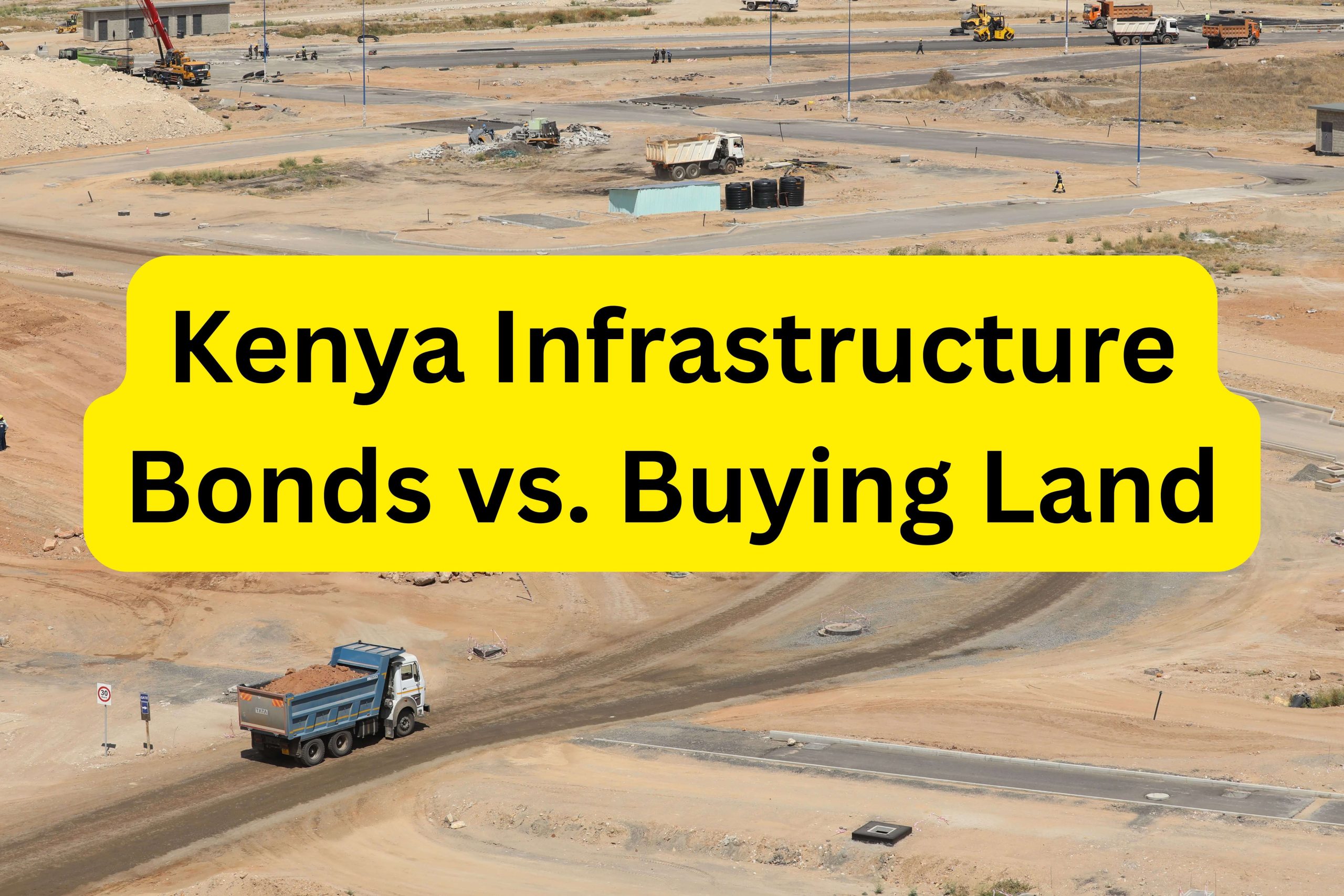
Kenya Infrastructure Bonds vs. Buying Land: Which is Better?
You have KES 1,000,000 saved. Your family says buy a plot in Kamulu. Your financially literate colleague says buy infrastructure bonds. Your WhatsApp investment group is split down the middle. Both sides are passionate. Neither side is showing you the actual numbers.
This article runs the numbers.
We compare KES 1,000,000 invested in Kenya infrastructure bonds against KES 1,000,000 used to buy a 50×100 plot in the Kamulu-Joska corridor — over the same five-year period, accounting for every real cost on both sides. No cherry-picking. No emotional arguments about ancestral land. Just maths.
What Are Kenya Infrastructure Bonds?
Kenya Infrastructure Bonds (IFBs) are long-term debt securities issued by the Central Bank of Kenya on behalf of the National Treasury, with proceeds earmarked exclusively for infrastructure projects — roads, hospitals, energy, and water systems. They work like any government bond: you lend the government money, and the government pays you interest every six months until maturity, then returns your principal.
What makes IFBs categorically different from every other fixed-income instrument in Kenya is their tax status.
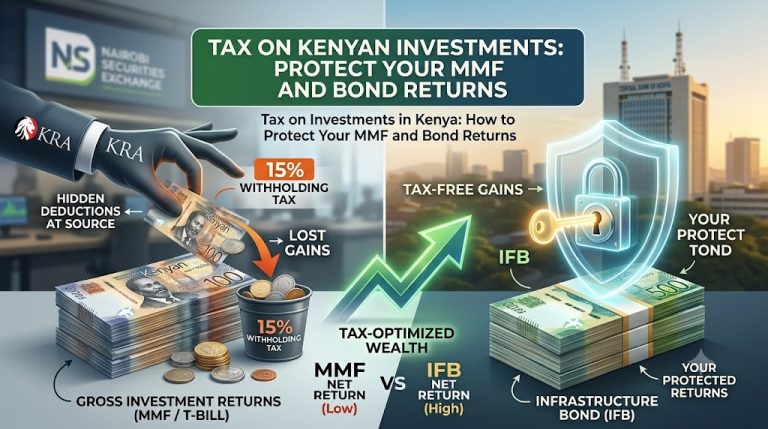
Infrastructure bond interest is completely exempt from withholding tax.
This is a specific exemption written into Kenya’s Income Tax Act. Compare this to:
- Regular Treasury bonds: 10–15% withholding tax depending on tenor
- Bank fixed deposits: 15% withholding tax
- Money market funds: 15% withholding tax
For KES 1 million in a regular Treasury bond at 14%, your annual interest of KES 140,000 loses KES 21,000 to the 15% WHT, leaving you KES 119,000 — an effective yield of 11.9%. The same KES 1 million in an infrastructure bond at 14% keeps the full KES 140,000 — a net yield of 14%.
That 2.1 percentage point difference compounds dramatically over five years.
Current IFB rates: Yields at recent auctions have ranged from 13–16% for tenors between 6 and 15 years. We use 14% in this analysis — a conservative midpoint within the verified 2026 range.
Demand signal: The February 2026 infrastructure bond auction drew KES 213.74 billion in bids against a KES 50 billion offer — a 427% oversubscription rate. Kenyan institutional investors, pension funds, and high-net-worth individuals treat IFBs as their primary fixed-income allocation. The question is whether individual investors should too.
What Does Buying a Plot in Kamulu/Joska Actually Cost?
Kamulu and Joska along Kangundo Road are the most actively marketed affordable land corridors for Nairobi’s middle class in 2026. BuyRentKenya lists Kamulu-Joska plots starting at KES 600,000 and averaging KES 1.65 million, with most residential 50×100 plots near tarmac ranging from KES 950,000 to KES 1,200,000.
We use KES 950,000 as our working plot price — a realistic near-tarmac, title-deed-ready 50×100 plot that a Nairobi middle-class buyer would actually purchase. Not the cheapest off-road option, not the premium gated estate. The standard aspiration.
Here is what that plot actually costs — beyond the sticker price:
Acquisition costs (one-time):
| Cost Item | Amount |
|---|---|
| Plot purchase price | KES 950,000 |
| Stamp duty (4% of value — verify current rate) | KES 38,000 |
| Legal/conveyancing fees | KES 25,000–40,000 |
| Title deed search and due diligence | KES 5,000–15,000 |
| Survey (if boundaries need verification) | KES 10,000–25,000 |
| Total acquisition cost | ~KES 1,040,000–1,068,000 |
Ongoing costs (annual):
| Cost Item | Annual Amount | 5-Year Total |
|---|---|---|
| Fencing (KES 100,000–150,000 — one-time but Year 1) | KES 125,000 | KES 125,000 |
| Security/caretaker (KES 4,000/month) | KES 48,000 | KES 240,000 |
| Annual land rates (Machakos County) | KES 3,000–8,000 | KES 15,000–40,000 |
| Total ongoing costs (5 years) | ~KES 380,000–405,000 |
Total money out over 5 years on a KES 950,000 plot: approximately KES 1,420,000–1,473,000.
Most land investment pitches show you the purchase price. None of them show you the security guard you will be paying for five years, or the fencing you need within months of purchase, or the land rates that arrive every year regardless of whether you have developed the plot.
The appreciation question:
Kamulu-Joska has seen land appreciation in recent years driven by Nairobi’s expansion, improved Kangundo Road access, and satellite town growth. Property analysts cite 8–12% annual appreciation for well-located plots in this corridor. We use a conservative 8% annual appreciation — below the midpoint, accounting for the fact that off-tarmac and less-serviced plots appreciate slower than advertised.
At 8% annual growth, your KES 950,000 plot is worth:
- Year 1: KES 1,026,000
- Year 3: KES 1,197,000
- Year 5: KES 1,396,000
Selling costs (when you exit):
| Cost | Amount |
|---|---|
| Capital Gains Tax (5% of profit) | KES 22,300 (on KES 446,000 gain) |
| Estate agent commission (3%) | KES 41,880 |
| Legal transfer fees | KES 20,000 |
| Net proceeds from sale | ~KES 1,312,000 |
Total money out: KES 1,420,000+ Net proceeds from sale: KES 1,312,000 Net financial position after 5 years: approximately -KES 108,000
The plot nominally appreciated. But once you account for the security guard, fencing, land rates, selling costs, and capital gains tax, you have spent more maintaining and exiting the investment than you gained from appreciation.
And critically: the land paid you zero during those five years. No income. No cash flow. No semi-annual payment. Just a piece of soil that you have been paying to protect.
The Number Comparison: KES 1,000,000 Over 5 Years
Scenario A: Infrastructure Bonds
Assumptions: KES 1,000,000 invested at 14% tax-free, semi-annual coupon payments reinvested at the same rate.
| Year | Cumulative Interest Received | Bond Value (Principal) | Total Position |
|---|---|---|---|
| Year 1 | KES 140,000 | KES 1,000,000 | KES 1,140,000 |
| Year 2 | KES 299,600 | KES 1,000,000 | KES 1,299,600 |
| Year 3 | KES 481,544 | KES 1,000,000 | KES 1,481,544 |
| Year 4 | KES 688,960 | KES 1,000,000 | KES 1,688,960 |
| Year 5 | KES 925,415 | KES 1,000,000 | KES 1,925,415 |
Simple (non-reinvested) return: KES 700,000 in interest received over 5 years + KES 1,000,000 principal returned = KES 1,700,000 total
Compounded return (reinvested coupons): approximately KES 1,925,415
Tax paid on all interest: KES 0 Income during the 5 years: KES 700,000 received progressively (KES 70,000 every 6 months)
Liquidity: Tradeable on NSE secondary market at any point
Ongoing costs: Zero
Scenario B: Kamulu/Joska Plot
| Item | Amount |
|---|---|
| Total money invested over 5 years | KES 1,420,000+ |
| Net proceeds from sale at Year 5 | KES 1,312,000 |
| Net financial position | -KES 108,000 |
| Income received during holding period | KES 0 |
| Liquidity during holding period | Very low (months to sell) |
Side-by-Side Summary
| Metric | Infrastructure Bond | Kamulu/Joska Plot |
|---|---|---|
| Initial outlay | KES 1,000,000 | KES 1,000,000 |
| Total money out (5 years) | KES 1,000,000 | KES 1,420,000+ |
| Income during holding period | KES 700,000 (progressive) | KES 0 |
| Value at year 5 | KES 1,925,415 (compounded) | KES 1,312,000 (net of costs) |
| Net gain over 5 years | +KES 925,415 | -KES 108,000 |
| Tax on returns | 0% | 5% CGT + 15% stamp duty |
| Liquidity | Moderate (NSE secondary market) | Very low (3–12 months to sell) |
| Effort required | Minimal | Ongoing (security, maintenance, visits) |
The headline finding: Under these assumptions, infrastructure bonds deliver a KES 1,033,415 better outcome than a Kamulu plot over five years — while requiring less money, less effort, and offering significantly better liquidity.
When Does Land Win? The Scenarios Where Real Estate Makes More Sense
This is not a hit piece on land. There are genuine situations where buying a plot outperforms bonds — and ignoring them would make this analysis dishonest.
Scenario 1: You intend to develop and generate rental income A plot with a rental unit changes the entire equation. If your KES 950,000 plot plus KES 800,000 in construction produces two bedsitters generating KES 16,000/month in rent, the annual yield on KES 1,750,000 invested is approximately 11% — competitive with bonds, with the added upside of appreciation. Development transforms land from a pure capital play into an income-generating asset.
Scenario 2: You have access to a rapidly developing corridor Plots adjacent to confirmed infrastructure projects — a proposed bypass, an SGR station, a new town centre — can appreciate 30–50% annually in the years before and after the development goes live. If you have specific, verified intelligence about such a development (not WhatsApp rumours), land speculation can significantly outperform bonds. This requires knowledge and timing that most buyers don’t have.
Scenario 3: Your holding period is 10+ years The costs that destroy the 5-year land return — fencing, security, selling costs — become smaller as a percentage of a larger appreciation base over a longer period. A KES 950,000 plot growing at 8% annually is worth KES 2,050,000 after 10 years, and KES 4,436,000 after 20 years. Land’s compounding is slower than bonds but it never expires and it cannot be hacked or go bankrupt.
Scenario 4: Portfolio diversification is the goal Land is uncorrelated to financial markets. When interest rates fall and bond prices drop, land continues to hold value. For an investor with significant exposure to financial instruments, a land allocation provides genuine diversification — a hedge that behaves differently from every other asset class. The lower financial return may be worth the uncorrelated risk profile.
The emotional case: Land in Kenya carries meaning that numbers cannot capture. Permanence. Legacy. The ability to point at something physical and say “that is mine.” For many Kenyan families, these non-financial values justify a lower return. The point of this analysis is not to dismiss that — it is to make sure you are making the choice consciously, knowing the cost.
The Hybrid Strategy — What Sophisticated Kenyan Investors Actually Do
The choice is not binary. The investors building the most durable wealth in Kenya in 2026 are doing both — but in a specific sequence.
Step 1: Invest in infrastructure bonds first. The semi-annual coupon payments provide the cash flow to save toward a land purchase without depleting liquid capital.
The maths: KES 500,000 in IFBs at 14% generates KES 35,000 every six months — KES 70,000 per year. Over three years, you receive KES 210,000 in coupon payments while your KES 500,000 principal remains intact. That KES 210,000 funds a meaningful deposit on a plot, without ever touching your principal.
Step 2: When you have identified the right land opportunity — with specific development catalysts, not generic appreciation hope — buy with the accumulated coupon income rather than your core savings.
Step 3: Develop the land to generate rental income. Now you have both income streams: bond coupons and rental income, with land appreciation as a long-term wealth base.
This is the structure most financial advisors recommend for Kenyan middle-class investors with KES 500,000–2,000,000 to deploy. Bonds for liquidity and current income. Land for long-term wealth and diversification. Not one or the other.
How to Buy Kenya Infrastructure Bonds in 2026: Step by Step
To buy IFBs at primary auction, you need a CDS account with CBK — separate from the CDSC account used for NSE equities. You can open a CDS account at any CBK branch in Nairobi, Mombasa, Kisumu, Eldoret, or Nakuru, or through a participating commercial bank under the CBK Treasury Mobile Direct service.
Step 1: Open a CBK CDS account Visit any CBK branch or apply through your commercial bank. Bring your National ID, KRA PIN, and bank account details. The account is free and typically activated within 2–5 business days.
Step 2: Watch for IFB auction announcements CBK publishes infrastructure bond prospectuses 2–4 weeks before each auction in national newspapers and at centralbank.go.ke. Not every bond auction is an infrastructure bond — confirm “Infrastructure Bond” in the title before bidding, as only these carry the tax exemption.
Step 3: Submit your bid Through your CBK CDS account, your commercial bank’s bond desk, or a licensed stockbroker. You can submit a competitive bid (specifying your required yield) or a non-competitive bid (accepting the market-determined rate — recommended for most individual investors).
Step 4: Receive your confirmation If your bid is accepted, funds are debited from your bank account and the bond is credited to your CDS account. You will receive a confirmation statement.
Step 5: Collect your coupons Semi-annual interest payments are deposited directly to your linked bank account. From there, transfer to M-Pesa or reinvest as needed.
Minimum investment: KES 50,000 through CBK direct. Some commercial banks have higher minimums (KES 100,000–500,000) — check before applying.
Important: Infrastructure bonds are also exempt from capital gains tax when traded on the secondary market through the Nairobi Securities Exchange, making them even more attractive as a long-term holding.
Frequently Asked Questions
What is the current Kenya infrastructure bond interest rate in 2026? Yields at recent auctions have ranged from 13–16% for tenors between 6 and 15 years. The exact rate for any specific auction is determined at the time of bidding and published in the CBK prospectus. Check centralbank.go.ke for the most recent auction results and upcoming auction dates.
Are Kenya infrastructure bonds safe? They are direct obligations of the Government of Kenya — the same sovereign credit risk as Treasury bills and regular Treasury bonds. Kenya has never defaulted on domestic debt. The primary risks are interest rate risk (the bond’s market price moves inversely with prevailing rates if you sell early) and the general risk of holding Kenya shilling-denominated assets.
Can I sell my infrastructure bond before maturity? Yes. IFBs are listed on the NSE and tradeable on the secondary market. The price you receive may be above or below your purchase price depending on the current interest rate environment — bonds rise in price when rates fall, and fall in price when rates rise.
Is land in Kamulu/Joska a good investment in 2026? BuyRentKenya lists Kamulu-Joska plots averaging KES 1.65 million, with entry-level 50×100 plots starting at KES 600,000. The corridor has genuine appreciation potential driven by Nairobi’s expansion — but the full cost picture (security, fencing, land rates, selling costs, CGT) significantly erodes the headline return over a 5-year horizon. For a 10+ year holding with development intent, the case for Kamulu land improves substantially.
Is interest on infrastructure bonds taxed in Kenya? No. Infrastructure bond interest is fully exempt from withholding tax under Kenya’s Income Tax Act. This is the primary financial advantage of IFBs over every other fixed-income instrument available to Kenyan retail investors.
What is the minimum amount to invest in Kenya infrastructure bonds? KES 50,000 through CBK directly. Some commercial banks have higher minimums — confirm before applying.
How does land CGT work in Kenya? Capital Gains Tax in Kenya is charged at 5% on the net gain from the sale of property (sale price minus purchase price and verified improvement costs). It is payable at the time of transfer. On a plot bought for KES 950,000 and sold for KES 1,396,000, CGT is 5% of KES 446,000 = KES 22,300.
The Verdict
If your goal is maximum financial return on KES 1,000,000 over five years, Kenya infrastructure bonds win by a substantial margin under any reasonable set of assumptions — because they pay you during the holding period, carry zero ongoing costs, and are completely tax-free on income.
If your goals include physical asset ownership, long-term family wealth, a hedge against financial market volatility, or development intent, land has genuine value that bonds cannot replicate.
The most common mistake is treating these as the same decision. They are not. Infrastructure bonds are an income and capital preservation tool. Land is a long-term wealth and development vehicle. The question is which one matches your actual goals — not which one your WhatsApp group is more excited about.
For the middle-class Nairobi investor with KES 1,000,000 and a five-year horizon who needs their money to work harder than inflation: the numbers point clearly to infrastructure bonds as the primary allocation, with land as the longer-term secondary goal funded by the coupon income.
For more on building wealth through Kenyan financial instruments, see our guides on the NSE Dividend Calendar 2026, Best Money Market Funds Kenya 2026, KCB Dividends 2026, and How to Invest in NSE Kenya 2026.
Infrastructure bond rates sourced from CBK auction results and verified sources current to July 2026. Land prices sourced from BuyRentKenya, Landstock Kenya, and active market listings as at July 2026. Cost estimates are based on publicly available data and should be verified with a licensed property agent and financial advisor before any investment decision. This article is for educational purposes only and does not constitute financial or legal advice. Capital Gains Tax rate subject to change — verify current rate with KRA before any property transaction.