Family Bank NSE Listing 2026: How to Buy Shares by Introduction on June 23
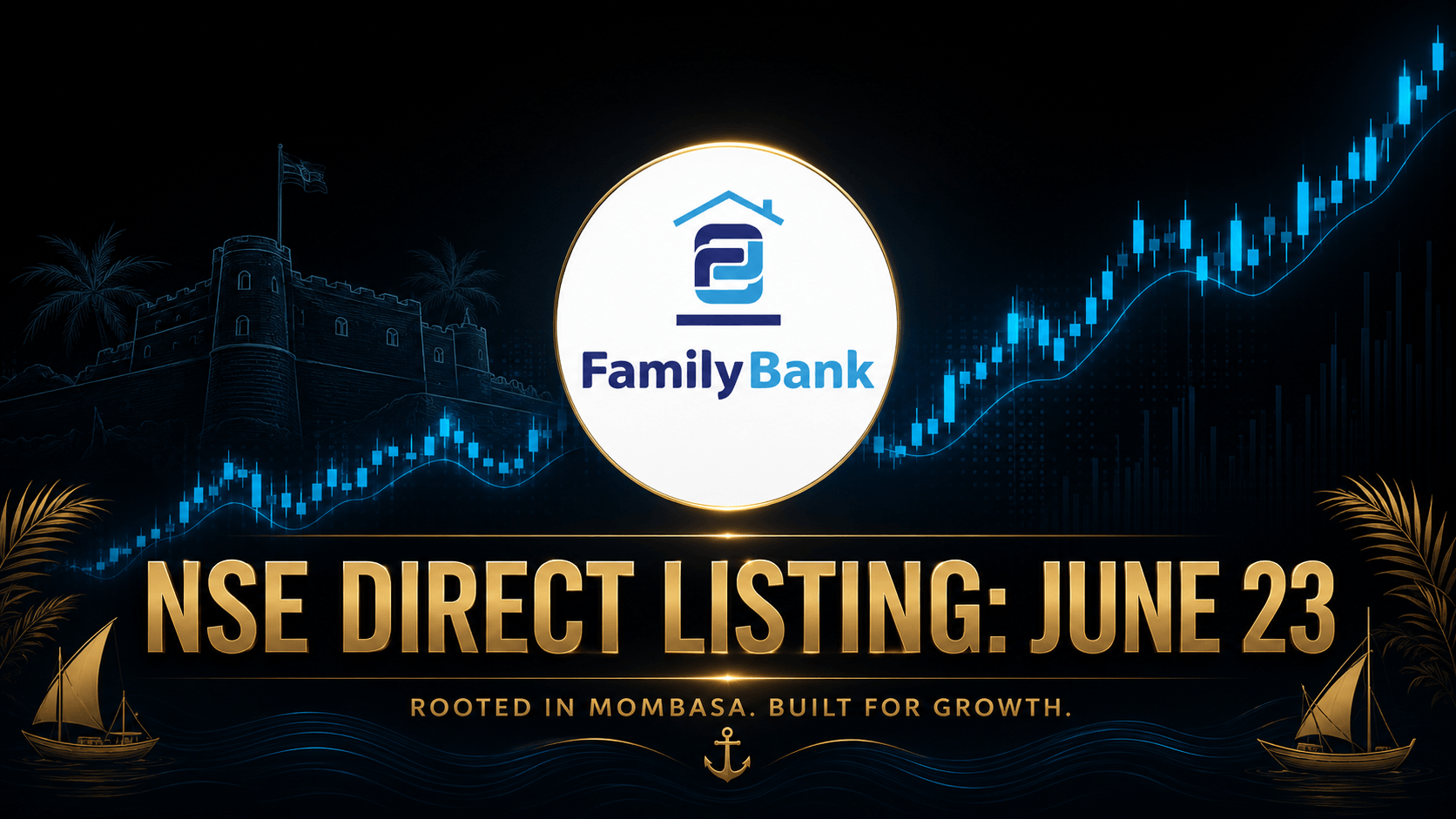
Family Bank NSE listing 2026 is finally here, and it changes everything for a stock that Kenyans have only ever been able to buy informally. Family Bank has traded over-the-counter since 2006, but on June 23, 2026, that ends — and there is no IPO to apply for. Here is exactly how listing by introduction works, and how to buy Family Bank shares once trading opens.
| Metric | Current Status (2026) |
| Listing Date | June 23, 2026 |
| Listing Method | By Introduction (No IPO) |
| Total Shares Listing | 1,662,654,760 |
| Transaction Adviser | Standard Investment Bank |
| Q1 2026 Net Profit | KES 1.6 Billion (+52.6% Growth) |
| Shareholders’ Funds | KES 34.7 Billion |
Family Bank NSE Listing — The Key Facts
The Family Bank NSE listing takes effect on June 23, 2026, on the Main Investment Market Segment of the Nairobi Securities Exchange. The Capital Markets Authority has already given its approval, with Standard Investment Bank serving as lead transaction adviser and PwC acting as reporting accountant.
A total of 1.66 billion shares (1,662,654,760 to be exact) will list. These shares are currently held by 6,345 existing shareholders, who have only ever been able to trade them informally on the over-the-counter market.
This listing makes Family Bank Kenya’s 12th listed bank, and it is the second NSE debut of 2026 after Kenya Pipeline Company’s listing in March. Top shareholders going into the listing include Kenya Tea Development Agency (18.98%), the Estate of Rachael Njeri Muya (10.05%), Daykio Plantations (9.53%), and founder Titus Muya, who holds 4.4% individually.
What “Listing by Introduction” Actually Means — And Why There’s No IPO to Apply For
Unlike an IPO, a listing by introduction does not create new shares or raise fresh capital. It simply allows shares that already exist to become tradeable on a public exchange.
Family Bank chose this route because it had already strengthened its balance sheet through a 2025 private placement that raised KES 8 billion, oversubscribed by 131%. With capital needs already met, there was no reason to issue new stock.
Here is the key implication for retail investors: you cannot “subscribe” or “apply” for Family Bank shares the way you would for an IPO. There is no offer document to fill in, no allotment process, and no minimum subscription period to watch for.
For the 6,345 existing shareholders, what changes is liquidity. Shares that have traded informally since 2006 will now be freely tradeable on the NSE, with proper price discovery and regulatory oversight.
For new investors, the process is refreshingly simple. You wait for the listing date, then place a normal buy order through your broker — exactly like buying KCB or Equity Bank shares today.
How the Opening Price Will Be Set — And What to Expect
Because this is a listing by introduction rather than an IPO, there is no fixed offer price. The market will establish Family Bank’s share price through actual trading from day one.
A few reference points are worth watching. Family Bank’s book value sits at approximately KES 20.91 per share, calculated from KES 34.77 billion in shareholders’ funds divided by 1.66 billion shares as of March 2026. Press coverage has cited an implied valuation of roughly KES 30 billion for the bank.
It also helps to compare Family Bank’s likely entry point to its listed peers. KCB trades around KES 76, Equity around KES 50, and Co-operative Bank around KES 31.60. Given Family Bank’s smaller size relative to these three, it would not be surprising to see it open somewhere in a comparable mid-range band, though the market — not a fixed price — will have the final say.
Expect some volatility in early price discovery. Many of the 6,345 existing holders may choose not to sell immediately, which could keep the initial free float thin. On listing day itself, watch the opening trade price, trading volume, and whether the NSE applies any circuit breaker or price band rules typically used for new listings.
How to Buy Family Bank Shares Once Trading Opens
Buying Family Bank shares once they list follows the same basic process as buying any other NSE-listed stock.
Step 1: Make sure you have an active CDS account with a licensed NSE stockbroker, or through a mobile investing platform such as the Mali App or Hisa App.
Step 2: Search for Family Bank’s ticker symbol on your broker’s trading platform once it is assigned. Confirm the exact ticker at nse.co.ke on listing day.
Step 3: Place your buy order. The same T+3 settlement rules that apply to every other NSE stock will apply here too.
Step 4: Understand that new investors will have no dividend entitlement until the next declared book closure. Check Family Bank’s dividend history and policy before buying if income is part of your strategy — our NSE book closure dates 2026 guide is a useful reference point.
One word of caution: avoid chasing the stock in the first few hours of trading. New listings can see exaggerated price swings before settling into a more stable range, and buying into early hype rarely ends well.
Family Bank’s Financial Profile — Is It a Buy?
Family Bank heads into its NSE listing from a position of genuine financial strength. Q1 2026 net profit came in at KES 1.6 billion, up 52.6% from KES 1.0 billion in the same period a year earlier. That builds on FY2025 profit growth of 55.4%, among the fastest profit growth rates of any Kenyan bank last year.
Shareholders’ funds stood at KES 34.77 billion as of March 2026, up 42.2% year-on-year — a jump that reflects both the 2025 capital raise and retained earnings. The bank is now operating under a 2025–2029 growth strategy built on the back of that stronger capital position.
Compared to listed peers like KCB, Equity, and Co-operative Bank, Family Bank has a smaller balance sheet but a noticeably faster growth rate — a profile that typically appeals to investors comfortable with higher risk in exchange for higher growth potential.
What remains unknown is Family Bank’s dividend policy as a newly listed entity. No public dividend policy has been established yet, so the bank’s first dividend declaration as a listed company will be the key signal for income-focused investors to watch.
What the Listing Means for Kenya’s Banking Sector and the NSE
The Family Bank NSE listing pushes the number of listed banks on the exchange to 12, giving investors even more sector choice. It also brings real price transparency and liquidity to a stock that has traded informally and inconsistently on the OTC market for two decades.
This is the second major NSE listing of 2026, following Kenya Pipeline Company’s debut in March, and it signals continued momentum in Kenya’s capital markets after a strong NASI rally this year.
One factor worth watching long-term: founder Titus Muya’s continued significant stake. Governance and succession questions remain relevant for investors planning to hold Family Bank shares for the long haul.
Frequently Asked Questions – Family Bank NSE Listing
When does Family Bank list on the NSE? Family Bank lists on the Nairobi Securities Exchange on June 23, 2026, on the Main Investment Market Segment.
Is there an IPO to apply for? No. Family Bank is listing by introduction, which means existing shares simply become tradeable on the NSE. There is no new share issue, no capital raised, and no offer document to apply for.
How many Family Bank shares are listing? A total of 1,662,654,760 shares (about 1.66 billion) will list, currently held by 6,345 shareholders.
What will the Family Bank share price be? There is no fixed price. The market will determine Family Bank’s opening price through trading on June 23, 2026. Book value is approximately KES 20.91 per share, which can serve as one reference point.
How can I buy Family Bank shares? Open a CDS account with a licensed NSE stockbroker (or use a platform like Mali App or Hisa App), locate Family Bank’s ticker once trading opens, and place a normal buy order.
Will I receive dividends immediately after buying? No. New investors are not entitled to dividends until the next declared book closure after their purchase.
For more on Kenya’s investing landscape, see our guides on how to invest in the NSE in 2026, the best Kenyan stocks for 2026, and dividend breakdowns for KCB and Equity Bank. For official listing updates, check the Nairobi Securities Exchange and the Capital Markets Authority directly.