How to Budget with an Irregular Income in Kenya
Learn how to budget with an irregular income, manage essential expenses, save during good months and avoid running out of money.
Managing money when your paycheck is consistent is straightforward. But if you rely on casual work, freelance gigs, farming, business profits, or commissions, traditional budgeting advice often falls flat. When you do not know exactly how much you will make next month, figuring out how to pay fixed bills can be incredibly stressful.
However, it is entirely possible to budget with an irregular income. It requires a strategic shift from predicting an exact salary to managing cash flow based on baselines and priorities.
1. What is an irregular income?
An irregular income is money you earn that fluctuates in timing, amount, or both. Unlike a standard 9-to-5 job that pays a set salary on the 30th of every month, an irregular income means you might earn KSh 50,000 one month, KSh 15,000 the next, and KSh 80,000 the month after. This is the reality for many Kenyans running small businesses, engaging in side hustles, or working on commission-based contracts.
2. Why budgeting is difficult when income changes
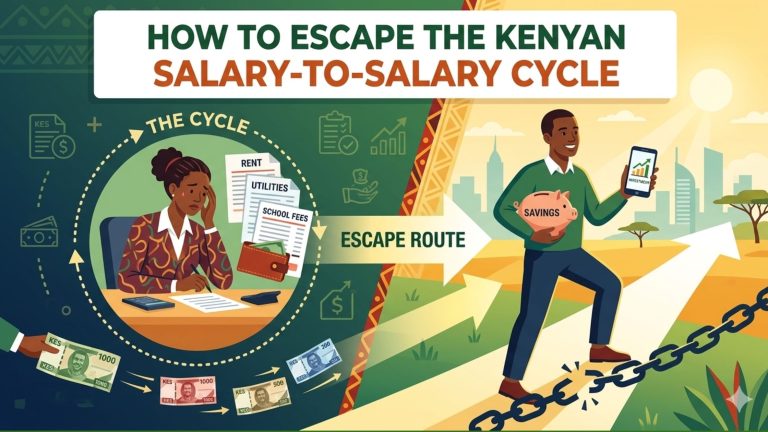
Budgeting is challenging with fluctuating pay because your living expenses—like rent, food, and utilities—remain relatively fixed, while your cash inflow is unpredictable. This mismatch often leads to a cycle of “feast or famine.” During a good month, it is easy to overspend, leaving you scrambling to cover basic needs during a slow month.
3. List all your income sources
To start building a reliable budget, you need a baseline. List every source of income you have, from main business profits to minor side hustles. Look back at your bank or M-Pesa statements over the last six to twelve months. Identify your lowest-earning month. When you budget with an irregular income, always base your spending plan on this conservative baseline—what you can reasonably expect to make on a “bad” month—rather than your highest-earning month.
4. Separate essential and flexible expenses
With your baseline income established, categorize your spending.
- Essential expenses (Needs): These are non-negotiable survival costs. Rent, basic groceries, electricity, water, and transport to work.
- Flexible expenses (Wants): These are lifestyle choices that can be scaled back. Eating out, entertainment, premium TV subscriptions, and upgraded data plans.
If your baseline income cannot cover your essential expenses, your immediate priority is to reduce fixed costs or find ways to increase your minimum income.
5. Create a monthly cash-flow plan
Instead of a traditional budget, use a cash-flow approach: estimate the money coming in and going out, then compare the plan with what actually happened. As the IYB (Improve Your Business) Planning framework explains, a Cash Flow Plan helps prevent cash shortages and should be reviewed regularly against actual results.
Use a simple table to track this flow as money hits your account:
| Date | Money in | Essential expenses | Other spending | Balance |
| 1st | KSh 15,000 | KSh 10,000 (Rent) | KSh 0 | KSh 5,000 |
| 10th | KSh 8,000 | KSh 4,000 (Groceries) | KSh 1,500 (Airtime/Data) | KSh 7,500 |
| 22nd | KSh 5,000 | KSh 2,000 (Water/Power) | KSh 1,000 (Eating out) | KSh 9,500 |
6. How to manage money during a high-income month
When you have a highly profitable month, resist the urge to inflate your lifestyle immediately. Cover your essential expenses first, fund your flexible expenses reasonably, and then capture the surplus. This extra cash is your lifeline for the future. Move it immediately to a separate savings or investment account so you aren’t tempted to spend it. (Read more: How to build an emergency fund)
7. How to cope during a low-income month
When income drops below your baseline, act quickly. Cut all flexible spending immediately. Do not rely on high-interest mobile loans to bridge the gap. Instead, this is the time to draw from the surplus you saved during your high-income months. If you operate multiple gigs, lean into the ones that pay out quickly. (Read more: How to manage side-hustle income)
8. Save for irregular expenses
Some essential expenses do not happen monthly but will completely derail your budget if you aren’t prepared. School fees, annual business licenses, and car insurance fall into this category. Total these yearly costs, divide them by 12, and treat that amount as a monthly essential expense. Setting aside this money consistently—even in small amounts—protects you from future shocks. (Read more: How to save KSh 1,000 a month)
9. Common budgeting mistakes to avoid
- Budgeting based on your best month: Assuming you will always hit your maximum income leads to over-committing to high rent or subscriptions.
- Failing to track actuals: A budget is just a guess until you compare it against what actually happened. Update your cash-flow plan weekly.
- Spending the surplus: Treating a good month as an excuse for an immediate shopping spree rather than a buffer for the inevitable slow month.
10. Frequently asked questions
Can I invest if my income is irregular?
Yes. You do not need a massive lumpsum to start growing your wealth. You can allocate a percentage of your surplus during good months to buy assets. (Read more: How to invest in shares and dividends)
What is the “envelope method” and does it work for irregular income?
The envelope method involves putting cash for different categories (food, transport, rent) into physical or digital envelopes. It is highly effective for irregular incomes because it physically prevents you from overspending in flexible categories when cash is tight.
Should I have separate bank accounts for business and personal use?
Absolutely. Mixing personal and business cash is the fastest way to lose track of your actual income. Pay yourself a “salary” from your business account into your personal account, even if the amount varies.
Plan for the income you can reasonably expect, record every transaction and adjust your budget as your situation changes.