How to Improve Your CRB Score in Kenya (2026 Complete Guide)
If your CRB score is low, every lender in Kenya already knows — before you say a word. Your credit history travels ahead of you, silently opening or closing every financial door you approach. The good news? You can change what that history says. This guide shows you exactly how to improve your CRB score in Kenya, step by step, starting today.
What Is a CRB Score — and What Range Actually Matters?
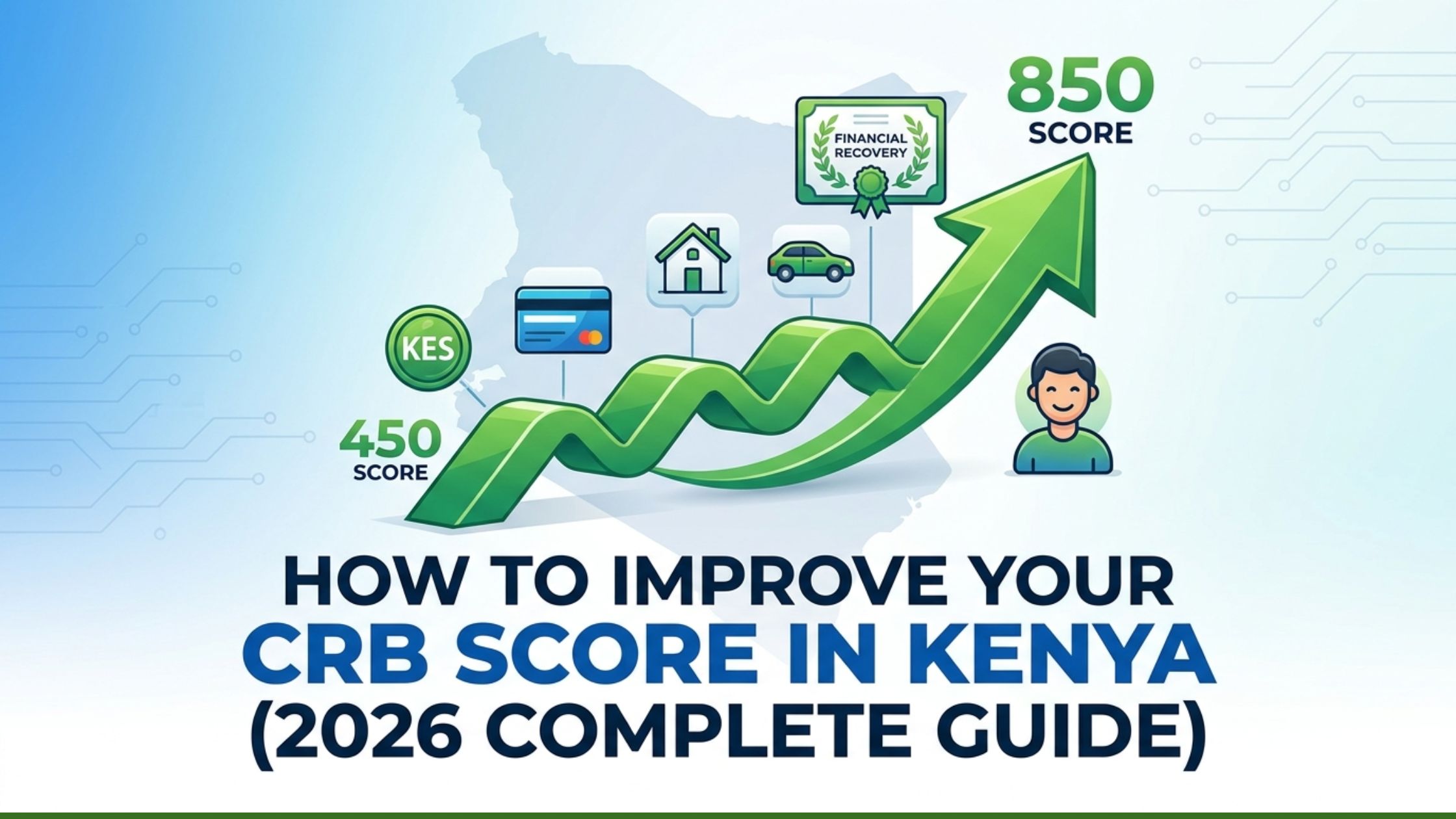
A CRB score is a number between 0 and 900 that tells lenders how likely you are to repay a loan. The higher your score, the lower the risk you represent — and the better your chances of getting approved, securing lower interest rates, and accessing larger loan limits.
In Kenya, three bureaus are licensed by the Central Bank of Kenya to calculate and maintain these scores:
- Metropol CRB — accessible via *433# or the CrystalBall app
- TransUnion Africa — accessible at transunionafrica.com
- Creditinfo Kenya — accessible at creditinfo.co.ke
These bureaus don’t make up your score. They collect real data reported to them by banks, SACCOs, microfinance institutions (MFIs), telcos like Safaricom, and mobile lenders. Every loan you take, every repayment you make or miss, and every new credit application you submit feeds into your CRB record.
You are entitled to one free credit report per year from each bureau. That means up to three free reports every year — one from Metropol, one from TransUnion, one from Creditinfo. Use them. Kenyans who never check their reports are often shocked to find errors, outdated listings, or forgotten debts quietly blocking their loan access.
The Five Factors That Determine Your CRB Score in Kenya
To improve your credit score in Kenya, you need to understand what is actually being measured. Your score is not random. It is calculated using five key factors, weighted differently by each bureau.
1. Payment History — The Single Biggest Factor (About 35%)
This is the most important element of your CRB score. Every on-time repayment works in your favour. Every missed payment or default works against you. This applies to all credit — your bank loan, your SACCO loan, M-Shwari, Fuliza, and even small apps like Zenka or Branch.
Many Kenyans are shocked to discover that a Ksh 500 mobile loan default has blocked them from a Ksh 500,000 bank loan. The size of the debt is irrelevant. A default is a default, and it counts the same whether it is from a bank or a mobile app. If you want to understand how mobile loans compare and which ones report to CRBs, it helps to read up before you borrow.
2. Outstanding Debt Levels and Debt-to-Income Ratio
Lenders want to know how much of your income is already committed to existing debt. If your monthly repayments eat 60% of your salary, any new lender will be cautious — or simply say no. Most Kenyan banks target a debt-service ratio below 40–50% of your net income. Under Kenya’s risk-based credit pricing framework, borrowers with high outstanding debt are assigned higher risk categories, which translates directly to higher interest rates or outright rejection.
3. Length of Credit History
The longer you have been borrowing and repaying responsibly, the more data lenders have to trust you. A Kenyan who has used M-Shwari for three years and repaid on time looks far more credible than someone applying for their very first loan. This is why starting early matters — even if you are only borrowing Ksh 1,000 at a time.
4. Number of Active Loans and Recent Credit Applications
Every time you apply for a loan, the lender makes a “hard inquiry” on your CRB report. Multiple applications in a short period signal financial desperation and can lower your score. Similarly, holding active loans across five different apps at the same time — commonly called loan stacking — raises red flags even when none of them are in default.
5. Credit Mix
Lenders look favourably on borrowers who manage different types of credit responsibly — a personal loan here, a mobile loan there, perhaps an asset finance product. A varied credit portfolio shows financial sophistication. If you are comparing which credit products make the most sense to start with, see our breakdown of M-Shwari vs KCB M-Pesa vs Fuliza to understand how each one affects your credit profile differently.
How to Improve Your CRB Score in Kenya: Step by Step
Here is the practical sequence — not theory, but a concrete set of actions in the right order.
Step 1: Pull Your Report and Check It for Errors
Before you do anything else, get your credit report. Errors on CRB reports are more common than most Kenyans realise. You may find loans you already repaid still showing as active. You may find a debt attributed to your ID that is not yours. You may find incorrect payment dates inflating what you owe.
If you spot an error, you have the legal right to dispute it. File your dispute directly with the relevant CRB. They have 21 working days to investigate and respond. Keep your evidence ready — M-Pesa transaction confirmations, bank statements, and any correspondence with the lender.
Step 2: Clear All Outstanding Defaults
There is no shortcut here. If you have an active default — a debt you have not repaid — it will sit on your record and block your access to credit. You must clear it.
Contact the lender directly, negotiate a settlement if you cannot pay the full amount in one go, and always get a written or emailed clearance letter once payment is made. The lender is then legally required to update your CRB record within 30 days of receiving full payment.
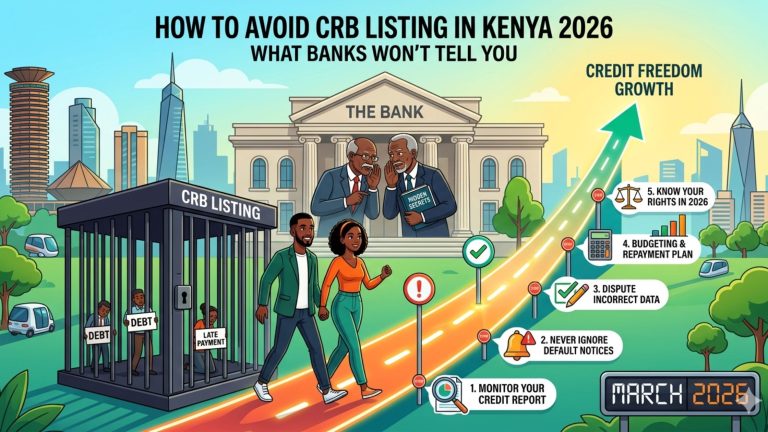
Do not just pay and walk away. Follow up. Many Kenyans remain CRB-listed simply because they did not track whether the lender actually reported the update to the bureau. If you want to understand how to avoid CRB listing altogether in the future, that is a habit worth building now.
Step 3: Automate Your Repayments So You Never Miss a Due Date
Once existing defaults are cleared, the goal is to never create a new one. The single most powerful ongoing action for your CRB score is to repay every loan on time, every time, without exception.
Use M-Pesa standing orders or set calendar reminders for your repayment dates. For bank loans, set up a standing instruction. Remove the human error from the equation — automate it where you can. The cheapest loan apps in Kenyatypically have short repayment windows of 30 days or less, making automation especially important for mobile borrowers.
Step 4: Reduce the Number of Active Loans You Hold
Loan stacking is one of the most damaging behaviours for a CRB score. If you currently have outstanding loans across multiple apps, prioritise paying them down before applying for anything new. Every loan you close reduces your debt-to-income ratio and removes a line of risk from your credit profile.
A clean profile with two loans managed perfectly is far more attractive to a lender than a profile with seven loans in various stages of repayment. If you are currently managing SACCO loans alongside mobile loans, it helps to understand how SACCO loans work and what they report — SACCOs are CRB-reporting institutions, and defaults there are treated just as seriously as bank defaults.
Step 5: Diversify Your Credit Responsibly
Once your existing debts are under control, start building a healthy credit mix. Take a small loan, repay it before the deadline, wait a cycle, take another. Each completed repayment cycle adds a positive data point to your history.
Only borrow what you genuinely need and are certain you can repay within the agreed term. Every responsible repayment is an investment in your CRB score. If you are trying to decide whether to borrow from a bank or a SACCO, comparing SACCO vs bank in Kenya can help you choose the route most suited to your situation and financial history.
Step 6: Save Consistently — It Matters More Than You Think
Banks and mobile lenders use your savings behaviour as a signal of financial discipline. Consistent deposits into M-Shwari, a SACCO savings account, or a formal bank savings account — even small amounts — demonstrate that you manage money rather than just spending it. Over time, this strengthens your overall financial profile and increases the loan limits lenders are willing to extend.
If you are not sure where to keep your savings to maximise both interest and your credit profile, compare the best savings accounts in Kenya in 2026. A dedicated savings account also makes it easier to separate your loan repayment funds from your day-to-day spending, which is one of the simplest discipline tools available.
Common Mistakes Kenyans Make That Wreck Their CRB Score
Even people who understand credit often make these errors. Recognising them is the first step to avoiding them.
Ignoring a small mobile loan. A Ksh 500 Tala loan you forgot about can block you from a Ksh 2 million mortgage. There is no minimum threshold below which a default does not count. Clear everything, no matter how small.
Paying a debt but not confirming the CRB update. Clearing the debt with the lender is only half the process. The CRB record must also be updated, and that requires the lender to actually report the change. Follow up in writing, keep your clearance letter, and verify on your next report that the status has changed.
Applying for many loans at once. If you need money urgently, the temptation is to apply everywhere simultaneously. Each application triggers a hard inquiry, and a burst of applications in a short window signals financial distress to every bureau. Apply to one lender at a time, and check your eligibility before applying rather than after. Understanding how to get a loan in Kenya — and what lenders are actually looking for — can help you target the right lender the first time.
Mishandling Fuliza. Fuliza has a direct relationship with your CRB score, and many Kenyans manage it carelessly. Leaving a Fuliza balance unpaid for 120 days triggers a CRB listing. Opting out of Fuliza and back in resets your scoring history, losing months of positive repayment data. Before making any changes to your Fuliza usage, read about what actually happens when you stop using Fuliza — the consequences are not always obvious.
Living without a budget. Many CRB problems start not with bad intentions but with bad planning. When you do not know exactly what is coming in and going out each month, loan repayments are the first casualty. A solid monthly budgetis not just a financial wellness tool — it is a credit protection tool.
How Long Does It Take to Improve Your CRB Score in Kenya?
This is the question everyone asks. The honest answer depends on where you are starting from.
If you have an active default: Your score will not move meaningfully until the debt is cleared and the CRB record is updated. Once that happens, you are beginning a new chapter — but the history of that default remains visible for 5 years from the date of your last payment. That is not a penalty; it is simply how the system works. Lenders will see it, but they will also see everything you have built on top of it.
What “cleared” actually means: When a lender updates the CRB to show a debt is settled, your status changes to “cleared” — but your score does not jump overnight. Lenders can still see your full repayment history. The score improves gradually as you add new positive data points over time.
Here is a realistic timeline once you commit to the right actions:
| Timeframe | What to Expect |
|---|---|
| 0–30 days | Pull report, identify errors, dispute inaccuracies, begin clearing small defaults |
| 30–90 days | CRB records update after lender reports; first clean repayment cycles recorded |
| 3–6 months | Measurable score improvement if repayments are consistent and no new defaults created |
| 6–12 months | Better products begin opening — higher M-Shwari limits, SACCO loan eligibility, bank pre-qualification |
| 1–2 years | Strong, documented credit history; access to cheaper bank loans and better interest rates |
The Kenyans who improve fastest act systematically. They pull the report, clear the debts, automate repayments, and then leave the score alone to recover. Chasing the score daily or continuing to take on new debt while old debts are unresolved slows everything down.
Your CRB Score Is Not a Verdict — It Is a Record You Can Rewrite
A low CRB score does not define you. It reflects a history, and histories can be rewritten — one on-time repayment at a time. Kenya’s credit system is built to reward consistent, responsible behaviour. The lenders want to say yes. They simply need the data to justify it.
Start today. Pull your free report from Metropol, TransUnion, or Creditinfo. Find out exactly where you stand. Then work through the steps above, in order, without skipping any.
If you want to go further in strengthening your overall financial position, learning how to save money consistently in Kenya is the natural next step — because a strong savings record is one of the most reliable signals a lender can see.
This article is part of a series on credit health and personal finance in Kenya. Related reading: CRB Kenya 2026 — Everything You Need to Know | How to Avoid CRB Listing in Kenya | Fuliza Kenya 2026 | How to Get a Loan in Kenya